This feature originally appeared in Issue 16, published May 16, 2026. You can read this piece and more by purchasing a copy of or subscription to the magazine.
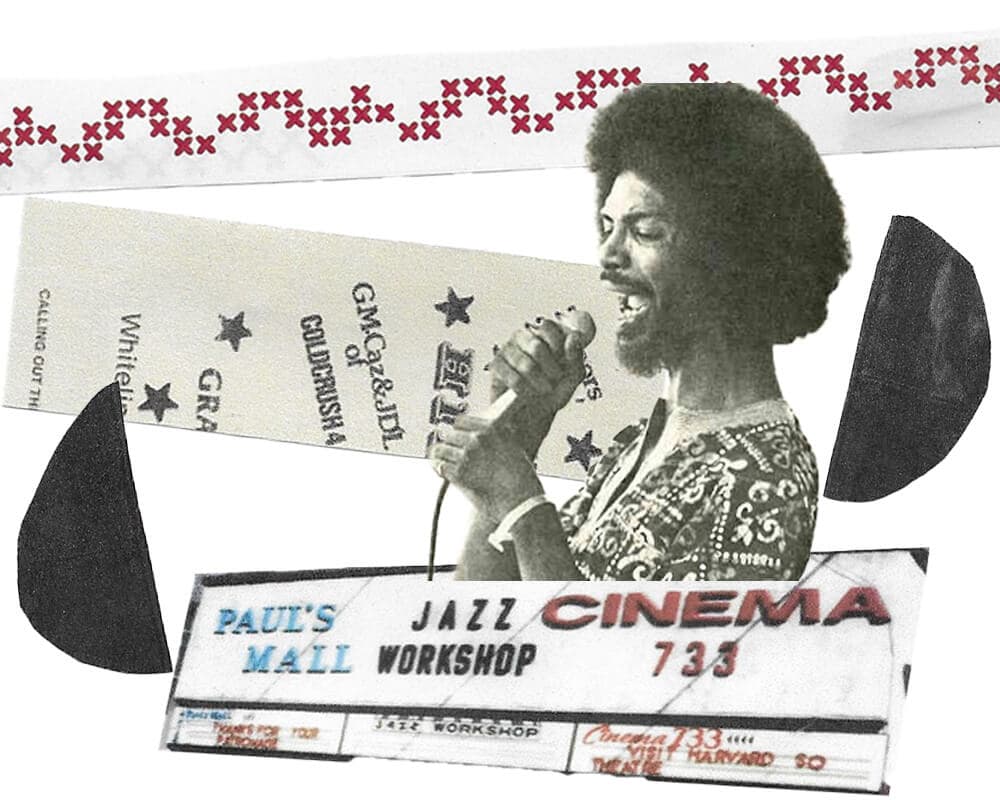
On July 1, 1976, the poet and musician Gil Scott-Heron took the stage for the first of two nights of performances at Paul’s Mall, a nightclub in Boston’s Back Bay neighborhood. The shows were recorded for a live album that captured Scott-Heron and Brian Jackson’s group at several venues that month. At Paul’s Mall, they were in good company. Artists including Miles Davis, Bob Marley, and Muddy Waters had recorded performances at the club.
At the time, Scott-Heron (1949–2011) was an established artist best known for his social commentary. Over fifteen studio albums and five books, his erudite yet streetwise spoken-word poetry and baritone voice influenced countless hip-hop artists in the decades to come, from Chuck D to Earl Sweatshirt.
As we mark the 250th anniversary of the American Revolution this year, you can expect to hear many puns and quips rooted in the title of Scott-Heron’s most famous song, “The Revolution Will Not Be Televised.” For your Semiquincentennial playlist, however, I recommend “Bicentennial Blues,” a poem recorded at Paul’s Mall. As a time capsule from this earlier commemoration, it provokes questions about how today’s artists will respond to Boston’s time in the spotlight in 2026. Scott-Heron understood that the excessive nostalgia of the 200th was a reason to engage, rather than avoid, the contradictions between America’s professed ideals and the realities facing so many Americans in 1976. For anyone wondering whether the 250th is worth the effort, “Bicentennial Blues” reminds us of the necessity of artists willing to probe the gap between gauzy versions of American history and the realities of contemporary America.
Born in Chicago in 1949, Scott-Heron began his contributions to American history at an early age. In 1962, at thirteen, he was one of three Black students who integrated the previously all-white I.B. Tigrett Junior High School in Jackson, Tennessee. Shortly thereafter, he moved with his mother to Manhattan, where he was immersed in the music and culture of his predominantly Puerto Rican neighborhood. Following in the footsteps of his hero, Langston Hughes, Scott-Heron attended Lincoln University, where he met Jackson.
He hit his artistic stride during the Nixon years. Relocating to Harlem, he intersected with the Black Arts Movement (BAM), which sought to recenter Black creativity as an independent, self-nourishing form of liberation. Scott-Heron is a close literary cousin of BAM figures like the author Ishmael Reed, whose fantastical novels portrayed the triumphs of Black anti-heroes over cartoonish, craven white politicians; and the poet/critic Amiri Baraka, who traced the evolution of Black music from the early blues of enslavement to its unparalleled, complicated role in popular culture. Scott-Heron’s spoken word style shares its roots and cadence with the Last Poets, the alchemists of poetry and Black Panther ideology often credited as the original source of New York hip-hop.
In songs, poems, and works of fiction, Scott-Heron used satirical, schoolyard nicknames for presidents (“King Richard,” “Re-Ron”), cabinet members, and various politicians. He was also a sympathetic chronicler of the despair of the 1970s and early 1980s, from Watergate to the war on drugs.
But fifty years ago, he had turned his critical eye toward the Bicentennial. Introducing the poem to the Boston crowd, Scott-Heron explains that he and the band call themselves “bluesicians,” who seek to define the various forms of blues coursing through the body politic. There are chuckles when Scott-Heron sends Philadelphia Mayor Frank Rizzo “our coldest regards” in his recovery from “lie detector blues,” a reference to Rizzo’s 1973 failed polygraph in a corruption case centered on a deal the mayor cut in a bathroom. Former Vice President Spiro Agnew’s is a case of the “ex-officio” blues. This is classic Scott-Heron, naming names in a trickster’s purr.
“And what we’ve found ourselves becoming afflicted with over the past six months or so is the ‘Bicentennial Blues.’” The audience erupts at the first mention of the poem’s title. Perhaps they, too, had heard enough soaring rhetoric and were ready for some real talk.
In the city where the Revolution began, the anniversary year was full of bitter reminders of the gap between progressive ideals and the realities of residents. The busing crisis reached its peak just as Boston prepared to welcome the nation’s gaze. No amount of Minutemen in red, white, and blue could erase the image of the American flag brandished against Ted Landsmark in City Hall Plaza that April. More than twenty years after most US cities began to confront desegregation in public schools, the nightly news carried images of white crowds menacing Black schoolchildren. Despite the pageantry, Boston in 1976 appeared isolated and enraged, hostile to change and quick to violence. Expected to put on a good show for visitors like Queen Elizabeth, the audience that arrived for Gil Scott-Heron welcomed the chance to listen to the blues.
The band puts its instruments down as the poem begins by affirming that the blues are as American as “apple pie.” The question, Scott-Heron asks, is why? What made America the perfect place for this music of struggle and soul? In a rhythm that picks up as he moves forward, Scott-Heron’s words spark sporadic applause, laughter, and occasional sighs.
The blues was born on the American wilderness
The blues was born on the beaches where the slave ships docked
Born on the slave man’s auction block
The blues was born and carried on the howling wind
The anaphora continues, giving credit for the blues to Nat Turner and Harriet Tubman, big city isolation and white fear, Duke Ellington and Paul Robeson, Bessie Smith and Ma Rainey. Forged in struggle, the blues took on its own powers of memory and subversion.
The blues is grown, but the country has not
The blues remembers everything the country forgot
It’s a bicentennial year, and the blues is celebrating a birthday
Instead of remembering, the United States takes the opportunity to focus on marketing. For centuries, he says, “this country has been ripped off.” Instead of “bicentennial,” the year has become a “buy-centennial.”
Buy a car
Buy a flag
Buy a map
To Scott-Heron, the blues are the counterweight to the commercialization of the anniversary, which threatens to once again obscure the facts. The Bicentennial with its “partial deification / of partial accomplishments / over partial periods of time” was half-baked history, another diversion from the state of the nation in 1976. The crowd at Paul’s Mall laughs as the poem’s first section concludes, “It’s a half-assed year.”
Before moving into more specific targets of ridicule, though, Scott-Heron reminds the audience that laughter can be an opiate, something today’s late-night hosts would do well to remember.
And we would be silly in all our knowledge
In all our self-righteous knowledge
When we sit back and laugh and mock the things that happen in our lives
To accept anything less than the truth about this bicentennial year
Scott-Heron marvels at the ways the blues upstaged or “got by” (another play on bicentennial) everyone from George Washington to then-President Gerald Ford as well as Henry Kissinger and future presidents Jimmy Carter and Ronald Reagan. The blues unmasks their phoniness and reveals America’s “legacy of hypocrisy.”
Reagan is a very favorite target in several Scott-Heron compositions, labeled here as “Holly-weird” for his corniness and unlikely reinvention from B-movie leading man to aspiring president. “Acted like a actor, acted like a liberal, acted like General Franco when he acted like governor of California, now he acts like somebody might vote for him for president.” In retrospect, there’s a cruel irony: Reagan’s drug war policies would eventually ensnare Scott-Heron himself. And like the poet, we too live with the shocking effectiveness of a once ridiculed television character who transforms himself into a tough-talking candidate.
Boston, too, was in the grip of its own blues. In the somber penultimate verse, Scott-Heron brings the crisis in the birthplace of the Revolution to a human scale.
It’s a blues year for Boston
Looking for justice
It’s a blues year for babies on buses
It’s a blues year for mothers and fathers with babies on buses
It’s a blues year for Boston
The Boston of 1976 was much different than Boston in 2026, smaller, less diverse, and more provincial. Between then and now, the city was transformed by the Big Dig, new waves of immigrants, and the rise of the biotech sector. Still, the Boston that welcomes visitors this year struggles with persistent economic inequities that threaten to displace Scott-Heron’s artistic heirs as well as the descendants of those babies on buses.
On a stage in Back Bay, just days before the Fourth of July fireworks and Pops concert, a week before Queen Elizabeth’s visit to Boston and the arrival of the tall ships, Scott-Heron reminded his audience that American history is complex, full of competing narratives and submerged truths. Fifty years later, we look out on an America struggling to find ways to celebrate amid so much fear. There’s a chilling resonance of the poem’s concluding lines.
We would do well to join the blues looking for justice, liberty, and equality
The blues is in the street
America has got the blues
But don’t let it get by us.
This final call to pay attention, to refuse to shrug and hand the commemoration over to car salesmen and cynical politicians, has new importance in 2026. Boston is again an outlier in the nation, this time for honorable reasons, most notably the refusal of the Wu administration to bend to pressures from Washington. Like the audience in Paul’s Mall, many of us are in search of artists who can put the contradictions and silver linings of the Revolution into a contemporary context. Yet our troubles are both similar and very different from those of the listeners in 1976.
I’m reminded of a recent conversation with the always astute Nathaniel Sheidley, CEO of Revolutionary Spaces, who noted that the Bicentennial unfolded during something of a national hangover, with memories of Watergate and Vietnam still fresh but receding. Today, Sheidley noted, we are very much in the thick of our own historical disaster, making the 250th a bigger challenge for artists and critics alike.
There is hope, however. If we need a Scott-Heron today, we might look to Revolution-minded artists like the Boston-based Silence Dogood. Borrowing a pseudonym of Benjamin Franklin, the collective began projecting quotes on historic buildings in the city last year. In response to a threat by the Trump administration’s border czar to bring “hell” to the city due to its status as a sanctuary city, Silence Dogood lit up the side of the Old North Church with a defiant statement that would make Scott-Heron proud. “You can’t bring hell to Boston. It’s been waiting for you since 1770.”
The next day, Mayor Wu testified to a congressional committee. I was in Washington that afternoon, waiting outside Congresswoman Pressley’s office for a meeting about the hell that was coming for the National Endowment for the Humanities. As I leaned against the corridor wall, the image of the Old North Church and those words showed up via text. I looked up and saw members of Mayor Wu’s staff exiting Pressley’s office. I imagine I felt a bit like the concertgoers at Paul’s Mall. This, I thought, is the 250th we deserve.
Yet where Scott-Heron’s audience laughed wearily, I laughed with hope. Here are the artists and leaders we need right now.