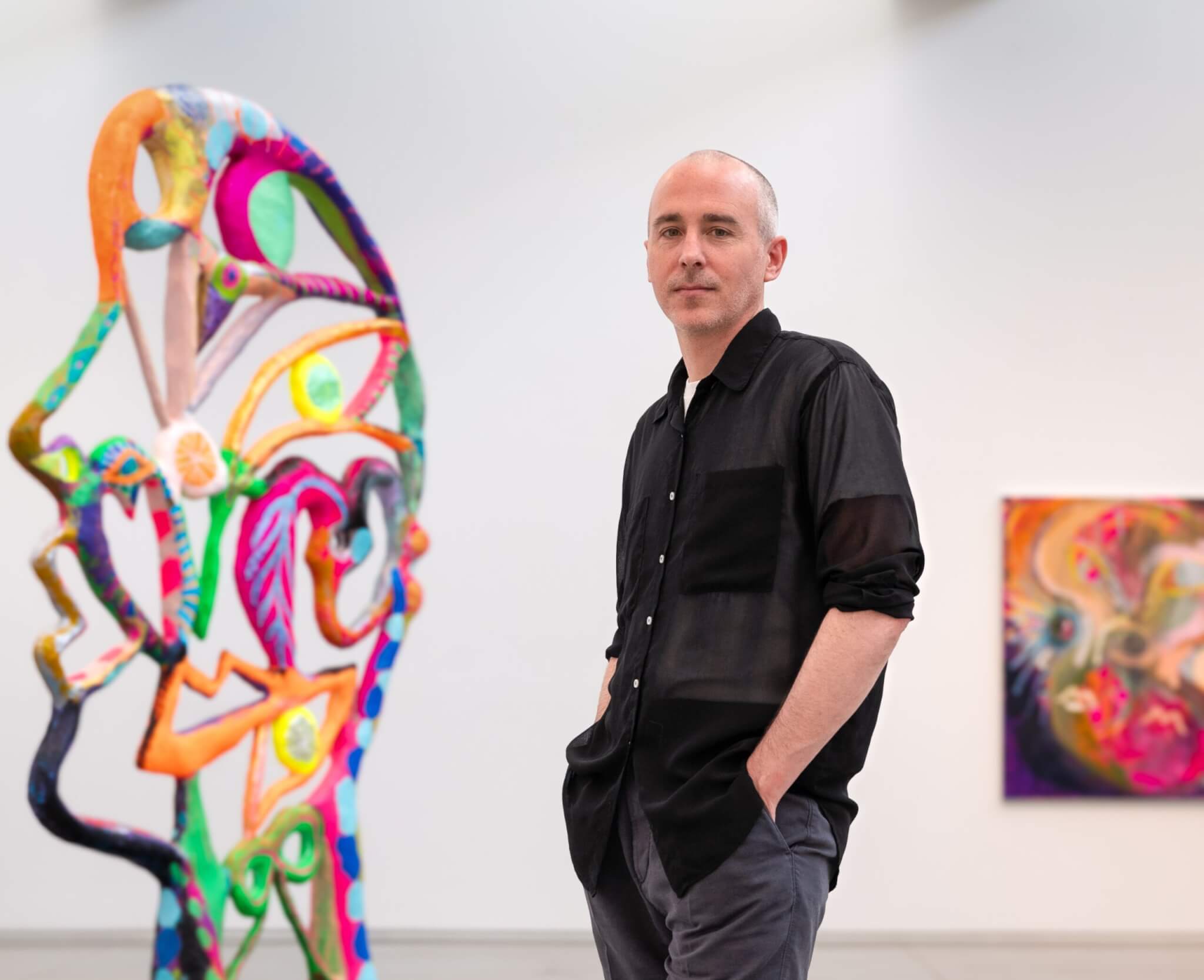
“This is going to sound really grandiose and naïve, but I’m giving myself permission to say it,” declares Grant Wahlquist, curator at the Center for Maine Contemporary Art (CMCA) in Rockland. “I want to be part of shaping art history. That’s something I’ve learned from artists. Great artists want to be part of art history, and the incredible thing about being a curator is you get to be a huge part of making it.”
In some ways, Wahlquist set foot on this trajectory at the CMCA as soon as he was appointed in June of last year. Founded in 1952 as the Maine Coast Artists cooperative, the museum has employed numerous director-curators over its history, including Suzette McAvoy and Tim Peterson, who combined curatorial and executive responsibilities. Wahlquist’s arrival coincides with a new chapter for the institution: the first full separation of those roles, with Executive Director Robert Wolterstorff leading the organization while Wahlquist concentrates on exhibitions and artistic programming. Before joining CMCA, Wahlquist owned and operated his own namesake commercial gallery from 2017 to 2025 in Portland.
The forty-two-year-old Wahlquist has already expanded the types of media the CMCA will present. “Maine is a place that has an almost monocular focus on painting,” he says. “But I have a lot of experience working with artists who make multichannel video installations, for example, and we should be doing those kinds of things.” To that end, he is “really pushing the Hughes Gallery [of the museum] into a time-based media space for the foreseeable future.” First exhibition in that direction is “Abbey Williams: Fugue,” which opened last month. “[Williams] is someone deeply connected to Skowhegan, and she made a five-channel video installation that in part was finished at Surf Point,” Wahlquist says. “It was premiered by Broadway Gallery at Art Basel in Switzerland, but we are the US debut venue for that piece, which she is re-editing for us.”
A fall exhibition, “Because the Sky is Blue,” will juxtapose various artists’ work against Bo Bartlett’s Blue Sky paintings, which Bartlett began after the 9/11 attacks, realizing, as he wrote on Instagram, that “even with the horrific events, the world kept spinning, the sun kept shining, the tides kept ebbing and flowing,” and that “what America was experiencing were ‘human problems.’”
One of the remarkable aspects of this exhibition, Wahlquist points out, is that “we are going to have international artists in the show for the first time in the CMCA’s history.” These include Latvian-born Vija Celmins, Chinese native Miao Wang, Paris-based Clémentine Adou, and French–Portugeuse artist Wilfrid Almendra. “I think it’s going to be a real sign of where I want things to go in terms of really rigorously curated exhibitions.”
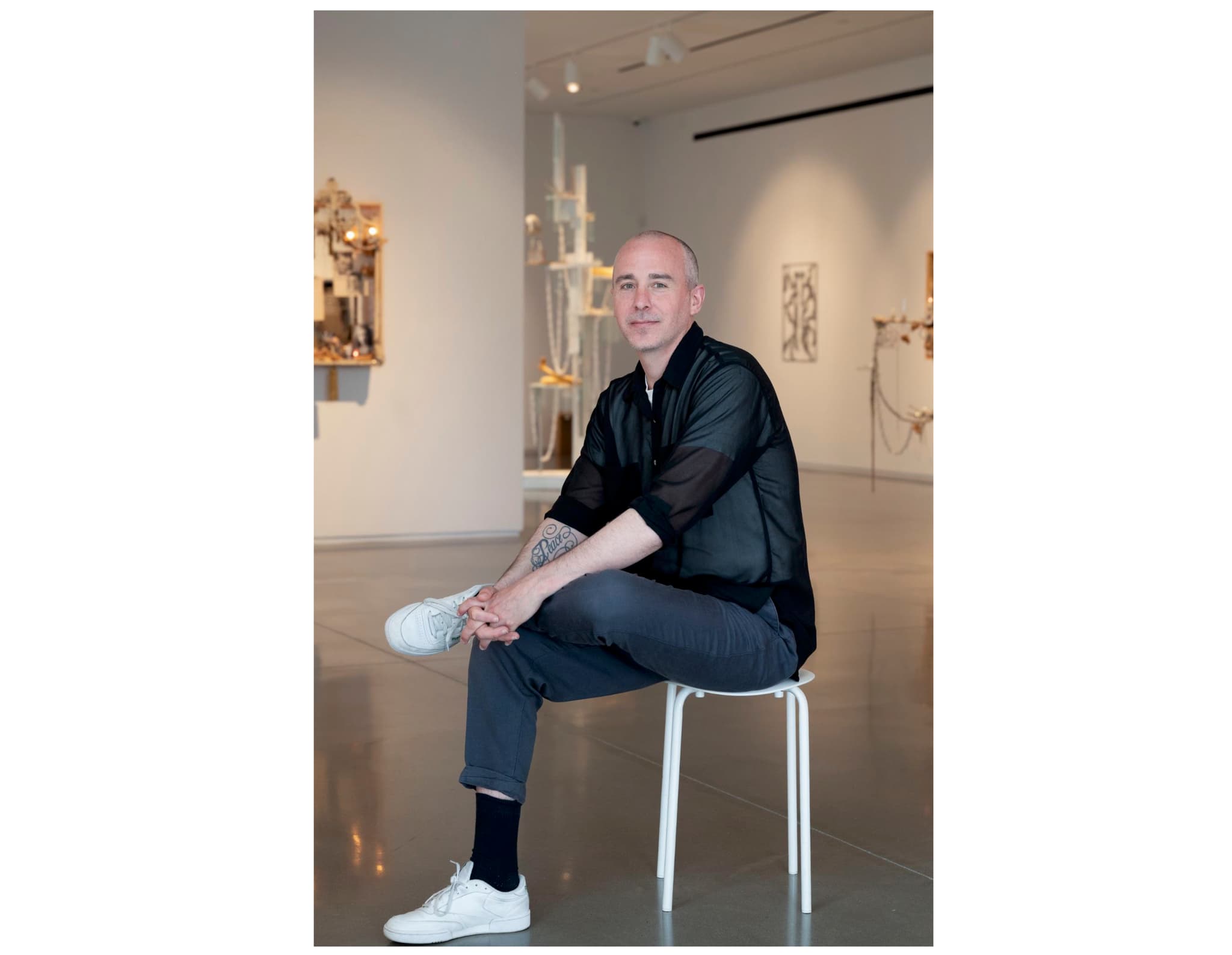
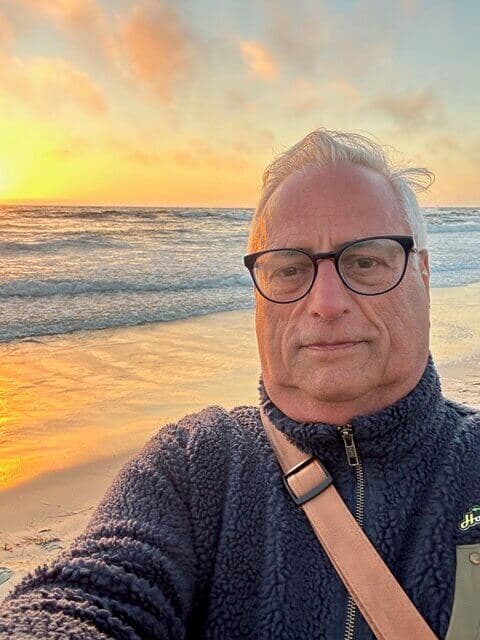
Portrait of Grant Wahlquist at Center for Maine Contemporary Art, June 2026. Photo by Dana Clark for Boston Art Review.
Transforming the CMCA into a pioneering institution is at the core of Wahlquist’s grand scheme. “I want it to be a place where firsts happen,” he explains. “The first institutional show or first real presentation in Maine, or the first time an artist has a chance to do something really different for them.”
Beyond that, he seeks “to educate internally around who our models should be. We were looking at a certain set of peer institutions when we moved to Rockland, and now we need to be looking at a different set of peer institutions. CMCA should be a place that is thought of alongside the Renaissance Society in Chicago and Artists Space in New York.”
Wahlquist was raised in Orange County, California, and initially trained as a classical pianist at the Orange County High School of the Arts. There he encountered its visual arts program, where, he remembers, “I caught the bug.” But then Wahlquist took what he characterizes as “a detour into evangelical Christianity.” On a 2021 episode of the podcast Voices On Art, he told host Daniela Steinfeld that religious systems were like “an alternative family structure…safe spaces to ask big questions when [you] were very young.” Thinking about the meaning of life at eighteen, he laughs, “wasn’t cool.” Wahlquist attended a small religious college, becoming a children’s minister for two years while pursuing a master’s degree in theology and art at Fuller Theological Seminary in Pasadena.
Stepping away from full-time ministry at age twenty-three, Wahlquist pursued further graduate study in philosophy and worked at the Orange County Museum of Art before enrolling in law school the following year. Wahlquist knew his objective was to open an art gallery, but realistically he was well aware that he had neither the resources for this project nor the business skills. So he got his law degree and practiced full-time in New York for nearly six years while doing some curation and art criticism on the side.
Wahlquist had met conceptual photographer Tad Beck back in Los Angeles in 2008 and married him two years later. The men spent summers at Beck’s studio in Vinalhaven, Maine, where Wahlquist fell in love with the natural beauty of the state and with the interesting people he connected with there. After leaving full-time legal practice, he used savings to open his gallery in Portland. Asked to synopsize the mission of Grant Wahlquist Gallery, he says, “I wanted to be the first gallery in Maine that had a program that was national in scope…a contemporary art gallery functioning the same as it would function in New York or LA or Chicago. I’m proud of the fact that slightly more than half of the artists were not from here, and artists who worked and lived here could get access to new material. That’s how artists grow.”
The focus was on mid-career artists. “The market favors, as Marilyn Minter says, ‘bad boys and old ladies,’” Wahlquist quips. “I knew a number of artists with substantial institutional exposure and in significant museum collections, but there was no one looking after them from a gallery perspective. [The roster] was deliberately very queer, whether because of my social circle or my own particular interests. And I am interested in artists who in one way or another are challenging the expectation of legibility. The demand for legibility falls disproportionately on artists from historically marginalized communities. They are often expected to package any aspect of themselves that deals with those issues in a way that is super digestible for people who don’t share those experiences.”
Wahlquist and Beck formally closed the Portland gallery in 2025. Shortly after, Wahlquist interviewed with the CMCA. Wahlquist emphasizes, “This isn’t Grant Wahlquist Gallery on a different scale. A good curator does put their taste on display. But we have to make sure there’s a balance. It’s about making sure it doesn’t go too hard in one direction or another.”
On the other hand, Wahlquist fiercely maintains that “general audiences are capable of a lot more than I think museums give them credit for. If you are welcoming and friendly, and you have good interpretive materials available, and you don’t condescend to people, they might surprise you with what they like and what they respond to.” He also reminds us that the present, at least institutionally speaking, is hardly ever a good predictor of the future. “Most great works that comprise the (deeply problematic!) thing we think of as ‘the canon’ were controversial, confusing, or perhaps even offensive when they were first presented but were later understood to have opened up new possibilities in art. The further away we get from those initial moments, the better our museums and institutions are at integrating these pivotal moments and contextualizing the initial response.”
From this perspective, Wahlquist believes, the sky’s the limit. “The only thing that will hold us back is being timid. We just have to be brave.”
Support for Maine arts reportage is provided by the Marion Boulton “Kippy” Stroud Foundation.