The 250th anniversary of the United States arrives as the country’s leaders are upending every founding principle that led to independence from England—even democracy itself. The stakes couldn’t be higher as the government takes alarmingly regressive actions. These include redefining America as a white nationalist Christian state, restricting who can call themselves American, and revising the record to emphasize white greatness and erase evidence—or even mention—of injustices the country perpetrated against Indigenous peoples, women, people of color, immigrants, the gay and trans community, the environment, and more.
Archetypal strategies employed by the current administration include attempting to establish an oligarchy, co-opting political structures, and controlling education, the media, and, of course, culture. Institutions are reeling, especially those dependent on government funding. Museums in Maine are approaching this contemporary reality in a variety of ways.
Back in 1776, the state’s territory was actually the District of Maine within the Commonwealth of Massachusetts. So citizens of Maine fought in the Revolutionary War as Bay Staters, even though there was already a lively debate afoot about whether to separate from the Commonwealth. After achieving independence from England, however, efforts began in earnest. Between 1792 and 1819, six elections were submitted to the General Court over the matter (others lacking enough ballots were also introduced, but considered illegitimate).
Independent statehood arrived in 1820 with the Missouri Compromise, an effort to quell tensions in Washington between slaveholding and nonslaveholding states. Maine was admitted to the Union, but only after Missouri—a slaveholding state—was also granted entry. The move divided America at the 36°30′ N latitude. North of it was considered free territory, while south of it slavery continued.
Technically, Massachusetts had outlawed slavery in 1783, though in reality enslaved people were not often told of the new law and remained in a state of modified bondage. In what eventually became Maine, slavery was not institutionalized as in the South, but rather served as a marker of status amongst the rich and aristocratic. However, as late as 1850, the Bath, Maine-based shipping fleet Clark & Sewall was still participating in the transference of enslaved peoples from Baltimore to New Orleans, and many Maine sea captains made fortunes by transporting sugar, cotton, indigo, and other crops from slave-worked plantations in the Caribbean to New England.
With few exceptions, Maine museums and other institutions did not really start confronting the state’s insalubrious past for the next 150 years or more. Rather, they mostly championed Anglo-European artistic achievements and presented Maine’s artistic heritage as if it had suddenly sprung forth, fully formed, in the nineteenth century with artists such as Thomas Cole, Edwin Church, and Winslow Homer. If Native arts were exhibited, the context was strictly anthropological and ethnographic. Though that context is changing and representation and presentation of this work is growing in museum collections, Wabanaki curator Danikah Chartier wrote in an email, “You can’t have restorative justice or allyship with the Wabanaki if you do not also stand against the injustices happening today to Indigenous Peoples globally.” One recent positive step at an institutional level has been the University of Maine’s decision to return the remains of twenty-six Indigenous people and 532 burial objects to Wabanaki Nations.
Art that dealt critically with LGBTQ+ discrimination or the legacy of enslavement was similarly rare. For instance, when I started visiting the Ogunquit Museum of American Art—located in a community that has been a gay haven since the early twentieth century—the issue of homosexuality was not raised in a single exhibition. Thanks to new, bold leadership there, this has changed radically, with at least one or two exhibitions per season centering the LGBTQ+ experience. Some years ago I criticized a show at the Farnsworth about extraordinary Maine women because the label accompanying a work by Berenice Abbott—her iconic portrait of the bisexual writer Edna St. Vincent Millay—alluded to Millay’s sexuality as a kind of madcap indulgence of the bohemian downtown scene (even though her husband knew and supported his wife in this lifestyle), and it made absolutely no mention of Abbott’s own lesbianity. It seemed antithetical to me, I argued, to ignore the courage it took for these women to be out, to live their truth despite statutes that outlawed the active practice of their sexuality. That commitment was integral to their extraordinariness.
In general, it takes a tragedy to raise consciousness—the HIV/AIDS epidemic for LGBTQ+ issues, for example, or the murder of George Floyd for awareness around racist police brutality. A 2025 museum director survey, for example, pointed out that Floyd’s murder was a pivotal moment for broader flourishing of art by Black and Brown artists in museums nationwide. I expect the anti-immigrant policies of the administration and the coldbloodedness of ICE raids will similarly bring institutional attention to the art of this community. Indeed, even before the deployment of ICE, as Trump’s anti-immigrant rhetoric was was just beginning to fulminate, Colby Museum of Art mounted a timely exhibition of Chicanx protest posters culled primarily from the 1960s and ’70s, illustrating that we’ve been here before and encouraging us to look closer at why this situation is once again upon us.
The 250th anniversary of the United States is an occasion for some Maine museums to rethink issues of “America” and “Americanness” with new exhibitions that tackle them head on. But I’m happy to report that some of this work already began with a more inclusive reinterpretation of permanent collections at various museums, which continue to freshen those rehangs by revolving works in and out periodically. It’s a step in the right direction.
“Passages in American Art” at the Portland Museum of Art reinterprets the institution’s permanent collection, rotating works in and out intermittently. It is laudable for the sensitivity with which it was compiled and a wealth of works and educational materials that interrogate the Anglo-European-centered narratives currently in vogue in Washington. It also connects the dots in important ways, helping us understand the causality between beliefs and lifestyles of colonists and the way these drove mass exploitation of other human souls and resources.
One label about the many violated treaties entered into by Indigenous peoples points out that “by the 19th century, the newly created State of Maine furthered these violations, authorizing the sale or exploitation of unceded tribal lands and pressuring Native people to abandon their cultural traditions.”
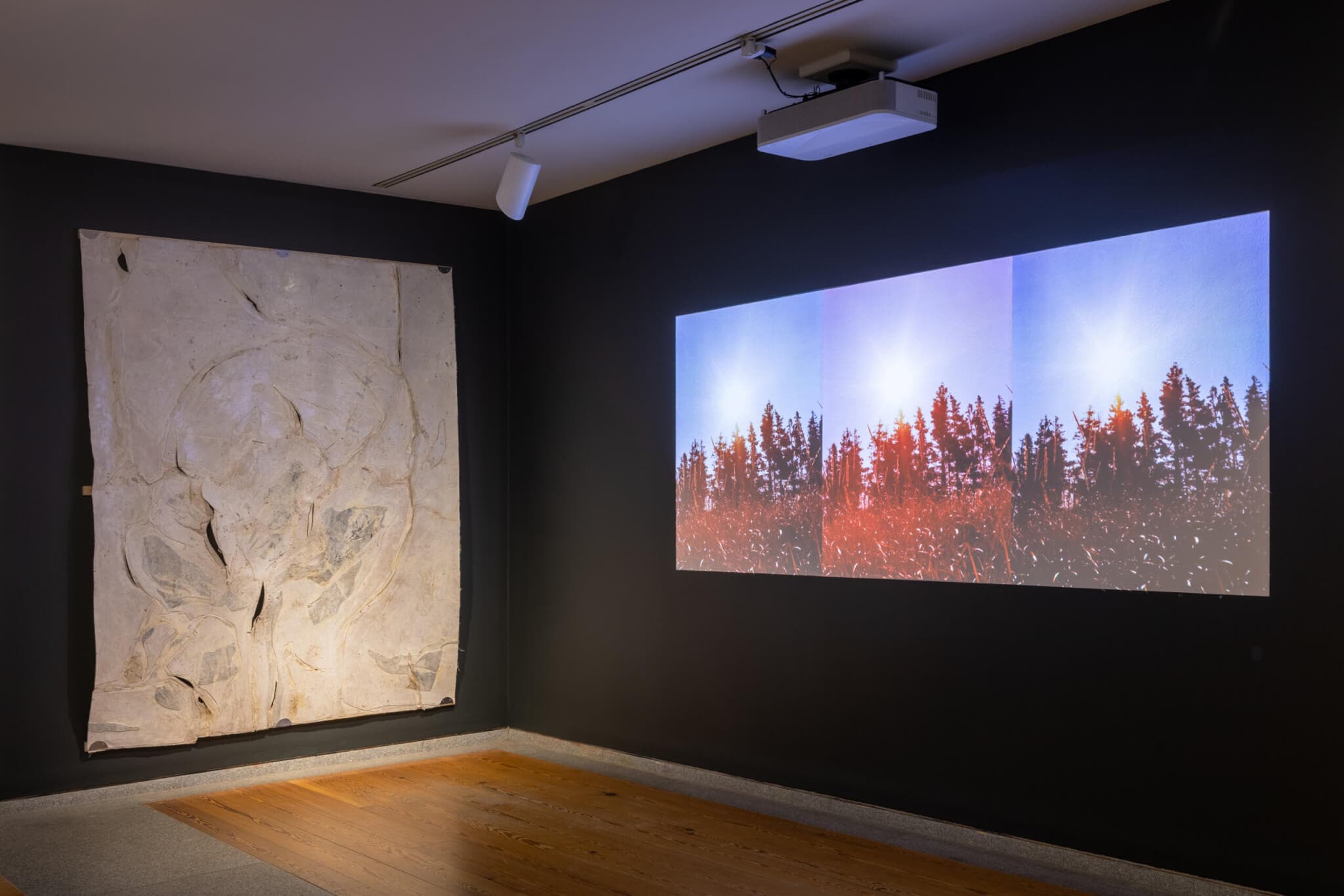
Shane Charles (United States (Penobscot and British descent), born 1983), Into the Sun, installation view, 2025. Single-channel video projection. Courtesy of the artist at the Portland Museum of Art, Maine. Image courtesy the Portland Museum of Art, Maine.
Into the Sun (2025), a video installation by Maine-based Shane Charles (part Penobscot; part English), grapples with the colonization of Matinicus Isle, a small island in Penobscot Bay, where settlers burned tall grasses for agriculture, forever changing the island’s topography and natural environmental systems (i.e., filtration and breeding grounds provided by marshes). Another work in Charles’s installation incorporates glacial clay from Wabanaki land and addresses the planting of non-
Indigenous species (here, Rosa rugosa) that also irrevocably altered coastal habitats throughout New England.
Winslow Homer’s iconic 1894 painting Weatherbeaten shares space with an 1880s Penobscot canoe. We’re informed such vessels embodied “innovative and elegant technologies perfected by Indigenous makers over millennia,” but are “also powerful works of art.” This acknowledgement elevates the usual ethnographic approach to exhibiting Indigenous artifacts at museums. It also illustrates the simultaneity of two different kinds of human achievement and asks us to question the artistic hierarchy that prizes one as “great art” and designates the other as something vaguely described as “craft.”
There are displays of Wabanaki “fancy” baskets and tools nearby. But a small, sterling-silver, lidded basket by mixed-media artist Shane Perley-Dutcher (Tobique First Nation) illustrates how these ancient, craft-based media continue to evolve and be refined. Importantly, this belies images of Indigenous civilizations romantically (and erroneously) portrayed by white artists such as Frederic Remington as a nearly extinct culture.
The show also addresses Maine’s complex entanglement in the slave trade, primarily in an edifying section about sugar. We learn that Portland had one of the biggest sugar refineries in New England, which processed raw cane shipped from Caribbean plantations worked by enslaved Africans into rum, molasses, and other luxury products. “We have underestimated how important slavery was to the construction of our institutions and our cities and to our most prominent citizens,” reads another label. “Even after slavery was abolished, Cuban planters found ways to perpetuate the exploitation of people of color. Beginning in the 1860s, Maine and other New England ships began to transport Chinese indentured servants from China to work on sugar plantations and harvest guano…in caves in Cuba.”
The exhibition is a collaboration between the museum’s curators and an advisory council composed of Black and Indigenous organizations such as Indigo Arts Alliance (where Charles and Perley-Dutcher, in fact, completed residencies), the Akomawt Educational Initiative, and the Gulf of Maine Research Institute. It presents truth without self-consciousness, apology, or excuse. This is a sorely needed antidote to the propaganda of erasure being imposed upon our schools and arts institutions today.
Two exhibitions at the Ogunquit Museum of American Art (“American Conversations” through July 19, and “Looking for America” through November 15) are deliberately provocative. As curator Devon Zimmerman shares, each confronts “how the retelling of history is so corrupted at the present moment.” Unlike the PMA’s sober, measured tone, these shows pull no punches. They court controversy and discussion.
“American Conversations” pairs artworks from the museum’s collection with loans from other institutions, intending to provoke contemplation of some uncomfortable subjects. Rashid Johnson’s Untitled (Seascape) of 2023 hangs alongside an untitled Homer graphite on paper (1883). Johnson’s piece explores Black identity by drawing allusions to the transatlantic slave trade, while Homer’s drawing depicts a more conventional fisherman scene—thus viewing the ocean in both nefarious and nourishing contexts.
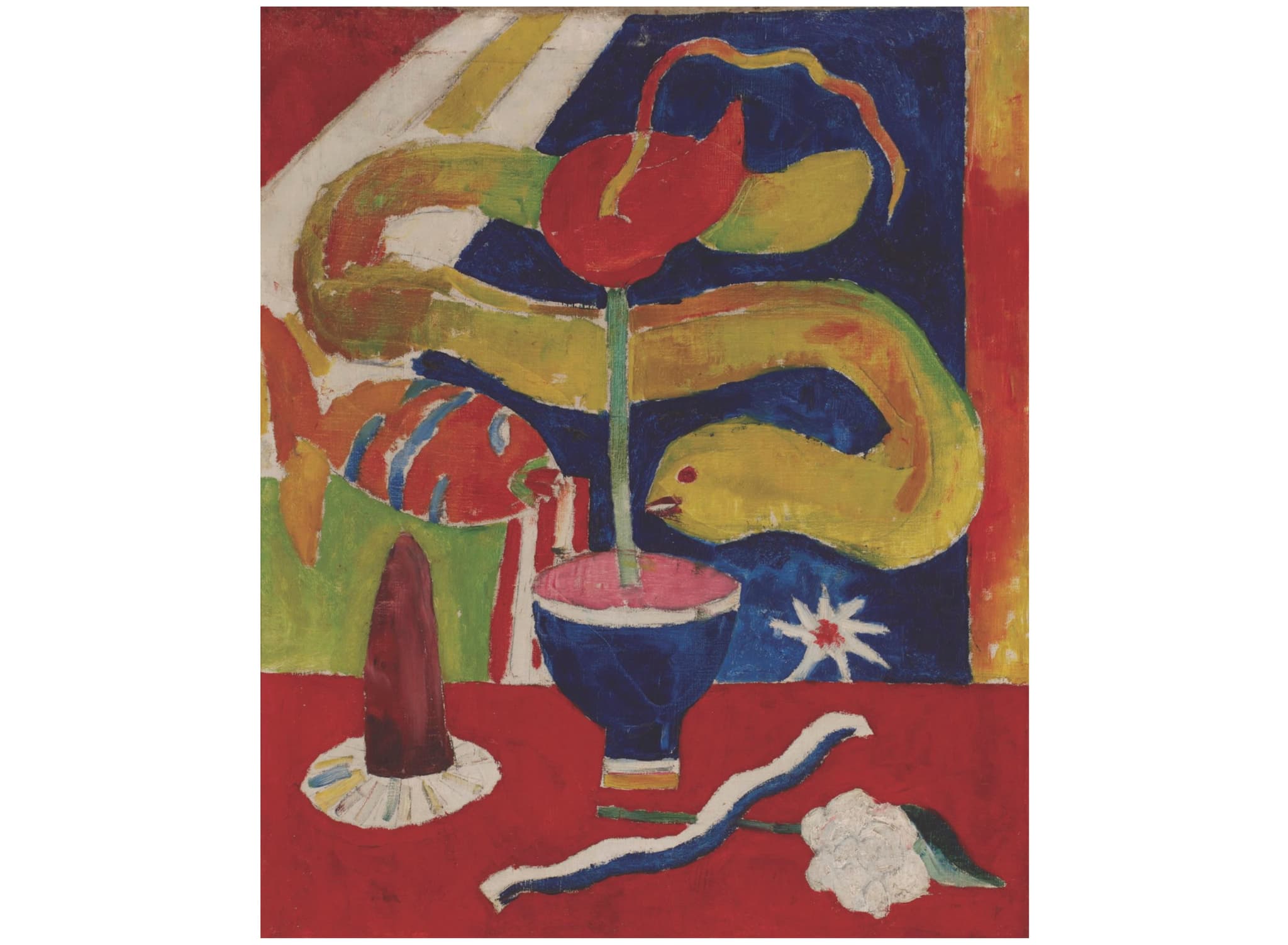
Marsden Hartley (1877–1943), Still Life with Eel, ca. 1917. Oil on canvas, 29 x 24 1/2 inches. Gift of Mrs. William Carlos Williams, 1967.26. Photo by Luc Demers. Courtesy of the Ogunquit Museum of American Art.
The juxtaposition of two works featuring flowers—Marsden Hartley’s Still Life with Eel (1917) and Spanish artist Luján Pérez’s A perfectly timed Exchange, After Kitagawa Utamaro (2021–22) seems innocuous enough. But if we understand that Hartley painted Eel during a trip to Bermuda with fellow gay artist Charles Demuth, it becomes clear that objects in the still life—an anthurium, the eel, what looks like a banana standing upright on a plate—carry barely disguised homoerotic innuendo. Pérez’s work refers to the eighteenth-century ukiyo-e master Utamaro, who became famous for depicting erotic scenes as well as the geisha of the Yoshiwara district in Edo (now Tokyo). Suddenly, we find ourselves contemplating sexuality and gender rather than botanicals. Permanent collection works will be swapped out periodically, at times reframing the conversations.
“Looking for America” organizes twenty-three works by Hank Willis Thomas and sixteen by various other artists into seven themes. Overt references to the Black American experience come in works such as Willis Thomas’s Freedom Ride (Red, White and Blue) (2017), which recalls the Freedom Rides organized by the Congress of Racial Equality in the 1960s to protest racial segregation on buses and in bus terminals. Certainly, the patriotic color palette indicts the denial of civil rights that these events were trying to (and did) overturn.
Willis Thomas collaborated with Will Sylvester on Black Righteous Space (2015), a video that presents a Confederate flag in Pan-African colors that morphs into countless patterns as it picks up sounds from a microphone in the middle of the room, thus implicating us in a discussion of the Confederacy’s history, legacy, and resurgent ideology in the present day. Throughout its almost two-hour loop, we also hear Black musicians, politicians, and comedians talking about Black culture and self-determination.
Chris Berntsen’s for chip (2025), on the other hand, is a cyanotype collage that asks us to consider “the shining sea” of our national anthem as something “complex, contested, and deeply entangled with human experience,” reads the wall text. “This section invites viewers to consider how water holds history—reflecting not only ideals of freedom and openness, but also the weight of journeys undertaken, willingly or by force.” That Berntsen is a queer artist legitimizes the weight of these journeys, as well as any involving identity.
In both shows, “America” and “American” are dynamically evolving concepts—exactly the opposite of what our government is currently trying to codify. “The goal is not to run from this moment,” Zimmerman explains. “As the only American Art museum in Maine, it’s our charge to explore all aspects of American experience, from queerness to race to nature, and so on.” It’s an audacious approach.
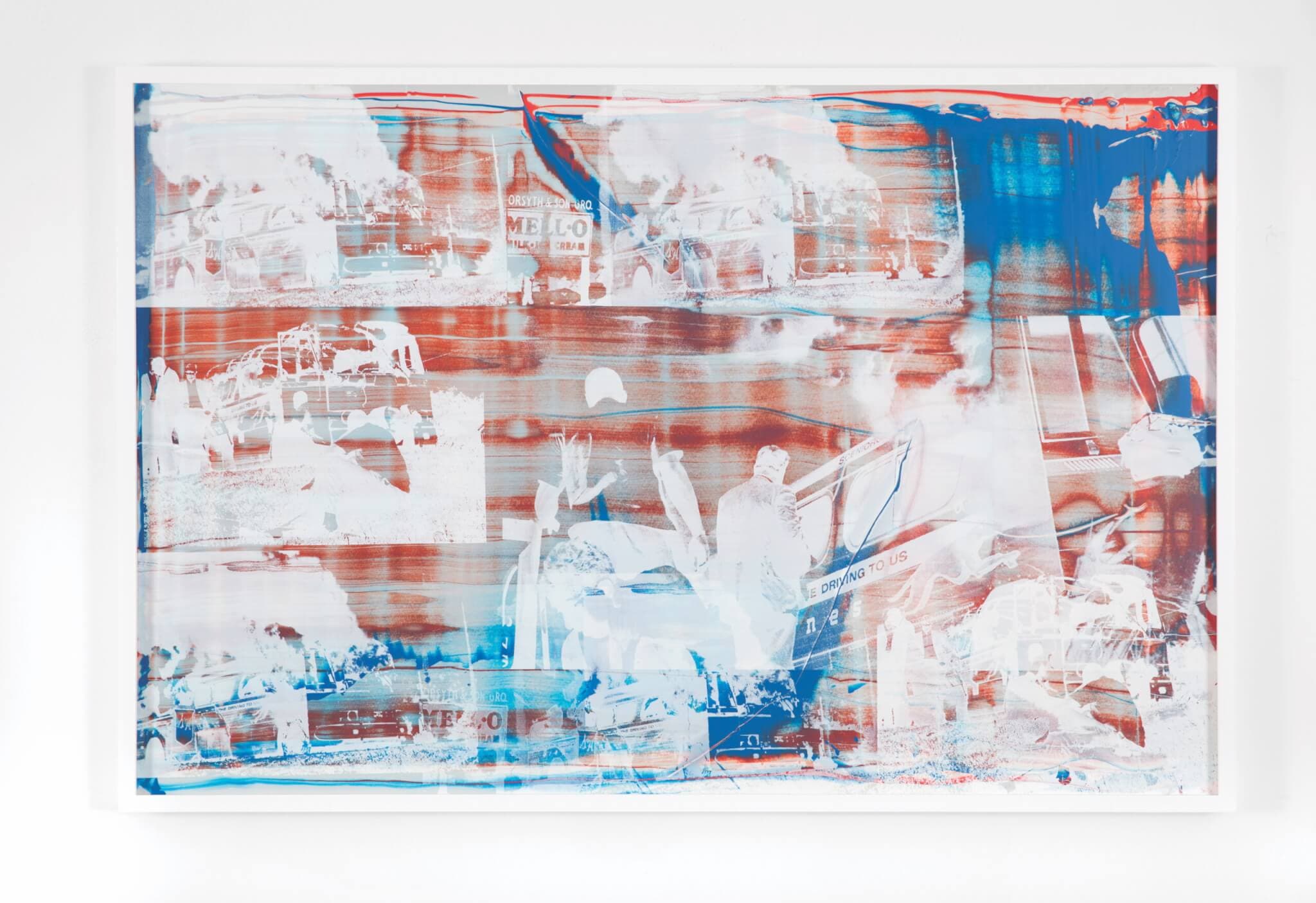
Hank Willis Thomas, Freedom Ride (Red, White and Blue), 2017. Screen print on retroreflective vinyl, mounted on Dibond, 33 x 49 x 1.75 inches. Image courtesy the artist. © Hank Willis Thomas.
The Abbe Museum in Bar Harbor often receives grants from the embattled Institute of Museum and Library Services, which Trump tried to defund (a recent court order compelled the restoration of grants the POTUS had blocked). Yet the Abbe continues to pose tough questions regarding erasure of Native histories. Who of us, for instance, knows the Declaration of Independence’s twenty-seventh “grievance,” which describes Native tribes as “merciless Indian Savages”? Or that tribes weren’t granted freedom of religion until 1978, or the right to vote in many states until the 1960s—even though Native Americans still have the highest per capita military service in the nation? “In the Shadow of the Eagle” at the Abbe (through October 2026) sparks conversations around these contentious issues. But, says Executive Director Betsy Richards (Cherokee Nation), “We’re trying to teach people through their heart space to imagine the ‘We’ in ‘We the People’ in a broader way through the eyes of artists. It’s a fine art exhibition, not an ethnographic one.”
The “eagle” of the title carries different meanings for Indigenous people (the sacred) and colonizers (power). The title mirrors a book of the same name by Penobscot Nation elder, poet, and author Donna Loring, who says, “I’d like people to understand that we have our own stories and our own ways of telling our stories, that we are still here as sovereign tribal nations.”
The narrative arc, then, comes through the eyes of Loring and her fellow curators, Dr. Darren Ranco (Penobscot Nation) and Virginia Museum of Fine Arts Curator Siera Hyte (Cherokee Nation). They propose fascinating dialogues among art and artifacts. Emma Hassencahl-Perley (Wolastoqey/Maliseet/Tobique First Nation) contributes two captivating textile-based works. One, thank you for your service (2025), features an actual M64 field jacket (common armed services camouflage, but also worn by Indigenous activists in the 1960s–1990s during standoffs over land and water rights). It is adorned with beaded ornaments that look like medals. Ahtolimiye (she keeps praying) (2019) is a traditional Wolastoqey “jingle dress,” but one made with shredded pieces of the Indian Act (1876), which the wall label states “forcibly legislate(d) Indigenous identity, governance and rights of Indigenous peoples to practice their culture,” including dances showcasing jingle dresses.
There is a scrimshaw powder horn belonging to eighteenth-century Penobscot Chief Orono, whose etched designs are incorporated into a sumptuous contemporary dot painting, Circa 6/20/1775 (2025) by James Eric Francis Sr. (Penobscot). In the latter, Orono canoes to the 1775 Continental Congress in Massachusetts in hopes of allying with American revolutionaries in exchange for protection of Penobscot lands.
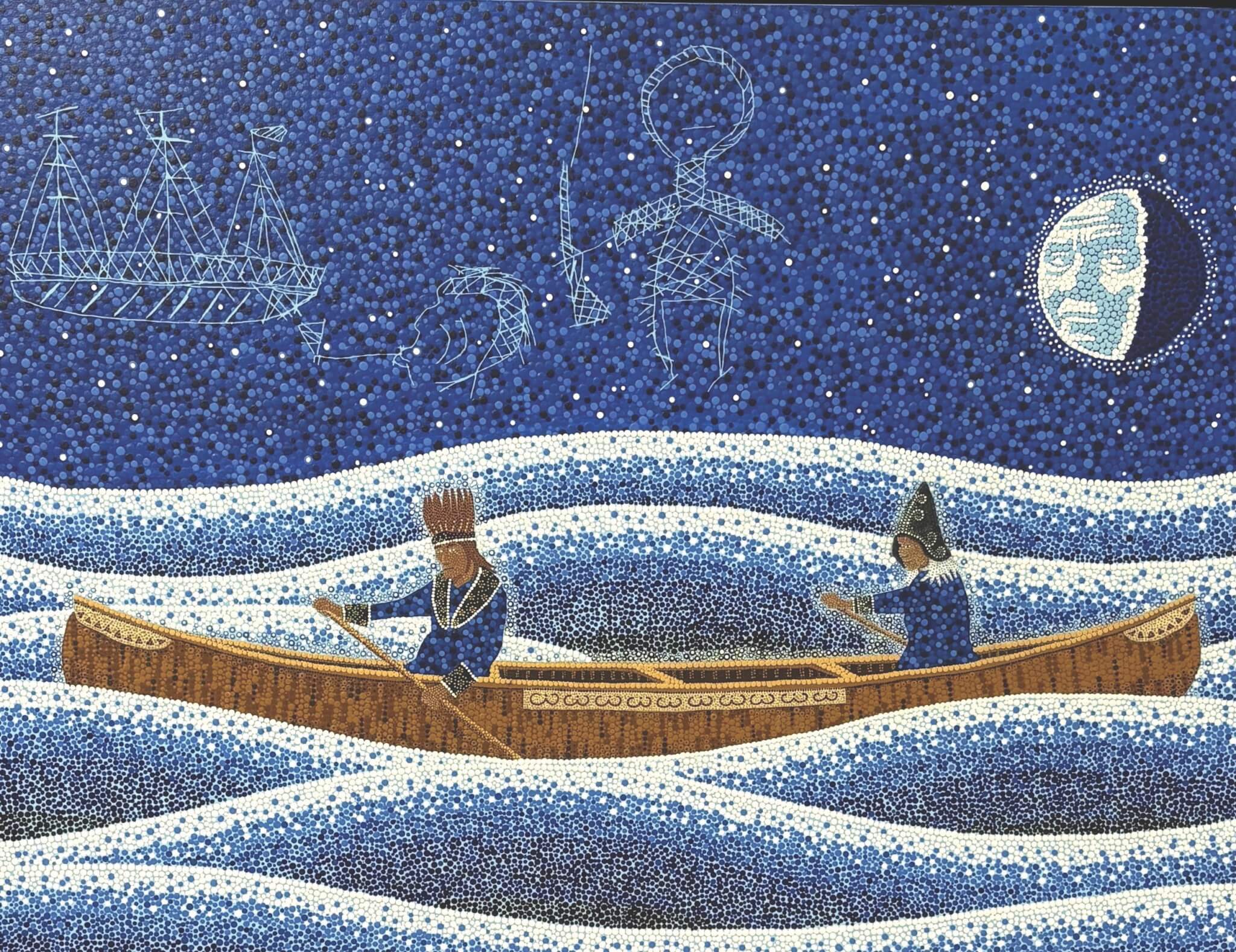
James Eric Francis Sr. (Penobscot, b. 1969), CIRCA 6/20/1775, 2025. Acrylic on canvas. Museum purchase with funds from an anonymous donor. Courtesy of the Abbe Museum.
The Abbe will also be one stop on a statewide tour of the Maine Historical Society’s early copy of the Declaration of Independence (August 21 and 22). This document contained a section of twenty-seven “grievances” against King George III that enumerated reasons the colonies should claim their independence. Specifically, it states: “He has excited domestic insurrections amongst us, and has endeavored to bring on the inhabitants of our frontiers, the merciless Indian Savages whose known rule of warfare, is an undistinguished destruction of all ages, sexes, and conditions.”
Rather than simply display the document, the Abbe plans to use it as a teaching tool, creating programming that dissects this grievance “from a Wabanaki historical, cultural, and political perspective,” says Richards.
Maine still ranks as one of the whitest states in the nation (93.2 percent according to the 2024 census). In a way, then, it should not be surprising that it has taken this long for these sorts of exhibitions to manifest at its cultural institutions. As these shows demonstrate, there are many approaches that go beyond rote Indigenous land acknowledgements common today: educational (PMA), confrontational (Ogunquit), or undertaken in the spirit of collaboration and healing (the Abbe). All are important, especially in the current fractious climate the current administration is shamelessly perpetuating and exploiting.
We—Mainers, Americans, and, in fact, all humanity—must reckon with the totality of our history. Why? Because, as the philosopher George Santayana said, “Those who cannot remember the past are condemned to repeat it.”