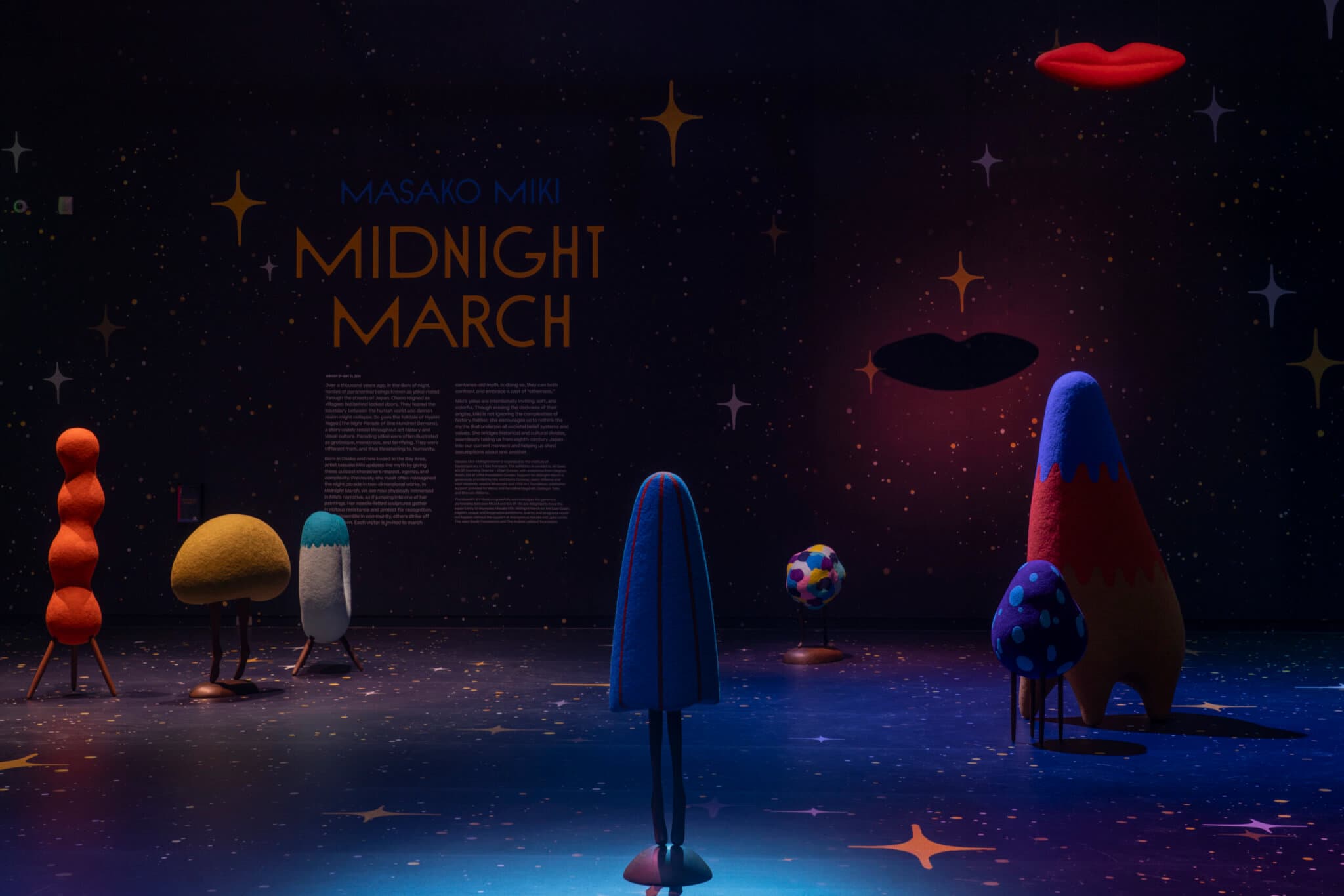
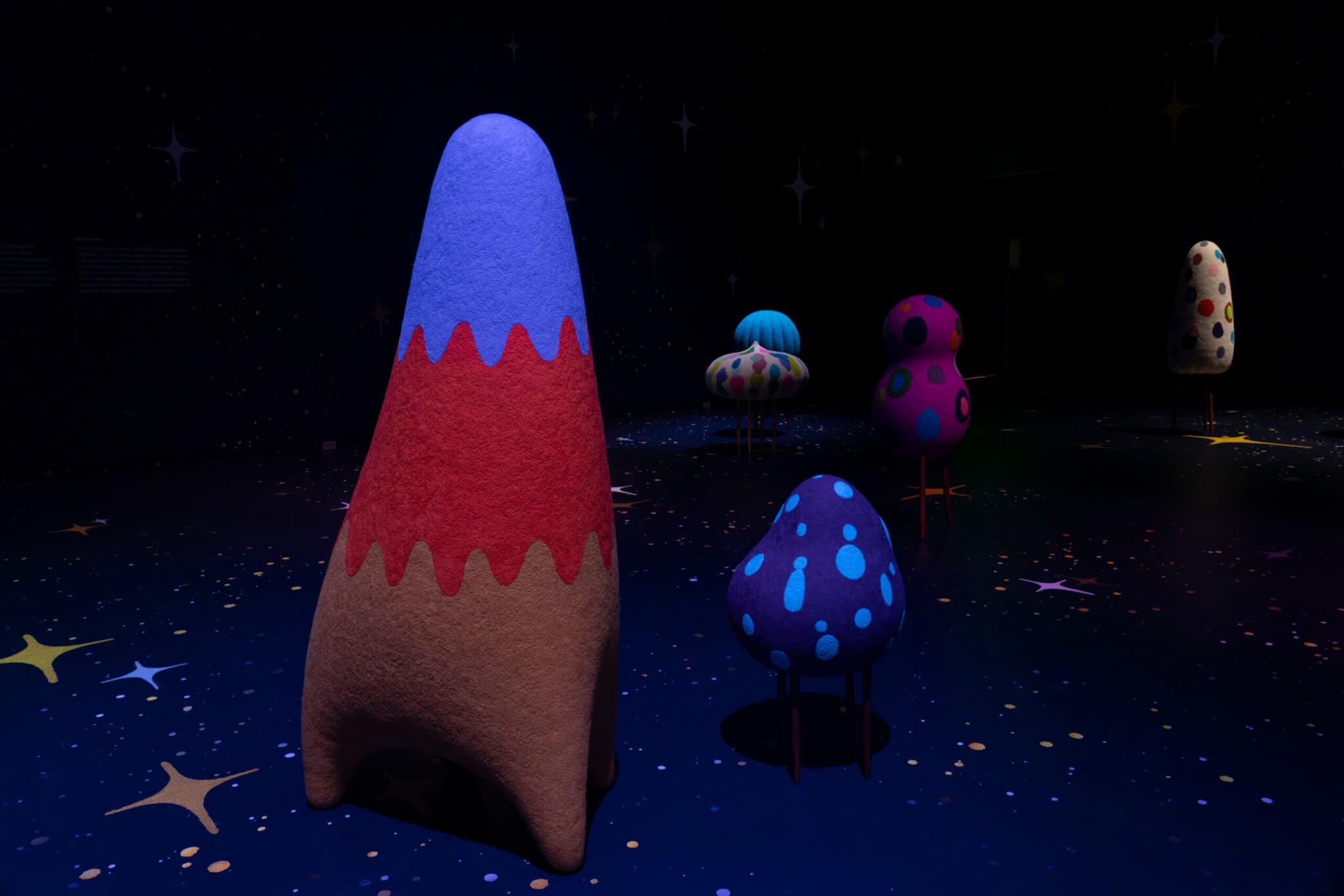
To view “Midnight March,” an installation by the artist Masako Miki at MassArt Art Museum, one ascends from the bright lobby to a darkened space on the floor above. It is here that the titular march is taking place, though its participants are rather scattered and inert. The group assembled in the gallery is a selection of Miki’s human-sized felted wool sculptures, fabricated between 2018 and 2025. Those present include One Million-Year-Old Horse (2024), a faceless, four-legged creature sporting cartoonish tones of purple, orange, and mustard. Nearby is Umbrella’s Whispers (2025). The umbrella in question is lightly anthropomorphized, its handle replaced with two demure wooden legs standing on tiptoe, its closed blue canopy drooping toward the floor like a cloak.
“Midnight March” traveled to Boston from the West Coast, where it was first presented at the Institute of Contemporary Art San Francisco (ICA SF). Born in Japan, Miki currently resides in Berkeley, California, and in recent years her sculptures have been shown in a variety of Bay Area art institutions. The installation at ICA SF, described by the museum as “her largest presentation to date,” seemed a culmination of the artist’s steady work crafting a menagerie of plush, eccentric creatures.
Installation view, “Masako Miki: Midnight March,” MassArt Art Museum, Boston, MA, 2026. Photo by Robin Jamkatel. Courtesy of MassArt Art Museum.
Miki draws heavily from Japanese folklore in both her sculptures and paintings, toying with a set of mythic characters who recur across her work. “Midnight March” riffs on the story of Hyakki Yagyō, which tells of a nocturnal procession of yōkai (spirits or demons) who have slipped into the world of the living. The ghostly parade of yōkai has been a popular motif in Japanese art for centuries, but unlike many traditional renderings of the subject, Miki’s phantoms are benign-looking creatures with nary a horn or fang in sight. They are soft and smooth, polka-dotted and playful. They have globular, organic forms, suggesting mushroom caps, amoebae, or root vegetables. Most of the wool sculptures at MAAM stand on slender legs of dark wood that recall modernist furniture and its contemporary facsimiles. With their whimsical minimalism, the sculptures put me in mind of the colorful home goods found at MoMA Design Store, or the bulbous sofas sold by Roche Bobois. I imagined Miki’s creatures nestled in photogenic, expensively decorated living rooms, an impression that felt in tension with the works’ unearthly referents.
The bulk of the show is displayed in MAAM’s Stephen D. Paine Gallery, a vast, high-ceilinged, square-shaped room. Last year, it was in this gallery that the museum presented Nicholas Galanin’s “Aáni yéi xat duwasáakw (I am called Land),” an arresting installation involving a roboticized drum and video projections that commanded the large space it occupied. “Midnight March,” in contrast, feels sparse. Eighteen sculptures are spread out across the floor, mostly isolated from each other by a few yards of distance, though some stand near each other in uncertain companionship, proximate but not quite cohering into groups, illuminated by spotlights that beam down from above. Two sculptures—one taking the form of vivacious red lips, the other resembling a pair of dreamily closed eyes—are suspended from the ceiling. The only other presence in the room is the overly literal midnight blue wallpaper, which is splattered with the kind of four-pointed stars that make up the sparkle emoji and have come to symbolize the “magic” of artificial intelligence. MAAM’s website describes the installation as an “experiential world,” yet I didn’t feel that there was much world to experience.
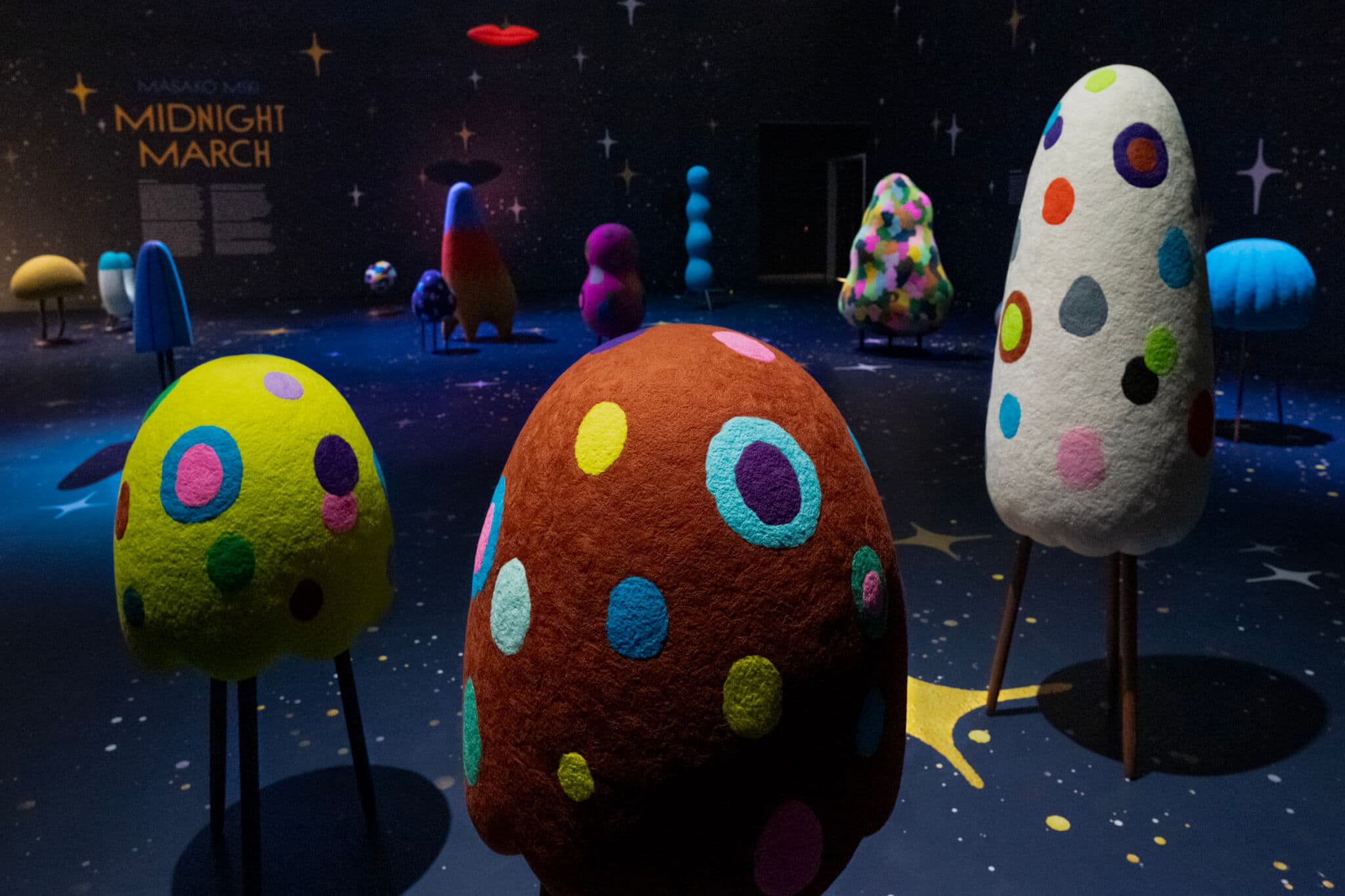
Installation view, “Masako Miki: Midnight March,” MassArt Art Museum, Boston, MA, 2026. Photo by Melissa Ostrow. Courtesy of MassArt Art Museum.
The exhibition continues in a small strip of gallery space overlooking the main installation from a floor above. Here, we see samples of Miki’s mythological lexicon rendered in other media. There are two watercolor paintings, completed last year, that bear the name of the exhibition. They render in two dimensions the gathering of spirits suggested by the felted sculptures, though they convey more verve than the cozy blobs downstairs. Both paintings show a melee of watery cerulean silhouettes set against an inky black void. Animals, plantlike shapes, and household objects jostle and squirm, their boundaries porous. These densely packed but fluid compositions are more suggestive of a lush spirit world than the sculptural installation, evoking the qualities Miki prizes in the shapeshifters of Japanese folktales and in Shinto animist beliefs. “They are never defined as one entity, as they are always in transition,” Miki has said of the ghosts and deities that inspire her practice.1
At the same time, Miki’s ghosts are certainly not camera-shy. The exhibition, with its bright forms set aglow by the spotlights, photographs well, almost too well: The experience of seeing the art in person is remarkably similar to looking at photographs of it. The works are cheerful and inoffensive to begin with, so the addition of high-contrast lighting and splashy wallpaper makes “Midnight March” feel especially optimized for Instagram transmission. The notion that Miki’s sculptures “gather in riotous resistance,” as MAAM’s exhibition guide asserts, seems a bit of a stretch.
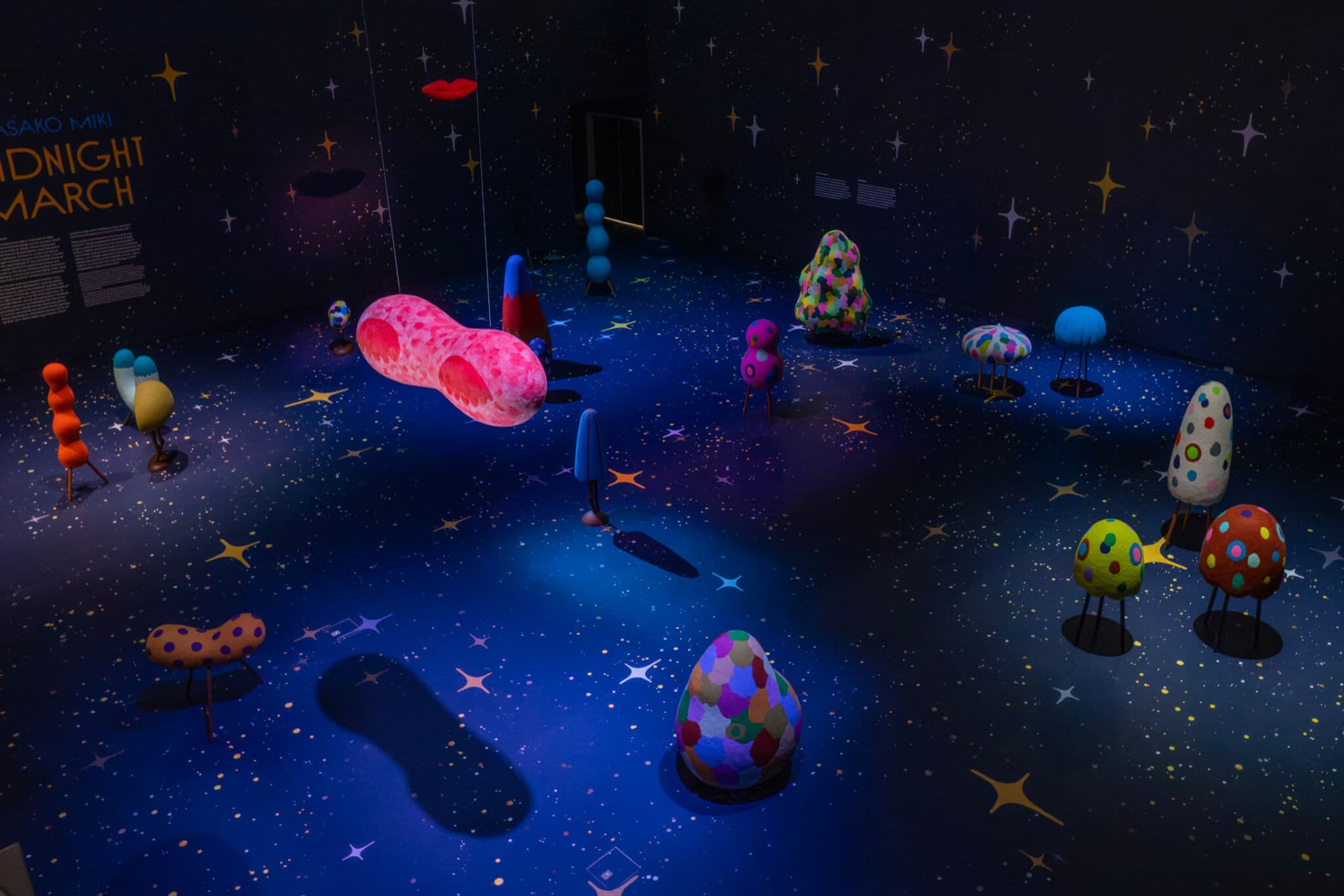
Installation view, “Masako Miki: Midnight March,” MassArt Art Museum, Boston, MA, 2026. Photo by Melissa Ostrow. Courtesy of MassArt Art Museum.
Ultimately, I found myself wishing that the sculptures had preserved more of the grotesquerie and malice of their source material. Because of their clean lines and good-natured appearances, Miki’s yōkai have turned out to be well suited to commercial spaces. Several years ago, Miki was commissioned to create a suite of sculptures to adorn the walkways around Uber’s San Francisco headquarters, a project which found the artist rendering her affable beings in painted bronze, slick and shiny like the buildings which loom behind them. Other recent commissions include a window display for a Hermès store in Tokyo’s Ginza shopping district, and, back in San Francisco, a wall installation at the Chase Center, a sports and entertainment arena. The way Miki’s characters easily integrate with corporate aesthetics is hard to square with the idea of these figures as emblems of “otherness,” as the curators at ICA SF and MAAM would have it. In the watercolor paintings, one might see similarities to the “Corporate Memphis” illustration style that has dominated tech industry graphic design for the past decade, giving us hoards of flat cartoon people whose curving limbs wiggle with empty optimism. “Midnight March” celebrates Miki’s shapeshifters for the way they resist categorization and break down boundaries, but it is worth remembering that fluidity is also a guiding principle in the visual vocabulary of big tech, an aesthetics which prioritizes compatibility across devices, frictionless interfaces, and mass appeal. Defanged and mollified, the woolen creatures at MAAM cast off their monstrous origins, eager to install themselves in the sanitized terrain of the digital image economy.
—1 Kristin Farr, “Masako Miki: The Mighty Shapeshifter,” Juxtapoz, December 19, 20219, https://www.juxtapoz.com/news/magazine/features/masako-miki-the-mighty-shapeshifter/.
“Masako Miki: Midnight March” is on view through May 31, 2026, at MassArt Art Museum, 621 Huntington Avenue, Boston, MA.