This review originally appeared in Issue 16, published May 16, 2026. You can read this piece and more by purchasing a copy of or subscription to the magazine here.
One catches glimpses of artist Edmonia Lewis’s personality in her cartes de visite, the portraits she would leave behind as calling cards. There’s the gentle lift of the lips that suggests a sense of humor, a gaze that is both playful and shrewd. A confidence, too, that says don’t you dare question this power, a radiance that blazes beneath the still frame.
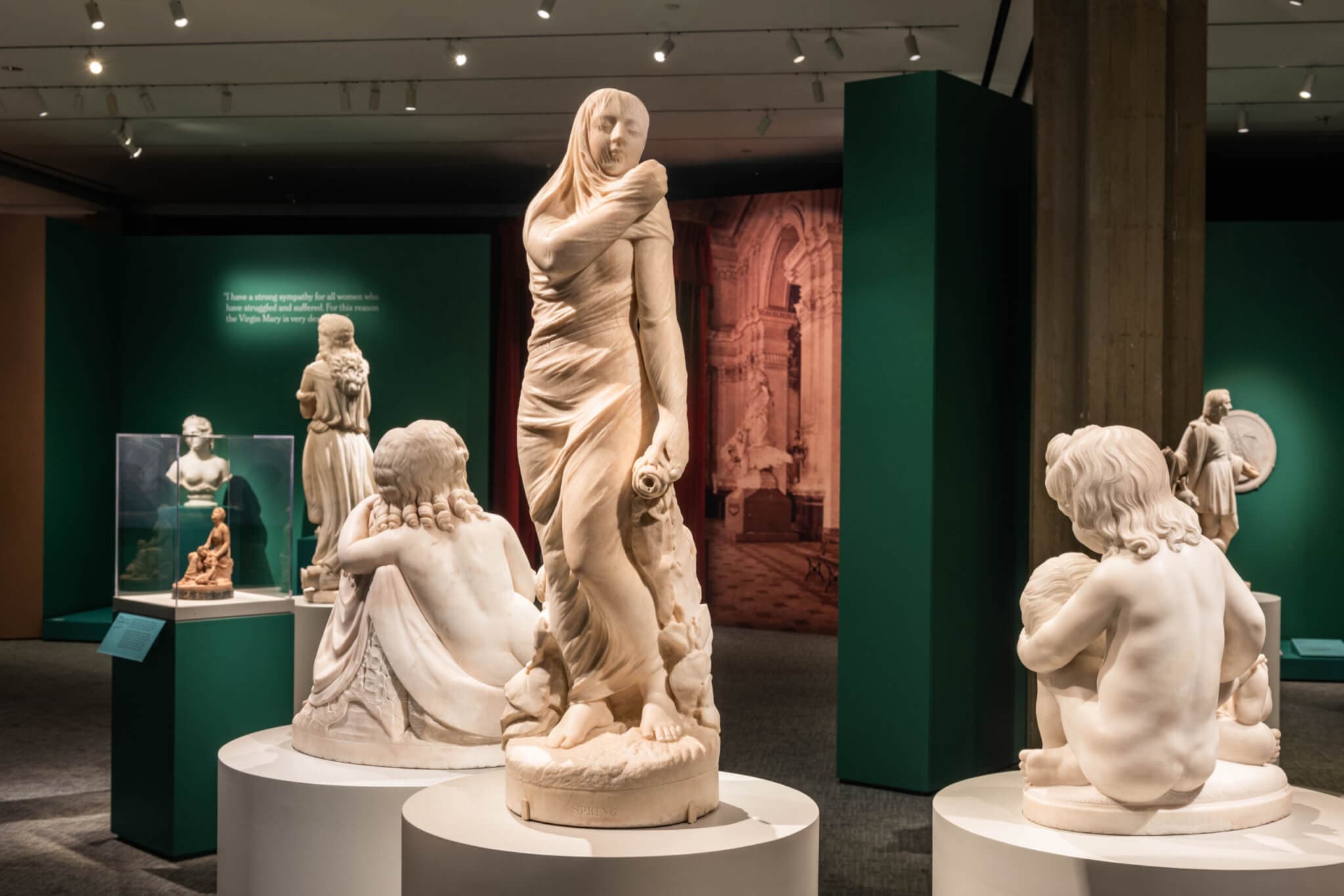
“Said in Stone,” the first comprehensive exhibition of Lewis’s work, on view at Peabody Essex Museum (PEM) until June 7, reckons with Lewis’s power—what she once described as “an unconquerable energy” that commanded “the respect and honor of all true lovers of art”—and her singular status as the first Afro-Caribbean and Indigenous sculptor to gain international recognition. Despite the recognition she achieved during her lifetime, Lewis died in relative obscurity, and many of her works remain lost. “Said in Stone” thus positions itself as an “ongoing project of recovery” that endeavors to create a cohesive narrative from fragments—a hefty proposition.
A traveling exhibition, “Said in Stone” was co-organized by PEM and the Georgia Museum of Art at the University of Georgia, where it will stop next, before concluding at the North Carolina Museum of Art. Co-curated by Shawnya L. Harris, Lydia Peabody, and Jeffrey Richmond-Moll, with guidance from Karen Kramer, the Stuart W. and Elizabeth F. Pratt Curator of Native American and Oceanic Art and Culture, “Said in Stone” features thirty sculptures by Lewis alongside eighty-five additional paintings, photographs, sculptures, and artifacts. The inclusion of the latter, meant to contextualize Lewis’s life and elaborate on the communities, traditions, and political movements that influenced her work, makes for a dense and at times overwhelming viewing experience. Why couldn’t—ironically, given the exhibition’s title—Lewis’s sculptures speak for themselves? Did each of the eighty-five other pieces offer necessary context or were some of them there to validate Lewis’s oeuvre? At times their inclusion weighed down her works, and I found myself wishing they had more room to breathe. I couldn’t help but feel as though the exhibition was trying to cover too much ground all at once, perhaps burdened by the pressure that comes with a major retrospective of a historically significant artist, especially if that artist is deemed “the first” of his or her kind.
“Said in Stone” organizes Lewis’s works into five overarching themes, each with its own section: Antislavery and Emancipation, Indigenous Artistic Worlds, The Studios of Rome, How Edmonia Lewis Became an Artist, and Religion, Mythology, Transcendence. Upon stepping into the first section, Antislavery and Emancipation, one’s eyes scan a number of works before settling on one of Lewis’s most notable sculptures, Forever Free(1867), which depicts a man and woman moments after their emancipation. The woman, whose hands are clasped in prayer, kneels but looks as though she is about to stand. The man triumphantly raises a fist in the air while his other hand rests on the woman’s right shoulder, a gesture that emphasizes the kinship between them, a reclamation of the bonds chattel slavery so often ruptured. Contrary to typical representations of emancipation that depict white men freeing the enslaved, the pair break their own shackles. Lewis gives them agency, presenting them not as passive recipients of freedom but active participants in their own liberation.
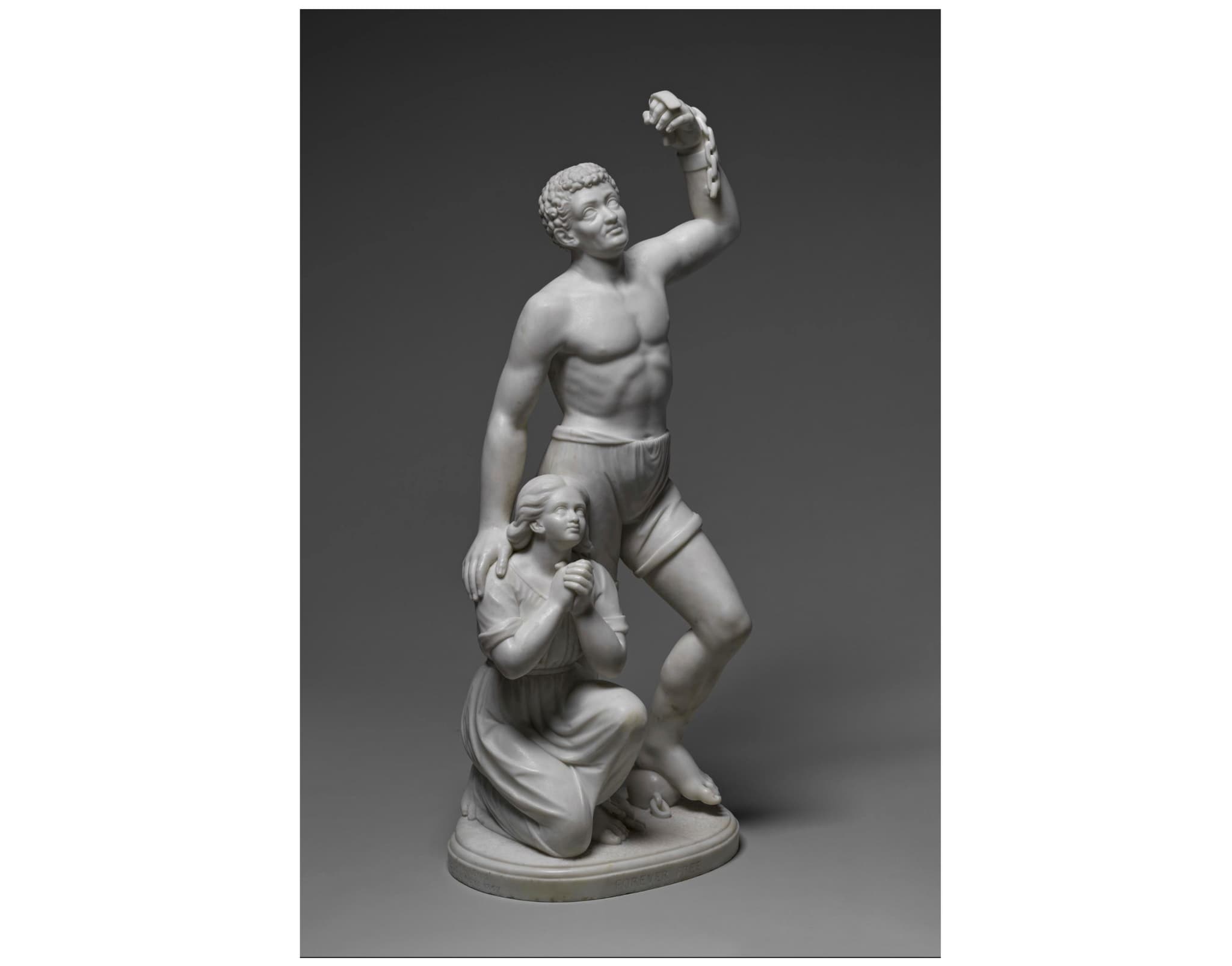
Edmonia Lewis, Forever Free, 1867. Carrara marble. Howard University Gallery of Art, Washington DC / Licensed by Art Resource, NY. Photo: The Metropolitan Museum of Art.
Beside Forever Free is Sargent Claude Johnson’s wooden sculpture of the same name, created sixty-six years later, in which a Black matriarch presses two children close to her sides. She is their protector, their first line of defense. Her eyes are hopeful, her expression graceful and sanguine. Her lifted gaze mirrors the uplifted faces of the figures in Lewis’s Forever Free and that of a kneeling enslaved woman in chains engraved on a copper medallion installed across from the two sculptures. The medallion bears the phrase “Am I Not a Woman and a Sister?” Widely circulated in the 1830s, this image became an emblem of the abolitionist movement, an appeal meant to evoke empathy and persuade white audiences of Black women’s humanity. And while the woman in Johnson’s Forever Free is unmistakingly Black, the female figure in Lewis’s sculpture is racially ambiguous. Together, these three works create a compelling triangulation that raises questions about how Lewis chose to represent Black women, the limited visual conventions that were available to her, and how she reconfigured classical forms.
Antislavery and Emancipation includes busts Lewis created of prominent abolitionists and patrons—Robert Gould Shaw, Dr. Dio Lewis, Maria Weston Chapman, and Ednah Dow Littlehale Cheney—as well as her bust of Abraham Lincoln, whose heavy brows and piercing gaze are immediately recognizable. Lewis moved to Boston in 1863 after meeting Frederick Douglass at Oberlin College, where he encouraged her to “seek the East.” There she was embedded in a network of activists, abolitionists, and social reformers who commissioned and helped Lewis sell her work. These relationships nurtured Lewis’s artistic development and sustained her career.
Born to a Black father and a mother who was both Black and Indigenous, belonging to the Mississauga tribe, Lewis was orphaned at a young age and raised by her maternal aunts in present-day Ontario. Lewis’s aunts taught her how to weave and create beadwork, and she would accompany them during trips to souvenir markets at Niagara Falls and Watkins Glen, where they sold their work. “Said in Stone” pays particular attention to how Lewis’s Indigenous upbringing informed her practice. Within the section Indigenous Artistic Worlds are a number of Anishinaabe and Haudenosaunee objects that underscore the craftsmanship and sculptural traditions of First Nations cultures. Surrounding Lewis’s sculptures Hiawatha’s Marriage (1866/1870) and Old Indian Arrowmaker and His Daughter (1866/1867), inspired by Henry Wadsworth Longfellow’s poem “The Song of Hiawatha,” are vitrines that display various objects, including a pair of moccasins, a pipe bowl, a walking staff, a bowl, a feast ladle, dolls, a baby carrier, and a ceramic and wood sculpture titled Singers (1984–85) by Onondaga artist Peter B. Jones. While these works illuminate how Lewis emphasizes Indigenous artistry in the aforementioned works—in Old Indian Arrowmaker and His Daughter, Minnehaha braids a mat of rushes while her father carves an arrowhead—there’s a touch of the ethnographic, a curatorial choice that threatens to affix Indigeneity in the past.
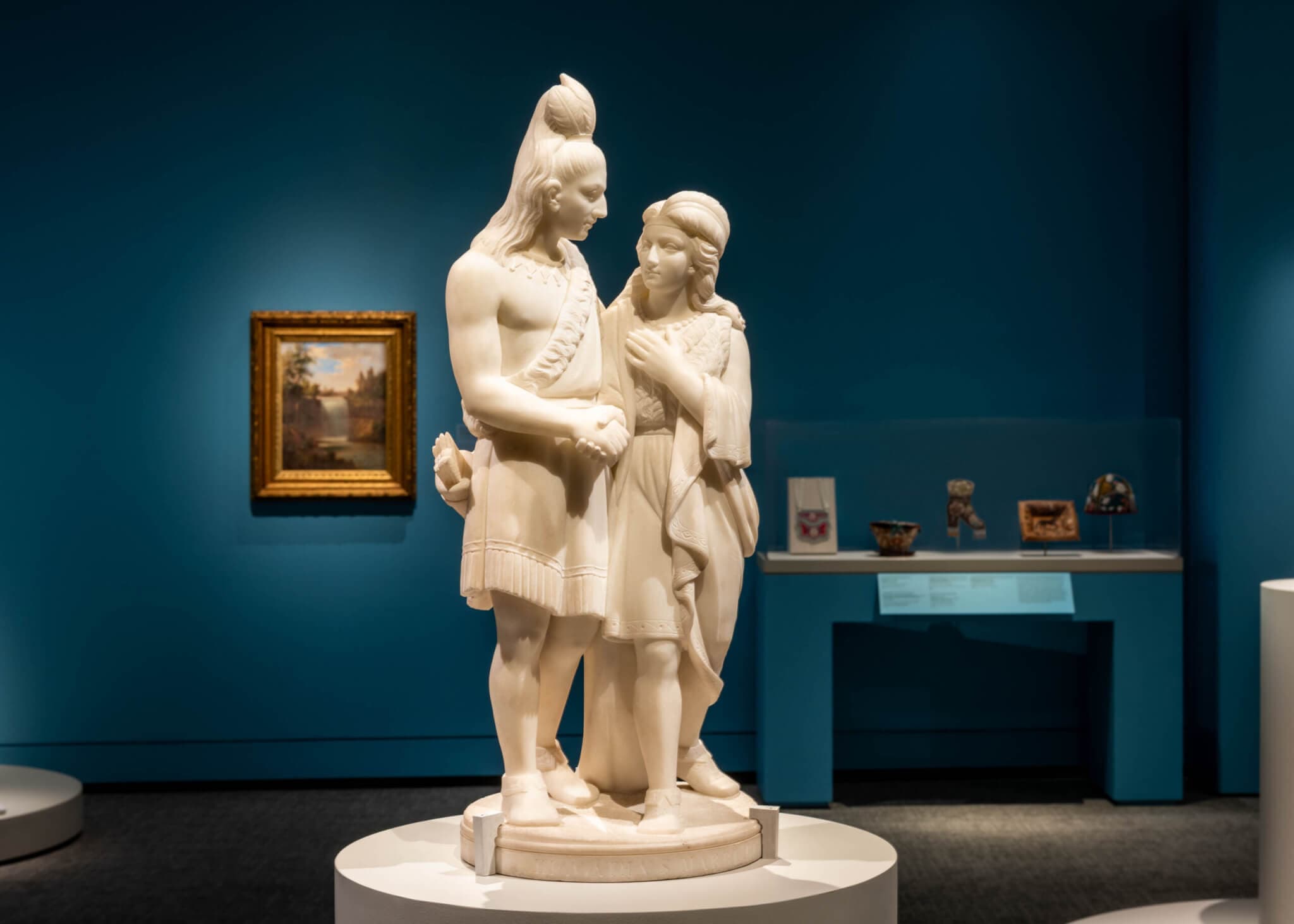
Edmonia Lewis, Hiawatha’s Marriage, modeled 1866, carved 1870. Installation view, “Edmonia Lewis: Said in Stone,” Peabody Essex Museum, 2026. Photo by Kim Indresano. Courtesy of Peabody Essex Museum.
The inclusion of Writing Home, Letter to Sandy (2025), a diptych by Bonnie Devine, a member of the Serpent River First Nation, is a welcome foray into the contemporary. On the left side of the diptych is a giclée print of water and stone, the right an excerpt of a story layered over a watercolor drawing of a natural landscape. The work functions as a record of the ongoing dialogue between Devine and the natural landscape, one that enriches our understanding of Lewis’s relationship to marble beyond its classical associations.
The third section of the exhibition, The Studios of Rome, covers Lewis’s time in Rome, a period of immense growth. With financial support from her brother Samuel, Lewis immigrated to Italy in 1865, for “the land of liberty had no room for a colored sculptor.”1 After arriving in Rome, Lewis moved into a studio once occupied by the Italian sculptor Antonio Canova, a master of neoclassical sculpture. The exhibition attempts to bring Lewis’s studio to life through a series of stations that model how Lewis would have created Old Arrow Maker(1866/1872) and sheds light on the intense labor involved in producing her sculptures.
Rome gave Lewis the opportunity to deepen her understanding of classical art and mythology, knowledge that influenced works like Bust of Augustus (1800s), modeled after Canova’s portrait of the Roman emperor. Yet Lewis remained anchored in the United States, continually drawing inspiration from its defining figures and contemporary political struggles in works such as Forever Free and busts of abolitionist John Brown and poet Henry Wadsworth Longfellow.
The influence of religion and mythology on Lewis’s practice can be seen in works such as Hagar (1875) and Moses (After Michelangelo) (1875), allusions to Biblical figures that represent ideas of freedom and spiritual transcendence. Lewis’s version of Moses is contemplative and restrained, and her mastery of form is on full display. Seated, Moses appears regal and resolute. His flowing robes are crafted with ultimate precision, the curls of his hair and beard rendered in exquisite detail. Next to Moses is Noah’s Ark (1927) by painter Aaron Douglas, which bears his characteristic flattened, layered perspective and muted tones. The pairing indicates the significance of biblical narratives within African American communities and their function as vital expressions of endurance, hope, and survival.
Although Lewis’s career flourished in Rome and later Paris and London, recognition of her significance waxed and waned after her death in 1907. Without an archive, studio, or descendants to preserve her work, many of her sculptures wound up in unexpected places. Yet Black scholars, women’s organizations, and HBCUs kept Lewis’s legacy alive, including her art in exhibitions and acquiring works for their collections. A short wall text briefly references these efforts, a moment in the exhibition that would have benefited from further elaboration, as they were critical to preserving Lewis’s contributions across generations.
“Said in Stone” closes with two works from artist Gisela Torres: Conjure No. 3 (2020) and Reverie and Slumber(2020), both from her series Looking for Edmonia (Self-Portrait) (2018–22). Conjure No. 3 is a photograph of Torres in Rome printed on marble. Moved by the knowledge that she passed by Lewis’s gravesite for years without knowing, Torres uses critical fabulation to fill in the gaps the historical record has left behind.2 In the video Reverie and Slumber, Torres wanders through the streets of Rome as she attempts to retrace Lewis’s footsteps, imagining the places Lewis once roamed. This footage is layered with projections of plaster casts Torres made of her own head. Torres sings Peggy Lee’s melancholy “Is That All There Is?” as we hear footsteps and the sound of a chisel striking marble. She calls out to Lewis, an evocation that collapses time and space.
Lewis’s ability to satisfy public expectations while resisting and subverting the racial and cultural assumptions imposed on her suggests she was a savvy shapeshifter who refused to be defined in limited terms. As I exited “Said in Stone,” I wondered what it would look like to unburden Lewis from her singularity. What would it mean to let her remain elusive, to untether her from being a First? The exhibition, and museum writ large, could never express the breadth of her artistic practice. Perhaps a more truthful representation would let her remain elusive, fugitive, impossible to pin down.
—1 “Why Miss Edmonia Lewis, the Colored Sculptor, Returns to Rome—Her Early Life and Struggles,” New York Times, December 29, 1878, 5, https://timesmachine.nytimes.com/timesmachine/1878/12/29/81739789.html?pageNumber=5.
—2 Saidiya V. Hartman, “Venus in Two Acts,” Small Axe, Vol. 12, Iss. 2 (June 2008), 1–14.
“Edmonia Lewis: Said in Stone” is on view through June 7, 2026 at Peabody Essex Museum, 161 Essex Street, Salem, MA.