While scarcity politics alienates people from communities and extractive capitalism wreaks ecological havoc on the planet, two arts events, Walk&Talk Biennial and Fabric Arts Festival, together propose another rhythm: one of gathering, generosity, and connection across the Atlantic.
In 2016, when Michael Benevides, owner of the Portuguese import market Portugalia in Fall River, visited Walk&Talk on São Miguel, one of the nine islands that make up the Azores archipelago, he was struck by the festival’s vitality. He wondered how something similar might work in Fall River, a city “often referred to as the tenth island of the Azores because of its large Azorean diaspora community,” he noted in an interview. “A lot of the festivals that took place in Fall River were traditional, or oftentimes religious,” Benevides explained, continuing, “No one was paying attention to the contemporary art scene that was developing in the Azores. [Fabric Arts Festival] was an attempt at bringing contemporary Azorean and Portuguese culture to the diaspora, and also to connect with second and third and fourth generation Portuguese.”
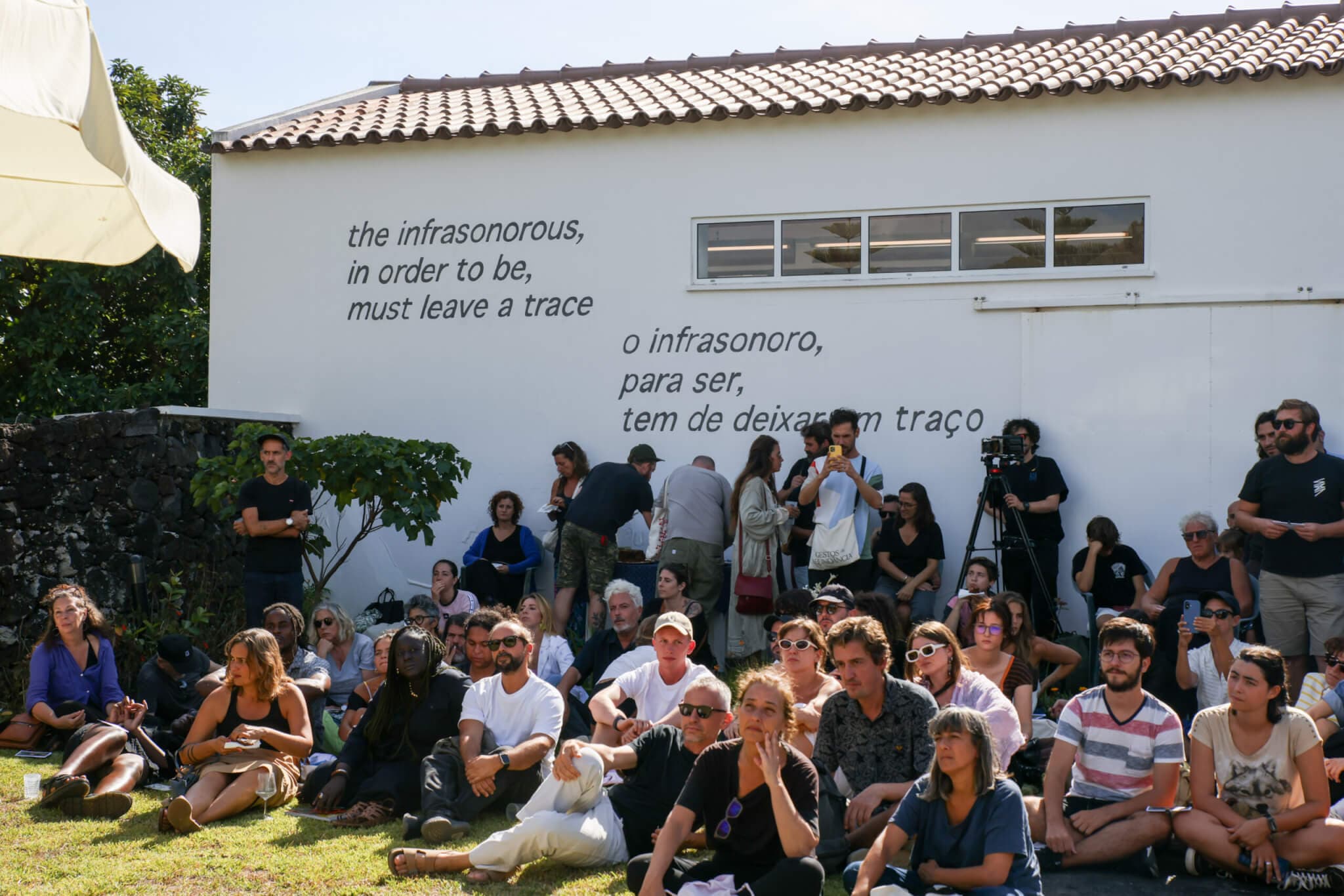
Attendees gather for the opening of the 2025 Walk&Talk Biennial, Gestures of Abundance: Centro Cultural da Caloura. Writing on the side of the building is part of Lucy Bleach’s An Infrasonours archipelago, 2025. Photo by Mariana Lopes. Courtesy of Jesse James.
The visit to his family’s home island of São Miguel prompted Benevides to recognize the limitations of the North American narratives of the Azores he had heard since immigrating as a young child. This realization led Benevides to invite Jesse James, creative director of Walk&Talk, and his colleagues, Sofia Carolina Botelho and António Pedro Lopes, to visit Fall River and envision a festival that could connect the archipelago and its diaspora. Together, they co-founded Fabric Arts Festival, now organized by Casa dos Açores de Nova Inglaterra under James’s artistic direction and with Benevides’s support.
“I felt that we can try to bridge these two places across the Atlantic,” said James, “but it needs to be broader than that. It should be about movement—of diasporas and what they contain.” Since James and his collaborators first brought artists to Walk&Talk and Fabric, the movement of ideas and people remains an essential strategy for reframing the Azores and Fall River from peripheral to central points from which networks and globally relevant cultural dialogues can emerge through the arts.
Fall River, long overshadowed by Boston and Providence, has struggled economically since the textile industry relocated overseas. Since 2019, the Fabric Arts Festival has pushed against that marginalization by animating the city through gathering and cultural exchange facilitated by artistic programming.
This October marked Fabric’s sixth edition, with programming expanding into multiple Providence locations including ODD-KIN gallery, arts nonprofit AS220, and Brown University, where Henrique Ferreira and Diogo Lima led a talk and listening session on Calafonas, their research project on overlooked disco and pop traditions of Portuguese-Azorean musicians in the 1970s and ’80s.
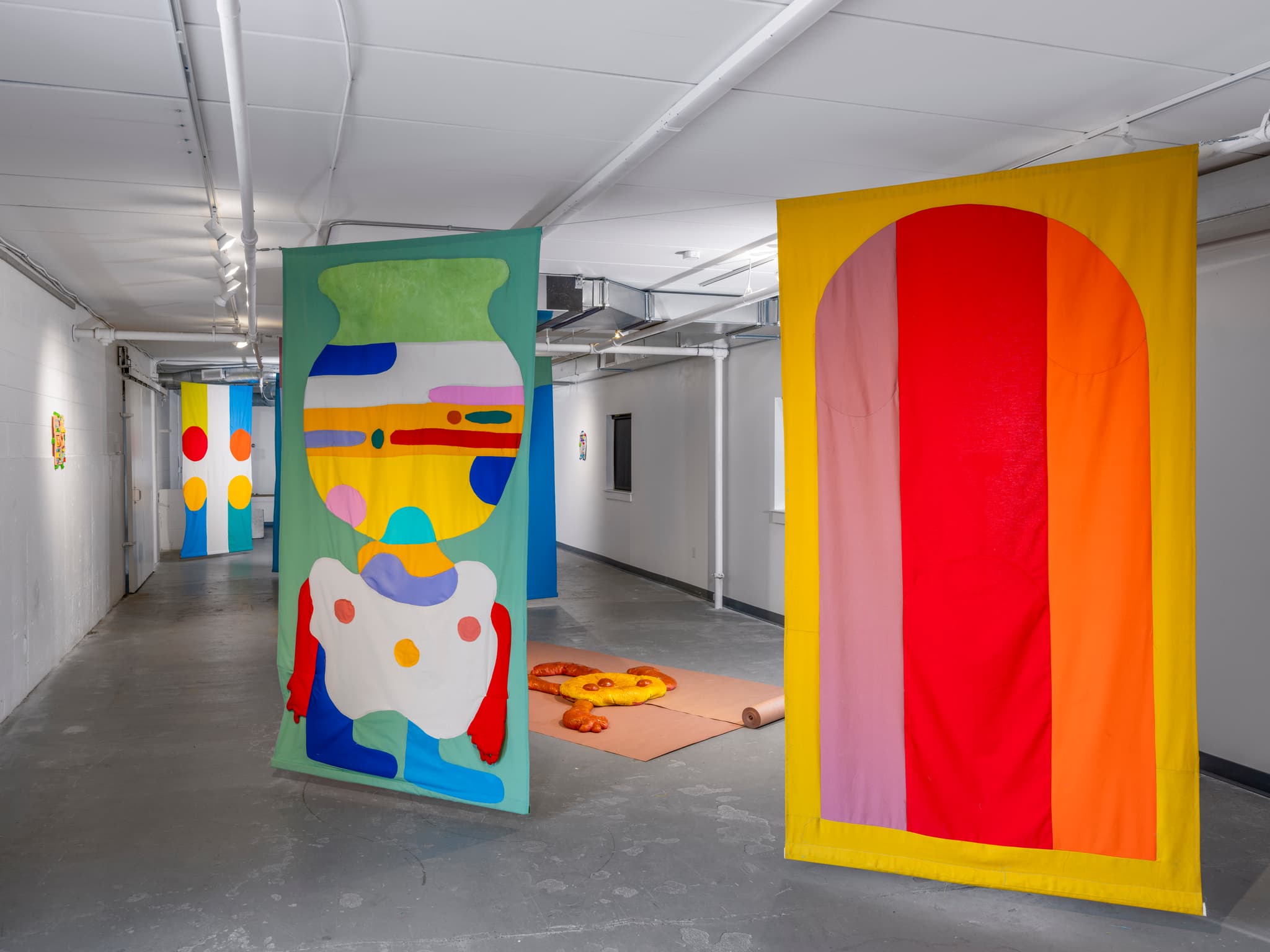
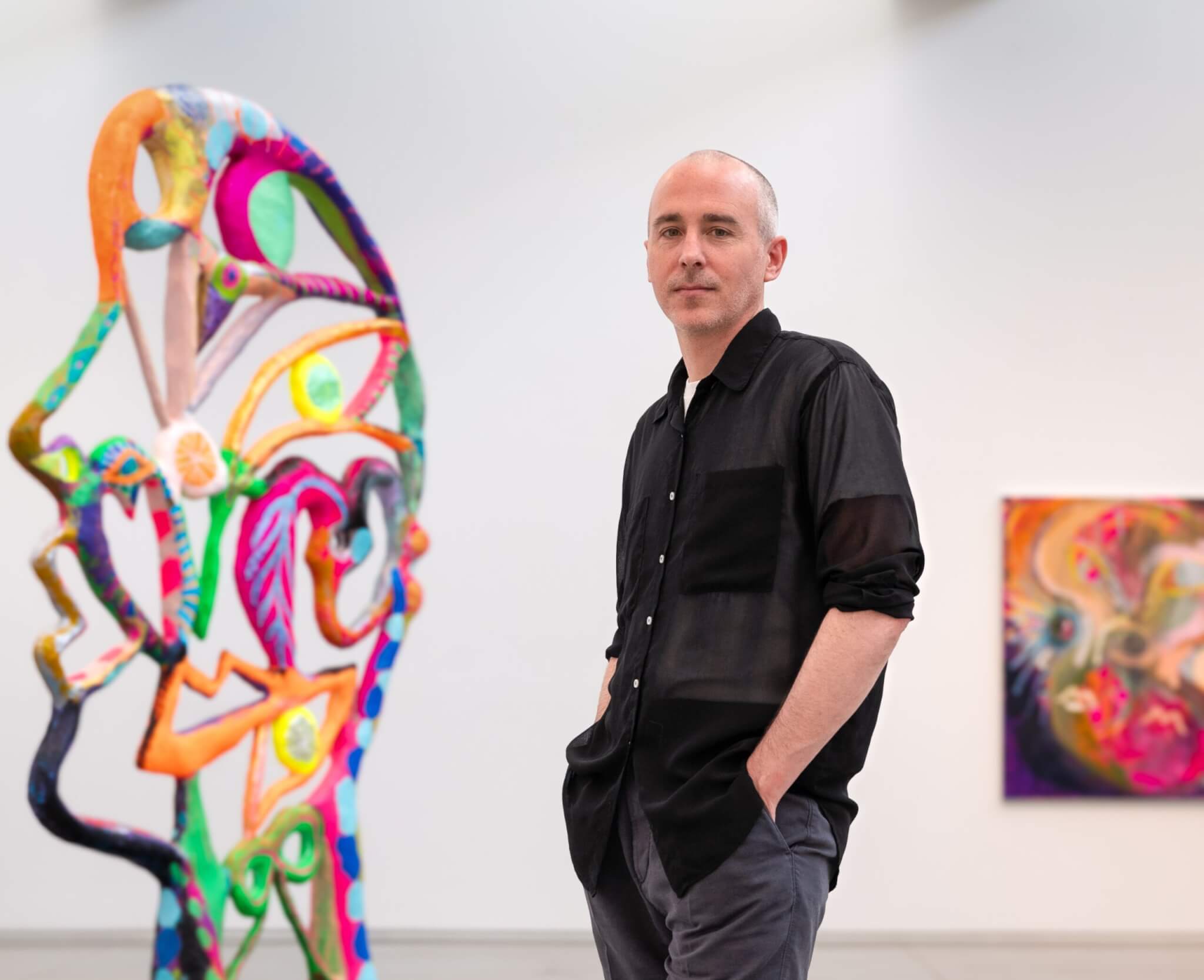
Installation view, Hugo Brazão, “Loafhead,” ODD-KIN, Providence, RI, 2025. Photo by Rafael Medina. Courtesy of Jesse James.
Among the festival’s nine presentations in nine locations, highlights included Crosscurrents/Contracorrentes, a performance at AS220 by Daniel Wyche and Matthew Azevedo combining Atlantic field recordings from the Azores and New England with images of the islands projected onto domestic curtains—turning sound into a map of shared distance and resonance. Another highlight was the opening of “Post Scarcity Sculpture” organized by Fall River MoCA, which features the work of four artists and one sound artist-in-residence who reworked technological detritus into “future antiques” that envision a world liberated from the artificial scarcity imposed by capitalism. Opened in 2020 during the second Fabric festival, thanks to seed funding from Benevides, the artist-run exhibition space was founded by artists Brittni Ann Harvey—whose mother is from the Azorean island São Jorge—and Harry Gould Harvey IV.
“Initially the festival was designed to showcase contemporary art that was coming from Portugal and the Azores,” Benevides noted, “but there was, from inception, an attempt at connecting with local artists that are doing work in the area. It would be very sort of disingenuous of us to just bring in foreign artists and not pay any attention to the local artists. So there was always a deliberate attempt at showcasing the makers and the artists that existed.”
Often, local and visiting artists team up to create food and music experiences that Fabric’s core language of gathering. Early editions featured contemporary reinterpretations of Fado; later programs expanded into jazz, experimental ambient, and dance sets by musicians of the Lusophone and African diasporas. This year, the closing night took place at Crib, a Providence nightclub co-founded by Cape Verdean–American DJ Jason Almeida who was joined by artists from Lisbon, Brazil, and LA. The night before, Back for a Beat of Saudades, a banquet-scale dinner collaboration with food made by Azorean chef Hugo Ferriera and DJ sets from Calafonas, filled Fall River’s historic Cultural Center. The intimacy of these gatherings—bringing contemporary art and diaspora communities together in ways large institutions often struggle to do—mirrors Walk&Talk’s ability to bridge experiences across scale and distance.
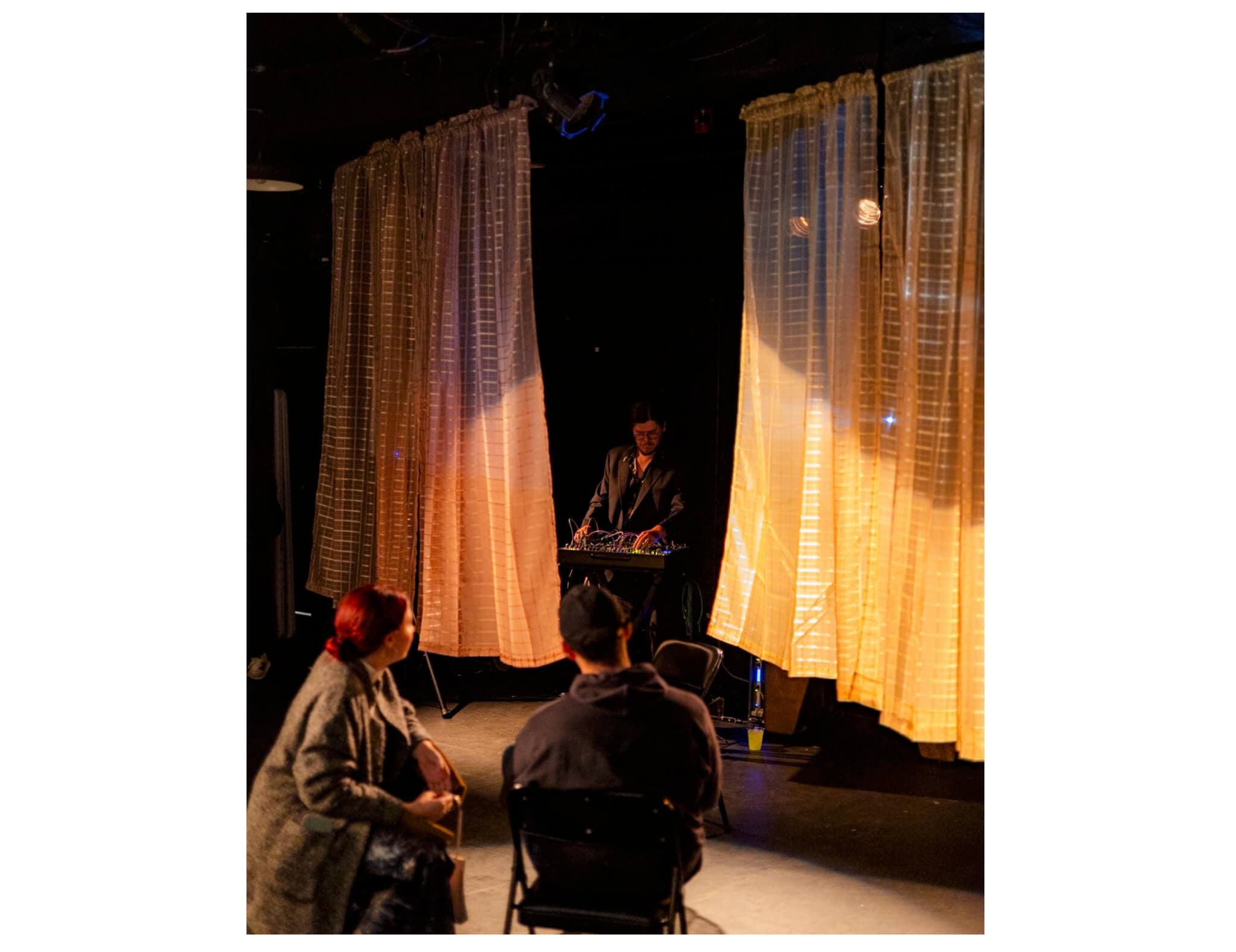
Daniel Wyche and Matthew Azevedo perform Crosscurrents/Contracorrentes at the 2025 Fabric Arts Festival. Photo by Rafael Medina. Courtesy of Jesse James.
Both founded in 2011, Walk&Talk and its commissioning organization, cultural association Anda&Fala, have become a transformative force in the Azores. Together, they challenge long-held perceptions of isolation, scarcity, and immobility in the Portuguese island regions of the Azores, which, along with Madeira, are considered “ultra-peripheral” or “outermost regions,” designations used by the EU Parliament to describe regions that “qualify for special treatment owing to structural difficulties”—like remoteness—which create economic, social, and security challenges to governance and development.1
After more than a decade of annual summer editions, Walk&Talk returned this year with a biennial format. Running from the end of September through November 30, this year’s title, “Gestures of Abundance,” indicated the project’s overarching curatorial theme.
“Gestures of Abundance” presented exhibitions, performances, interventions, and installations at more than fifteen sites across São Miguel’s coastal, municipal, and rural landscapes.
The curatorial team—James, joined by Fatima Bintou Rassoul Sy (Dakar), Claire Shea (Toronto), and Liliana Coutinho (Lisbon)—asked the central question: How might we shift our perception of scarcity to one of cooperative abundance?
When I spoke with James, he reflected on the question’s relevance to Anda&Fala: “Everything that we’ve been doing collectively has been this act of repelling a narrative of scarcity in the Azores—that there’s no space, no art, that there’s no interest. Instead, we wish to show what’s already here, what exists, and what can move and be said from this place.”
In doing so, “Gestures of Abundance” renews the festival’s ambitions to reframe the archipelago’s stigma as an ultra-peripheral territory. The archipelago, situated deep in the North Atlantic, shifts from dense forests and crater lakes to lava fields and geothermal springs. São Miguel, the largest and most populous island, serves as Walk&Talk’s primary stage. Despite increasing tourism, the Azores remains the region with the highest poverty rate in Portugal. “Gestures of Abundance” repositions the archipelago as a rich ground for artistic and social practice, generating ecological, communal, and planetary possibilities.
“When we say that abundance is a political position,” James said, “it’s in these gestures that are sometimes very invisible and can’t always be seen in an exhibition. This is equally important for us.”
James reflected that he and Walk&Talk co-founder, Diana Sousa, didn’t have a clear vision of what the festival would become as young adults seeking community, but a motivation to connect around art was there from the start. Growing up gay on a conservative, predominantly Catholic island can be isolating, but university programs for first-generation Azoreans enabled James to study in Lisbon.
“At that time, gay marriage had just been legalized, increasing acceptance. For me, Lisbon was mind-blowing nightclubs in Barrio Alto, a gay neighborhood, spaces like ZBD, an important contemporary art venue, movements in the streets, the anti-austerity protests.”

Meg Stuart, Sulphur Edges, 2025. Installation view, Walk&Talk Biennial, São Miguel, Azores, 2025. Photo by Mariana Lopes. Courtesy of Jesse James.
James and Sousa wanted to bring Lisbon’s civic energy and community home to São Miguel. A proposal to local and regional governments for one commissioned mural and a music performance soon evolved into an annual festival of murals across the capital, Ponta Delgada. Walk&Talk, titled for peripatetic encounters with art that the festival facilitates, expanded into a festival celebrating twenty mural commissions.
“We were young, it was the 2010s,” he said a bit apologetically. “Street art made sense: It was visible, accessible, and didn’t require much infrastructure. Remember, there were very few art spaces here.”
In fact, there were only two contemporary art spaces at the time—one being Caloura Cultural Center that painter and respected elder Tomaz Borba Vieira opened in 2005—yet James refutes the notion that the Azores lacked artistic life: “It’s important to remember that there were [always] artists here, often working in isolation, and sometimes through the dictatorship.”
The murals elicited excitement, and over the years, projects and partnerships expanded the forms of artistic interventions to exhibitions, excursions, and performances. Anda&Fala has earned substantial public trust through Walk&Talk. In 2016, the Azorean government designated Anda&Fala as a “Public Utility Entity,” giving it a policy designation similar to other essential public services like transportation and electricity. The full-time team of ten, which grows during Walk&Talk, now organizes residencies, exhibitions, programs, and youth arts education year-round.
Anda&Fala also advocated for policy changes to Portuguese legal frameworks, making it possible for artists and organizations in self-governed autonomous regions to apply for Portuguese national funds. Now, any artist or organization in these regions can apply.
It’s not always been easy. At one point, Anda&Fala received homophobic threats online. “It was scary to feel we could lose our grants,” James said, “but that fear made us professional. They could say we were gay—true—but never that we were irresponsible with public money.” Eventually, the fear of change dissipated. Now Anda&Fala also supports São Miguel Pride, securing funding and engaging the municipality to increase visibility. “I have distance now to see how important Walk&Talk has been, for lack of a better term, in normalizing these bodies, expressions, languages, in a context like São Miguel,” said James.
—1 Christiaan Van Lierop, “”Outermost Regions of the EU,” Think Tank European Parliament, May 5, 2020, https://www.europarl.europa.eu/thinktank/en/document/EPRS_BRI(2020)651918
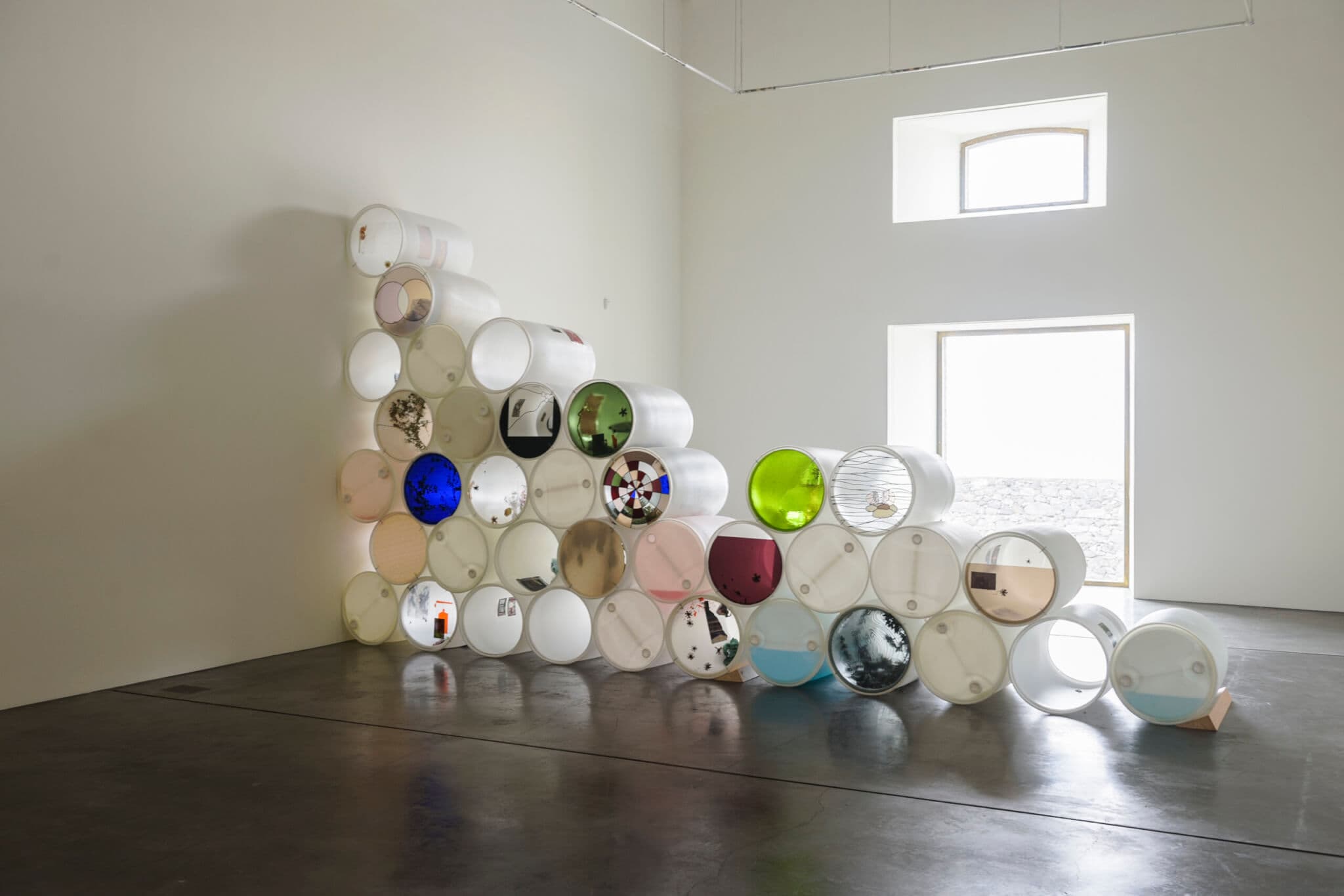
Nadia Belerique, Holdings, 2021–. Installation View, Arquipélago – Contemporary Art Center, Ribeira Grande, Azores, Portugal. Photo by Sara Pinheiro.
As Fabric develops, James hopes to expand exchange in both directions across the Atlantic. “If there are 1.3 million Azoreans and people of Azorean descent in the States and Canada, there are surely many artists among them. Fabric can be a kind of lighthouse for diasporas.”
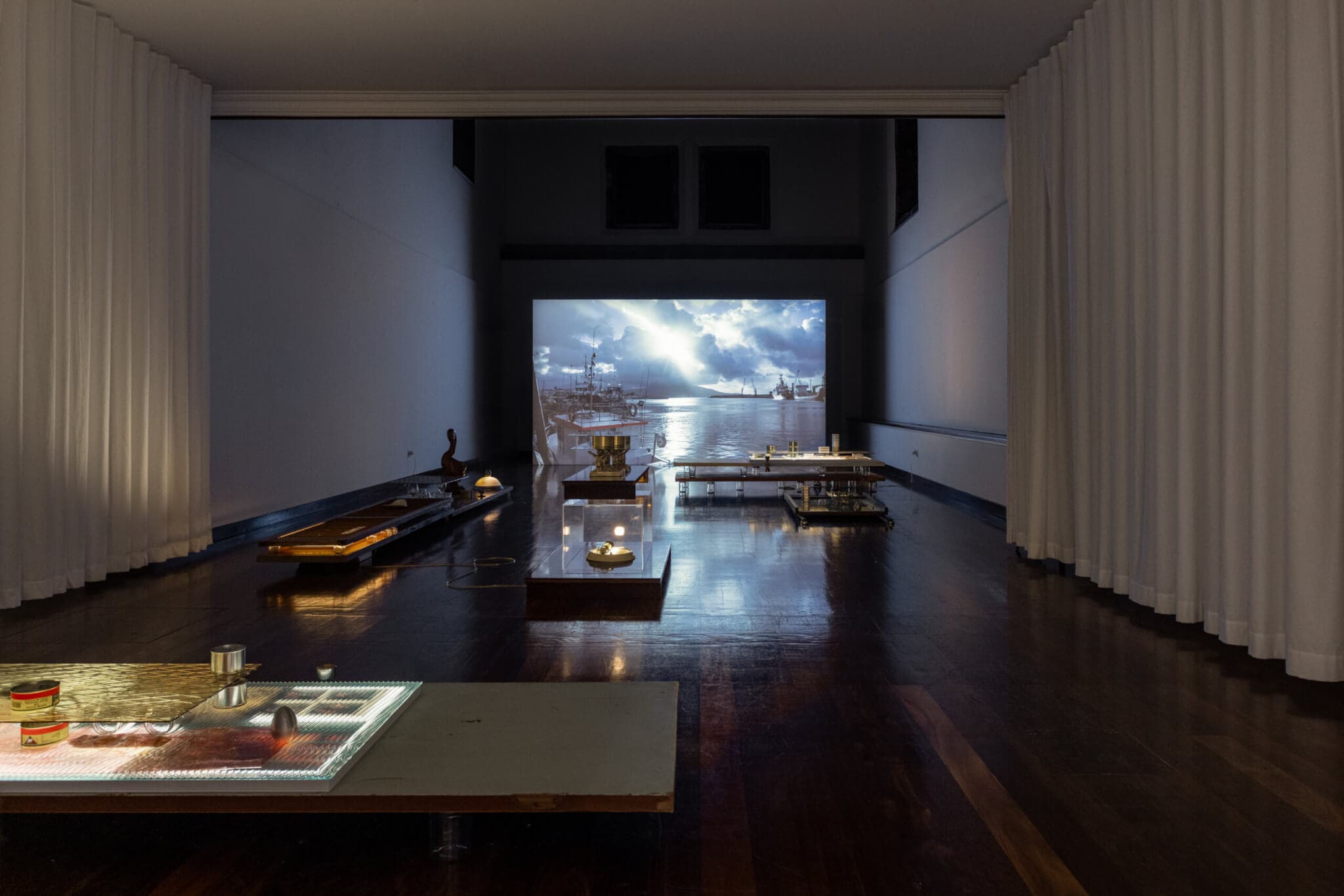
Artists like Nadia Belerique—one of several artists from Ontario featured in “Gestures of Abundance”—illustrate Walk&Talk’s growing constellation of connection with Azorean diasporas. Belerique’s parents emigrated from the Azores to Canada in the ’70s, but the first time she visited São Miguel was for her first Walk&Talk residency in 2019. She created Holdings (2021–), a modular sculpture made of stacked and altered plastic barrels, the kind commonly used to ship food, clothing, and other goods to family members in the Azores. The piece was shown during the 2021 Walk&Talk at Arquipélago Contemporary Arts Center, and later it traveled to Fall River for the 2023 Fabric Arts Festival. This year, her hypnotic film, LOTA (2025), created at the Ponta Delgada fish auction during her second residency, debuted with a group of works by artists who attend to the ocean, mapping a site of industry and catastrophe to abundant sustenance.
After over a decade of gathering people and conversation around art within the so-called peripheral sites of the Azores and Fall River, James has come to see how open-ended connections can shape both a community and an event. At the opening of this year’s Walk&Talk, he captured that ethos: “We offer a sense of hope during multiple crises, but we don’t have extreme expectations; the Biennial won’t save the world—but it can act as a hope spot for conspiring.”