This interview originally appeared in Issue 16, published May 16, 2026. You can read this piece and more by purchasing a copy of or subscription to the magazine here.
From afar, Chenlu Hou’s ceramics are bright, patterned, playful. Up close, first impressions break into detail: Chinese knots and eggplants dangle, brightly colored zip ties spike perimeters, jutting forms resolve into corn stalks, and faces appear where you don’t expect them. The artworks feel almost animate, like they’re pulled from folklore or the half-legible space of dreams, where the line between familiar and surreal becomes porous. Drawing from everyday forms, memory, and shared visual references, Hou renders these objects with a striking symmetry and precision rooted in Chinese paper cutting and traditional practices. These references don’t read as citations. They structure the work from within.
Born in Shandong, China, and now based in Providence, Hou received her MFA from RISD in 2019 and has since completed residencies at MASS MoCA, the Museum of Arts and Design, Penland, Houston Center for Contemporary Craft, and the Archie Bray Foundation. Her work has been shown internationally, and she currently serves as a visiting critic at RISD and a resident artist at Harvard Ceramics. “What the Hands Remember to Hear,” on view at Connecticut’s Aldrich Contemporary Art Museum through May 25, places her work in dialogue with that of artist Chiara No. The exhibition unfolds as a sensory field where form, color, and resonance evoke ceremony, remembrance, and the ways cultural knowledge is carried through storytelling.
Hou’s understanding of art began in proximity to her father’s calligraphy practice, to her mother’s intricately knitted sweaters, to paper offerings burned during festivals. In Chinese culture, meaning is inherently layered—at once poetic and practical, shaped by history, spirituality, folklore, and myth, and embedded across all aspects of life from the macro to the micro. It’s easy to say that a Chinese artist is making work about being Chinese, but that’s not what Hou is doing. She isn’t offering symbols to be recognized, but working through a mode of thinking, one that moves between humor, reverence, and a poetic logic that becomes clearer the longer you sit with it. Through Hou’s work, I am reminded of what it means to carry cultural inheritance with you: to hold ancestral and spiritual knowledge close, to let it move through daily ritual, everyday language, relationships, and shared imagery, to let it shape how you see and make sense of the world (and what you choose to carry forward) without ever needing to fully explain.
The following conversation has been edited and condensed.
Emmy Liu: Your work frames storytelling as a meeting point between past and present. When you begin a new piece, are you starting from memory, myth, or something more bodily? And can you talk about your process—from drawing to paper cutting to clay?
Chenlu Hou: I think it emerges most of the time from daily life. It’s almost everywhere. [laughs] If something catches my interest, I’ll sketch it and make a paper cut. Then I sort through it and ask, Is this worth diving into?
It all comes from watching, planning, and using paper cutting [techniques]. Paper cutting is made of ornaments and symbols, all connected. In order for it to function structurally, everything has to be linked—otherwise it falls apart when you cut it. That logic of interconnection carries into the sculpture. The detail is already embedded in the method. And formally, I’m also thinking about ornamentation, embroidery, decoration—correlated traditions that build meaning.
EL: Color feels so assertive in your work. How do you think about it formally and emotionally?
CH: Using color is new for me, starting around 2020. Before that, I’d describe my palette as unpolished. I used combinations like bright blue with bright orange—which in a traditional art education might be considered “wrong.”
But that clash is powerful. It’s very bold, very unleashed. That energy comes from folk art I grew up with. Folk art has often been looked down upon within fine art hierarchies. For a long time, I worried the colors were “too much.”
Coming out of Covid, I began using color as a way to enjoy making again. I wanted to celebrate making. I wanted to celebrate people who have moved here and are dealing with daily life in complex ways. If we can’t have freedom or enjoyment in artmaking, then what’s the point?
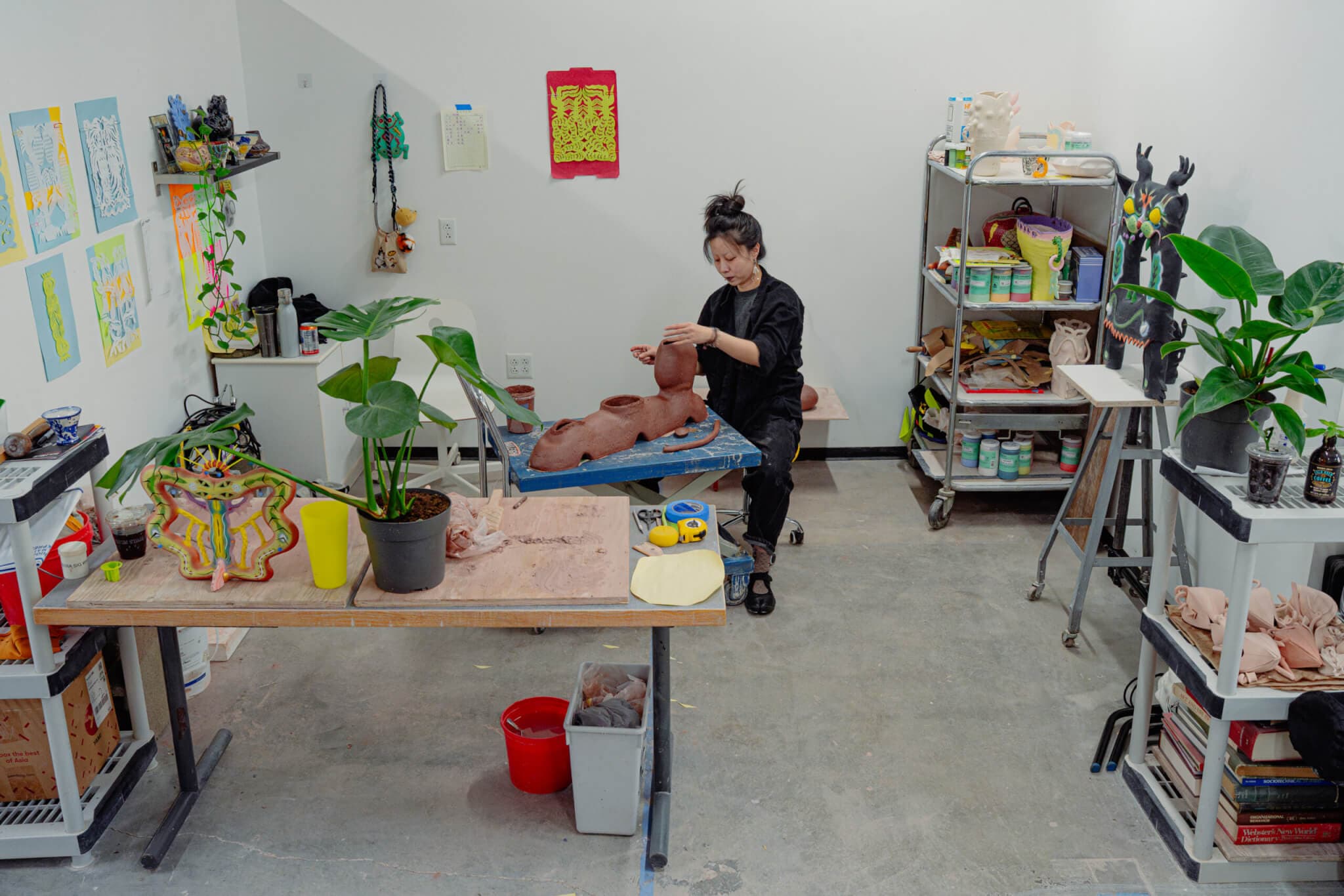
Portrait of Chenlu Hou in her temporary studio at Harvard Ceramics, where she is a 2025/2026 resident. Photo by Cameron Kincheloe for Boston Art Review.
EL: There’s a celebratory, joyful quality in your work, but it doesn’t feel unserious. Play and whimsy often aren’t taken seriously in a fine art context, but I don’t think that’s fair. And the humor is my favorite part of your work. The humor comes up not as a punchline but as a texture and through details in your work.
CH: I think humor has always been very close to survival for me.
The stories I grew up hearing were never loud or punchline-driven. Often they were told from the perspective of a tiger living in the mountains, or a mischievous spirit. By the time you finished the story, you realized you had learned something about human behavior, about morality, vulnerability, or the social structures of that time. The storyteller would carefully weave critique into the narrative. They didn’t yell at you. The lesson was there, but delivered gently. Your perspective shifted almost without you noticing, and that sensibility has deeply shaped my work.
I didn’t fully find my voice until after the Covid era. That period was destabilizing. During lockdown, I got married, out of love, but also out of the urgency of being able to stay here. I was thinking about immigration, belonging, racism, survival, and the future. These are heavy subjects. But direct, confrontational advocacy does not come naturally to me. What feels instinctive is humor and storytelling.
In my work, humor functions as a texture, as you beautifully described. It supports the whole piece. It’s not there to provoke loud laughter. It softens the entry into something complicated. It holds contradictions, creating a small space where tenderness can coexist with discomfort. Sometimes exaggeration or absurdity allows difficult truths to surface without becoming didactic.
I too resist the idea that whimsy equals a lack of seriousness. Play is serious. In many folk traditions, humor is how communities metabolize fear, power, and uncertainty. It’s a way of looking directly at something hard without becoming rigid. For me, humor is not decoration. It’s a strategy. It’s how I stay open and how I invite others in.
EL: Your titles feel like extensions of the work rather than labels. How do you think about language and titling? What’s been your approach to titling your pieces? I’m thinking about it in relation to something like 成语(chengyu),1 fables, and the way they encourage you to parse layered meaning.
CH: I agree with what you said about 成语 (chengyu), which are only four characters but hold so much. There’s an efficiency in that thinking.
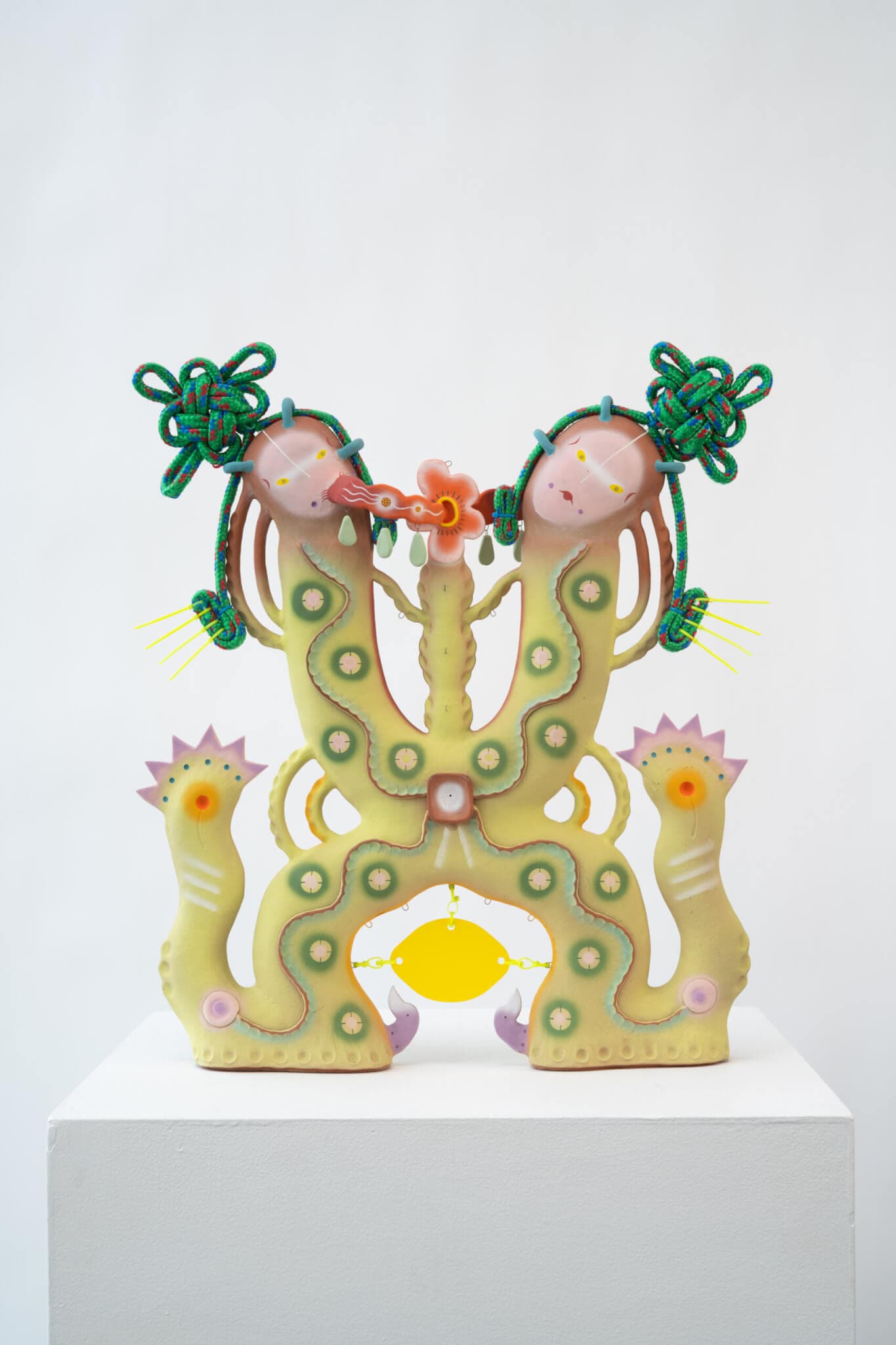
Chenlu Hou, Two vegetarian snakes are sucking nectar through retractable straws, 2024. Terracotta, underglaze, zip-ties, high-temp wire hooks, rope, gold ink; slab hand-built, air-brushed surface with underglaze, 22 x 25 x 7 inches. Courtesy of the artist and Kristen Lorello, NY.
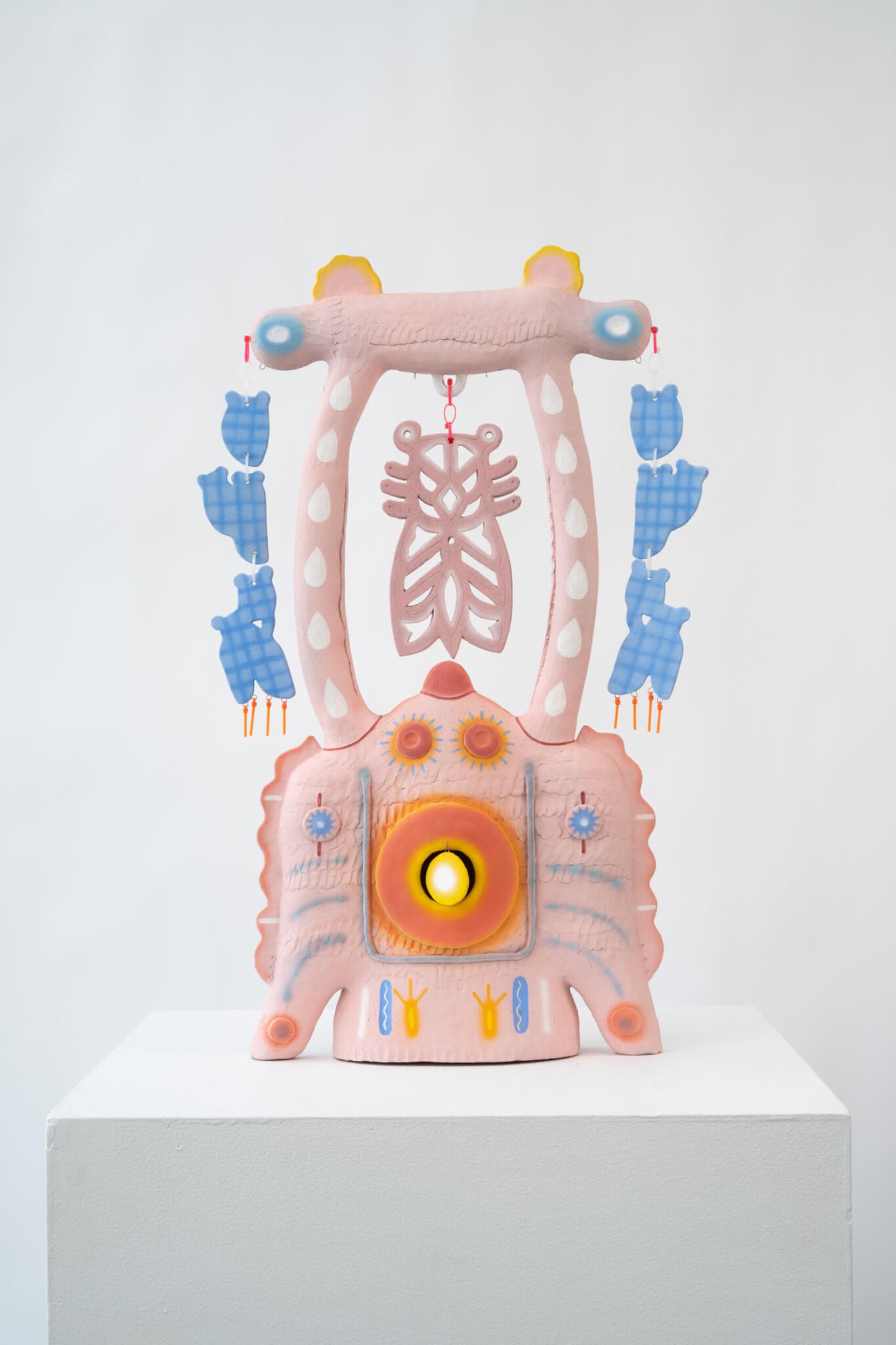
Chenlu Hou, Birds don’t eat cicadas that are shedding, 2023. Terracotta, underglaze, industrial strength nylon and plastic zip ties, metal hooks; 28 x 13 1/2 x 2 1/2 inches. Courtesy of the artist and Kristen Lorello, NY.
EL: Which is kind of opposite to your titles, but to me, the effect is really similar, even if it’s the opposite end of the spectrum. Efficiency versus expansiveness. But there is a thread there, a shared core.
CH: Thanks for bringing up language as an influence, because for me, language isn’t only a tool for communication; it’s tied to identity. Chinese is deeply bound up with who I am: being Chinese, being a daughter, and carrying more than thirty years of memories across time and place. My emotional habits, my internal “ecosystem” of feelings, even the way I argue and debate, all of that was formed inside the Chinese language system. English is a later system I entered. It’s much more tied to occupation. It’s outward-facing, public, and professional in a different way.
During Covid, I made a series of drawings that included Chinese characters. Trying to place Chinese into a limited flat space made me reexamine the language itself. It is a compressed system, especially in chengyu. Chengyu are most often made of four characters, and they compress an entire story or historical reference into four words. They simplify time and space, keeping only the essential elements. They function like a key: You see the phrase, and your mind automatically “decompresses” the larger story behind it.
Of course English has its own versions of compression, too. I love seeing protest signs for that reason—how people pack huge amounts of information, attitude, fact, satire, and sometimes humor into a rectangle of cardboard.
In my work, I’ve become very conscious of giving them long titles, so long that when I apply for exhibitions or grants, the full title sometimes doesn’t even fit into the form. Since living here, my opportunities to speak Chinese have decreased dramatically. Often a title begins in Chinese, and as the piece develops, it becomes clearer and fuller in another dimension. It also “decorates” the work, like another surface layer made of language.
In the sculpture, I’m already trying to compress a lot—images, forms, sometimes historical references, feelings, contradictions—into one body. The title often works through the opposite logic. It stretches out. I think I use titling as a way to keep thinking and analyzing rather than summarizing.
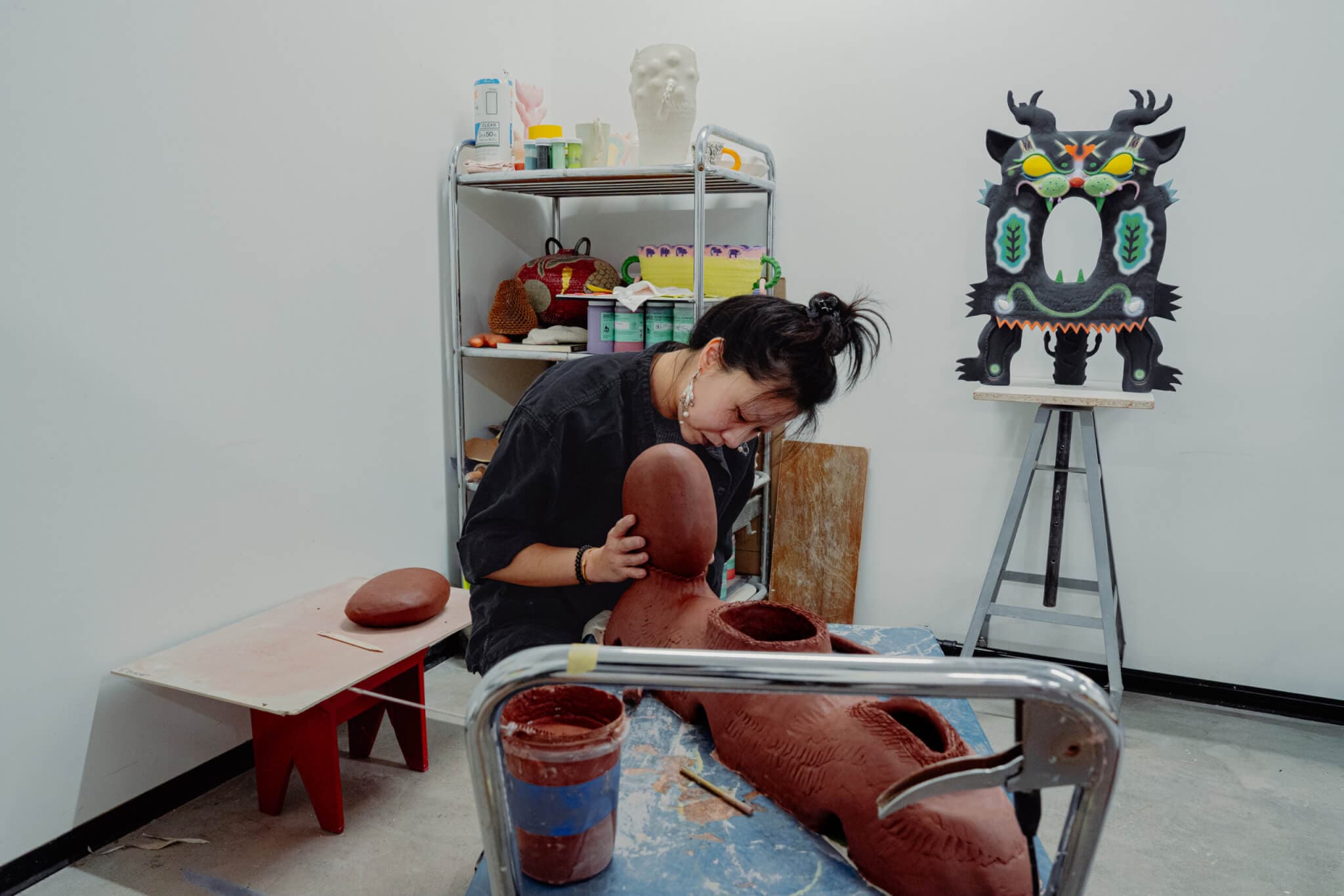
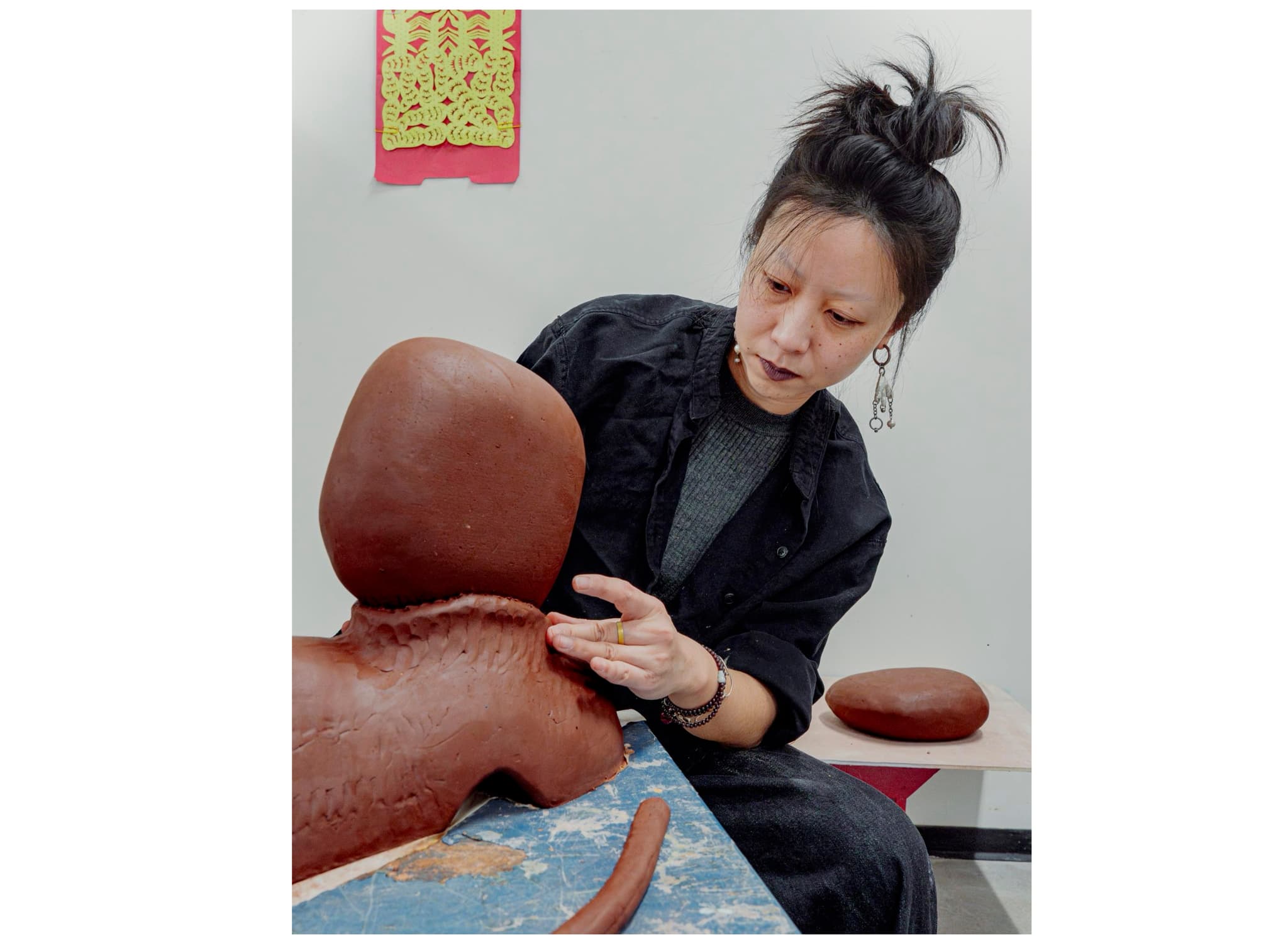
Chenlu Hou constructs a clay sculpture in her Harvard Ceramics studio. Photo by Cameron Kincheloe for Boston Art Review.
EL: Your work engages deeply with ancestry. How do you think about cultural inheritance as something alive rather than archival? Especially having lived in different places? Do you draw from texts like 红楼梦 or 西游记?2
CH: I think I don’t experience cultural inheritance as something stored in an archive. It feels alive—something that mutates, misbehaves, and adapts depending on where you are standing.
When I reference folklore, traditional motifs, or family memory, I’m not trying to reconstruct a fixed past. I’m not interested in preservation for preservation’s sake. What I inherited was never static to begin with. Even in my own hometown, traditions shifted between generations. Offerings for certain festivals changed over time—now people might place McDonald’s or P.F. Chang’s on an altar for their ancestors. Paper cuttings looked different depending on who cut them; traditional motifs were reinterpreted through each person’s hand. Recipes changed based on availability. Folk tunes were played with different emphases and ornamentations. Cultural knowledge was always being edited in real time. It adapts.
Living in the United States intensified that awareness. It requires flexibility, working with what is available and accessible. In that sense, inheritance is something I internalize and carry forward.
So for me, cultural inheritance is not about nostalgia. It’s about what happens when inherited forms enter a new landscape and have to negotiate space.
EL: You also teach and critique. How do those roles shape your practice?
CH: Growing up in Tai’an, Shandong Province, in the 1990s, exposure to what was formally recognized as “art” was limited. There were no museums or galleries to visit. In elementary and middle school, art classes were often taken over by math teachers, which quietly but clearly established a hierarchy: math was essential and intellectual; art was optional and expendable. That experience is one reason I value art education so deeply now.
When I teach, I’m constantly reminded that even in clay, especially in clay, there are always new things to learn. Students ask questions that destabilize assumptions. They take risks I might not take myself. They approach the material in ways that feel fresh and unexpected, and that energy feeds back into my own practice. Being honest about not knowing something is healthy. It keeps the space open. Critique, in particular, has shaped how I listen. In a critique setting, you learn to observe carefully before speaking. You learn to sit with ambiguity.
Teaching also grounds me. It keeps me in conversation with a younger generation navigating their own anxieties about material, identity, and the world. Staying connected with them keeps me alert and responsive to reality as it shifts. In the classroom, I’m dealing with real people. Teaching is not only about sharing knowledge; it’s about communication, psychology, empathy, and responsibility.
Their urgency and curiosity remind me that making is not just personal expression. It holds larger meanings. In many ways, making is a form of freedom, something increasingly precious in the world we are living in now.
—1 成语 (Chengyu) are Chinese idioms that consist of four characters but often hold deeper and poetic lessons, meanings, or expressions. There are over five thousand chengyu phrases, and chengyu are considered a collection or archive of cultural wisdom.
—2 Dream of the Red Chamber, an eighteenth-century novel by Cao Xueqin, and Journey to the West, a sixteenth-century novel attributed to Wu Cheng’en, are widely considered to be two of the four great classic novels of Chinese literature.