They came for what they knew amounted to begging for scraps that they weren’t likely to get. Still, they turned out.
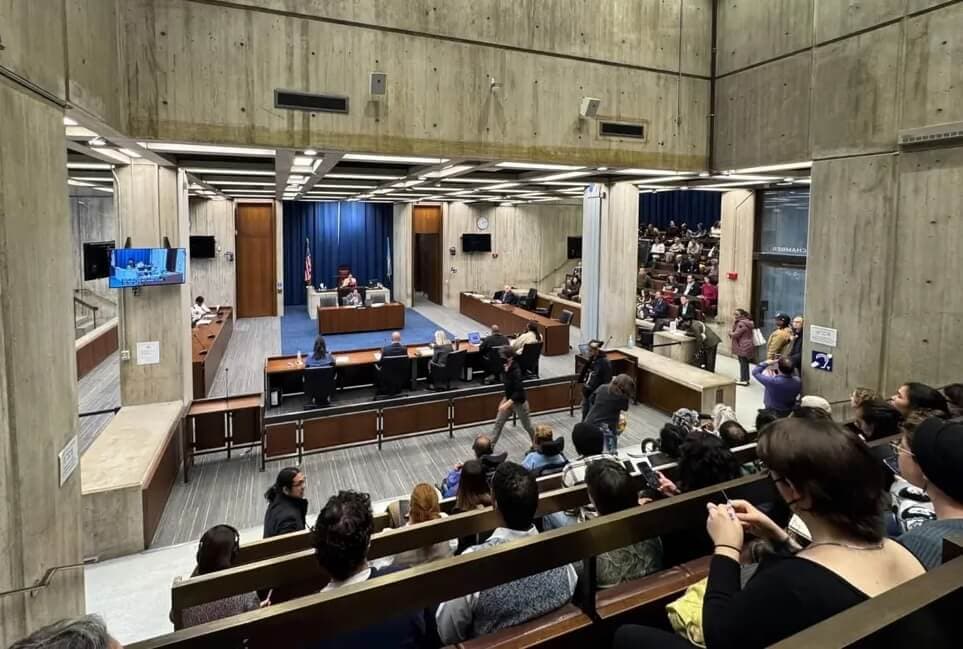
On April 30 at Boston City Hall, more than 150 workers from Boston’s arts and culture industry packed the brutalist-style building’s City Council chambers to testify, as part of the Council’s budget deliberation process, in the hopes of averting a proposed $1.4 million cut to the Mayor’s Office of Arts and Culture (MOAC). Educators, musicians, painters, dancers, DJs, and leaders of arts organizations, such as Boston Public Art Triennial Executive Director Kate Gilbert, were there to testify to the Council’s Ways and Means Committee about Mayor Wu’s proposed FY27 budget. They spoke about how its 27-percent cut to the Office of Arts and Culture will affect their work, the sector, and Boston at large. Council members also questioned Chief of Arts and Culture Joseph Zeal-Henry, joined by MOAC’s Senior Advisor for Creative Economy Kenny Mascary, about how the proposed budget cuts will affect his department.
At the scheduled 5:00 p.m. conclusion of the session, City Councilor and Ways and Means Chair Benjamin J. Weber invited anyone who had not yet spoken to line up and take their turn, pushing the hearing well past its scheduled end time. “[In] most of these hearings, there’s maybe four or five people, not 150,” he said in his closing remarks.
The day was spirited. At times, testimony veered emotional, though most attendees focused on making rational arguments, often invoking economic data to argue that cuts to the arts are cuts to the city’s own coffers. The arts make cities vibrant, they argued. When theaters and galleries close, it’s not just artists who move away; audiences are less likely to patronize restaurants and other neighborhood businesses. When main streets lose their sparkle, tourists stop visiting, and cities become less attractive to companies looking to set up shop.
City Councilor At-Large and Chair of the Arts, Culture, Entertainment, Tourism, and Special Events Committee Ruthzee Louijeune stated that City Council’s power is “limited.” The Council can veto or request revisions to the budget, but the mayor can veto the Council’s changes. The economic downturn the city is facing means that unless the mayor decides that the arts and culture industry offers a viable economic path forward for the city, the funding cuts are unlikely to be reinstated.
The Council members’ questions and Zeal-Henry’s responses showed that the mayor’s budget cuts are only one aspect of the lack of policy infrastructure for Boston’s arts sector. “There’s a lot of strategic policy work that we’re gonna end up inevitably doing,” Zeal-Henry testified. “We have to have more presence in zoning. It’s so hard just to open arts spaces because you have to go through the ZBA [Zoning Board of Appeal],” he added.
During one illustrative exchange, City Councilor Miniard Culpepper asked Zeal-Henry about other available funding, including from private sources. “We still have our appropriation for the revolving fund, which is $800,000 this year, that’s authorized,” Zeal-Henry replied. “I’m not here to raise money for myself. … I want to make sure that we are a city where funders are active.”
“Do you really need us to fight hard to restore that $1.25 million? Is that what you’re saying?” Culpepper replied. Zeal-Henry was unable to respond due to the crowd’s ovation. Echoing this sentiment, Louijeune said, “I will continue to push for us to partner with foundations to help us fill gaps.”
Several Council members seemed sympathetic to the testimony they heard. Weber said, “You don’t have to sell me on the arts. My son graduated from Boston Arts Academy; he’s now wrapping his freshman year at Pratt Institute in Brooklyn,” before citing the Pixies as an example of the strength of Boston’s music scene in the ’80s. “It seems like it’s not here right now. How do we go about [getting that back]?” he added, alluding to how the city seems to have lost the artistic verve of its alt-rock edge of some forty years ago. “The music scene—or things that make noise, shall we say—that is a massive challenge,” Zeal-Henry replied. “We’ve been collecting some data that shows that the sound industries are the most massively displaced—the most heavily hit—in the last twenty years.”
Weber’s observation about Boston’s current cultural scene versus that of the ’80s was echoed by Lauren Elias, founder and producing artistic director of Hub Theatre Company of Boston. She testified that the mayor’s funding cut to MOAC would force smaller arts organizations to trim their programs, causing the city to “lose citizens…[and] taxpayer dollars” because young people know that they cannot “make a life” here. “Mr. Weber [sic], I hate to say this: I would not advise your son to come back here with this budget cut once he finishes [his] degree in New York. I’m sorry to say it.”
The final budget is expected to be signed on June 30 and will take effect at the beginning of the fiscal year on July 1.
At the end of the hearing, artist Yuko Okabe testified via Zoom: “Artists love Boston, but I wish Boston loved us back.”