On April 8, when Mayor Wu filed her proposed budget for fiscal year 2027, belt-tightening was widely expected. While a review of the numbers revealed that many departments across the city were affected, the arts were hit particularly hard.
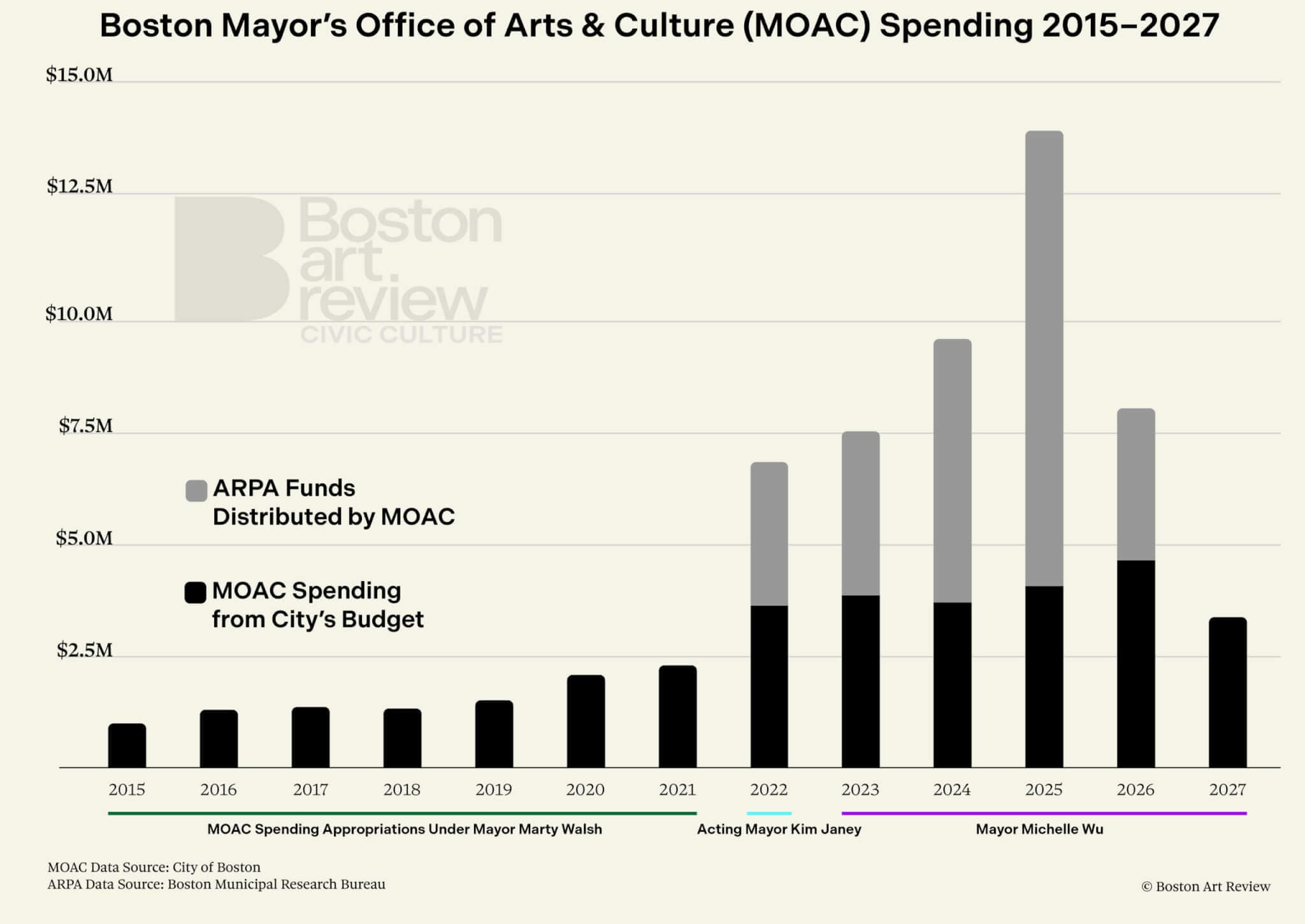
We reported in the last edition of ArtWonk that Mayor Wu’s proposed budget calls for cuts to the Mayor’s Office of Arts and Culture (MOAC) budget. The approximately 27 percent cut leaves the city’s budget for arts and culture in Boston with a total of $3,365,057 for fiscal year 2027. While still above pre-pandemic levels, even when adjusted for inflation, this is one of the largest cuts to any city department’s budget.
In response to concerns raised by the mayor’s proposed cuts, the newly formed grassroots organization Arts Activate Boston, together with MASSCreative, is calling on members of Boston’s arts and culture sector to attend the city council hearing in person to “share with city council members how the mayor’s proposed cuts to the office of arts and culture budget will negatively affect local cultural organizations and artists’ ability to serve the residents of Boston.” said Emily Ruddock, Director of MassCreative in a phone call.
The city’s arts budget is small, accounting for only around 0.07 percent of a total $4.9 billion. So while the cuts are not welcome, the real story here is less about this specific cut and more about how, together with the end of the Biden administration’s American Rescue Plan Act (ARPA), they reveal Boston’s historic underinvestment in the arts.
According to the Boston Foundation’s 2016 report “How Boston and Other American Cities Support and Sustain the Arts: Funding for Cultural Nonprofits in Boston and 10 Other Metropolitan Centers,” the last publicly available report of its kind, Boston ranked the lowest in terms of per capita government support for the arts compared to 10 other cities. It found that “Boston’s arts and cultural organizations receive the lowest per capita government support of all the cities studied,” noting that, “Even Baltimore—which has fewer than half the number of organizations Boston has—attracts a larger pool of government funding.”
Until this year, the MOAC budget had been steadily increasing since the office’s creation in the mid-2010s under Mayor Marty Walsh, except for 2017–2018, which saw an approximately 2.9 percent decrease.
The biggest MOAC budget appropriations jump, for FY22 of approximately 59.5 percent, was finalized and signed by acting Mayor Kim Janey on June 30, 2021. Mayor Wu took office in November that year. The MOAC budget appropriations did increase under Mayor Wu (first for FY 2023), but by far, the city’s biggest spending increase on the arts came from the pandemic response ARPA funding.
Of the $558.7 million ARPA dollars Boston received in August 2021, $26.2 million was earmarked for arts and culture. With this money, the city created a series of grants that targeted long-simmering issues, such as a lack of access to funding for nonprofit arts organizations serving BIPOC communities. Arts and cultural initiatives also benefited from other ARPA-funded grants, including the SPACE Grant, which did not explicitly target supporting the arts sector but was designed to fill vacant commercial spaces. A signature program funded by ARPA is the popular Boston Family Days program, which gives Boston students (grades K–12 and pre-K)—and two guests—free access to many of the city’s arts and cultural institutions on the first and second Sunday of each month through December 2026. The city has since announced that Boston Family Days will continue as a public-private partnership, but now, as ARPA winds down and the reality of the mayor’s proposed cuts to MOAC requires sacrifices, the city has not yet communicated which other ARPA-funded programs will be on the chopping block.
“Combined with reductions from the National Endowment for the Arts and decreased individual and philanthropic giving, Boston’s arts and cultural community feels increasing strain. These pressures are likely to be felt most acutely by small, BIPOC-led organizations, often operating with fewer financial buffers. In a city that has made meaningful progress in supporting these groups, the timing of these budget cuts presents a significant added challenge,” said Karthik Subramanian of Company One Theatre in an emailed statement.
This ARPA money was a federal government cash infusion designed to juice the economy. Since the grant required funds to be spent by the end of 2026, many organizations were able to weather not just COVID but also the impact of post-COVID inflation. However, the funding was always an artificial sugar high, and a crash was always coming.
On April 24, Boston’s Chief of Arts and Culture, Joseph Zeal-Henry, sent a letter addressing the budget crisis to recipients of arts grants overseen by MOAC. The letter indicates that MOAC-funded programs, the Opportunity Fund, and the Strand [Theatre] Grant have been removed from the FY 2027 budget and that the Boston Cultural Council Organizational Grant has been substantially reduced. It is unclear whether the city plans to evaluate ARPA-funded programs for permanent funding through the general fund in the city’s budget and, if so, how it would fund these programs.
Though the Boston Foundation report is over ten years old, it highlights a long-standing lack of support for Boston’s arts and cultural infrastructure. The city has underinvested in the arts for years. With the end of ARPA grants, the mayor’s proposed cuts, and the ongoing affordability crisis, that underinvestment is now being felt more acutely by the arts community.
The city faces a tough financial situation. Boston is unusual in that 73.1 percent of its 2027 revenue comes from property taxes. This revenue source has been hit hard by the downturn in the commercial real estate market and, most prominently, by new construction. Net property tax is expected to increase by the lowest level in nearly thirty years (since 1998).
While less money is coming in, the city’s costs are increasing. For example, while tied more to congressional gridlock than to macroeconomic factors, the cost of health insurance for the city’s full-time employees, which increased by 23.9 percent when the Affordable Care Act tax credits expired at the end of 2025, is a standout expense. Totaling 9.7 percent of the city’s budget, health insurance costs prompted policy think tank Boston Municipal Research Bureau (BMRB) to state in its report on the proposed budget that they “will impact the City’s budget for the foreseeable future.” The city’s hands are also fairly tied, as Massachusetts state law regulates how municipalities raise revenue.
The mayor has control over some of the budget’s appropriations, but not all. Pensions and state assessments are legally mandated payments in Boston, as is debt service on loans the city must repay to maintain its creditworthiness. “Just among those items, it’s about a quarter. I think it’s 24 percent, 25 percent [of the budget],” said Grant Farrington, a policy analyst at BMRB.
Core city services such as streets, Boston Public Schools, and public safety likewise offer limited flexibility. For example, collective bargaining agreements with powerful labor unions, such as the teachers and police unions, account for a significant percentage of the city’s spending. Boston Public Schools alone account for 35 percent of estimated expenditures, and public safety accounts for 17 percent, for a combined total of 52 percent. In Boston, the arts and culture sector has no comparable collective bargaining or trade organization; the closest equivalent, nonprofit arts advocacy organization MASSCreative, primarily works at the state level and does not engage in collective bargaining.
How much of the city’s budget—and how much will be cut by eliminating discretionary grants—remains an open question. “We hope that [the] city council can get more information out of the city on that,” said Farrington. “But right now, other than just the mayor’s word [that] that’s what is driving a lot of these cuts … I think [BMRB] doesn’t have a great sense of how much of the budget is these discretionary grants. Where are they focused? What departments?” he continued.
For now, the mayor’s budget is just a proposal. Next steps include a public hearing scheduled for April 30, during which the city council will hear public testimony on the city’s arts and culture spending as part of its review before voting on the city’s budget. Possible outcomes include approving the mayor’s budget, vetoing it, or sending it back for revisions.
The new budget for next year will take effect on July 1.
We will continue reporting on the budget as it moves through the city council’s review and vote.