Beyond the entryway and central annex of the Currier Museum of Art, the first room of “Embellish Me: Works from the Collection of Norma Canelas Roth and William Roth” beckons with a bright, seductive allure. Under a lilac-painted arch and a horizontal board emblazoned with the exhibition title, a large red heart hangs on a free-standing, museum-white wall: Miriam Schapiro’s Atrium of Flowers (1980). This giant valentine shimmers with metallic gold and abundant blooms reminiscent of Victorian paper ephemera. Or perhaps it’s a Sacred Heart; its orange acrylic paint strokes radiate flamelike from its center, with vines and gilded surfaces recalling Catholic iconography. Interspersed amongst the visual splendor is a checkerboard pattern of cut-and-pasted fabric squares, conjuring patchwork or quilting. The label multiplies associations, likening the work to “crazy quilts, printed tablecloths, and chocolate boxes.”
Schapiro’s heart establishes the exhibition’s emphasis on the Pattern and Decoration movement (P&D), underscored by its proximity to paintings by Robert Zakanitch. Directly across from Atrium of Flowers is Zakanitch’s Busy Bees (Souvenir Series) (1992), a painting of a swollen, decorative vase made monumental. Move to the other side of the initial heart wall and see two more by Zakanitch—Spring Fever (1976) and Untitled (1989)—the former a three-panel lavender painting vibrating with scrolling floral forms with peach, apricot, and mint petals; the latter, a smaller scale painting of an oblong green ovoid form floating in polka-dotted black negative space. It’s maybe a carpet, maybe a serving dish, or maybe an aerial view of a floral arrangement in a vase on a table. All of these demonstrate Zakanitch’s interest in interiors and domesticity, especially the textures of his grandparents’ home.
In 1975, Zakanitch hosted “perhaps the first major event where P&D began to be fleshed out,” an artists’ meeting at his loft on Warren Street in Hudson, New York.1 He, Schapiro, and others featured here, like Valerie Jaudon, Joyce Kozloff, Robert Kushner, Tony Robbin, and Kendall Shaw, gathered to discuss their shared interest in pattern. As the introductory text explains: “Though not bound by a unified style of doctrine, artists associated with Pattern and Decoration (or P&D) sought to challenge the art world’s misogyny and established hierarchies of value, while legitimizing the handmade, the sentimental, and decorative.” Formal embellishments—“ornament, craft, and richly patterned forms” or “detailed embroidery, gold foil, and mosaics”—were part and parcel with some artists’ political ideologies, reflecting “questions of identity, tradition, and cultural value” or the centrality of “feminism” and “women’s work.”2
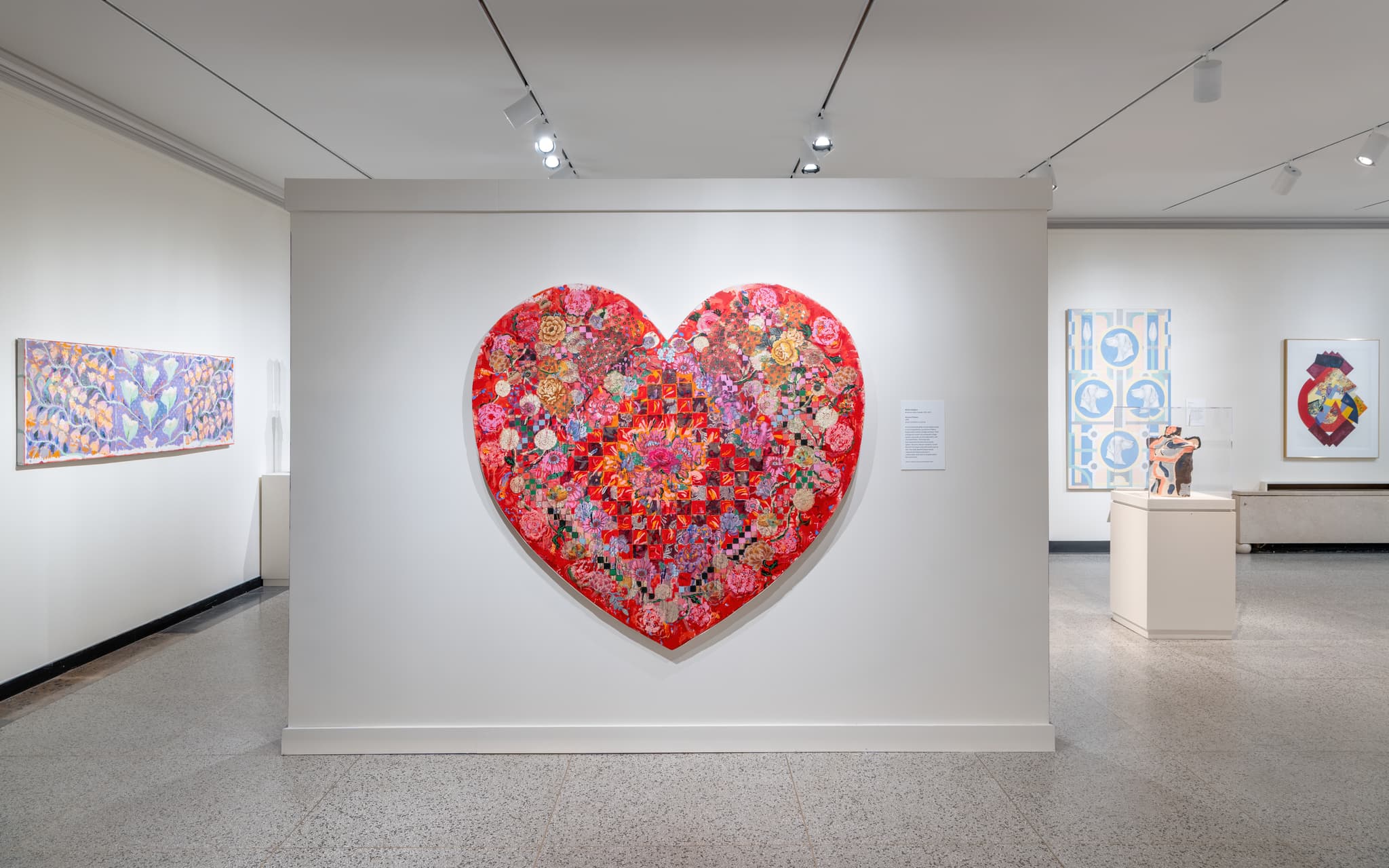
(center) Miriam Schapiro, Atrium of Flowers, 1980. Installation view, “Embellish Me: Works from the Collection of Norma Canelas Roth and William Roth,” Currier Museum of Art, 2026. Photo by Morgan Karanasios. Courtesy of the Currier Museum of Art.
The first gallery dazzles. Beyond Schapiro and Zakanitch, works by Lynda Benglis, Lucas Samaras, and Thomas Lanigan-Schmidt shimmer across the space. Benglis’s Sparkle Knot (1973) is flamboyant, thick with fluorescent pinks, aquatic blues, sea greens and loads of glitter, and likened to “gift bows, hair accessories, or cake piping,” or “intestines or a loop of contorted limbs” in its label. Glitzy and protuberant, this iteration of Benglis’s Sparkle Knot series sits at tabletop height on a pedestal instead of hanging on the wall. Its incandescent flicker resonates with Samaras’s Reconstruction 39 (1978), in which diagonal strips of patterned fabric and metallic scraps form a vibrant patchwork surface. Lanigan-Schmidt’s four sculptures incorporate aluminum foil, plastic, tinsel, staples, and more. His two crowns—Untitled (Crown) (1975) and Untitled (Crown) (1986)—similar in scale to the Benglis, look magical and otherworldly; the twisting amalgamations of translucent bubblegum pinks, gold pipe cleaners, iridescent fringe, orange and teal lollipops, and artificial fronds are equal parts camp and devotional. I was delighted to see one of his signature aluminum foil rats, Untitled (Golden Rat) (1972), which Lanigan-Schmidt sees as intimately related to himself and his friends, queer “street rats,” and his participation in the 1969 Stonewall uprising.
This trio of artists clarifies the exhibition’s strength: formal and material alignments made apparent through display. This grouping also shows that although “Embellish Me” centers P&D, the category is capacious. Benglis, Samaras, and Lanigan-Schmidt did not necessarily consider themselves part of P&D, but exhibited alongside its proponents and shared their embrace of ornament and charged materials. The exhibition’s additive stance echoes recent curatorial efforts to broaden the movement’s scope.
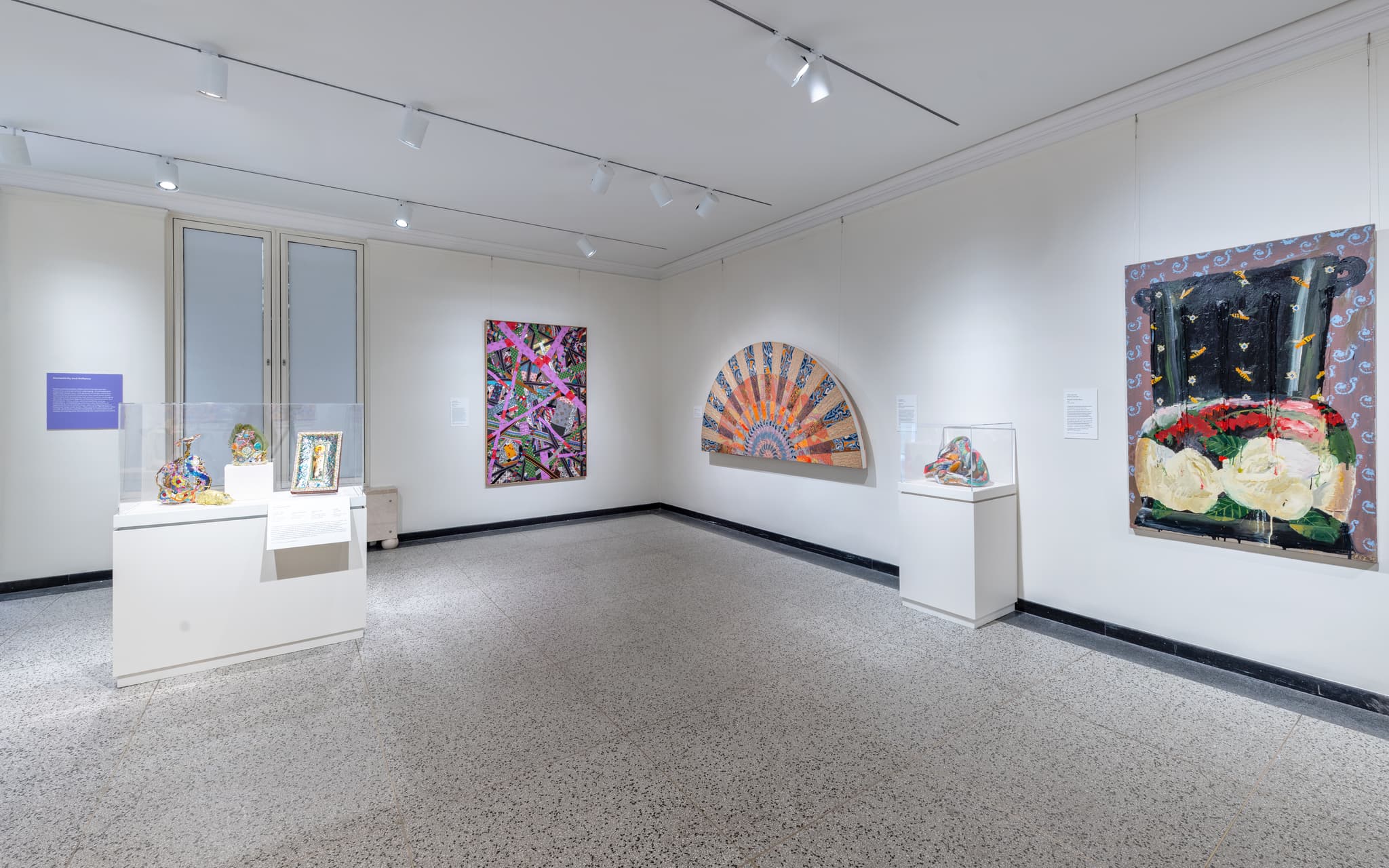
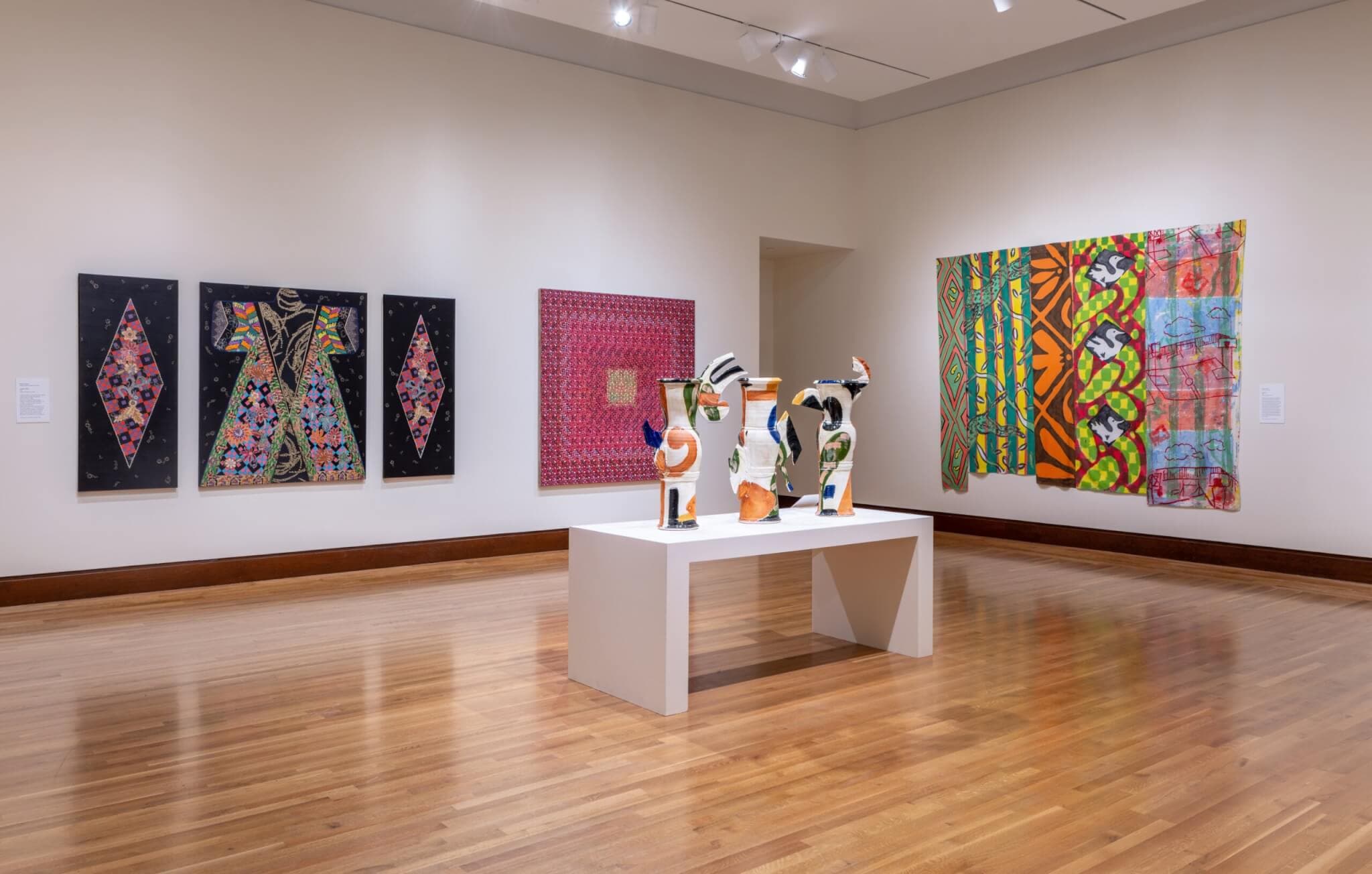
Installation view, “Embellish Me: Works from the Collection of Norma Canelas Roth and William Roth,” Currier Museum of Art, 2026. Photo by Morgan Karanasios. Courtesy of the Currier Museum of Art.
“Embellish Me” is the third iteration of a traveling exhibition previously shown at the Patricia and Phillip Frost Museum and the Tampa Museum of Art. At the Currier, curator Anastasia Kinigopoulo produced new didactics and bolstered the checklist with works from the museum’s collection. She arranged the presentation into four thematic sections: Domesticity and Defiance, Ornament Across Borders, Structured Surfaces, and A Sense for Sentiment. These themes revisit P&D’s familiar narratives, such as its engagement with decorative interiors and everyday objects, its overt embrace of global influences, its grids and repetitions, and its emphasis on personal expression. Throughout, Kinigopoulo foregrounds artists’ affiliations with the second-wave feminism of their moment and their rejection of Eurocentric art hierarchies, whether championing Islamic, East Asian, and South American visual sources or challenging the devaluation of domestic materials like wallpaper, quilts, and scrapbooks.
The title “Embellish Me” is striking and mysterious. Who is the “me?” My first impulse was to think of the phrase coming from the artists or from their artworks (think of a blank canvas begging for ornament). Undoubtedly, many artists in the exhibition openly celebrated embellishment. Schapiro wrote in 1979 that “‘Decorative’ includes an homage to anonymous decorators of the past … from all over the world and throughout time who used repetitive motifs to embellish hand made utilitarian objects,” insisting, “There is no reason for a work not the be embellished, ornamented and still not be a vessel for significant ideas.” Zakanitch similarly mused that “Even a blank canvas embellishes a room with its object-ness,” and “The objects I chose to use [have been seen] as trivial intimate decorations or embellishments. I am interested in them as ends in themselves.”3 These statements affirm embellishment both as an action performed (embellish as a verb) and as a condition, a state of being (embellished as an adjective).
Embellishing is an additive and accumulative act, and “Embellish Me” is an addition to recent, prominent reassessments of P&D. The first comprehensive survey, “Pattern and Decoration: An Ideal Vision in American Art, 1975–1985,” was organized by the Hudson River Museum in 2007. A renewed wave of attention followed in 2018 and 2019 with “Surface/Depth: The Decorative fter Miriam Schapiro” at the Museum of Arts and Design; “Pattern and Decoration: Ornament as Promise” at the Ludwig Forum and Museum moderner Kunst Stiftung Ludwig Wien; “Pattern, Crime & Decoration” at the Consortium Museum; “Less Is a Bore: Maximalist Art & Design” at the ICA / Boston; and “With Pleasure: Pattern and Decoration in American Art 1972–1985,” which premiered at MoCA Los Angeles.4 These exhibitions expanded scholarship and introduced P&D to broader audiences.
Bostonians who visited “Less Is a Bore” may remember that guest curator Jenelle Porter, who organized the show with ICA curator Jeffrey De Blois, positioned P&D in her broader reassessment of the term maximalism, connecting 1970s proponents to contemporary ornament. Anna Katz’s “With Pleasure” paired P&D’s founders with unaffiliated peers who created work with formal, material, or conceptual similarities.5 For example, in order to “propose a broader consideration of P&D that accounts for the vitality of quilting as an abstract decorative art form for artists of color,” Katz incorporated Al Loving and Sam Gilliam.6 Kinigopoulo follows suit, including an untitled collage by Loving (1986) and Sam Gilliam’s Pantheon (1984) from the Currier’s collection. Porter, Katz, and Kinigopoulo each embellish extant narratives around P&D, and Kinigopoulo embellishes the Roth holdings with institutional context.
While “Embellish Me” shares and builds upon the capacious models of P&D offered by its precedents, it also differs from these surveys because it originates in a specific private collection. Norma Canelas Roth and William Roth began collecting P&D in the late 1970s, forming close relationships with many of its artists. Many would-be outliers in the exhibition speak to the Roths’ personal tastes, relationships, and collecting patterns. Kinigopoulo’s curatorial embellishments (e.g. Sam Gilliam and Al Loving) join an already-established collection formed along personal affinity lines just as much as along any stringent lines of art historical categorization.
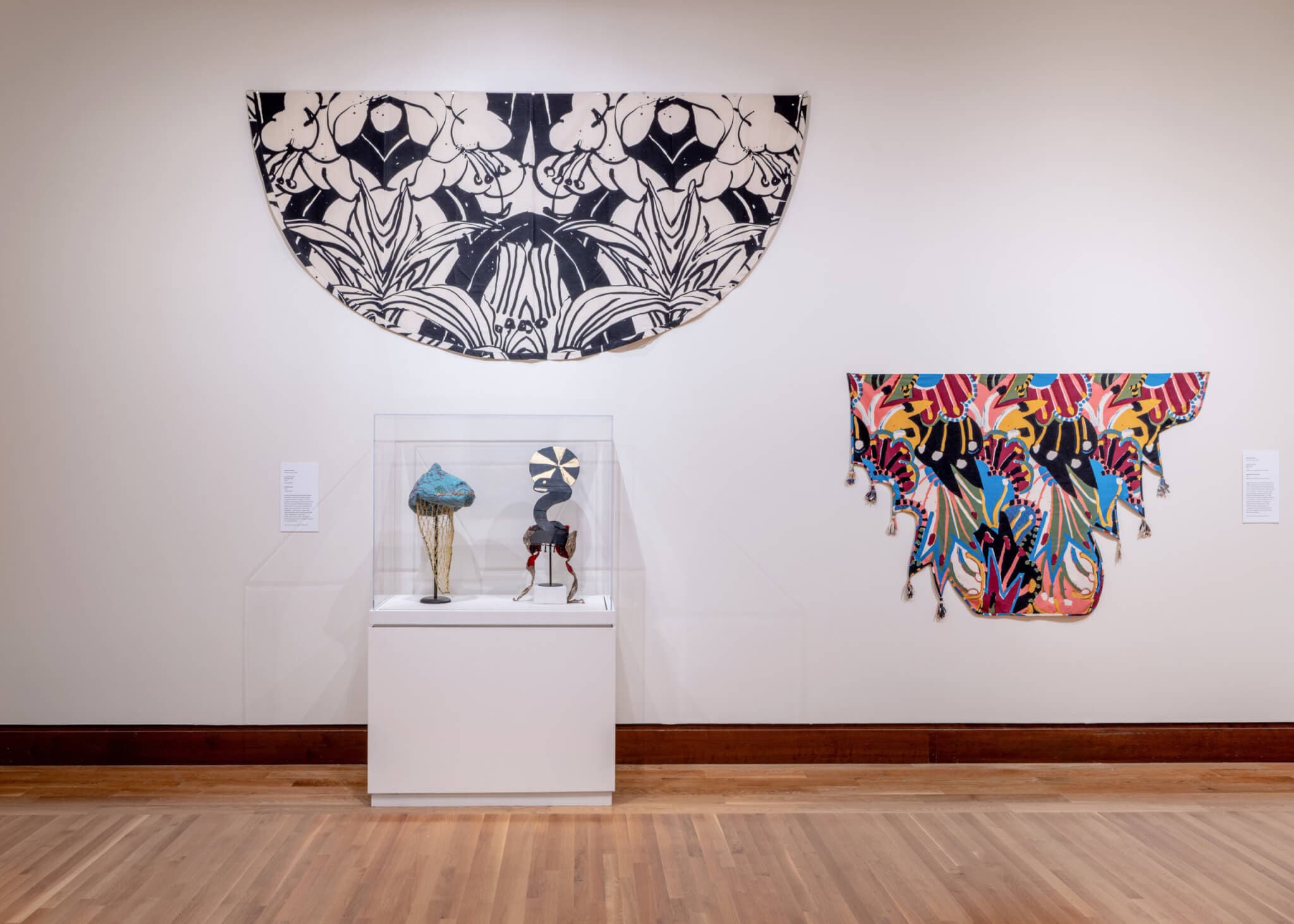
(top) Robert Kushner, Lilies Cape, 1977. (bottom right) Robert Kushner, Hawaiian Punch Cape, 1977. Installation view, “Embellish Me: Works from the Collection of Norma Canelas Roth and William Roth,” Currier Museum of Art, 2026. Photo by Morgan Karanasios. Courtesy of the Currier Museum of Art.
Moving through the exhibition space, I drew personal affinity lines of my own. Once in the second gallery, I quickly found myself transfixed by the array of Kushner’s performance-accessories-turned-display-objects on view: two capes and two hats! I recognized these from the artist’s eccentric, experimental performances from the 1970s in which he and models would wear his works as living sculptures. Kushner created these two capes, Lilies Cape (1977) and Hawaiian Punch Cape (1977), during his time as the Fabric Workshop and Museum’s first artist-in-residence. The Hawaiian Punch Cape’s salmon pinks, marigold yellows, and olive greens look celebratory and tropical, the shape of the unstretched canvas drawing my eyes along its edges, at times curved, soft, scalloped; at other times forming pointed, webbed, triangular stalactites, adorned with fringe tassels. The two untitled hats from 1979 look like strange creatures in their vitrine. For one, Kushner painted cardboard black and cut it into the shape of a serpent under a nimbus detailed with metallic gold, trailed with streamers of sequins; the other is like a blueberry beret with fishing net hanging pendulously below, topped with plastic-like, puffy paint stripes of fuschia and kelly green.
This second gallery has the biggest footprint and is split into two with a dividing wall. Kinigopoulo pairs Ornament Across Borders and Structured Surfaces in the two halves of this larger space, as these sections both incorporate tessellated surfaces with repeated, colorful, geometric motifs. Kushner’s moment is in the former, which tracks—his capes grew out of extensive travels in Iran, Turkey, and Afghanistan and his work repairing and restoring Middle Eastern carpets, culminating in his Persian Line performances in 1975 and 1976. The serpent-shaped hat draws from the iconography of royal ornament in ancient Egypt.
While looking, I listened to the exhibition’s audio recordings of Kushner. He describes his work first and foremost as a “refuge.” I orbited around Betty Woodman’s Athens (1991) ceramics, situated in front of ceramic tiles and silks by Joyce Kozloff. From one angle, I could see beyond Woodman into the third room and final section, A Sense for Sentiment. I paused to note the remarkable formal echo between Woodman’s rightmost vessel and P&D staple Ned Smyth’s sateen palm frond Dina (1979). Both Woodman’s and Smyth’s forms stretch upward, reaching in a soft arc to the left, almost anthropomorphic and dancerly.
That final gallery functions as an alternative entryway for museumgoers taking a different route. Seduced by the Dina sightline, I was surprised to find Smyth—a mainstay pillar of P&D group exhibitions—alongside three artists more peripheral to the movement: Joyce J. Scott, Paul Brach, and Ree Morton. Smyth’s childhood visits to Byzantine churches and Renaissance cathedrals inspire his architectural gestures, meant to conjure reverence, here articulated through the sensuous surfaces of his fabrics. The exhibition positions his frequent return to the palm tree as a motif in relation to leisure, escape, and longing, a point of connection for the nearby nostalgic landscape by Brach (Schapiro’s husband). Seeing Scott’s Necklace (Skeletons) (1984) took me aback—its presence amazed me because I love Scott’s work but had never seen it contextualized in a P&D setting.7 The Baltimore-based artist’s wearable beadwork often openly addresses race, gender, and class. She challenges white supremacy and addresses collective trauma in form and content, using her own idiosyncratic craft technique synthesized from African American, Indigenous American, and West African traditions. Though its imagery is less overt than some of her other figural beadwork, Skeletons points to death, and maybe the necklace as a form in and of itself can point to something equal parts gorgeous and ominous: “You know, when they open up ancient tombs, many times all they find left is a beaded necklace,” Scott has remarked.8
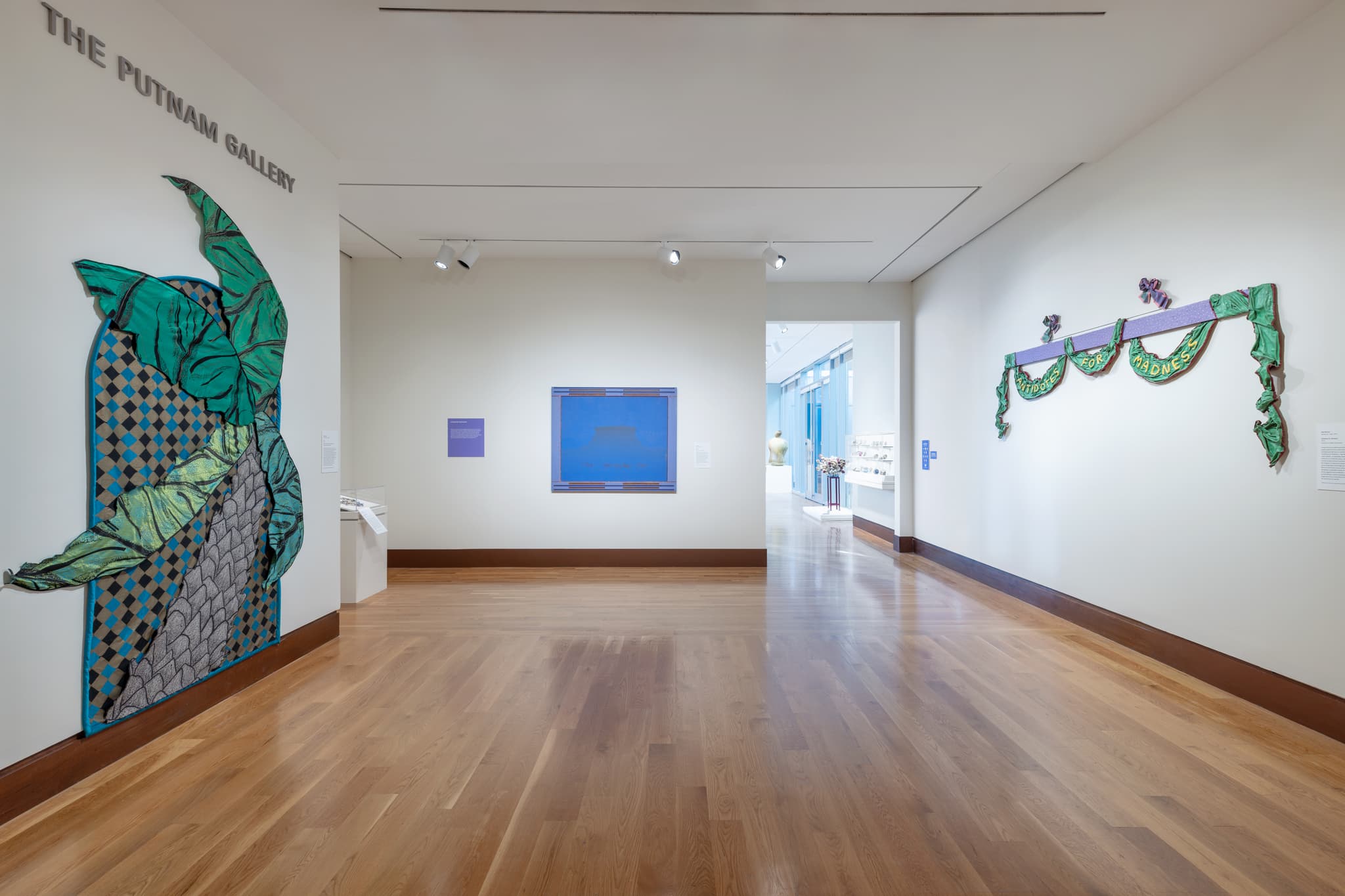
(left) Ned Smyth, Dina, 1979. (right) Ree Morton, Antidotes for Madness, 1975. Installation view, “Embellish Me: Works from the Collection of Norma Canelas Roth and William Roth,” Currier Museum of Art, 2026. Photo by Morgan Karanasios. Courtesy of the Currier Museum of Art.
Across from Scott, hung high on the wall like the swags and banners it references, Morton’s Antidotes for Madness (1975) makes an excellent greeting or farewell for museumgoers. Of Morton’s ten years working as an artist, she used celastic—a plastic-filled fabric that is malleable when wet, hardened when dry, and that was once used frequently in theatrical sets—for three, exploring the material from 1974 to her untimely death in 1977. Antidotes for Madness exemplifies Morton’s use of celastic to create colorful, shining forms that fold and drape, sculpting ribbons, bows, garlands, and curtains. In bright yellow, rounded, capitalized letters, Morton adorns the celastic swag with the ambiguous phrase “antidotes for madness,” sourced from the 1917 horticultural book Wild Flowers Worth Knowing by Neltje Blanchan.
Kinigopoulo writes in the label that Antidotes for Madness “suggests that ornament—revived and proliferating in 1970s contemporary art—might serve as a corrective to the austerity of the dominant art world.” This reading feels like an act of generative speculation, an imagined possibility that embellishes Morton’s enigmatic work.
For all the celebration and jubilance in P&D, embellishment can carry a simultaneous strain of melancholy. In Domesticity and Defiance, works by Pat Lasch engage mourning. Lasch’s Wilhelmena Widowed (1980) synthesizes allusions to nineteenth-century cemetery monuments and cake decoration in a tall, black, frosted sculpture enshrouded with wire mesh, accompanying another untitled work from Lasch’s Death Veil series (1980). To the right is a large, ruched curtain made from strands of pearls, Jane Kaufman’s Pearl Screen (1980), which reminds me of “the pearly gates” of Heaven, or the thin metaphorical barrier of the “veil” between life and the afterlife. This set of works is across the room, but relational, to Samaras’s Reconstruction 39, part of a series the artist described as “shrouds” for his mother after she passed away.9
Naming the exhibition “Embellish Me” means that anyone who wants to call the exhibition by its name will have to ask to be embellished themselves. When I say it, I feel a little silly and extravagant. It seems like a lavish, almost vulnerable request. Yet throughout “Embellish Me,” ornament appears as a reparative method, open and ongoing, continuing to accrue meaning through each encounter. If to embellish is also to strengthen, to reinforce structure with added layers, then the exhibition is an occasion to bolster the works with our own interpretative ornamentation, just as we allow the artworks to embellish us, reshaping us in turn. The title is, after all and above all, an invitation. Like the fantastical labels “Drink Me” and “Eat Me” in Alice’s Adventures in Wonderland, it solicits interpretation. “Embellish Me” asks us to join in, to embellish and to be embellished, engaging in the capacious, expansive, expressive potential of ornament.
—1 Anne Swartz, “Chronology of Shows and Writing,” in Pattern and Decoration: An Ideal Vision in American Art, 1975–1985 (Hudson River Museum, 2007), 113.
—2 Jonathan Griffin has observed of P&D: “Decoration, after all, situated itself close to pleasure, to aesthetic amelioration (rather than discord or toughness), and to a set of characteristics—the feminine, the queer, the decadent, the domestic, the folksy, the foreign—that were viewed by many in America as categorically marginal.” See “With Pleasure: Pattern and Decoration in American Art, 1972–85,” e-flux, January 28, 2020, https://www.e-flux.com/criticism/313169/with-pleasure-pattern-and-decoration-in-american-art-1972-85.
—3 Quoted in Pattern, Crime & Decoration (Le presses du réel, 2020), 85, 100, 104.
—4 For more extensive overviews of these sets of shows and their role in surfacing P&D, see Glenn Adamson, “Reassessing Pattern & Decoration, the Last Art Movement of the Twentieth Century,” Art in America, September 3, 2019, and Lynne Cooke, “Pattern Recognition,” Artforum 60, no. 2 (October 2021).
—5 In her assessment of “With Pleasure,” Lynne Cooke contends: “Katz’s recuperative agenda—the rehabilitation of an unjustly neglected artistic phenomenon—is at the same time threaded through by a corrective impulse. Reflecting today’s urgent issues, she enlarges the fluctuating network of original participants to include artists who ‘would’ve, could’ve, or should’ve’ been part of it had they not, like ceramist Betty Woodman, lived largely away from the coastal centers and self-identified as craftspeople.” See “Pattern Recognition,” Artforum, September 30, 2021, https://www.artforum.com/features/lynne-cooke-on-the-pattern-and-decoration-movement-250665/. Jonathan Griffin also wrote of Katz’s expansive exhibition checklist, calling it “unexpected and refreshing,” that the survey welcomes visitors with “three artists not typically associated with the movement,” Al Loving, Sam Gilliam and Lucas Samaras, “to lay out a preemptive defense of P&D’s broad reach and historical significance.” See “With Pleasure,” e-flux.
—6 Anna Katz, “Lessons in Promiscuity: Patterning and the New Decorativeness in Art of the 1970s and 1980s,” in With Pleasure: Pattern and Decoration in American Art 1972-1985 (Yale University Press: 2019), 30–31.
—7 I previously interviewed Joyce J. Scott while at the Museum of Fine Arts, Houston, in 2018. See “‘Stay the Course’: An Interview with Artist Joyce J. Scott,” https://www.mfah.org/blogs/inside-mfah/stay-the-course-an-interview-with-artist-joyce-j-scott.
—8 Laurence Ross, “The Skeletons of Joyce J. Scott,” Bmore Art, June 3, 2024. https://bmoreart.com/2024/06/the-skeletons-of-joyce-j-scott.html.
—9 On Samaras’s Reconstruction series: “His mother, he says, would have loved these gaudy materials, and because he wasn’t with her when she died several years ago he thinks of these new works as ‘shrouds to wrap her in.’” See Jeffrey Keeffe, “Lucas Samaras,” Artforum 16, no. 9 (May 1978), https://www.artforum.com/events/lucas-samaras-13-230793/.
“Embellish Me: Works from the Collection of Norma Canelas Roth and William Roth” is on view through April 12, 2026, at the Currier Museum of Art, 150 Ash Street, Manchester, New Hampshire.