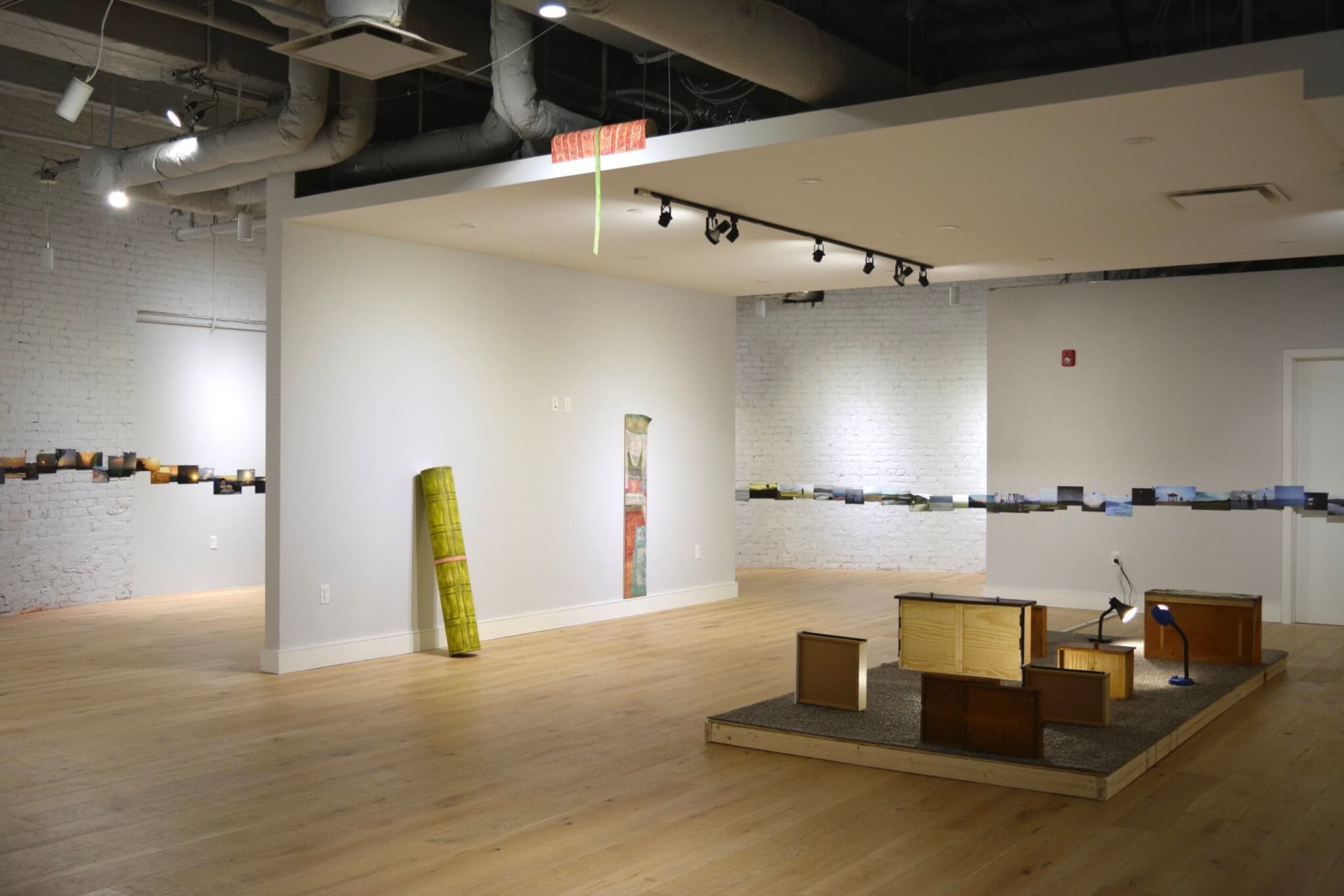
On view at Unbound Visual Arts, a small nonprofit space nestled in the basement of a historically preserved church, is a sculptural exhibition of poetic quietude. It seems fitting that “A Shell, A Peel, A Pause” should be shown here, as basements are often repositories hiding away mysterious and magical objects from memory. Outgrown shoes, unused chairs, boxes of ephemera, entire volumes of generational history frozen in photographs. All of these things are present in the exhibition, but warped. It is as if the three featured artists, An Hà, Miguel Caba, and Vivian Tran—recent Tufts BFA graduates who also help run Copenger, a curatorial and arts programming collective—cast a spell to make the familiar strange and wondrous.
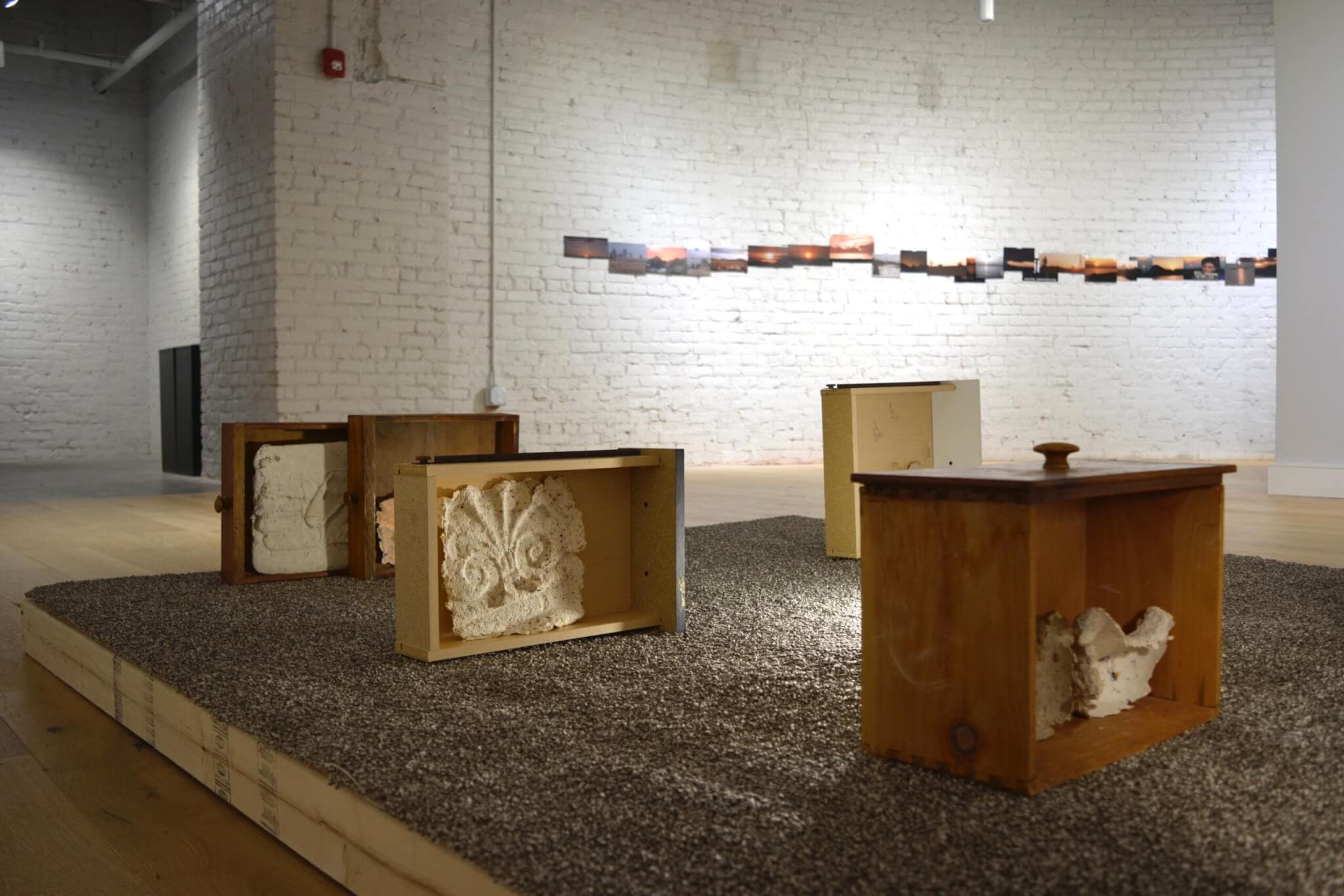
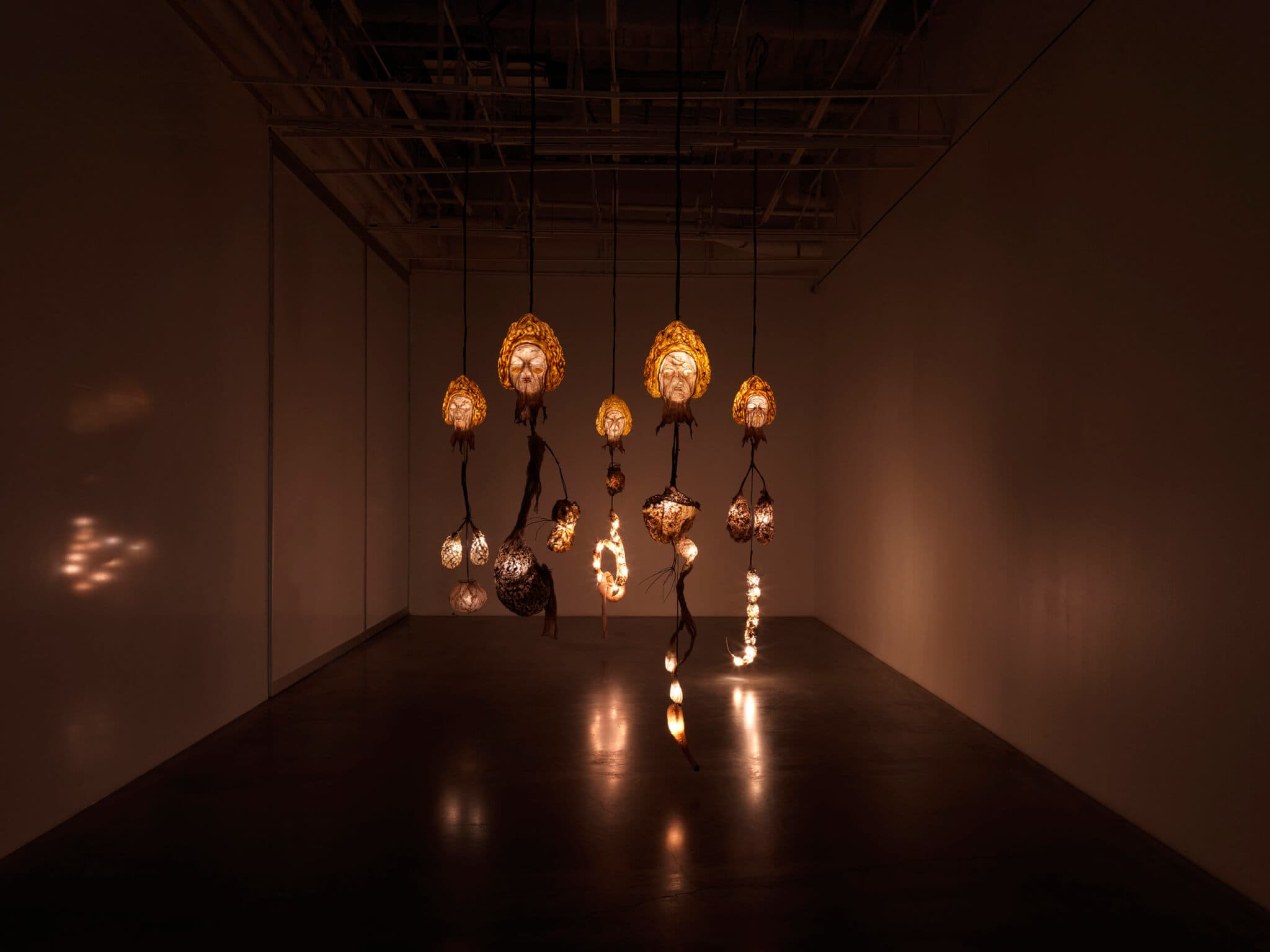
An Hà, Constellation, 2026–. Wood, carpet, lamp, drawer, ink on paper, electronics, household dust, scratched tickets, instant coffee, toilet paper, envelopes, food coupons, dimensions variable. Installation view, “A Shell, A Peel, A Pause,” Unbound Visual Arts, 2026. Courtesy of Unbound Visual Arts.
In the center of the space, Hà’s Constellation (2026–) immediately catches the eye. The large gray carpeted platform holds seven wooden drawers, two lamps, and a single lightbulb laying flat. Inside each upright drawer sits an obscure papier-mâché-esque shape made from some amalgamation of debris or ephemera: scratch tickets, toilet paper, food coupons, even instant coffee. One is the shape of two hollow birds kissing, another is imprinted with the outline of a wall socket. Though not visible upon entering the gallery, the contents of the upturned drawers are revealed as visitors walk around the piece. Framed by the walls of the drawer and illuminated by the lamps, each miniature tableau has the intimate display of a diorama. Like the star clusters after which the piece is named, the work ignites a sense of wonder. Is the gray carpet a night sky and these figurines the constellations that populate it? Who once owned these drawers and were the pieces inside of them born of its contents?
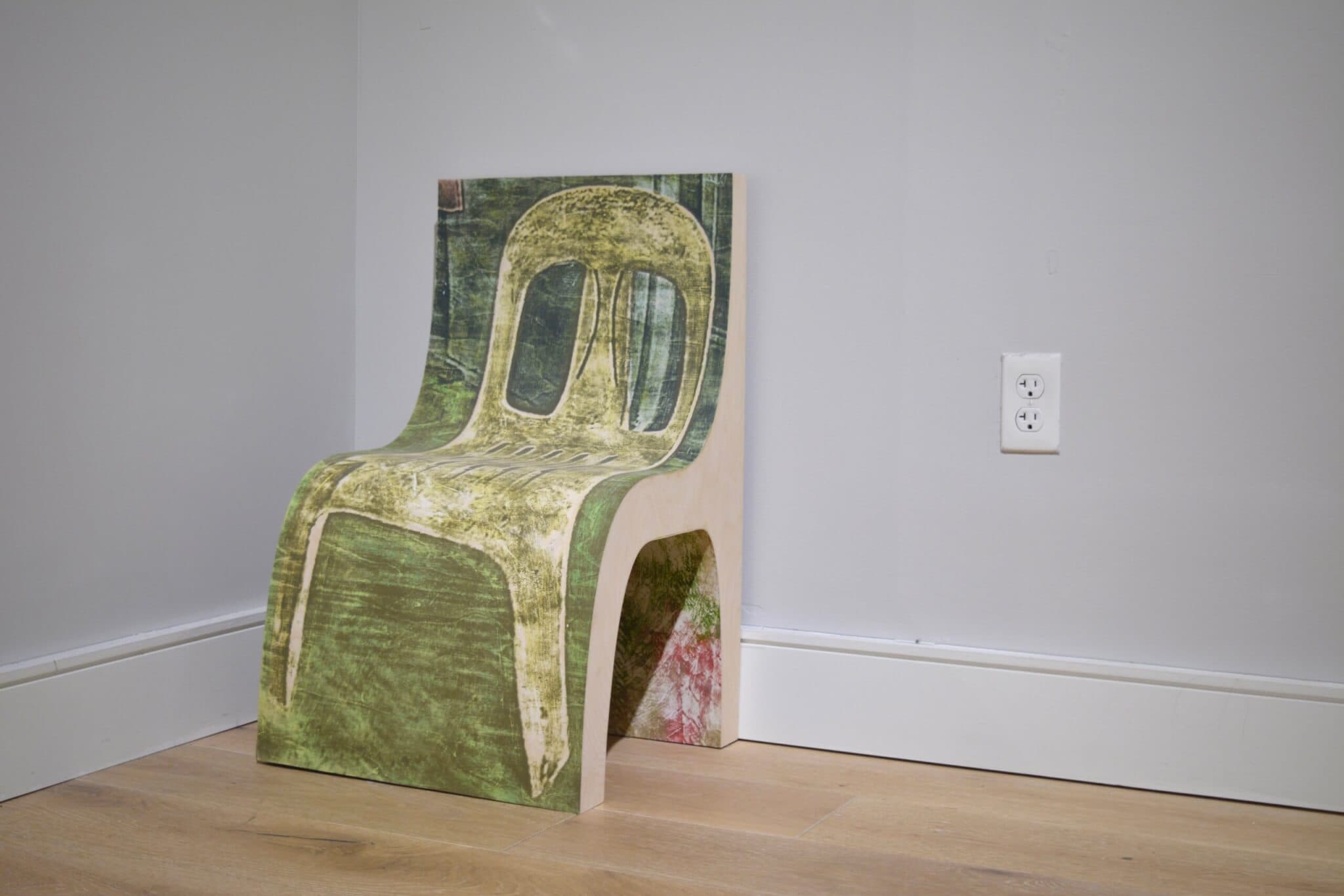
Miguel Caba, Chair, 2026. Acrylic on wood, 17 x 14 x 21 inches. Installation view, “A Shell, A Peel, A Pause,” Unbound Visual Arts, 2026. Courtesy of Unbound Visual Arts.
Surrounding Hà’s night sky are Caba’s acrylic-painted wooden sculptures, strewn about with a haphazard logic that felt like seeing my childhood home in a dream—deeply intimate but slightly uncanny. An’s shoes (2026), a painted pair of shoe-shaped wooden blocks, are planted playfully on the ceiling. Nearby, Unrolling (2026) resembles a roll of wallpaper about to unravel from the ceiling onto the floor, while Wallpaper (falling) (2026) does just that, its long backside of unpainted wood slouched over the small portion still clinging to the wall. In the opposite corner is Chair (2026), the image of a worn monobloc chair curves along the lines of a chair-shaped sculpture, its legs bending under the weight of use. The mesmerizing tilework of Floor (2026) peels upward and Wallpaper (2026) depicts the interior of a living room. The patterns and images painted on these wooden sculptures evoke Caba’s grandmother’s home through their blurred memory; together in the gallery they create a portal across time-space, fraying at the edges. Where pieces wilt, they herald impermanence, reminding us that the sentimental decoration of our inner lives could wither away like wallpaper.
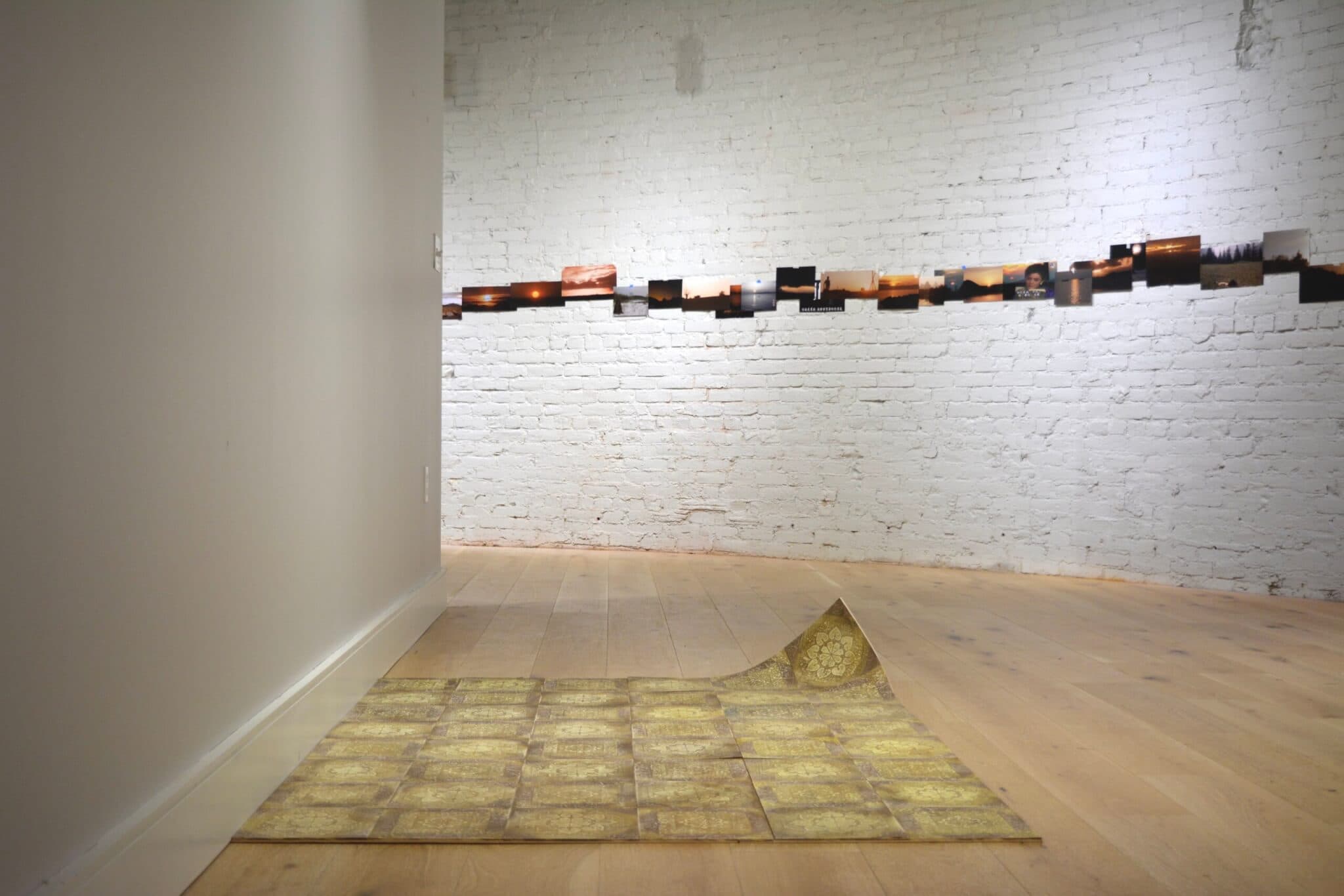
(top) Vivian Tran, Samsara, 2026. (bottom) Miguel Caba, Floor, 2026. Installation view, “A Shell, A Peel, A Pause,” Unbound Visual Arts, 2026. Courtesy of Unbound Visual Arts.
In a semicircle bounding the edge of the exhibition hangs Tran’s Samsara (2026–), an ongoing curvilinear collage of 129 archival photographs, depicting a range of subjects—from sunsets to historical cinema. The title is a concept central to several Eastern religions that refers to the cycle of rebirth. The Sanskrit term translates literally as “wandering through,” signifying how spiritual growth leads to one’s liberation from the endless cycle of reincarnation. The work’s physicality forces an embodied engagement, not only of close attention but literal wandering along with the narrative arc, which is strung together only by connected horizon lines. Each photo is a unique world unto itself, metamorphosed continuously into the next only by that single thread of commonality. Repetitions of imagery such as the sun, landscapes, or scenes of violence evoke the inescapability of certain human motifs. But the progression between themes, moods, and ideas is thrown out of logical continuity by the simplicity of the stitched-together horizon line. Its structure calls attention to itself, signaling the deeper basis of human knowledge as narrative—that ability to connect any event or object. It feels impossible to read Samsara outside of the context of infinite-scroll social media platforms, where bottomless wells of iconography enslave human attention. The piece is less about its contents and more about the chain of continuity itself. Unlike samsara in the traditional sense, the work does not form a complete circle; it breaks the cycle.
The cycles of our own daily lives have become dominated by ever-present screens and commodity culture, forces that distort our sensory relationships with ourselves and the objects we surround ourselves with. Each work in “A Shell, A Peel, A Pause” offers a means to thaw out from those numb ways of seeing the world.
“A Shell, A Peel, A Pause” is on view through May 24, 2026, at Unbound Visual Arts, 175 Washington Street, Brighton, MA.
This review was written by a fellow of the 2026 Boston Art Writing Fellowship, a partnership between Praise Shadows Art Gallery and Boston Art Review designed to offer an introduction to curatorial work and sharpen the critical skills of writing, editing, and storytelling in the contemporary art landscape.