In early February, when winter’s reign showed no signs of letting up, I, alongside my partner and my dog, boarded a train from Boston, Massachusetts, to Portland, Maine, to see the Portland Museum of Art’s (PMA) newest exhibition, “Ming Smith: Jazz Requiem—Notations in Blue.” Curated by Daisy Desrosiers, director and chief curator of The Gund at Kenyon College, the exhibition, which moved from the Midwest to the Northeastern most state in the country, showcases photographs from a precipice in the early moments of Smith’s career in the 1970s and ’80s. During this period, the trailblazing photographer was traveling throughout the United States and Europe with her camera in tow. The photographs in this exhibition, many of which were printed for the first time for this show, take viewers back to the years before and immediately after 1979—the year when the Detroit-born photographer infamously took her portfolio to the Museum of Modern Art (MOMA), sold two pieces to the photography department, and became the first Black woman photographer to have her works acquired by MOMA.
“Ming Smith: Jazz Requiem” reintroduces fans and invites newcomers to Smith when she was still developing her now-signature style and lens. The exhibition, subtitled, “Notations in Blue,” mirrors its titular inspiration and real-world context, the jazz tradition and Smith’s time traveling overseas with then-husband jazz saxophonist David Murray, through its adoption of the ethos of the “blue note”—a note in the jazz and blues traditions that, for the purpose of expressive impact, takes on a decidedly divergent pitch. In keeping with this idea of the blue note, each of Smith’s photographs serve as notations that distinguish themselves from one another even as they take part in the collective scale of the exhibition.
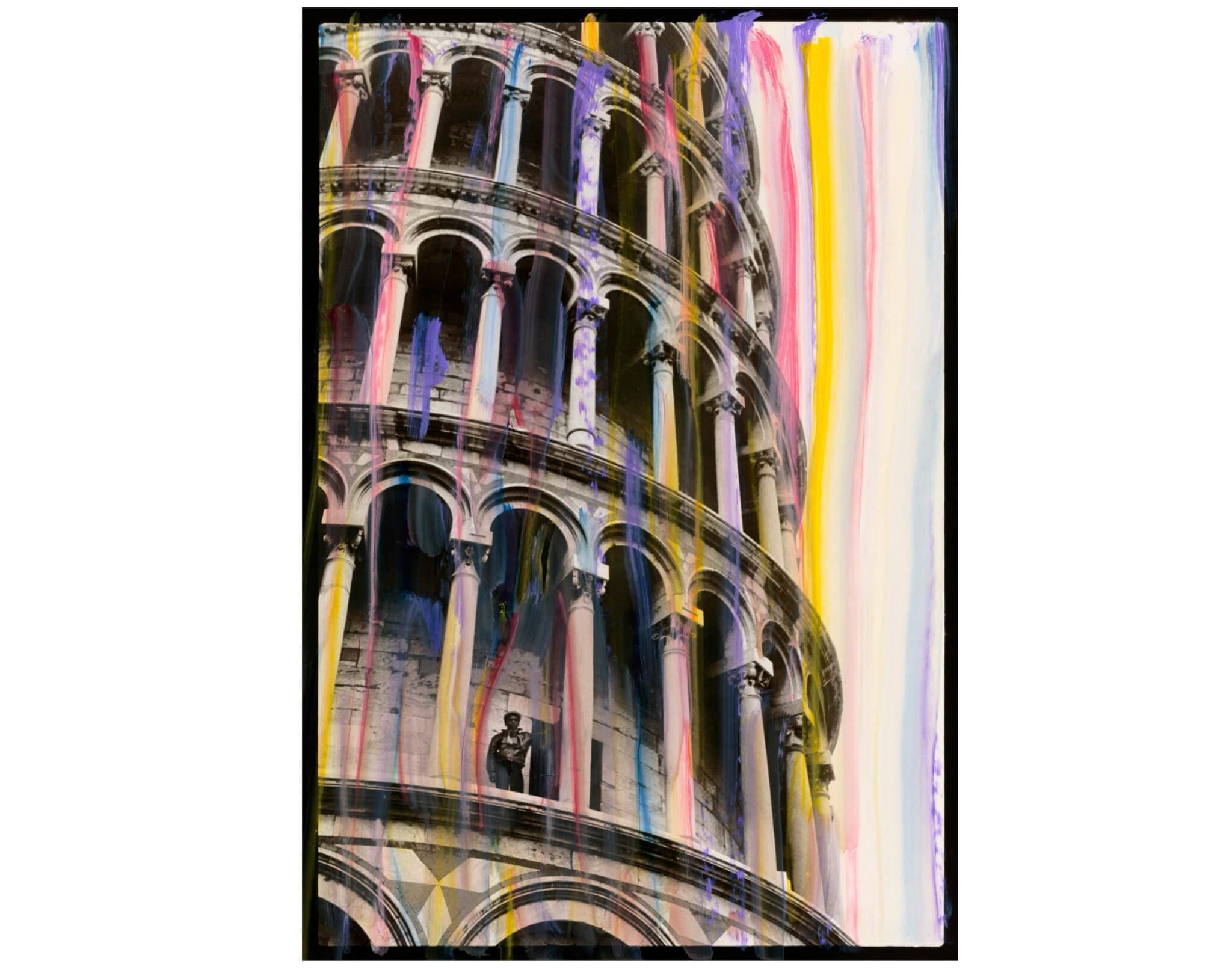
Ming Smith (United States, born 1947), Leaning Tower of Pisa, 1980. Pigment print on dibond, 60 x 40 inches. Courtesy of the artist and The Gund at Kenyon College.
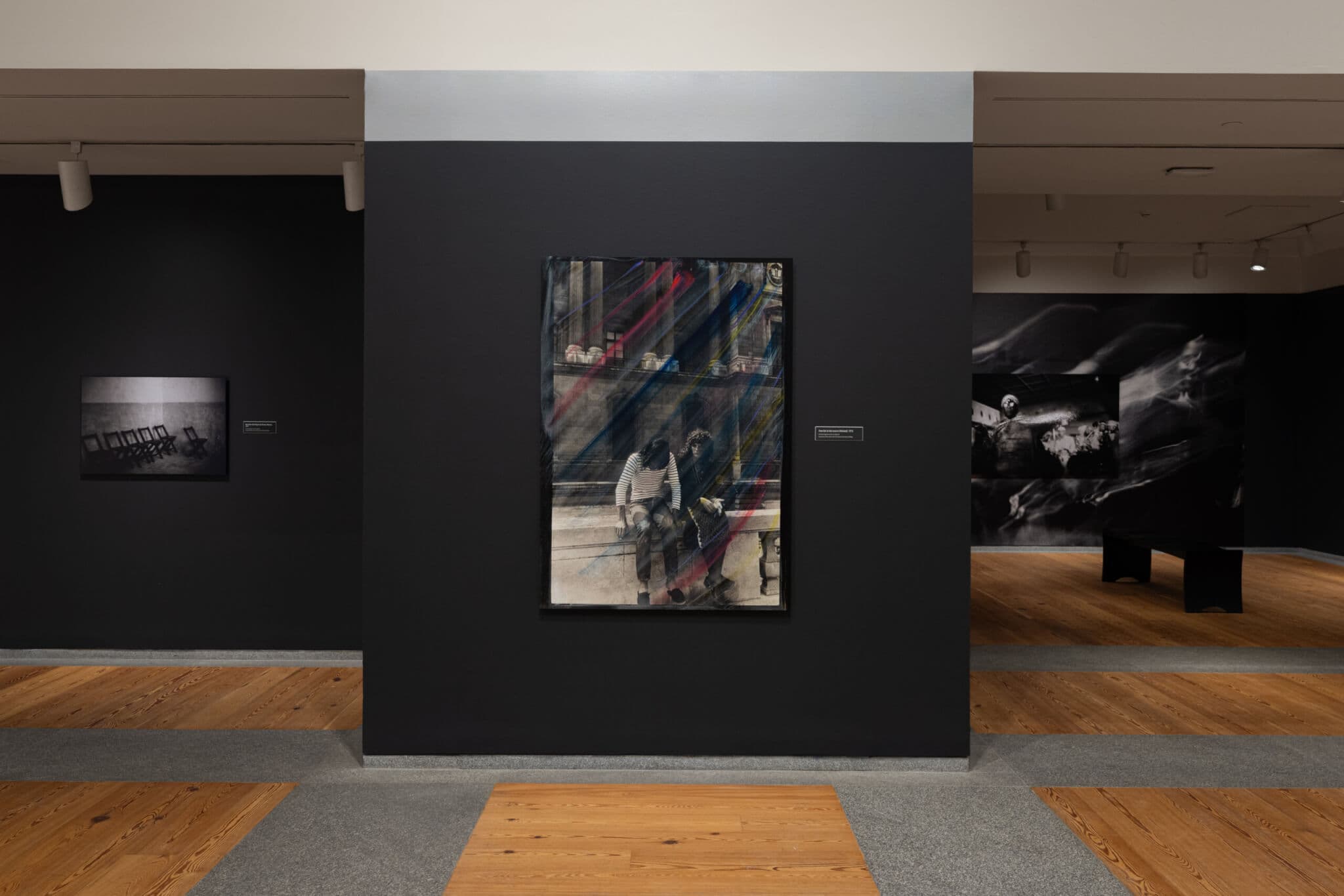
That the “blue” named in the title is not a chromatic reference becomes even more apparent upon entry into the exhibition. I was guided through the exhibition by the PMA’s Judy Glickman Lauder Curator of Photography Anjuli Lebowitz, and immediately greeted by a pink wall and a photograph of Smith herself, entitled Self Portrait (1989). Beyond the pink wall’s welcome, one encounters Smith photographs as wallpaper amidst the white and grey walls that make up the exhibition space. This richness of this palette is explored further in Smith’s early works. A testament to her attunement to the ensemble of light and dark at play in each image, her incorporation of unexpected colors is enhanced by the black and white film for which she is most famous. As I moved through the space, I gravitated to the works where Smith applied strokes and streams of paint to her photographs. In Leaning Tower of Pisa (1980), a Black man in a leather jacket places an outstretched arm on a column of the tower. His confidence grants the tower, a structure made infamous for its unstable foundation, a reprieve from a story of compensation. What Smith captures in the photograph and in the subject’s cool demeanor, she compounds with her addition of vibrant streaks of paint. These lines of yellow, blue, purple, red, and pink appear as reverberations from the tower. I wondered to myself if they might be manifestations of the energy exuding from the man posing within the structure. Smith, as photographer-painter, pulled my attention with pops of color, but what held my interest was the way she “paints with the light,” and the moments that entered and escaped illumination.
I did not forget about Self Portrait as I moved deeper into the exhibition space. A “mirror selfie” before such a phrase ever came to pass, Self Portrait features the artist still attached to her instrument. Smith holds the camera ever so gently between her fingertips. Positioned for a vertical frame, she squints, looking into the lens that will capture her. The camera covers half of her face; the machinations of self portraiture laid bare. A portrait of her process. A reflexive exercise to behold. What comes into focus in the blur of the photograph is only the intimate relationship between the photographer and her camera. Smith’s body contorts to accommodate and support the device. If a photograph is a “living thing,” as Smith put it in her 2026 conversation with Desrosiers at the PMA, Self Portrait is a work of symbiosis. A portal into the exhibition, Self Portrait showcases Smith’s ability to orchestrate a dynamic, mutualistic arrangement between the camera and the subject, even and especially when the subject is herself.
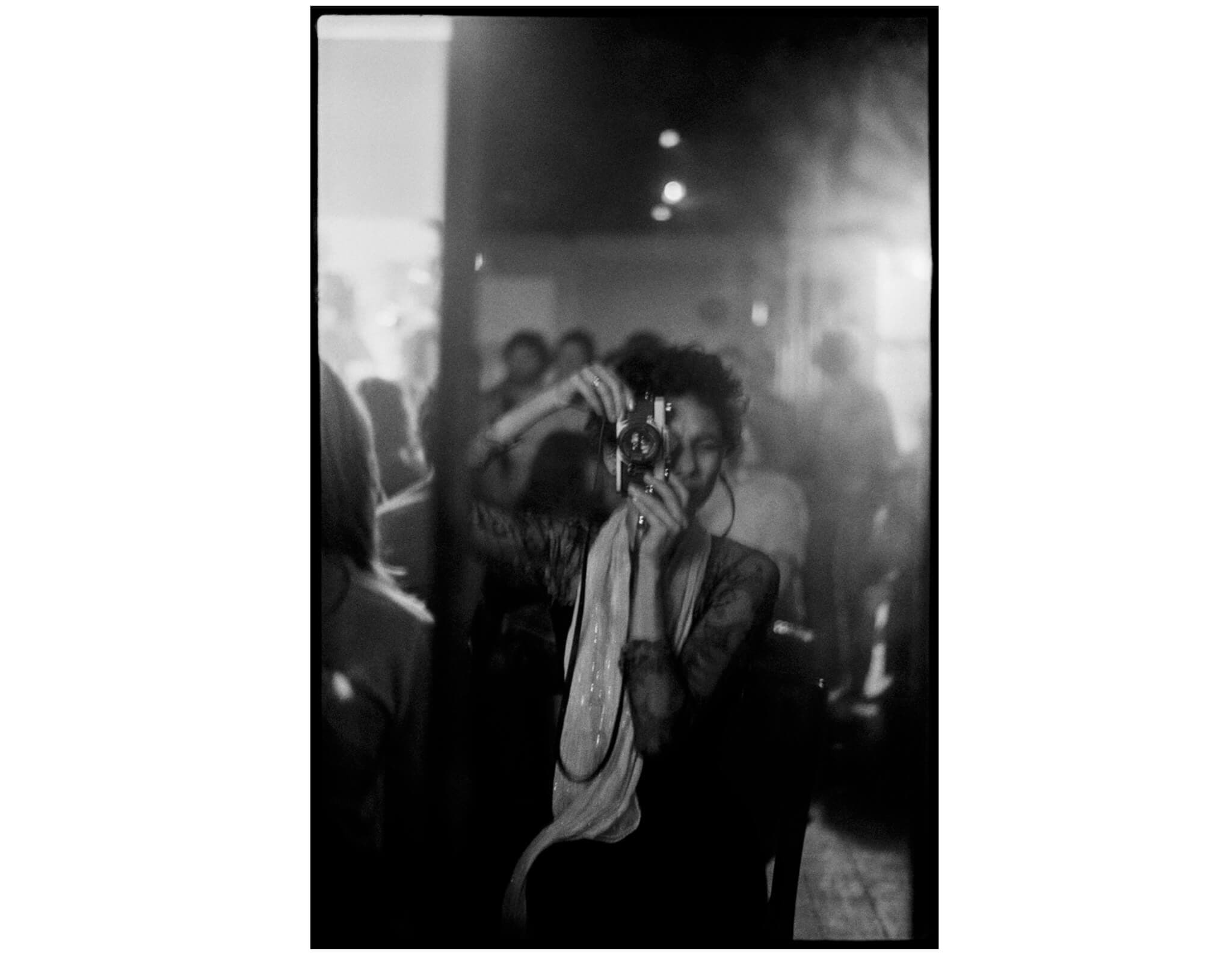
Ming Smith (United States, born 1947), Self-Portrait, 1989. Archival pigment print, 36 x 24 inches. Courtesy of the artist and The Gund at Kenyon College.
Self-Portrait as Josephine Baker (1986) offers another example of Smith’s gift for turning representations on their heads. The photographer portrays Baker, the iconic 1920s Black performer whose painful history with racial violence and segregation in her birthplace of St. Louis, Missouri, set the stage from her emergence as a civil rights activist and an enigmatic expatriate to Paris where she later renounced her American citizenship. Merging her past as a model with the insight she has acquired as a photographer, Smith poses knowingly, as herself, as Baker, and as image-maker. A blue note in Smith’s jazz requiem, this photograph is a meditation on the notes that linger long after they are played. A conduit for her craft, Smith acts as a placeholder for a past self and a deceased icon. Her presence vibrates with the hum of history.
In Smith’s photographs, grief and gratitude appear in her attention color, motion, and form. Figures who have now entered the ancestral realm are captured in a time before their passage and in others, the loss is pictured in the aftermath of their transition. The late great dancer and choreographer Judith Jamison and the inimitable jazz experimentalist Sun Ra make their appearances. The latter glitters and glides in Sun Ra Space I (1978), a photograph where Smith captures the artist in motion, his shimmering cape a constellation. The former, in Judith Jamison (1981), stands still in a sliver of light, a costumed performer resting in the warmth of her interior world. My Father’s Tears (San Miguel de Allende, Mexico) (1977), an experiment in hand-tinting, registers the passing of Smith’s father in an intimate tinted photograph of a church sculpture she encountered during her travels in Mexico. For Brassai (Paris, France) (1979) features a solitary diner amidst the flow of restaurant work in a nod to Hungarian–French photographer Brassaï’s stylistic and technical endeavors to “immobilize” the ephemeral quality of urban life. That same year, Smith met and photographed Brassaï in New York. In 1984, just five years later, Brassaï passed away.
My favorite photograph in the exhibition, Nuns in Rome (1988), indexes another kind of grief entirely. The image, taken on Smith’s second trip to Rome in the late ’80s, reflects the moment when the artist “saw [her] first black nun.” In the photograph itself, one makes out nuns in the blurry assembly of figures from the headcovering and long skirts and the familiar colorblocking of Catholic service. Yet, the kind of blackness to which Smith refers is not seen so much as felt in Smith’s story of her pursuit after the nuns which preceded the photograph. Here, there is no clear picture of a single nun to be identified as Black or clarity as to how each nun pictured might fare before the aesthetic regime of racialization. What is clarified by the photograph however is Smith’s earnest eagerness for the familiar, her search for Blackness beyond the borders of her birthplace, and her discovery of a Blackness that exceeds visuality. On display here in this photograph and throughout the exhibition is Smith’s ability to not only capture light but to complicate our engagement with the darkness that precedes it. In this way, “Jazz Requiem” invokes the opposite of what Fred Moten describes as “a history of photography as a scientizing aid for realist painting.”1 This is Smith’s photography of her history, captured and painted by her hand. Each image, an experiment aided by technology but never bound to its explanatory or expressive boundaries.
—1 Fred Moten, “Preface for a Solo by Miles Davis,” Women & Performance: A Journal of Feminist Theory 17, no. 2 (2007), 217–46.
“Ming Smith: Jazz Requiem” is on view through June 7, 2026, at Portland Museum of Art, 7 Congress Street, Portland, ME.