On the evening of March 31, a group of roughly ten anonymous cultural workers projected a five-minute protest video of looped messages onto the Fenway façade of the Museum of Fine Arts (MFA), Boston. The anonymous calls, written in the institution’s own branded font, began just after 9:00 p.m. with questions playing on the museum’s branded tagline from its 2022 rebrand: “Here All Belong?” and “Who Belongs Here?” before answering the question with stark data. “No DEI Leader. No Black Curators. No Muslim Curators. No Arab Curators. No Indigenous Curators.”
The group designed the action to create public awareness and accountability for the institution’s sudden layoffs, which impacted over 6 percent of its workforce in late January, including sixteen union members, the directors of its inclusion and learning departments, and many curators of color. The resulting Instagram video was shared collectively on the accounts of Ayia Elsadig, Boston Art Activation, Design Studio for Social Intervention (DS4SI), and the Silence Dogood project. The projection doesn’t name individuals directly, but prior reporting by Boston Art Review in January includes a full list of everyone laid off.
The reduction was presented as a $5.4 million solution to the museum’s $13 million operating deficit; no other strategies to address the remaining $7.6 million deficit have been communicated in the months since. The institution has an endowment of $830 million. The lack of transparency surrounding the layoffs and targeting of specific departments, including those that supported teens, community engagement, and young people of color, have eroded staff and public trust. A change.org petition to reinstate Black and Indigenous staff has garnered over 2,500 signatures.
For colleagues in the space, the move also signaled a stark departure from diversity, equity, and inclusion initiatives, publicly championed as a commitment of the MFA in 2022. The museum was previously embroiled in a public scandal in 2019 when students of color were harassed during a school visit, causing the institution to sign a memorandum of understanding (MOU) with the MA attorney general, which expired in 2024.
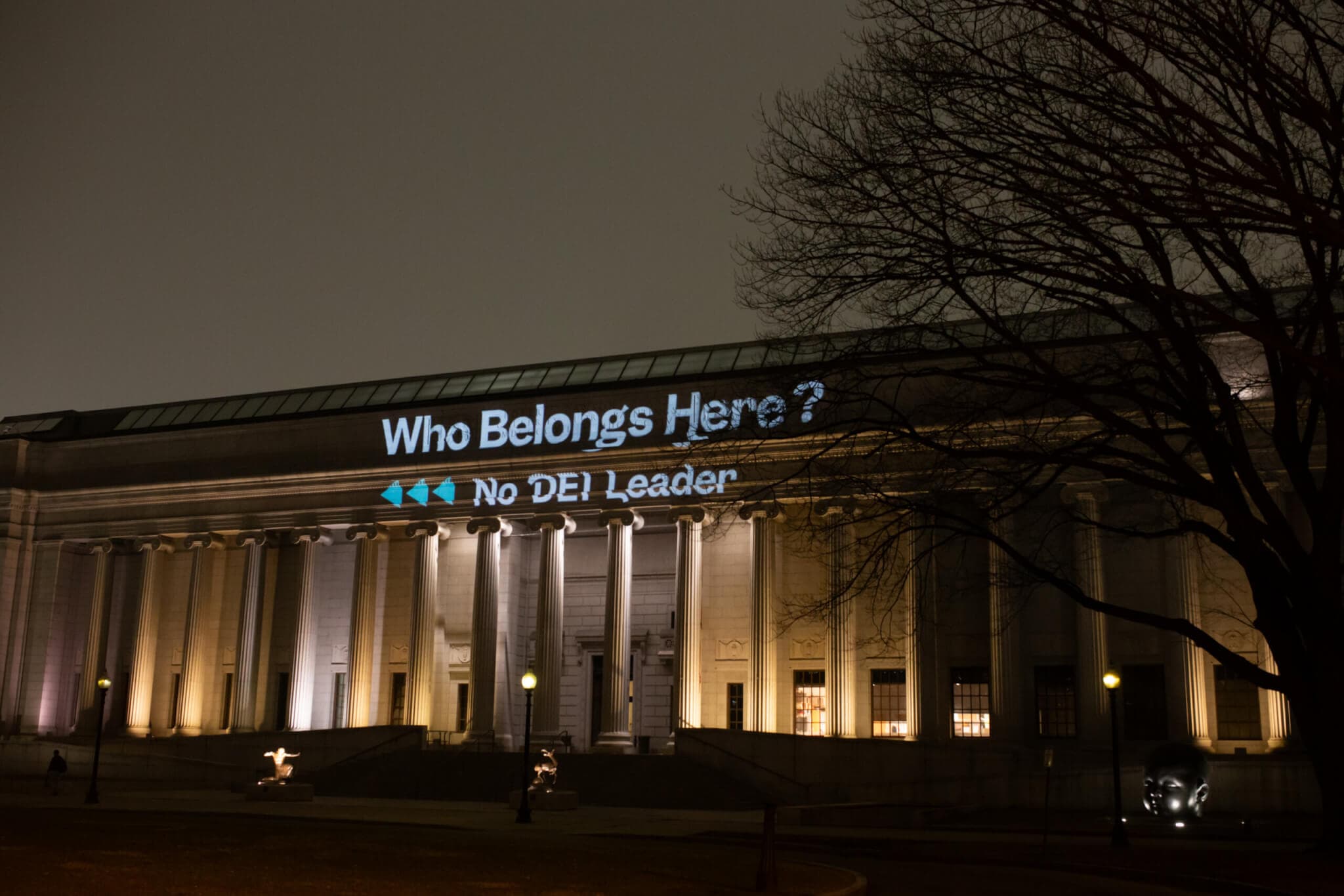
Text projected on the Fenway entrance of the Museum of Fine Arts, Boston on March 31, 2026. Photo by Marianna McMurdock for Boston Art Review.
“Where is that [commitment] now? And what kind of leadership walks away from a commitment as easy and quickly as that?” Lori Lobenstine, co-founder and program design director with DS4SI, told BAR. “…It’s stunning that we are even talking about ‘the only’ Black curator, or ‘the only’ Indigenous curator. And the MFA is walking away from their commitments even at the cost of their ability to showcase their amazing collection and tell stories from multiple perspectives.”
Lobenstine was one of several concerned cultural workers who produced Tuesday’s action. After witnessing how quickly the layoffs faded from discourse and local news, she wanted “to figure out how we can make more people know.”
“What are they going to do about the things that are supposed to be happening? How did an endowed position get cut?” she asked outside the MFA as projections faded.
Boston Art Activation is a group seeking accountability and dialogue for the area’s arts and cultural community, naming the layoffs as part of a pattern of systemic racism in museums. It has already hosted and is seeking to host additional unsanctioned tours of the MFA, which highlight structural inequities and the impact of the cuts. The tours specifically discuss what art is shown or avoided, and where.
Several members of the group met with other concerned cultural workers over recent weeks to process and discuss how they wanted to continue the conversation through an action, landing ultimately on the question of who (and what) belongs in a cultural institution.
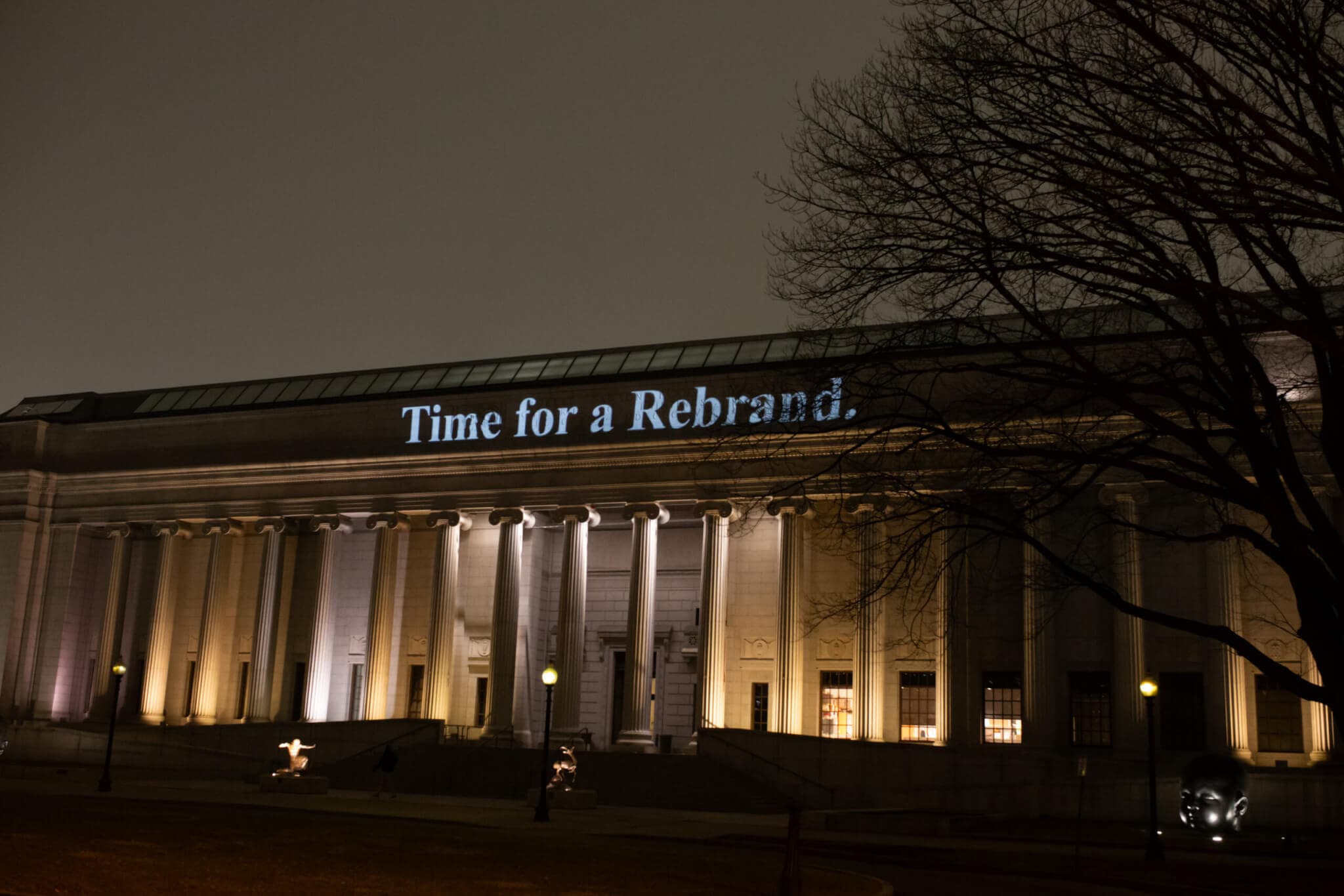
“Time for a Rebrand” is projected on the Fenway entrance of the Museum of Fine Arts, Boston on March 31, 2026. Photo by Marianna McMurdock for Boston Art Review.
They intentionally utilized “the branding of the museum and how contradictory it feels to how decisions are being made,” said Diane Dwyer, an artist who provided the projection technology as well as support for the messaging production with the group behind the action. She is also one of about a dozen artists behind the Silence Dogood project, which has brought guerrilla projections about revolution to historical sites across the region.
It is disappointing, she said, that this moment of targeted attacks on cultural institutions has not been met with more organizing for those struggling through layoffs and the arts more generally. Instead, many disengage from cultural institutions that lose their trust, like the Kennedy Center or the MFA, Boston, stating in the comments of the projection video, even, that they will cancel memberships. “I just wish this could have been a moment of solidarity and, you know, mutual support,” said Dwyer.