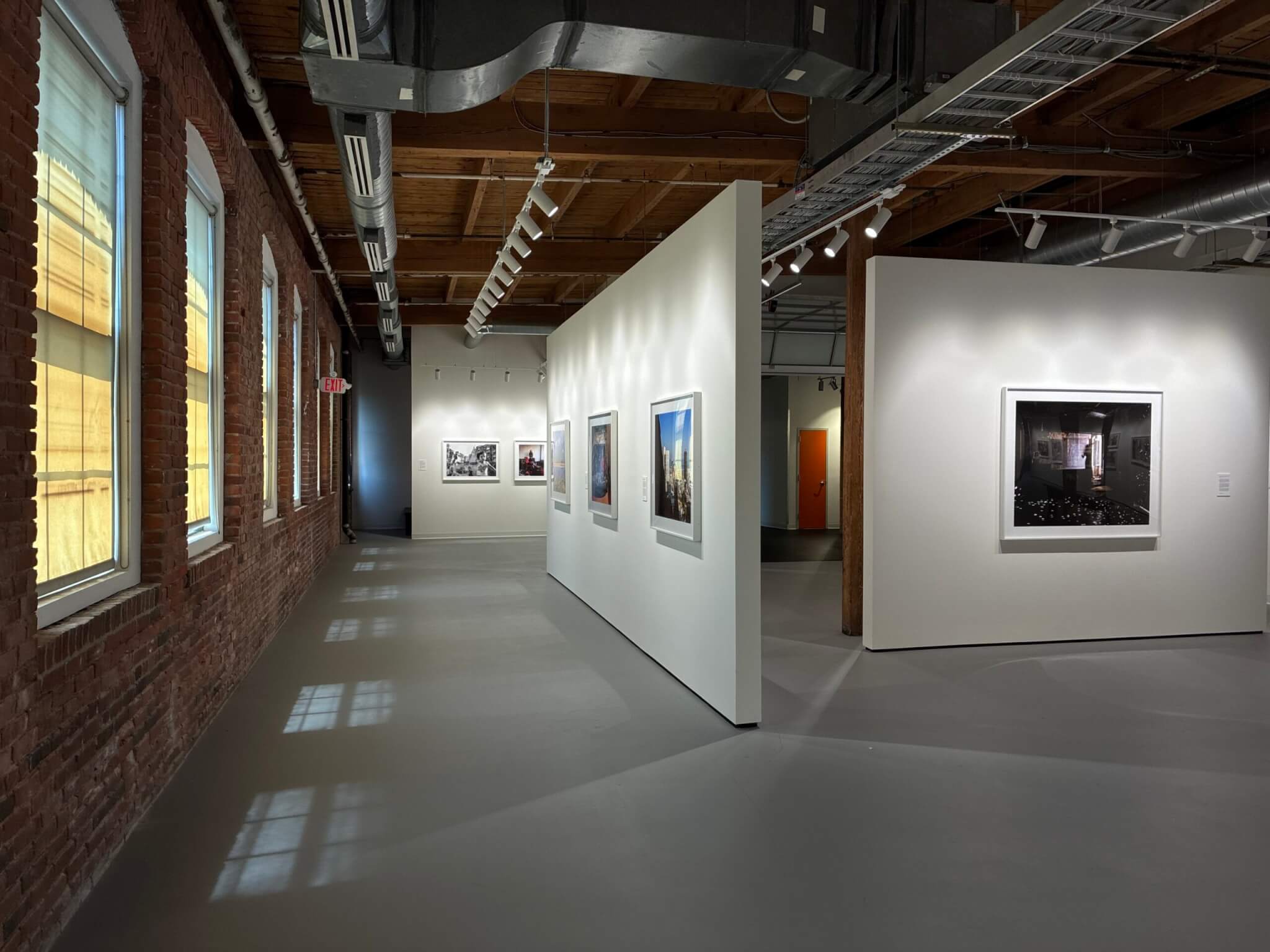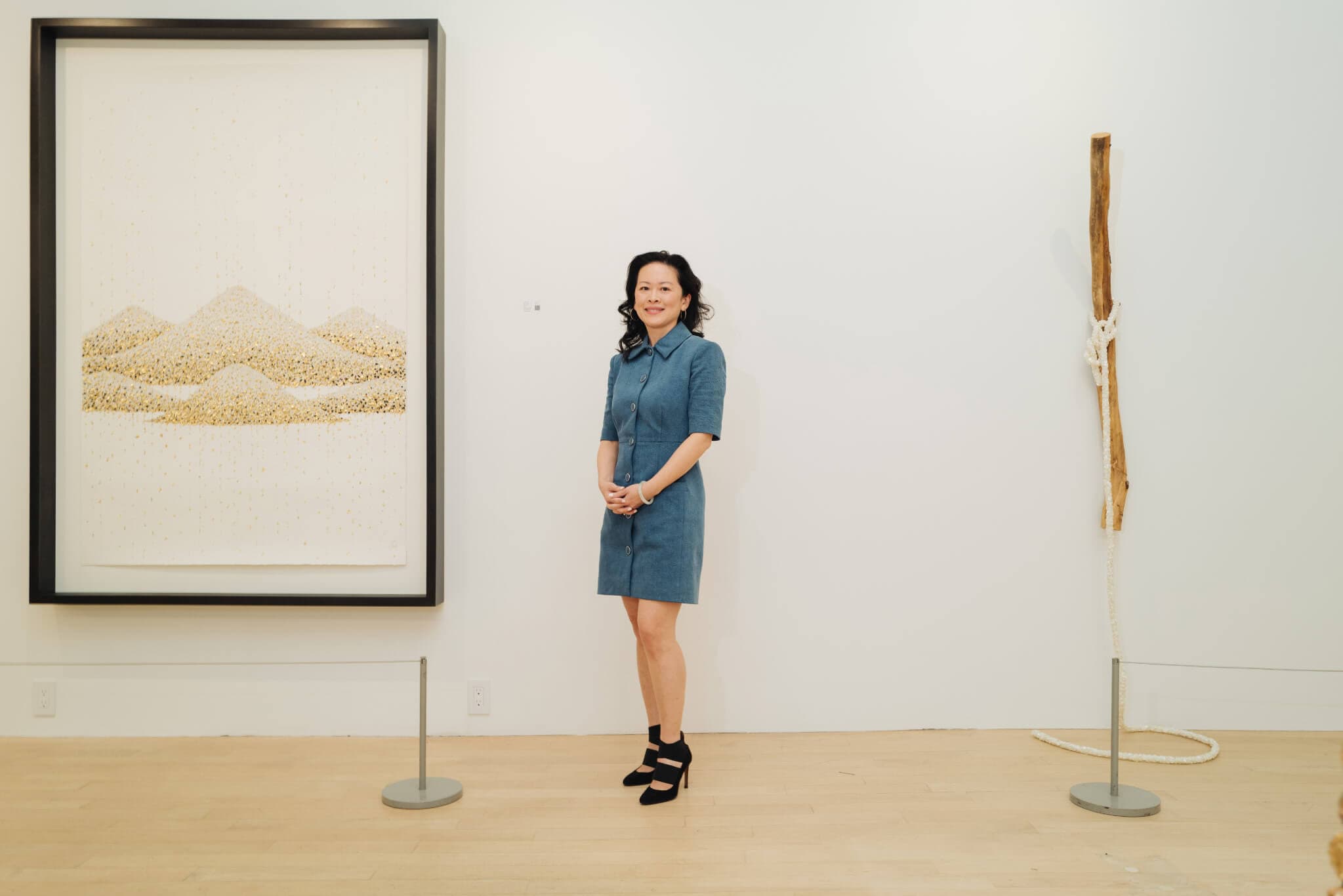
On March 13, Praise Shadows opened its new Downtown Boston location with “Summoning,” a group exhibition that drew a significant turnout of people to the gallery’s expanded, light-filled space at 129 Kingston Street. Framed by large windows, the opening marked a significant step for the five-year-old gallery and a notable addition to the city’s evolving cultural footprint.
Inside, the buzzy crowd moved between works by thirteen artists, including a new painting by Duke Riley, photographs by S. Billie Mandle, and sculpture by Cathy Lu. The exhibition, on view through April 11, invites artists and audiences alike to “summon” people, ideas, and memories into the space—a conceptual framing that doubles as a kind of inauguration for the gallery’s next phase.
In December 2020, at the height of the Covid pandemic, Yng-Ru Chen opened Praise Shadows in an intimate storefront right around the corner from where she grew up in Brookline’s Coolidge Corner. After spending twenty-five years working in arts institutions in New York City, Chen brought an ambitious perspective to her new endeavor. Over the course of five years, she built an impressive roster of both locally and internationally renowned artists including Jean Shin, Yuri Shimojo, Yu-Wen Wu, Helina Metafaria, and Oliver Jeffers, among others.
For Chen, the move signals a doubling-down on Boston amid an increasingly precarious commercial gallery scene here. She points to City leaders who made the move possible—including Mayor Michelle Wu, former director of cultural planning Joseph Zeal-Henry, and former chief of staff Tiffany Chu. Their support, alongside partners like the Downtown Boston Alliance and Arts and Business Council of Greater Boston (who functioned as the fiscal sponsor to receive the City’s grant), helped bring the new space to fruition.
During the opening night, Zeal-Henry, who was recently appointed as the City of Boston’s new chief of arts and culture, presented Chen with a certificate of recognition for her contributions to the city’s arts ecosystem.
“We’re excited to welcome Praise Shadows to Downtown Boston—a gallery that will build pathways for our artists and emerging curators, and writers to thrive in our city,” said Mayor Wu in a press statement. “Through fellowship programs, professional exhibition opportunities for student artists, and free public programming, Praise Shadows will help nurture local talent and make high-quality art accessible to everyone – uplifting and supporting the next generation of artists while welcoming residents and tourists to a vibrant Downtown,” she continued.
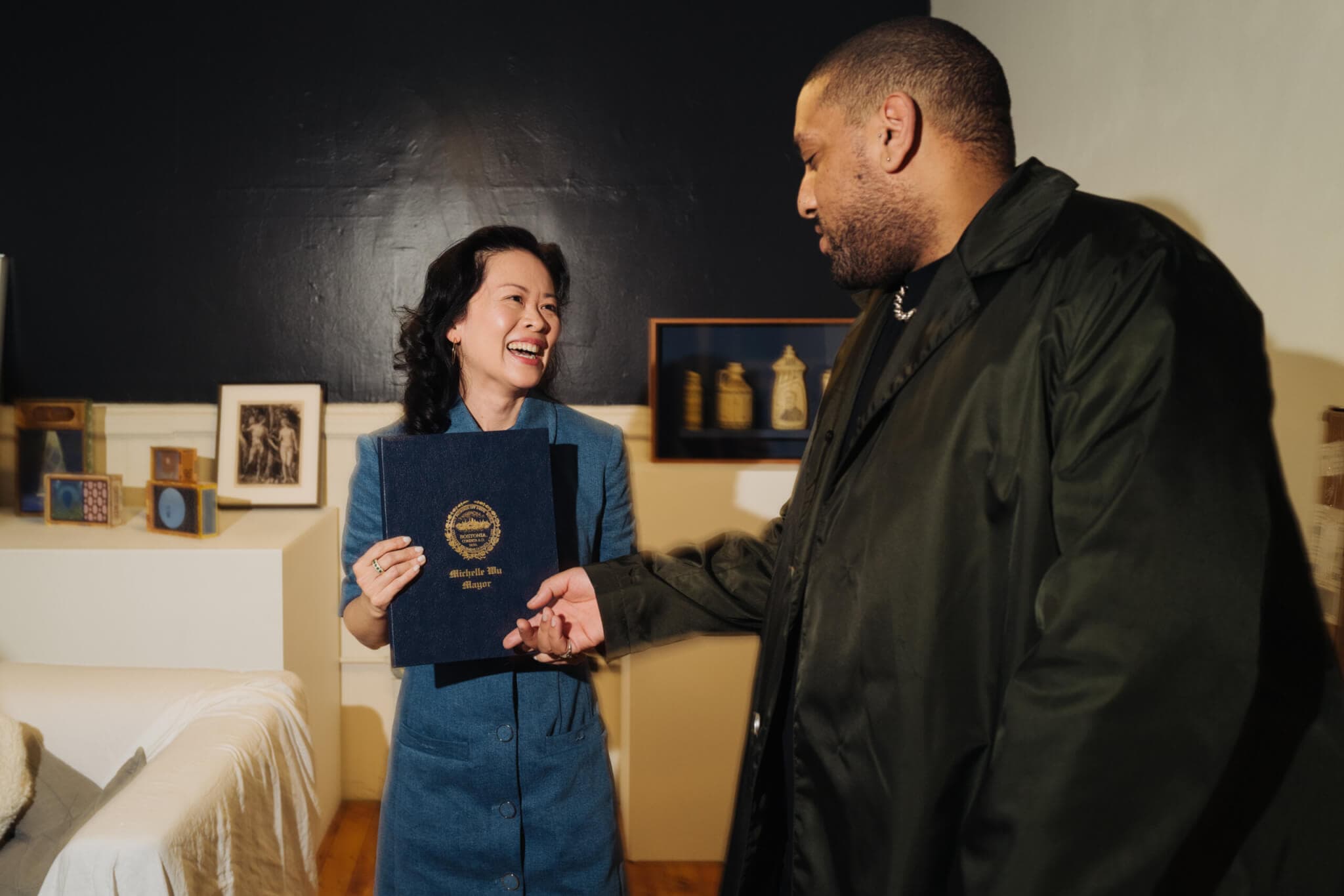
Joseph Zeal-Henry presented Yng-Ru Chen with a certificate of recognition from Mayor Michelle Wu. Photo by Vikram Valluri/BFA.com.
In its new location on Kingston Street, Praise Shadows now has two thousand square feet of exhibition space, as well as an upper floor with an office, a private viewing room, and storage. The gallery’s tall ceilings and columns create an atmosphere reminiscent of post-industrial lofts in Soho or Tribeca, familiar to those from the art world, Chen said.
“I saw it from the outside and thought, ‘This is it. It has to be it,” she shared. “It takes a New York frame of reference into a Boston gallery.”
The building, constructed in the early twentieth century, is a six-story block of offices and is also home to architecture firms Marcus Gleysteen Architects and Studio Enée. It is owned and managed by the Druker Company, known for multiple development projects in the Boston area, including the Heritage On The Garden in the Back Bay and Atelier 505 in the South End.
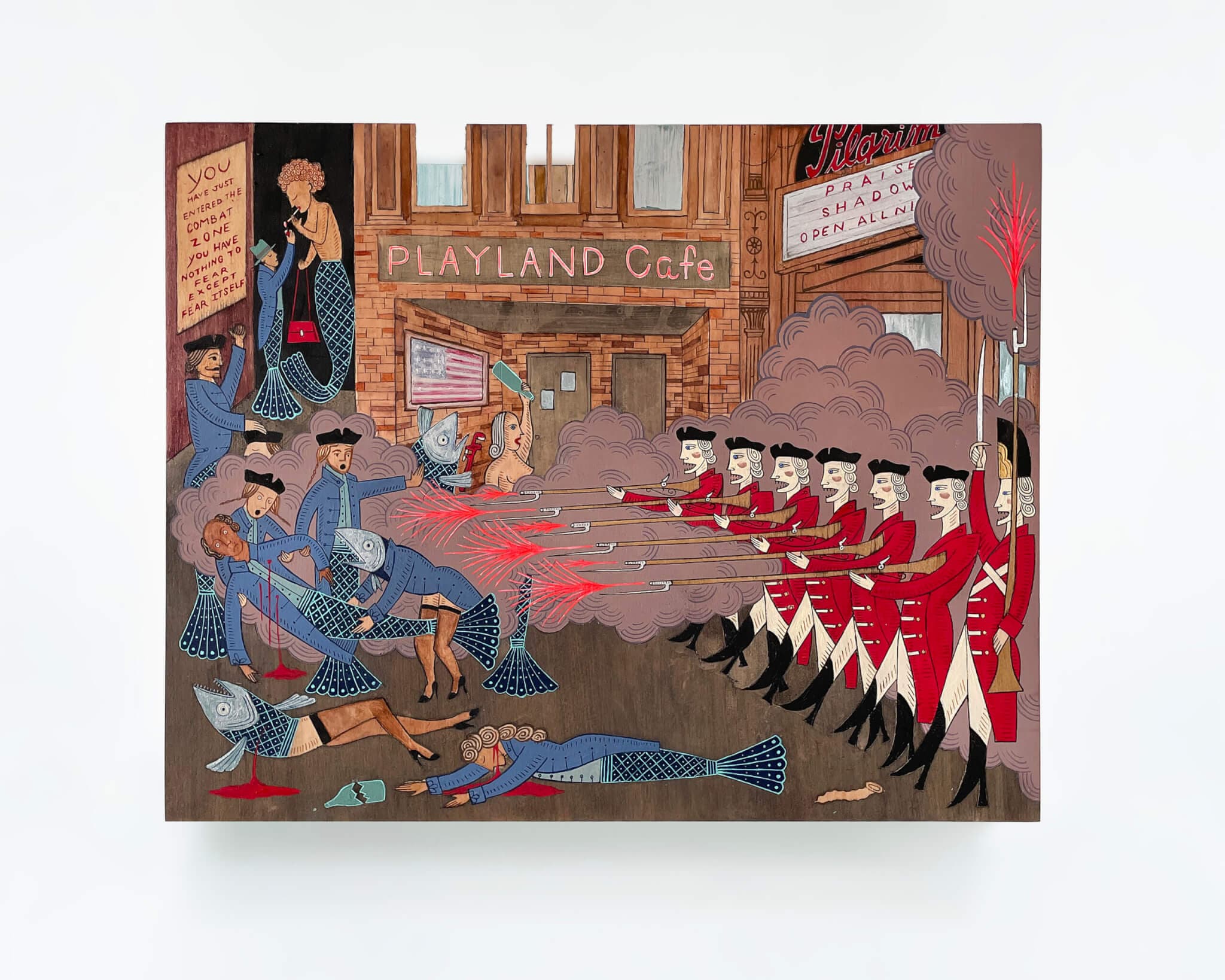
To mark the occasion through a new painting, Duke Riley drew on memories of Boston’s Combat Zone, a city-sanctioned red-light district near Chinatown that operated from the 1960s to the early 1990s. Pictured: Duke Riley, Praise Shadows, 2026. Gouache, ink, and wood stain on wood panel, blackened steel frame. 18 1/2 x 22 1/2 inches (including frame). Image courtesy the artist and Praise Shadows, Boston.
Although the new space is geographically located in the Leather District, a nine-block neighborhood tucked between the Financial and Theater Districts, it is also only a few steps away from the Chinatown Gate. Nearby, Praise Shadows joins a roster of cultural spaces in the neighborhood: The gallery overlooks the Rose Kennedy Greenway’s Auntie Kay & Uncle Frank Chin Park while nearby cultural and community hubs include Pao Arts Center, Blue Triangle, and the Asian Community Development Corporation.
A successful art gallery joining Chinatown’s growing arts and culture ecosystem offers more opportunities for connection in the neighborhood, said Cynthia Woo, director of the Pao Arts Center.
“We welcome anyone who wants to come play in our sandbox and work with our community and build those bridges in any way that’s appropriate,” she said. “We’re certainly here to collaborate when the opportunity arises to uplift and celebrate Chinatown.”
“There’s deep excitement on my end to have collaborations with institutions that are nearby or with the city,” Chen shared. “[The new location] is about diversifying how we showcase artwork and what our artists are able to do.” In addition to the news of the opening, Praise Shadows announced on March 5, that Rebecca Hayes has been hired as director of sales—a new position for the gallery.
Praise Shadows will host three solo shows throughout 2026, all featuring Boston-based artists. Crystalle Lacouture will have an exhibition in April and Juan José Barboza-Gubo in September. Both artists are represented by Praise Shadows. Brooke Stewart will follow in November.
Due to limited gallery space in the city, the type and scale of work Boston artists can create is often limited by the spaces it can be shown or stored in. The size of 129 Kingston Street offers the opportunity for artists to push their practices. In conversations with artists whose work will be shown this year, each noted how the increase in square footage has shifted the ways they are preparing for their exhibitions.
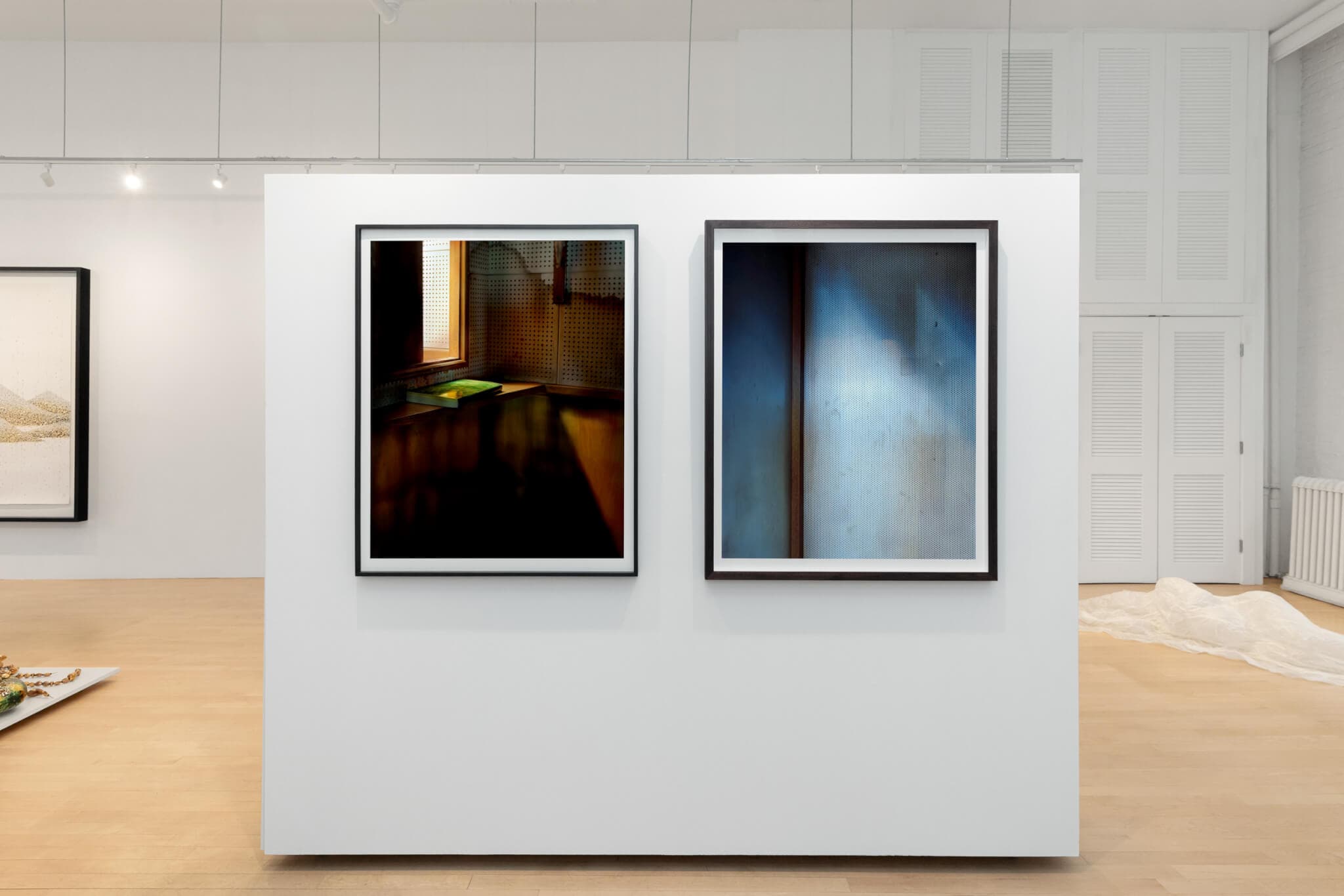
Pictured at center S. Billie Mandle, (left) Saint Christopher, 2008–18 and (right) Saint Peter, 2008–18. Installation view, “Summoning,” on view at Praise Shadows March 13–April 11, 2026. Photo by Dan Watkins for Praise Shadows, Boston.
“I feel really honored by the faith she has in my work and in me,” Lacouture said. “With that, I’ve been absolutely cranking. No fun time, just head down, completely working to pull this off in the best way I can for myself, for the gallery, for her. I’m going to work until this is exactly right.”
Lacouture’s mediums are typically painting, drawing, and woodblock printing—but she felt that two-dimensional work hanging on the walls might not feel like enough for the increase in physical space in the new gallery. To adapt, Lacouture is creating a centerpiece sculpture of six standalone lanterns, which will offer viewers an immersive experience.
Lacouture says she’s also planning a light component to her pieces to catch the attention of passersby and take advantage of the large windows. “It’s my first solo show in two-and-a-half years and I’m trying some really crazy things, but I’m going for it,” she said.
Barboza-Gubo is also hard at work preparing for his solo show in the fall, working out of his studio in Lima, Peru. “I’m super excited that finally a gallery like this exists in Boston,” he said. “I’ve been in Boston for so many years and people really don’t take risks. [Chen] is finally doing it. She has such a clear idea of what she wants that it doesn’t matter where she is.”
Like Lacouture, Barboza-Gubo also pivoted his original plans for the show to include larger plexiglass sculpture installations, which he will transport back to Boston.
“The floor plan of the [new] gallery is almost four times bigger than the one in Brookline. All of us are going to really have to think about what we’re going to do because it can really eat you,” he said. “You have to be really smart about how to divide the space to really work well with your pieces.”
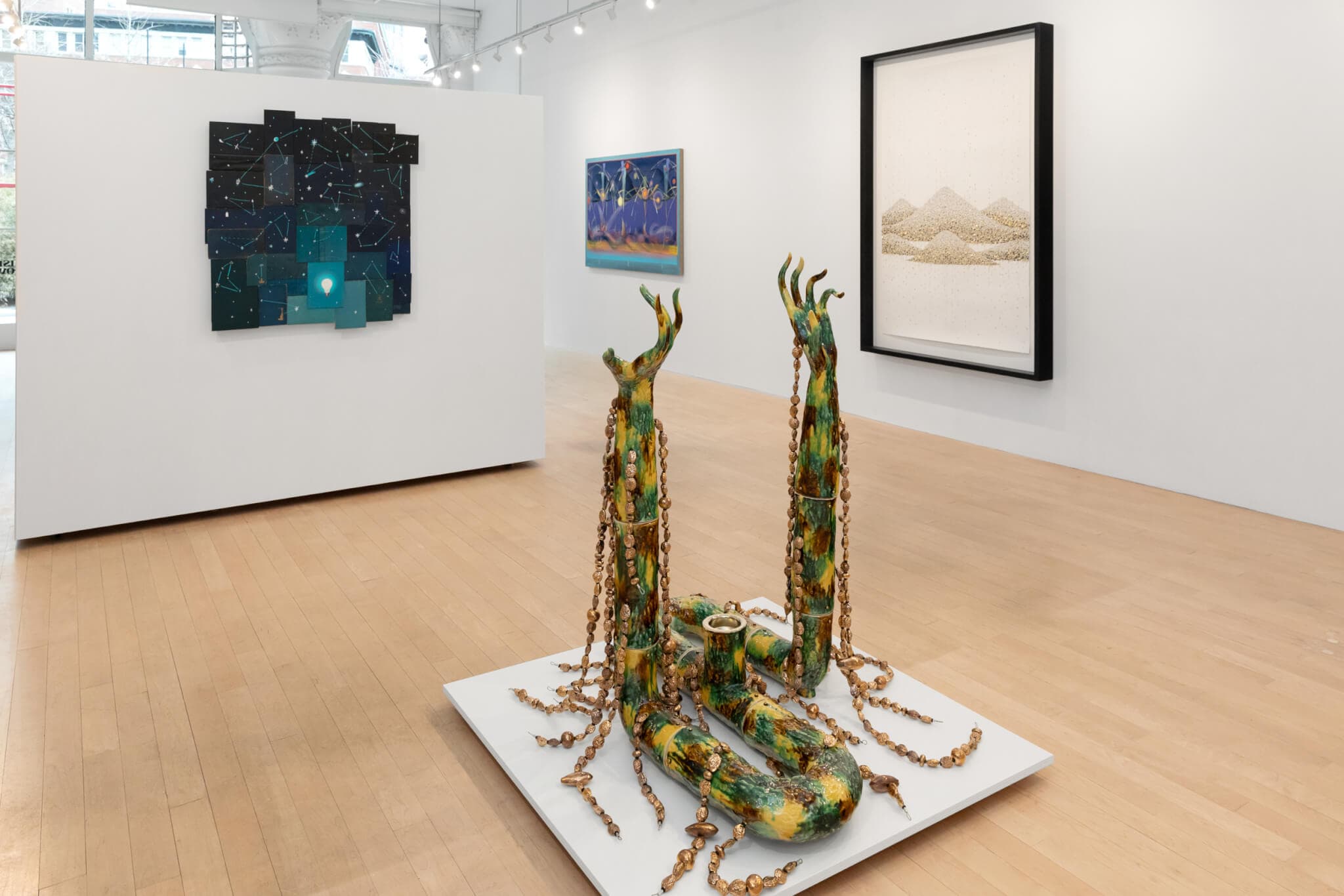
Installation view, “Summoning,” on view at Praise Shadows March 13–April 11, 2026. Photo by Dan Watkins for Praise Shadows, Boston.
While Stewart is already accustomed to painting large-scale pieces, she is looking forward to using stained glass for her first solo show. She hopes to use daylight as a medium by taking advantage of the tall windows and the light passing through both sides of the gallery.
Stewart’s works explore the intersection of art and sports and invite the viewer to be a player, not just a spectator. The pieces for her Praise Shadows show will feature scoreboards and clocks, representing the moments when the game clock is “the only thing that feels like a reality,” she said, and will encourage viewers to move around the space.
“What I love about the recent movement in Boston is there’s a lot of amazing female leaders and curators in our city that I find really exciting,” she said. “I’d love to see more commercial galleries do shows that are more about the power of art because I think there’s a lot of people in Boston who are looking for really strong meaningful work.”
The gallery is fully scheduled into 2028, but Chen said she also wants to spend the first year understanding the gallery’s new audience and how best to integrate into the community and surrounding neighborhoods.
“I’m very much the kind of person who’s focused on the present,” she said. “If you plan too far ahead, you’re missing the target that’s right in front of you—the people, the lives, the joy.”
Editorial note:Boston Art Review collaborates with Praise Shadows on a shared art writing fellowship curriculum and does not have a financial relationship with the gallery. This article was independently reported by a non-staff contributor, and interviews were conducted without involvement from Boston Art Review staff.