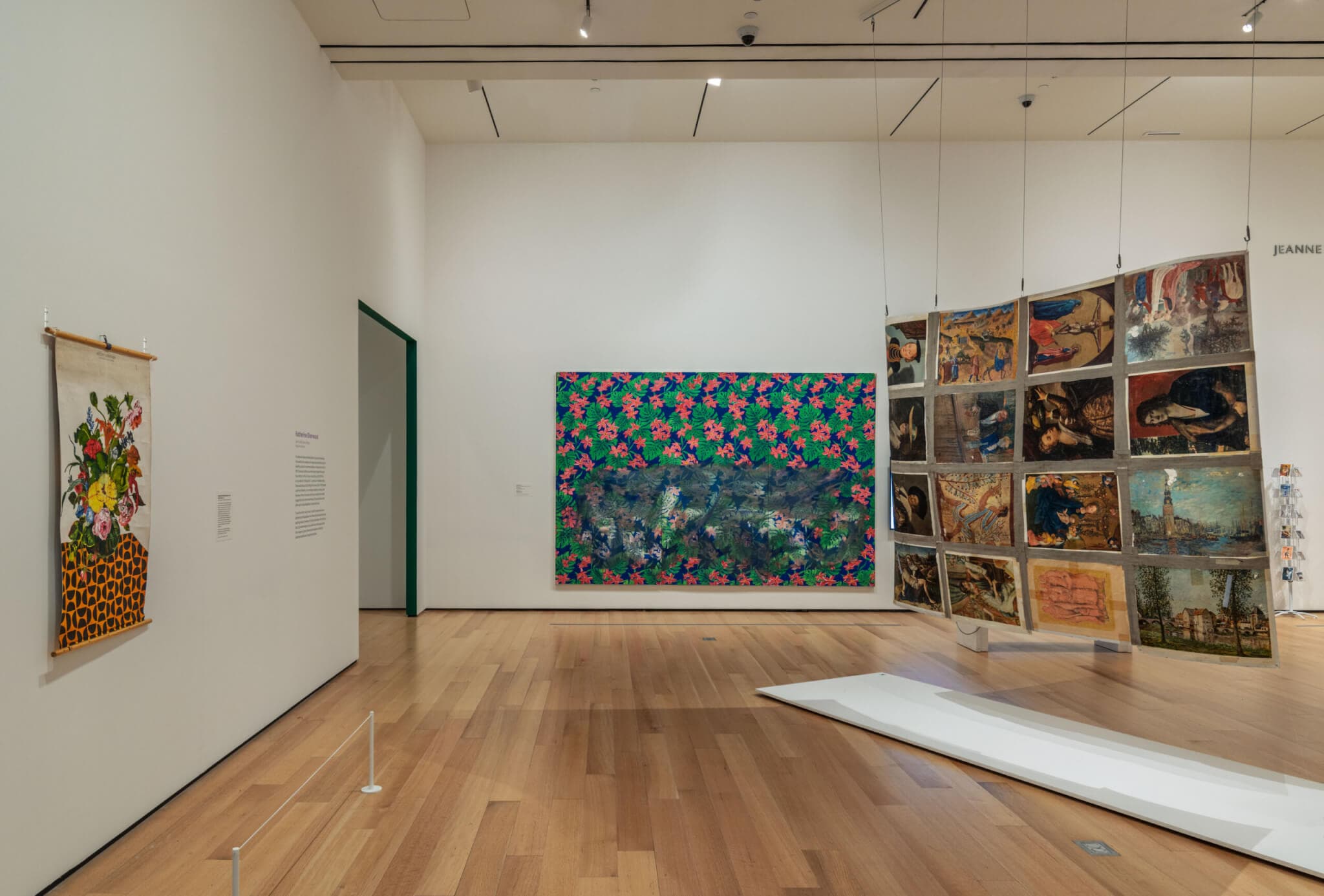
How many more shows do we need on the theme of the nude form? For many encyclopedic museums, this frequent trope is used to feature collection works that simply restage the status quo. Thankfully, in “Subvert, Repair, Reclaim: Contemporary Artists Take Back the Nude,” on view through August 2, curator Carmen Hermo has complemented six works from the MFA Boston’s collection of contemporary artworks with new loans and acquisitions that playfully and more complexly render the nude. Presenting over sixty works made by primarily femme and queer artists, including Xandra Ibarra, the late Nona Faustine, Salman Toor, and Maya Jeffereis, “Subvert, Repair, Reclaim” presents a compelling argument for more anti-colonial photography, paintings, collages, video, and sculpture that center people of color and LGBTQ+ subjects in the nude as necessary challenges to the fetishizing gaze inherent to our dominant Western art historical canon.
Entering the gallery, viewers are first treated to a large screen projecting Xandra Ibarra’s cheeky video Turn Around Sidepiece (2018), in which the artist, clad in nothing but a pair of socks and sneakers, is seated upon a rotating white marble platform. Reclining in a pose familiar to Ingres’s Grande Odalisque (1814) and other classic nudes, Ibarra both returns and refuses the male gaze—a critical gesture she took to even further extreme in a live performance of Nude Laughing on April 16. That evening, the artist strutted through the museum’s second-floor galleries wearing nothing but a pair of banana-yellow pumps and a ridiculous faux-nude breast covering, dragging a nylon stocking filled with wigs and other femme accessories. Her laughter—at moments sharp and derisive, other times coquettish and coy—was heightened for the many nudes on display at the MFA, in an act of sonically and spatially making room for women of color to represent themselves rather than be the objectified, silent muses of the white male imaginary.
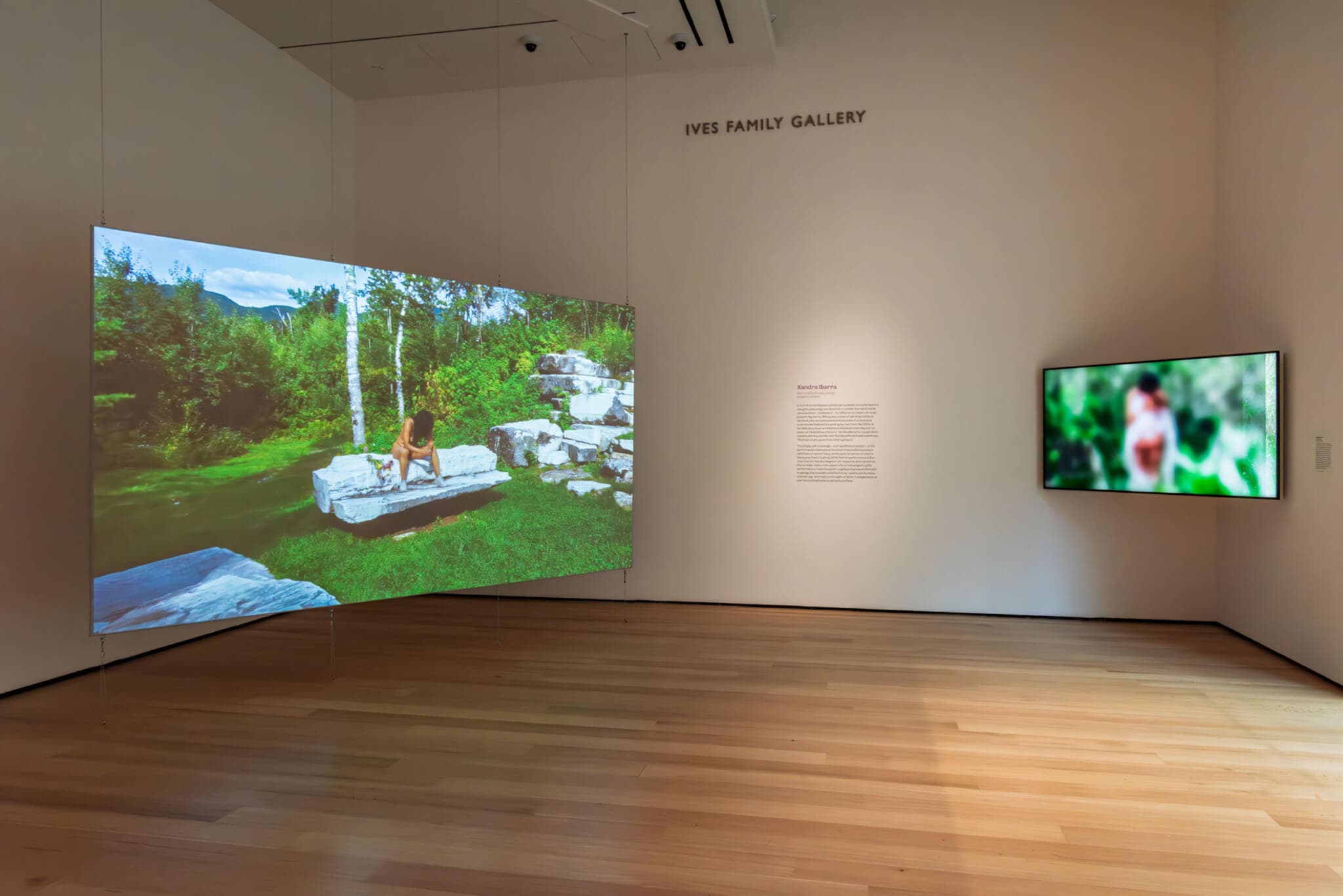
Xandra Ibarra, Turn Around Sidepiece, 2018. Installation view, “Subvert, Repair, Reclaim: Contemporary Artists Take Back the Nude,” the Museum of Fine Arts, Boston, April 4, 2026, to August 2, 2026. Linde Family Wing for Contemporary Art. Photograph © Museum of Fine Arts, Boston.
While that performance has already been the subject of a puritanical internet scandal in the local Boston press and covered in national news outlets like Hyperallergic, it is important to consider Nude Laughing in the context of Hermo’s larger exhibition. Ibarra’s strategy of brazen humor, while replicated in Turn Around Sidepiece, is a novel one within the show, whose tone more frequently lands in the realm of the quietly critical. For example, Maya Jeffereis’s Where shapes and forms become soft (2026) redacts the two women (one white, one Black) depicted in Jean-Léon Gérôme’s Moorish Bath (1870), producing a ghostly blur, while Mary Enoch Elizabeth Baxter recreates Thomas Eakins’s 1880s photographs of a young Black girl in the Consecration to Mary (2021) series and quite literally covers the child’s unclothed form to protect her from our prying eyes.
Perhaps the most subtly moving pieces in the exhibition are Cato Ouyang’s sculptural forms composed of an array of materials, including pine, plaster, horse hair, shells, beeswax, epoxy, and clay. Drawing from four Balthus paintings of his eleven-year-old muse, Thérèse Blanchard, the headless body of reliquary corpus (Thérèse Dreaming, 1938) (2022) contains within its open chest cavity stones and other fetish objects, delicate interiors that contrast with her more grotesquely sculpted and hairy exposed crotch. Nearby, Ouyang’s Janus-faced Martyr for Freedom (after Edmonia Lewis) (2022) stands as a silent sentry watching over Thérèse. One half-bust shows Union officer Robert Gould Shaw as carved by Lewis; its other face is a resting head of Guan Yin, the gender non-normative god of mercy. These works, in particular, offer both a critique of and respite from the colonial and exploitative representations of nude women and children found throughout the MFA’s permanent collection, such as paintings by Gauguin of his young Polynesian wives.
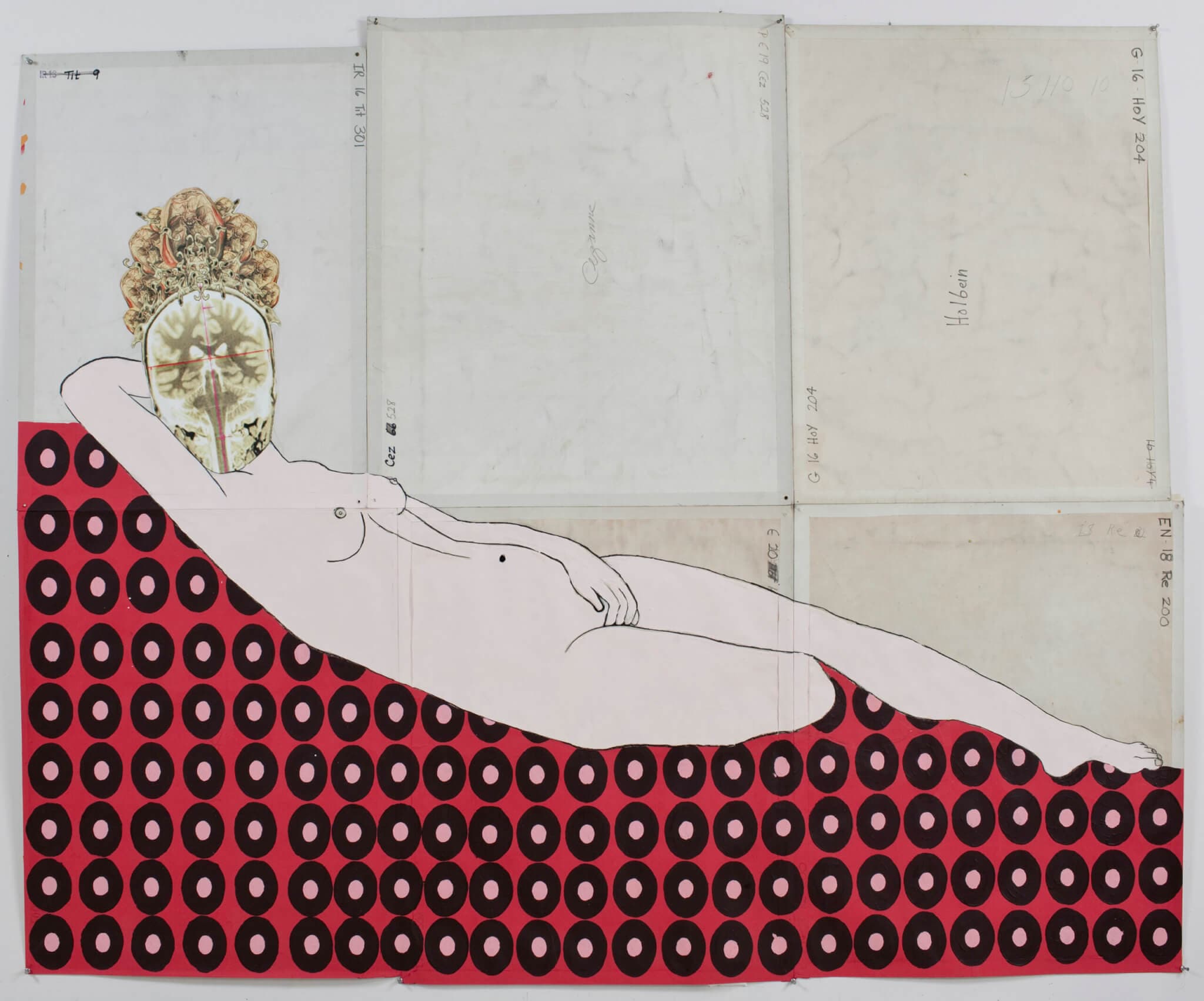
Katherine Sherwood (American, born in 1952), Sleeping Venus, 2014. Mixed media on found cotton. Courtesy of Walter Maciel Gallery and the Artist. © Katherine Sherwood. Courtesy Museum of Fine Arts, Boston.
Gauguin’s legacy is directly confronted in works by Gisela Charfauros McDaniel and Rachelle Anayansi Mozman Solano. McDaniel’s paintings return dignity to women from Oceania by creating reverently covered portraits of seated and reclining femmes, while the nearby assemblage by Solano, I was hopeful to find in this place my happiness (2018), collages an image from Gauguin’s Tahitian Woman with her own contemporary photographs of women from Panama, a place decried by Gauguin for not fulfilling his colonial fantasies of submissive Indigenous women. Titian and Giorgione, too, are taken to task here by Katherine Sherwood. Her Sleeping Venus (2014) masks a nude woman posed similarly to the reclining figure in the Renaissance painting of the same name at the center of a large mixed-media work on found cotton. Together, these artworks are perfect demonstrations of the exhibition’s thesis that nudity is “not a site of passive display, but a critical tool for refusal, self-fashioning, and redefinition.”
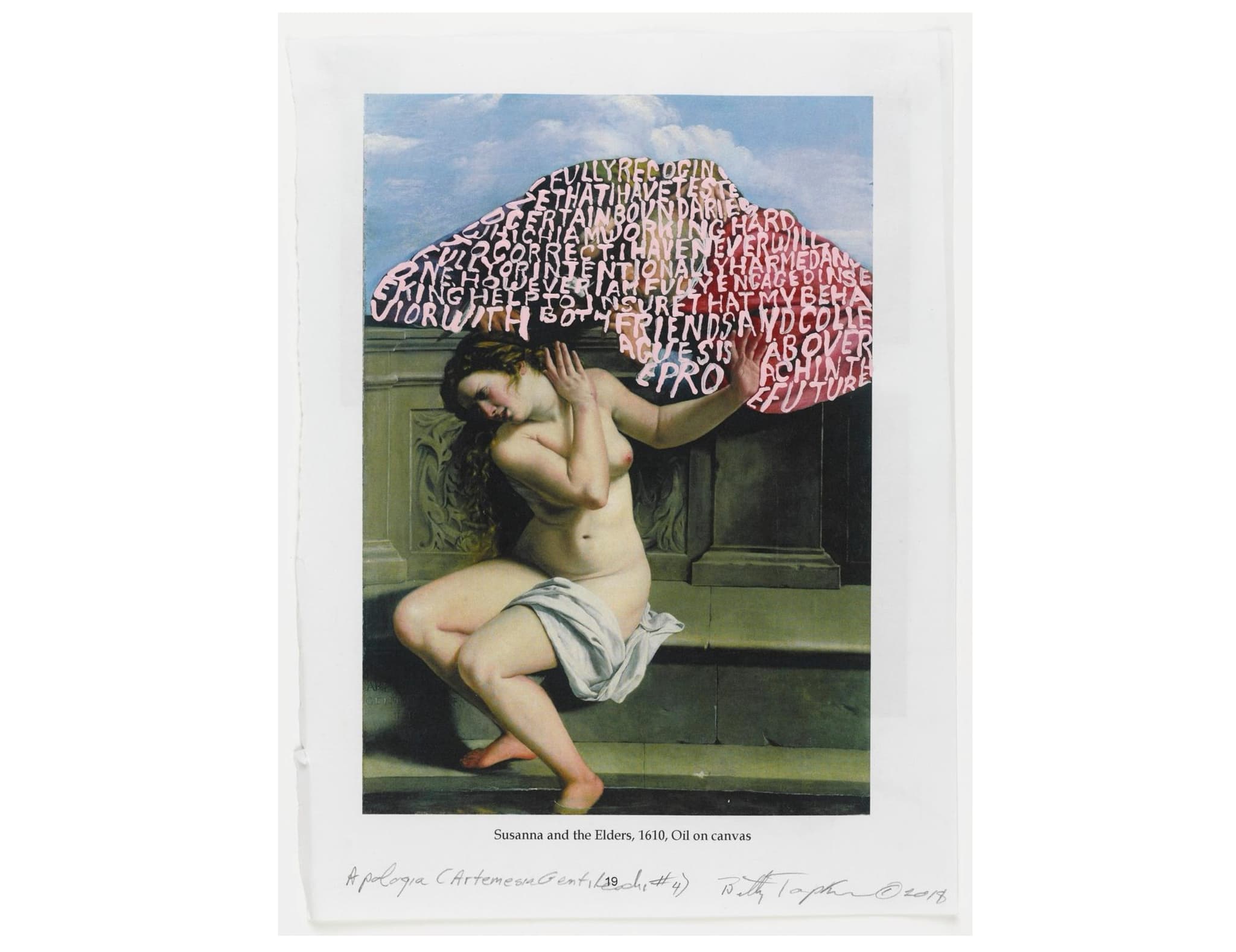
Betty Tompkins (American, born in 1945), Apologia (Mary Shepard Greene Blumenschein), 2018. Acrylic on book page. Courtesy of Betty Tompkins and P·P·O·W, New York. © Betty Tompkins. Photo by JSP Art Photography. Courtesy Museum of Fine Arts, Boston.
Should the critique of Western art history and dominant heteropatriarchal discourses in these aforementioned works be too subtle for viewers, Betty Tompkins’s Apologia series (2018–) pulls no punches in its overt calling out of male predators in the art world and in society at large. Snippets of milquetoast “public apologies” by prominent men are scrawled in a pale pink over the male figures in iconic paintings by heralded women and queer artists, including Artemisia Gentileschi, Caravaggio, and Suzanne Valadon. Begun during the #MeToo era, the Apologia series is as cutting in today’s Epstein-infused media landscape as it was nearly a decade ago; sadly, these works will remain relevant as long as sexual abuse scandals continue without any real consequences for the perpetrators.
I truly wish that an exhibition like “Subvert, Repair, Reclaim” was unnecessary or out of fashion. As long as major museum collections continue to prize the work of (white) male artists fetishizing the nude female form, museum-goers continue to deem the creative interventions of feminist artists as “hysterical” modes of “pornographic” “non-art,” and US society continues to be governed by fascist-leaning misogynists and homophobes, curators like Hermo will need to keep pushing buttons with exhibitions such as this. For better or worse, it looks like the nude is here to stay.
“Subvert, Repair, Reclaim: Contemporary Artists Take Back the Nude” is on view through August 2, 2026 at MFA Boston, 465 Huntington Avenue, Boston, MA.