I’ve always felt that art possesses the ability to transform us and stir us to action. Not all art has to do that, of course. But for me it was an important way I came to understand history at a young age. Jacques Louis David’s Death of Socrates (1787) inculcated me into the importance of standing up for truth, even in the face of death. Picasso’s Guernica (1937) brought to graphic life the cruelty and criminality of war. A painting like The Raft of the Medusa (1818–19) by Theodore Géricault was not only a masterpiece but taught me about France’s colonialist aspirations in Africa and how one painting forced the French people to look into their souls and reassess the hubris and ambitions that had caused this human tragedy.
So, what lessons can we take away from “Maine: A Force within American Art (1890–2026)” at the Farnsworth Art Museum? The exhibition is intended to contextualize Maine as a major incubator and nexus for American art. It takes as its organizing principle the art schools and residencies that have lured artists to Maine since the nineteenth century, beginning on Monhegan Island and ending with various contemporary institutions that host residencies promoting innovation and forward-thinking work.
There is a lot of very beautiful, even great, art in this show. However, the exhibition feels a bit tepid considering it was organized, according to the museum’s website, “in honor of America’s 250th anniversary.” If the Semiquincentennial had come around during a peaceful, prosperous, and unified time in our nation’s history, this sort of exhibition would have felt just fine, if a bit old school.
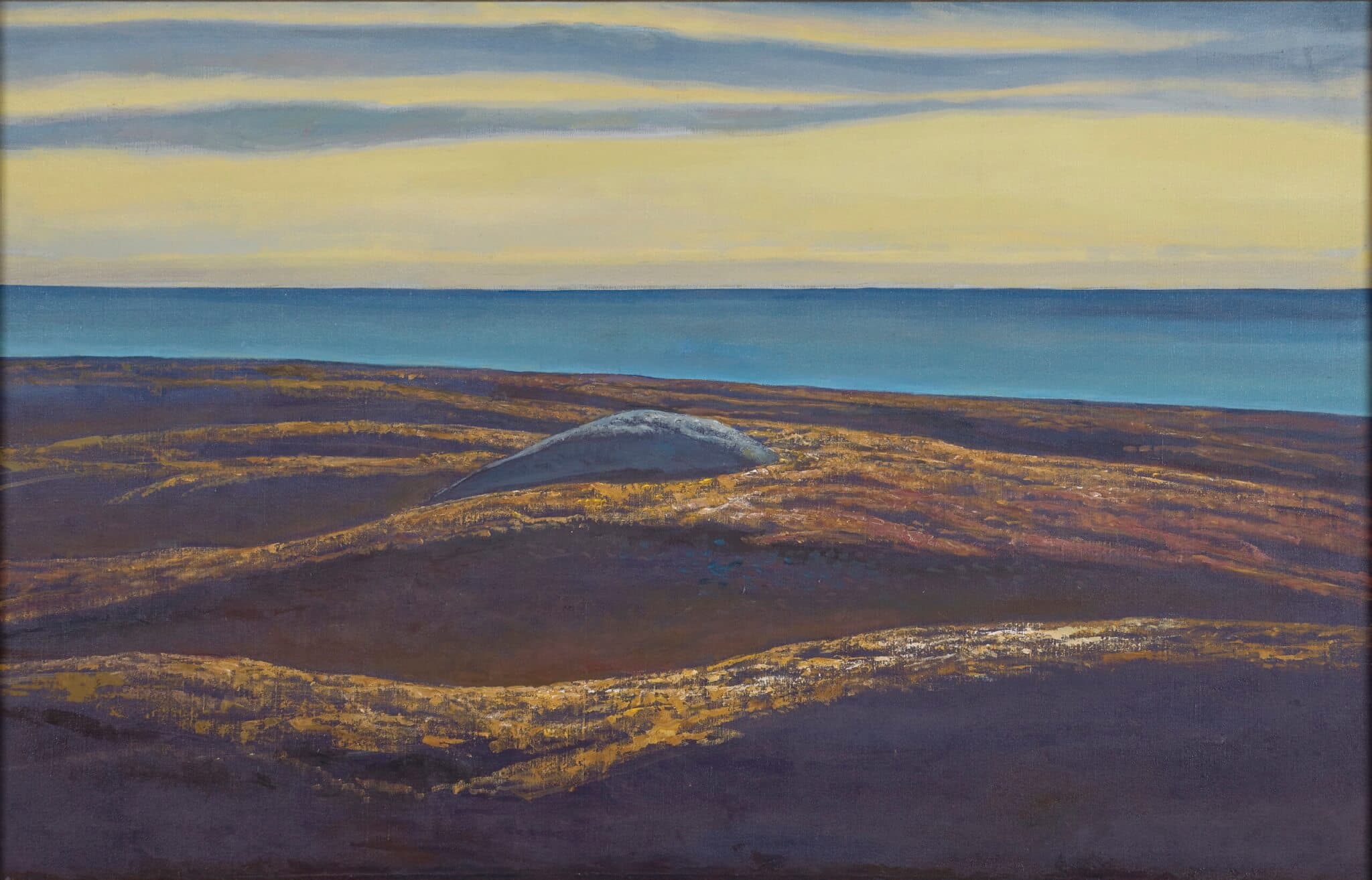
Rockwell Kent (1882–1971), Lone Rock and Sea, 1950, oil on canvas, 28 x 44 inches. Farnsworth Art Museum, Museum purchase, 1977.35. © Rights courtesy of Plattsburgh State Art Museum, State University of New York, USA, Rockwell Kent Collection, Bequest of Sally Kent Gorton. All rights reserved.
Yet that is not where we find ourselves today. The country remains profoundly divided as the governing administration systematically dismantles almost every principle upon which our nation was founded—deporting immigrants in record numbers, banning books that present points of view that are not heterosexual and white, defunding museums that do not remove works it deems offensive, complaining that art, literature, and education dwell too much on subjects such as colonization, theft of Indian lands, slavery and other historically verifiable American atrocities…and on and on. The time feels ripe for analysis and reckoning, rather than an approach that is, essentially, a metaphorical pat on the back.
The exhibition claims to be organized chronologically, but the chronology feels somewhat wonky from the get-go. If we were starting at the beginning, after all, you’d expect to find historical Wabanaki basketry first and return to it in the final gallery, which displays contemporary examples of the genre. Even a couple baskets under Rockwell Kent’s sublime Lone Rock at Sea (1950), visible immediately upon entry, would have established the primacy of Native peoples in the introductory gallery.
Overall, the show has a feeling of having run out of space. In the early galleries we deal expansively with artists who worked on Monhegan (Robert Henri, George Bellows, and, in a terrific surprise, a less conventionally rendered landscape—Monhegan Cliffs of 1945—by Joseph De Martini). Other pivotal events invoked in this gallery are the Armory Show of 1913 and Alfred Stieglitz’s 291 gallery (one of whose artists, John Marin, painted the 1947 Movement: Seas After Hurricane Red, Green, and White, Figure in Blue, Maine, a revelation near Kent’s painting for its near abstraction and unusual color palette).
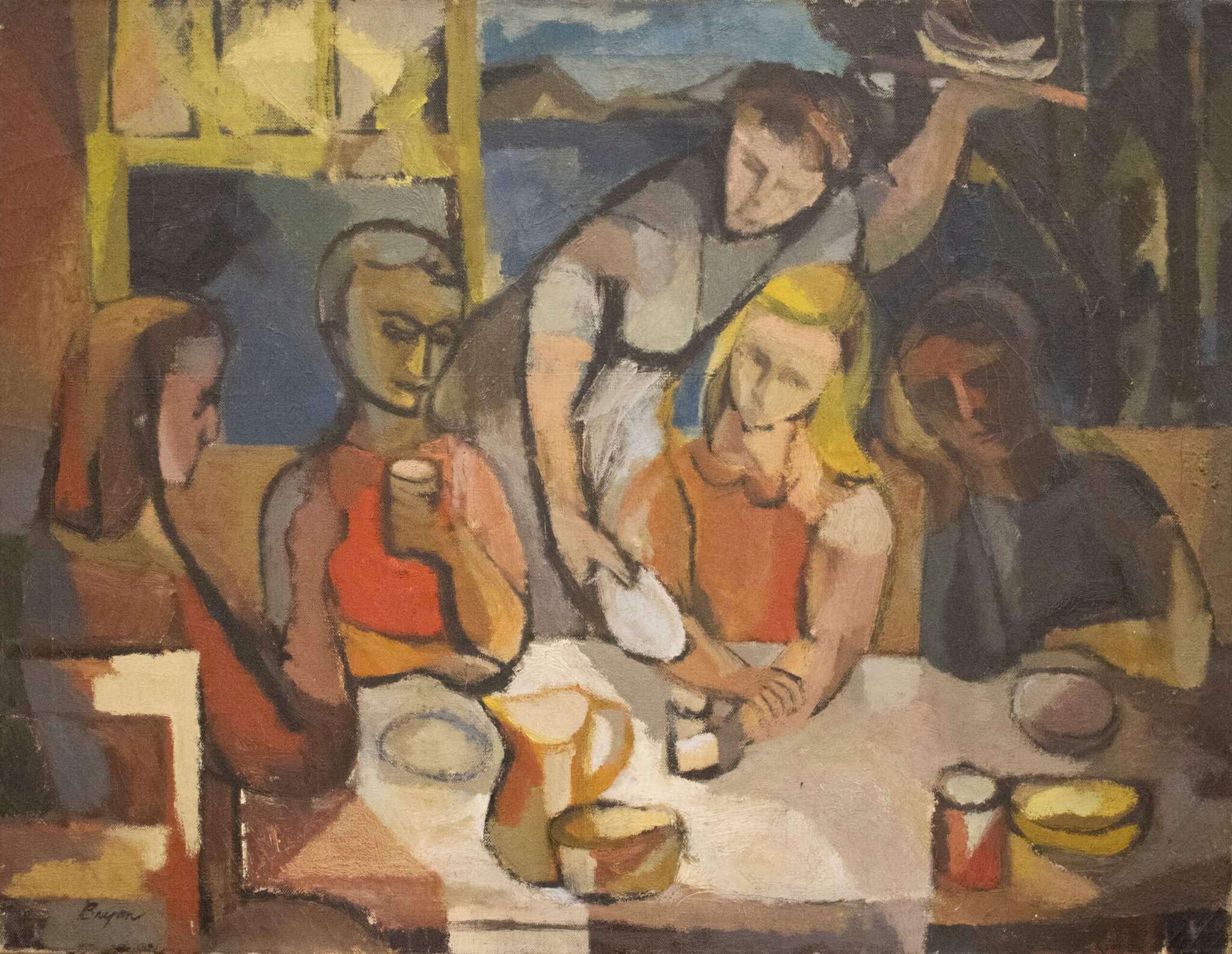
Ashley Bryan (1923–2022), Dining Room, 1946, oil on canvas, 28 x 36 inches. Skowhegan School of Painting & Sculpture. © 2026 Courtesy of The Ashley Bryan Center.
The gender disparity of the Armory Show is mentioned in a sentence that notes that only about fifty of the three-hundred artists exhibiting were women. Female artists—Beatrice Whitney Van Ness, Gertrude Fiske, Anne Carleton—enjoyed much more respect at Charles Woodbury’s school in Ogunquit, which is dealt with in a gallery at the bottom of the stairs. But there is no information about how these Boston artists were something of an anomaly in that they strove mightily at the turn of the twentieth century for the same opportunities granted their male counterparts, and yet, when the history of the Boston School was written, their efforts and work were largely eclipsed by male painters. Wikipedia lists the “key” figures of this movement as Edmund C. Tarbell, Frank Weston Benson, and William McGregor Paxton. Women are relegated to a single short paragraph at the very end of the entry.
This room includes works by Ashley Bryan and, during April, featured rotating works by David Driskell. Both were Black students at Skowhegan (Driskell later joined the faculty), but the exhibition provides little context about how they came to attend the school in the first place. (Bryan was offered a scholarship in 1946, Skowhegan’s inaugural year, while studying art at Cooper Union after serving in World War II. Loïs Mailou Jones, who taught at Howard University in New York when Driskell studied there, nominated him for a scholarship in 1953. Both scholarships predated the Civil Rights Movement.) As a peer-to-peer residency, was Skowhegan’s structure somehow more welcoming to marginalized groups? Were there, during the civil rights uproars of the 1960s and ’70s, other people of color attending Skowhegan for whom Bryan and Driskell opened doors? Could the exhibition have used this moment to talk about art’s ability to break through societal boundaries? Answers to these questions are not forthcoming because the questions themselves are not asked.
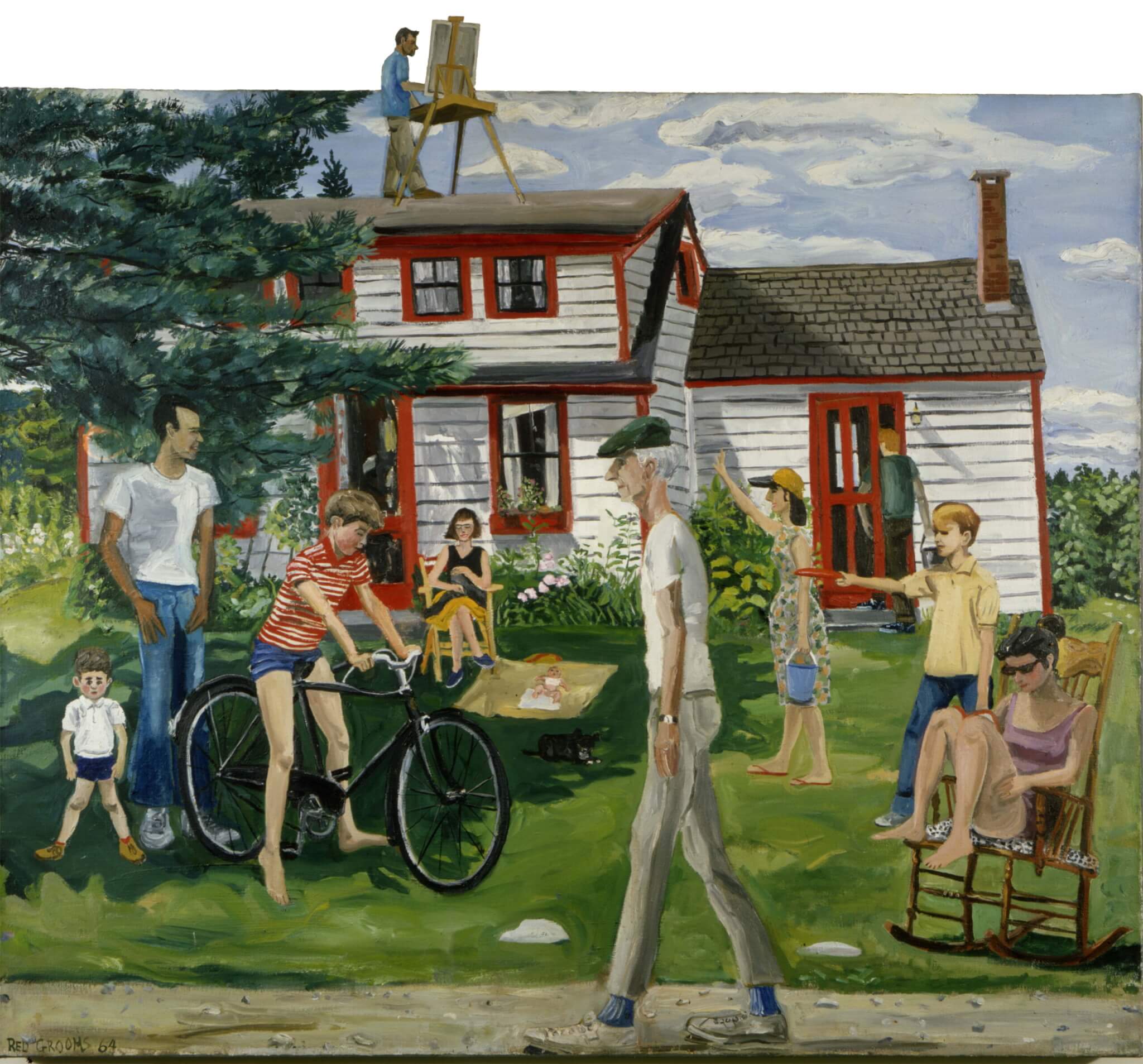
Red Grooms (born 1937), Slab City Rendezvous, 1964. Oil on canvas with wood and cardboard, 54 1/4 x 60 inches. Farnsworth Art Museum, Gift of Drs. Robert N. Mayer and Debra E. Weese-Mayer Family Collection, 2019.1. © 2026 Red Grooms, Member of Artists Rights Society (ARS).
Further on, we learn about Maine artists who exhibited at Tanager, an artist-run cooperative gallery in New York. We see work by seminal Maine female artists Lois Dodd and Anne Arnold (as well as men such as Alex Katz). Oddly, though, all the works here were created after the Tanager’s closing in 1962. We get no real sense of women artists’ struggle for recognition at a time when they were pushing back against the white male predominance of the field, or whether it was easier in Maine than New York to gain notoriety as a female artist.
By the time we arrive at a room about the Slab City artists, Haystack Mountain School, and Maine Media Workshops, it begins to seem as though the curators realized available space had been underconsidered. This room feels like a hodgepodge, presenting works of Slab City artists (Red Grooms’s 1964 painting Slab City Rendezvous depicts its cast of characters, including Katz, Rudy Burckhardt, Yvonne Jacquette, and Mimi Gross) and Dale Chihuly (supposedly Haystack inspired him to open his Pilchuck Glass School on Puget Sound); pottery by Karen Karnes and Haystack trustee Ayumi Horie; and photography by several Maine Media photographers (and Berenice Abbott, who did not attend the institution). The impression is of a rangy and diffuse array that quickly glides over art schools and enclaves that deserve more consideration and deliberation.
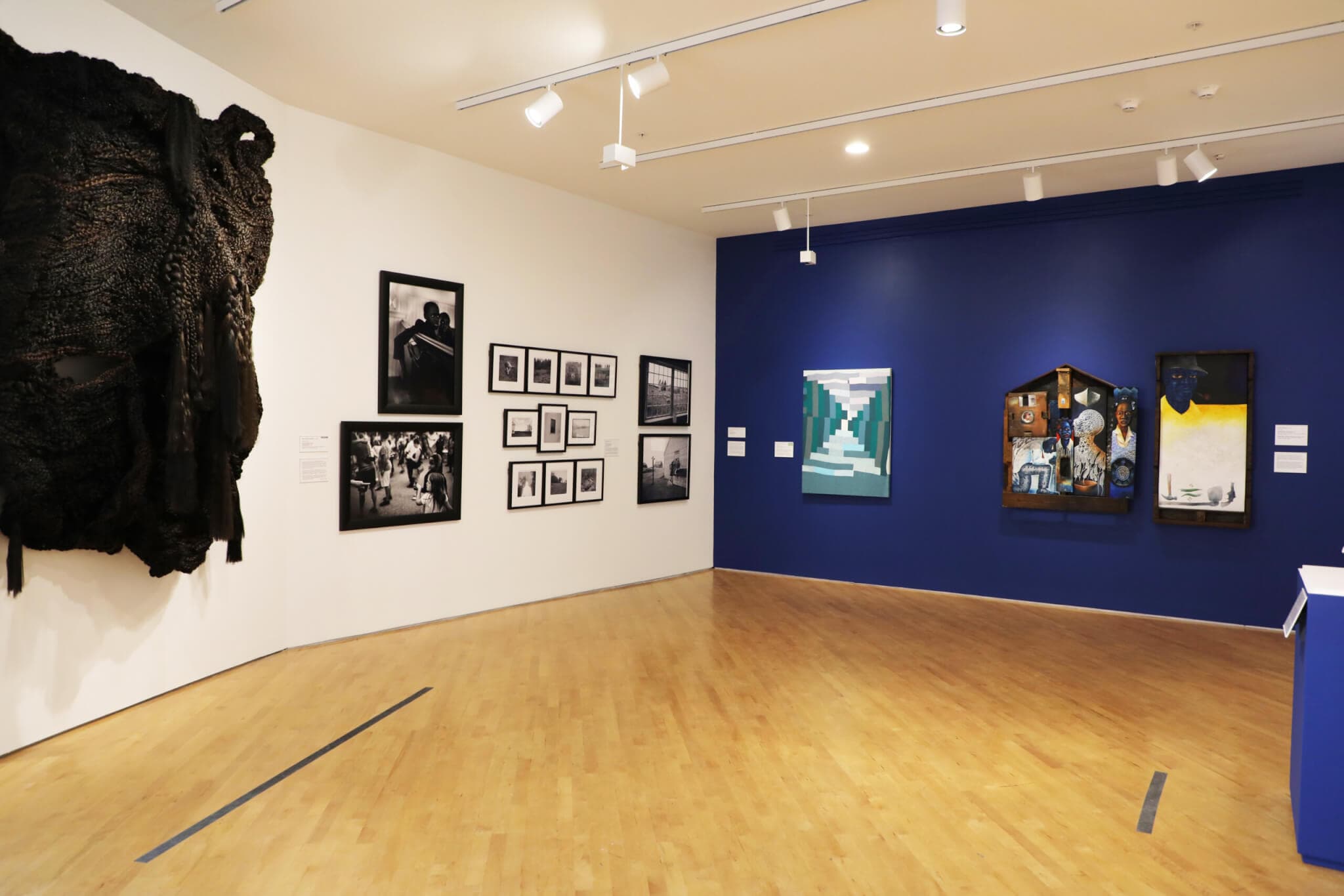
The exhibition picks up again with a room devoted to the modern residency programs of Indigo Arts Alliance, Indian Basketmakers Alliance, and the Ellis-Beauregard Foundation (EB). The work here is truly powerful (Daniel Minter’s assemblages; Verónica Pérez’s imposing braided-hair sculpture; Wabanaki artists’ innovative basketry; and fantastic works by EB artists such as Meghan Brady, Reggie Burrows Hodges, John David Ellis, and Sarah McRae Morton). If you’ve been paying attention, you’ll see quite spectacularly in this gallery how art and artists in Maine have changed and diversified. But texts don’t make that argument definitively, which also feels like a lost opportunity.
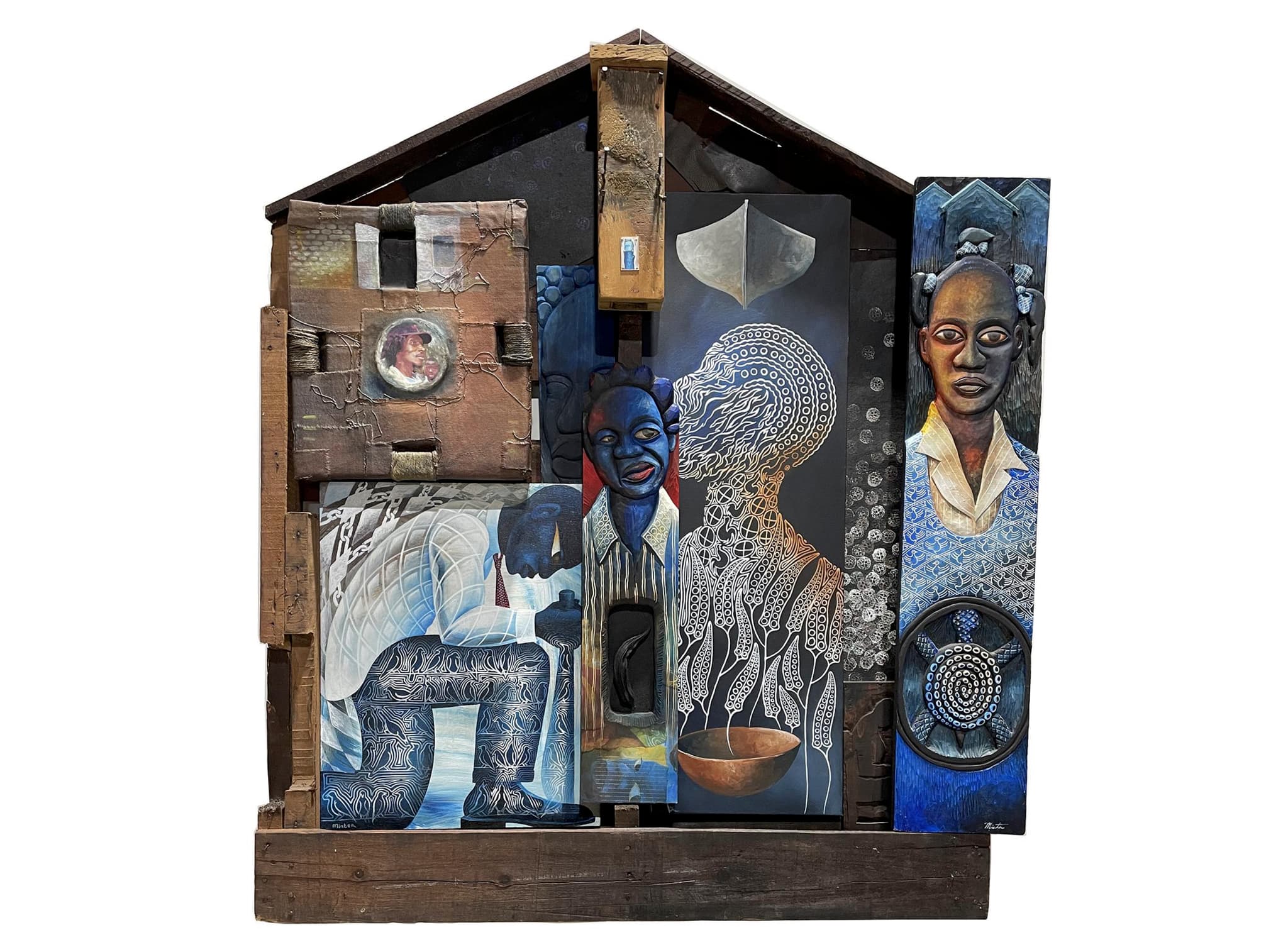
Daniel Minter (born 1961), A Distant Holla: Deep Inside Us, 2021. Mixed media wood construction, 49 x 42 1/4 x 7 inches. Farnsworth Art Museum, Museum purchase, supported by Ann and Dick Costello, 2022.3. © 2026 Daniel Minter.
In the end, the show does not unequivocally make the case for Maine’s importance to the larger breadth of American art. We don’t understand how the work done in Maine changed or evolved the art of the country. Yes, it was clearly a “force,” as the title indicates, but what were the impacts of that force? How did Hartley and Marin change landscape painting, for example, and what principles and perspectives did American artists gain here that affected art forms beyond Maine’s borders? We could argue, for instance, that the art of Daniel Minter, co-founder of Indigo Arts Alliance, brought to light the tragedy of Malaga Island in Maine (a mixed-race maritime community evicted in 1912 to make way for a tourist destination), which subsequently led to other American artists exploring this theme, namely Theaster Gates.
And some artists, though born and/or trained in Maine, really only acknowledged their Maine connections later in life. Louise Nevelson, for example, whose work is relegated to a hallway leading toward the gift shop, felt unwelcome in Maine and made her stamp on sculpture in New York, only later donating many works to the Farnsworth. I believe there is a definite case to be made for the way Maine art affected, for example, plein air painting in America and beyond, or how today’s artists are spreading awareness in the art world about issues such as theft of Native lands and climate change. In wanting to include so many schools and residency programs, it feels more like a catalog of famous artists who mostly summered here from larger urban centers like New York and Boston instead of illustrating how the state informed their larger perspectives about art.
“Maine: A Force within American Art (1890–2026)” is on view through January 3, 2027, at Farnsworth Art Museum, 16 Museum Street, Rockland, ME.