
Upon entering the Crewe Center for the Arts at the University of Southern Maine (USM) in Portland, I was impressed by the bright, capacious gallery, which is multifunctional and located at the center of an academic building. I was there to see “Even As We Grieve,” an exhibition of Peter Bruun’s works on paper and birch panel created between 2019 and 2024. His work lines one side of the space, so from a distance, I could see all four of his series in a single panoramic view. Across from that wall were dozens of framed oil pastel drawings made by participants in workshops that Bruun designed and led in cooperation with eight regional non-profit organizations. The inclusion of these drawings heightens the exhibition’s message of healing through human connection.
My first impression of Bruun’s work is its gentle and steady consistency. His residency at USM culminated in two exhibitions: one at this Portland venue, on view through July 31, 2026, which is the focus of this review, and another, “You Once Had An Aunt,” an immersive exhibition of one hundred paintings, inspired by the birth of his grandson, at the Gorham Art Gallery, which closes August 22, 2026.
“Even As We Grieve” and “You Once Had An Aunt” respond to the untimely death of Bruun’s daughter, Elisif, from a drug overdose in 2014. The fluency of his floating, intertwining, and crisscrossing forms affirms that he was an artist long before that tragedy. Indeed, the Copenhagen-born artist has an MFA from the Maryland Institute College of Art and specialized in the figure in his early career. The four bodies of work in “Even As We Grieve” have aesthetic through lines of linearity, organic grids, gesture, and accumulation. As the introductory text notes, the Memoir series (2019–21) was created after Bruun moved from Maryland to Maine. Communion (2008–10 and 2023) visually converses with art made by his late daughter. Big Crying (2020–21) works through intense emotion, and Together (2021–22), as Bruun wrote in the exhibition’s introductory text, “shows how the care and presence of others can make resilience—and even joy—possible.”
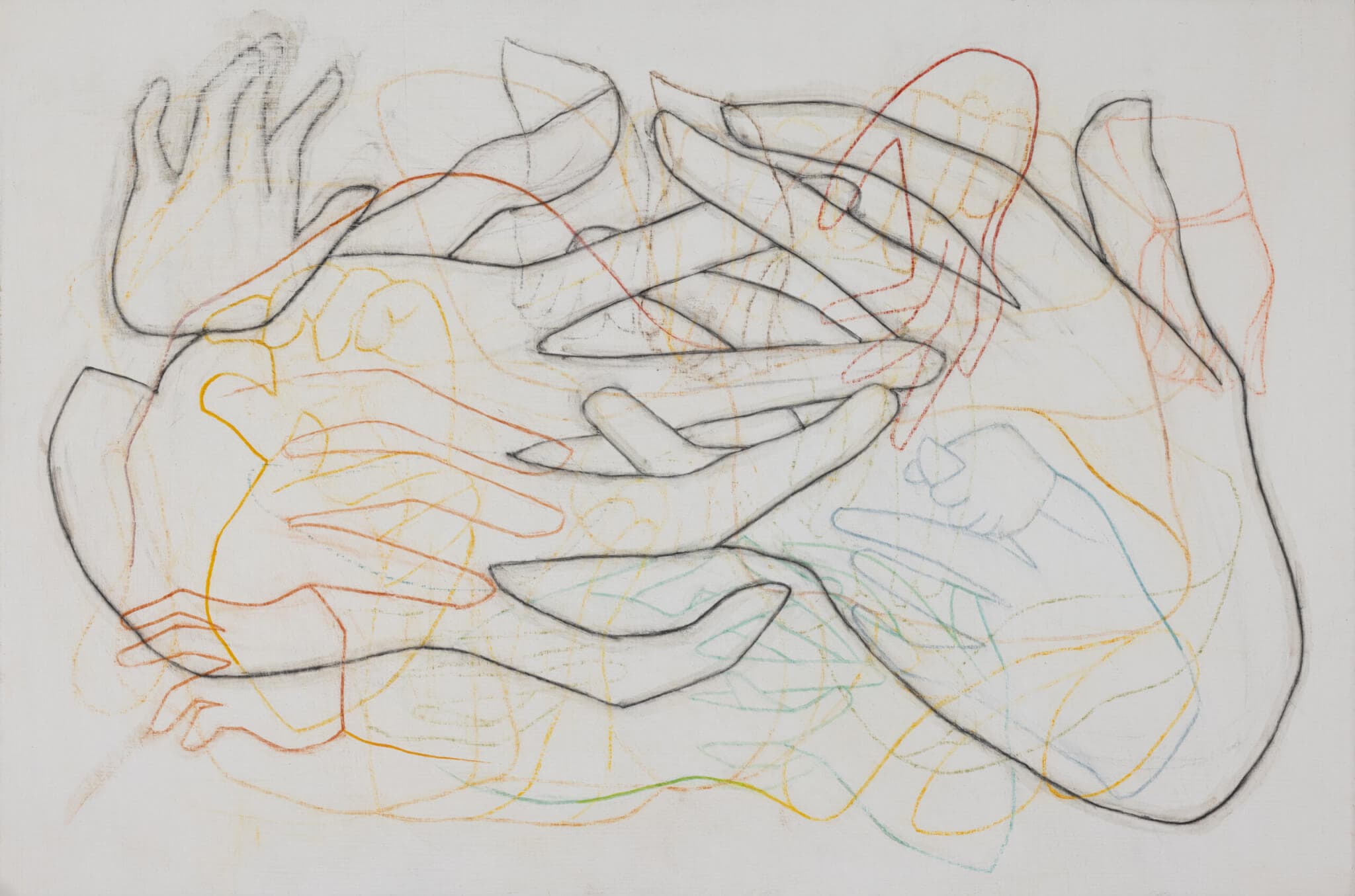
Peter Bruun, Together (detail, 1 of 27 panels), 2022–2023. Oil on gessoed panel, 12 x 18 inches. Courtesy of the artist and the University of Southern Maine Art Gallery.
The Together series hangs in a salon-style cluster to the far right of the lengthy wall where all of Bruun’s works are installed. The paintings feature layered contour drawings of hands that Bruun derived from Medieval and Renaissance European paintings and then arranged into layered compositions on birch panels. The bright clusters of hands form a friendly crowd, exemplifying how the aesthetic of accumulation can be so compelling. Positioned near the gallery’s entrance, the series serves as an early introduction to Bruun’s interest in bringing people together.
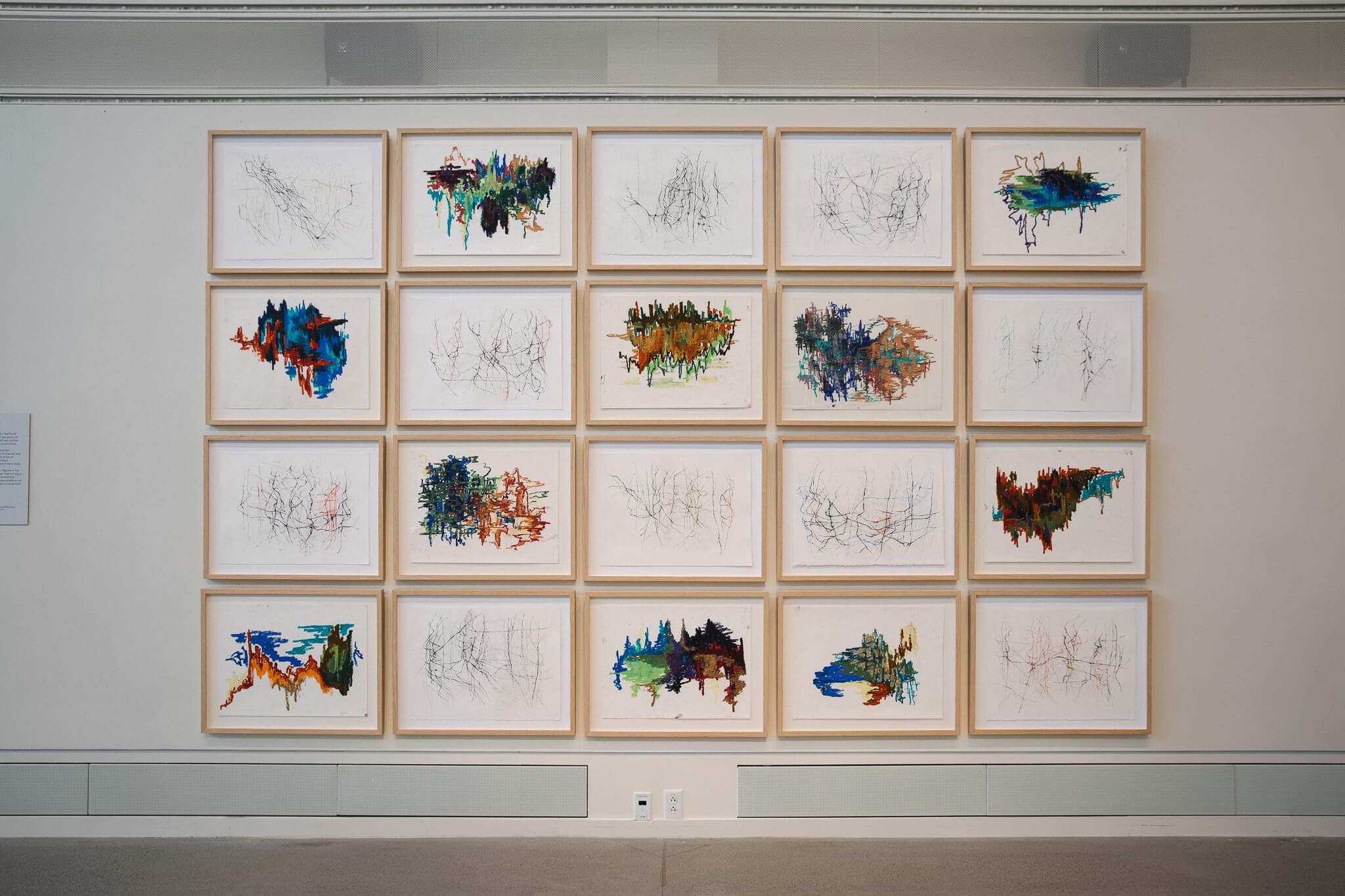
Communion is a meeting of works by two artists. Bruun’s description of this series in the wall text is touching: “My drawings start from profiles – figures in the act of turning toward one another … in our deepest crises, companionship is not a comfort but a necessity, whether it comes from the living or the dead.” To mark the tenth anniversary of Elisif’s death, Bruun responded to a series of oil pastel drawings on paper that she created between 2008 and 2010. There are ten works by Peter and ten by Elisif. Her marks are dark and firm, in contrast to her dad’s light, angled lines. A couple of Elisif’s paintings stood out to me because they resemble landscapes, with dark silhouettes of pine trees rising from the horizon, a lovely tension between abstraction and landscape. Bruun’s responses to his daughter’s drawings appear shaky, like reflections of the landscape onto rippling water. I saw Bruun’s reflecting ripples as metaphors for the fragility of emotional memories. Additionally, for me, the installation of Communion amplifies the series’ meaning. The four-by-five grid is organized with the father’s and daughter’s works alternating, except in the third and fourth columns, where there are pairs by the father and pairs by the daughter. Seeing Bruun’s work no longer right beside his daughter’s felt quietly devastating.
The works that comprise the Memoir series bring together text and floating, curved linear forms. Bruun’s small, all-caps print had a magnetic effect on me, as a compulsive reader who found the neatly written anecdotes and memories laid bare like journal entries. He wrote these vignettes as part of a ritual, writing in the wall text, “Each evening I walked to a spot overlooking the ocean and wrote.” Later, he reprinted the words and wreathed them with arcing loops and swirls. The sometimes stark lines, such as “as you lay there, no breath on your lips, the world passes,” form a tenuous balance with his nervy, angled lines. This series was informed by a community that he formed in the wake of Elisif’s death with “others living with addiction’s consequences.” In addition to the Memoir series, this community inspired Bruun to lift up the stories and expressions of vulnerable people, a commitment he pursued during his residency.
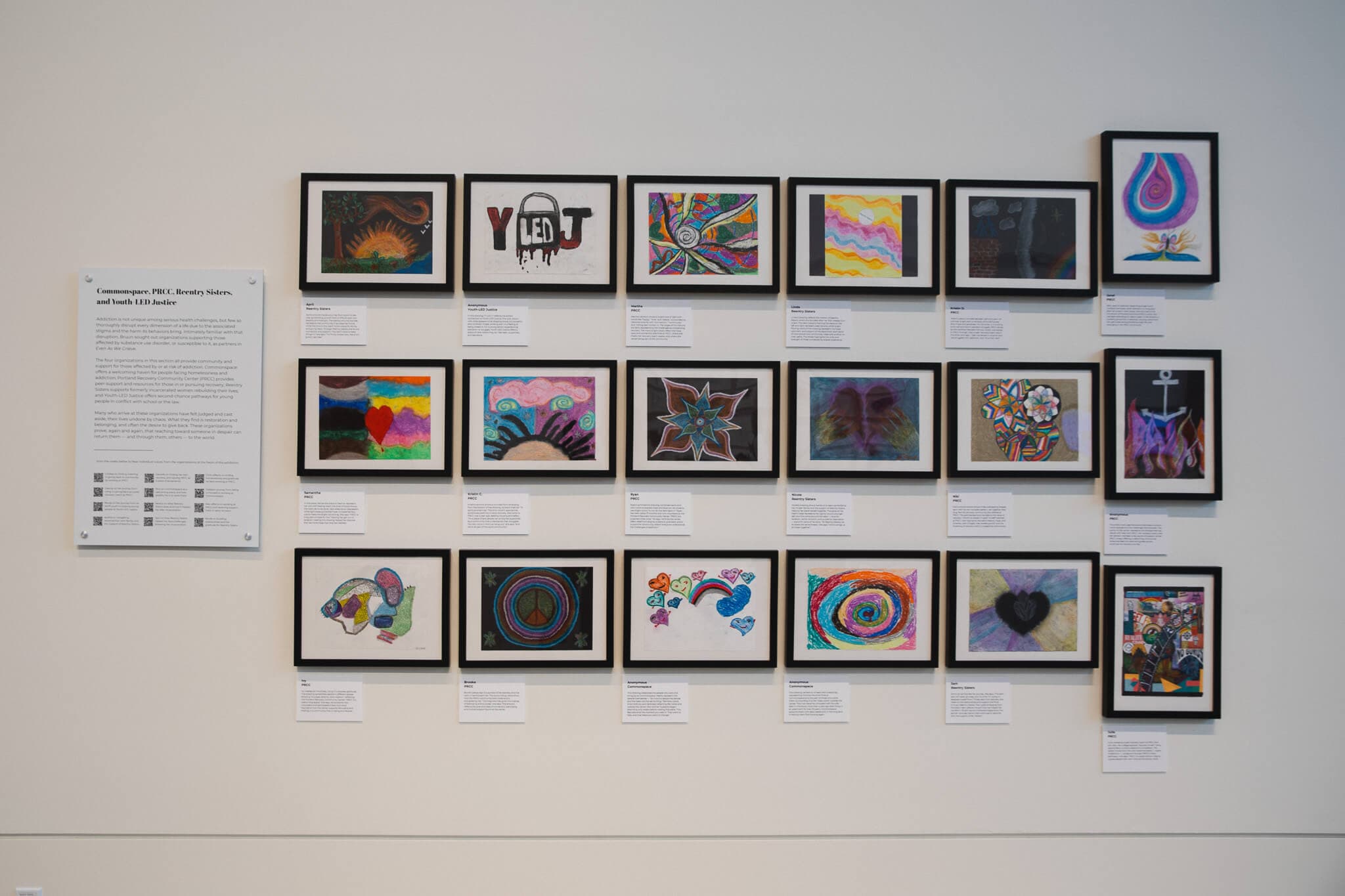
Various artists; art created in workshops with Peter Bruun at Commonspace, Portland Recovery Community Center, Reentry Sisters, and Youth-LED Justice, 2026. Part of “Even As We Grieve” at the University of Southern Maine Crewe Center for the Arts Great Hall Gallery, 2026. Photo by Vivienne Predock. Courtesy of the University of Southern Maine Art Gallery.
Nearby, directly across from the wall displaying Bruun’s art, are numerous drawings by participants in his workshops. Made with oil pastels—which Bruun chose for their vibrant color—they are on a standard-size paper for ease of framing, a detail that made for an elegant display. I spoke with him about the workshops, which he oversaw with great intentionality. He researched potential partners and, from twenty organizations, narrowed the list to eight, including the Center for Grieving Children and the Portland Recovery Community Center, among others.
Participants were recruited by staff at each organization, and the workshops took place at their respective locations. Bruun began each workshop by asking participants how the organization had supported them. He walked around, continuing to interact, but found that most people were so engaged in their work that most of the talking happened after they finished working. Many of the drawings are poignantly lovely. Afterward, Bruun asked the participants to share the story behind their drawing and then invited them to be part of the exhibition. He wrote the accompanying texts based on what each person shared and had participants review the labels for accuracy before they were printed. QR codes linking to audio recordings share vignettes by many participants. One is by Danielle, who received services from the Reentry Sisters, a program for women transitioning out of the carceral system. Danielle said that using was isolating, which reminded me that isolation is an ironic fact of addiction, despite people often using together. Her experience with the Reentry Sisters meant finding acceptance. The recidivism rate is high, and the safe harbor and personal connections she received provided a structure to support her in remaining out of prison. Bruun’s priority and gift for relationality come through on both sides of the gallery: in his work and in the outcomes of his time spent with participants in his workshops.
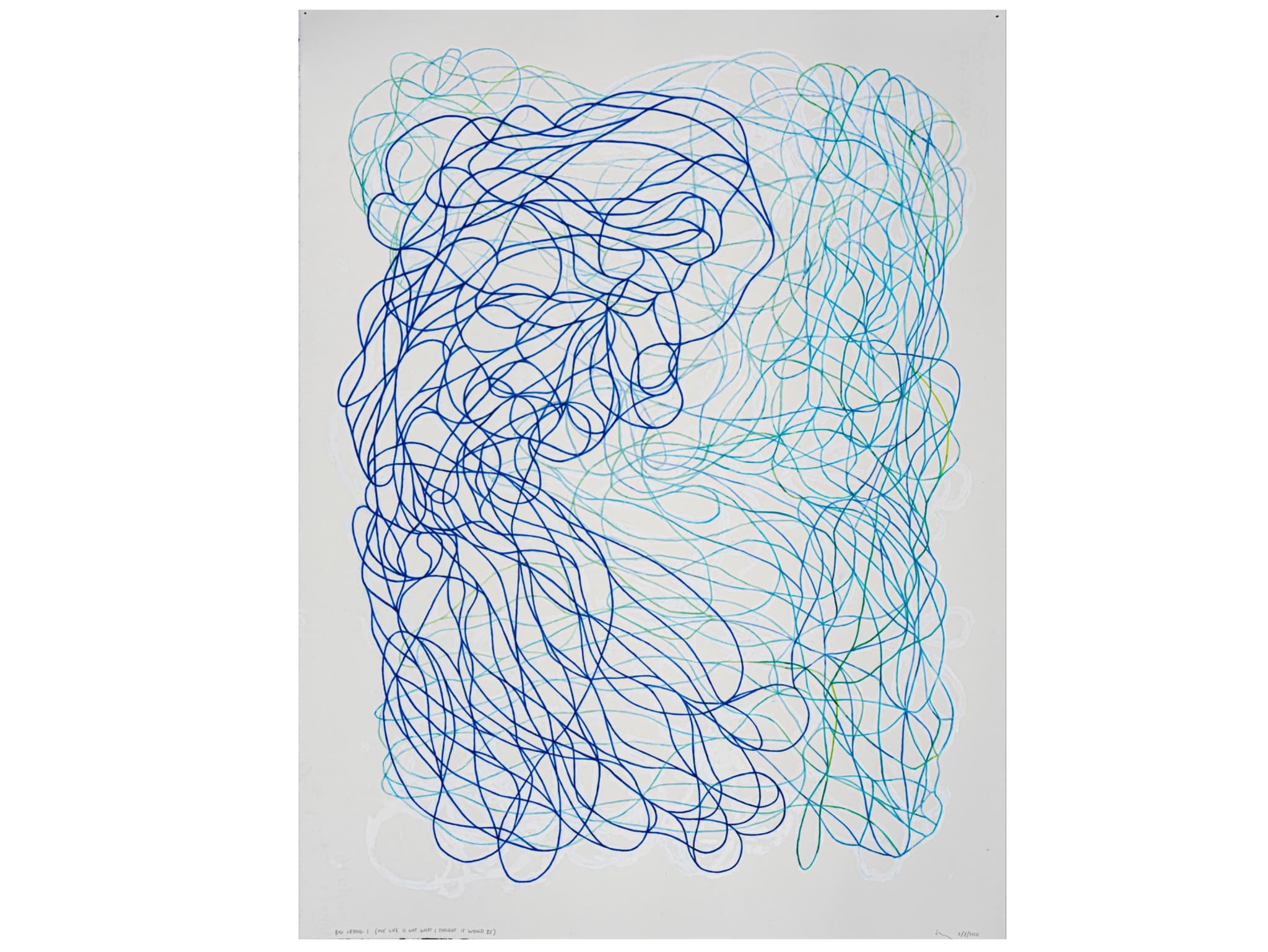
Peter Bruun, Big Crying I, 2020. Gouache and watercolor, 22 x 30 in. Courtesy of the artist and the University of Southern Maine Art Gallery.
At first, the Big Crying paintings, which hang to the far left of the installation, appeared to be simple grids. But after spending time with them, I began to see them as metaphorical safety nets that could catch someone if they fell. In the foreground, blue and green lines form dense, frenetic grids like drawings made with spirographs. Beyond the darker foreground lines are other marks that Bruun carefully covered with white paint, in a tone similar to the paper’s color. Why inscribe, then cover? The painted white layer creates a light texture that allows me to subtly trace his process and signals the malleability of his forms. The white is expressive, emphasizing the surface while also creating a sense of depth. Bruun’s technique reminds me of Robert Ryman’s mysterious, unforgettable white-on-white paintings. But rather than static plains of pigment, Bruun’s marks make poetic diagrams of interconnectedness, forming airy, stretchy networks capable of shape-shifting, like an ever-expanding web of life. Big Crying is a series of metaphorical roadmaps for when—not if—grief finds you.
Radiating with warmth, “Even As We Grieve” is an ode to community. The works do not plainly illustrate Bruun’s story; rather, they evince the cadence and contours of sustained presence, facilitate community-building, and remind us to really, fully live.
“Even As We Grieve” is on view through July 31, 2026, at the Crewe Center for the Arts at the University of Southern Maine, 111 Bedford Street, Portland, ME.