This feature originally appeared in Issue 16, published May 16, 2026. You can read this piece and more by purchasing a copy of or subscription to the magazine.
I was on my way to the Boston Athenaeum to see a preview of “Where’s Boston? 50 Years Later” when it occurred to me that I had lived in the city for almost twenty years, longer than I had lived anywhere else. Now, I rarely set out to discover it the way I used to when I was a graduate student: studying it, you could say, taking long walks, following the Freedom Trail, learning the city’s history—its proud Revolutionary War history—too easily absorbing it, eager to make the city my own. At some point, I don’t know when, Boston turned into the setting of my everyday; I had become a Bostonian, I suppose, like one of the people Constantine Manos included in his 1975 monograph, Bostonians, and this identification, this becoming part of the landscape in which I lived, had changed my approach to the city. I moved through it, rarely pausing to consider the various arcs of its history. It was as though the exhibition’s title—its question, its marking of time, its connection to Manos’s investigation—had invited this kind of reflection.
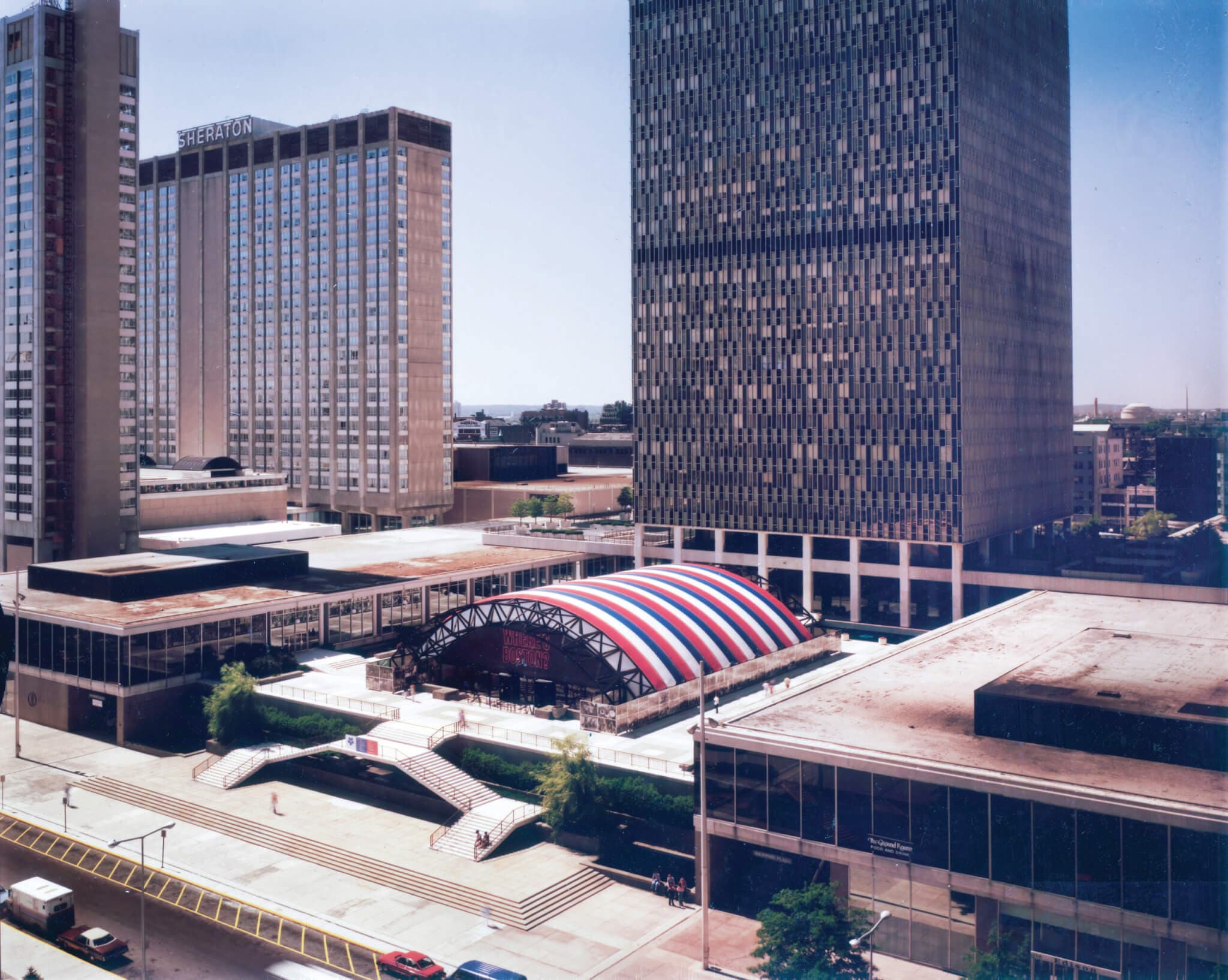
“Where’s Boston? 50 Years Later” features black-and-white photographs first taken by Manos in 1974 for the Bicentennial celebrations. Manos—a Magnum photographer who began his career at the Boston Symphony Orchestra and lived in the South End—used a 35mm Leica, the camera of choice for street photographers at the time, and over nine months took more than 19,000 photographs of the city and its people. He was mostly interested in public spaces and scenes: the Common, City Hall Plaza, parades, protests, athletic events, restaurants, libraries, and schools. He aimed for a kind of completeness, visiting nearly every neighborhood in Boston, as well as Cambridge and Brookline. For the resulting exhibition titled “Where’s Boston?”—which opened in 1975 and ran through 1978—Manos’s photographs were a kind of centerpiece: 154 of the images were enlarged and double-stacked around the perimeter of a large red, white, and blue-roofed pavilion in front of the Prudential Center. Inside, a slideshow of around 3,000 color images taken by fifteen photographers (including Manos) were presented on eight screens through forty projectors, overlaid with a score and over one hundred oral histories. The exhibition was so popular that it was maintained years after the Bicentennial, until the blizzard of ’78 destroyed the pavilion.
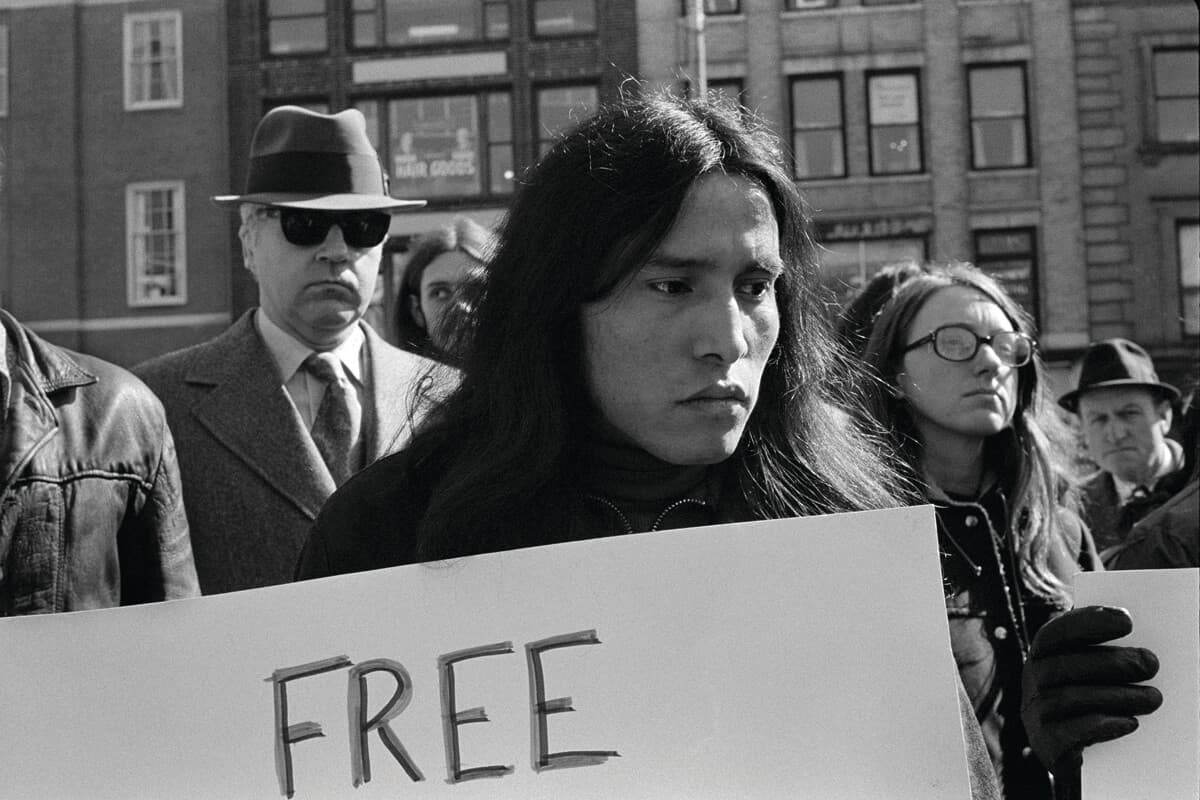
Constantine Manos, American Indian Rally on the Boston Common, 1974. Courtesy of the Boston Athenaeum.
The Athenaeum exhibition, curated by Lauren Graves, is a rigorous and thoughtful follow-up to that patriotic display. Opening June 15, it will feature fifty-three of Manos’s photographs—thirty-six from the Athenaeum’s collection (acquired from the Robert Klein Gallery in 2020), eleven borrowed from Manos’s estate, and six new gelatin silver prints made from digital scans. At the time of my visit, the exhibition was still a work-in-progress, but Graves laid out several of Manos’s photographs across four tables so I could see them for myself. As I stood above them and looked down, it was as though their very nature had changed. No longer celebratory, documentary images, and not yet on the walls as part of an exhibition, they turned into artifacts, objects from the archive that could be held, examined.
Manos, Graves said, was an extremely patient photographer. He spent hours waiting, never orchestrating a shot. I could hardly believe it. A few photographs especially—one of young mothers with baby carriages outside of a grocery store in Mattapan, a dog squatting at their knees; another of a lunchtime scene at Durgin-Park Restaurant; a third of a dancer working the tape off his heels while a child looks on—were so perfectly composed I felt certain they were staged.
About halfway through Manos’s nine-month project, the court-ordered desegregation of Boston schools began, and the subsequent anti-busing protests put Boston in the national spotlight. Manos captured scenes from this time—white protestors, mid-yell, waving American flags—but otherwise, that context isn’t immediately apparent. They’re mostly serene, artful images.
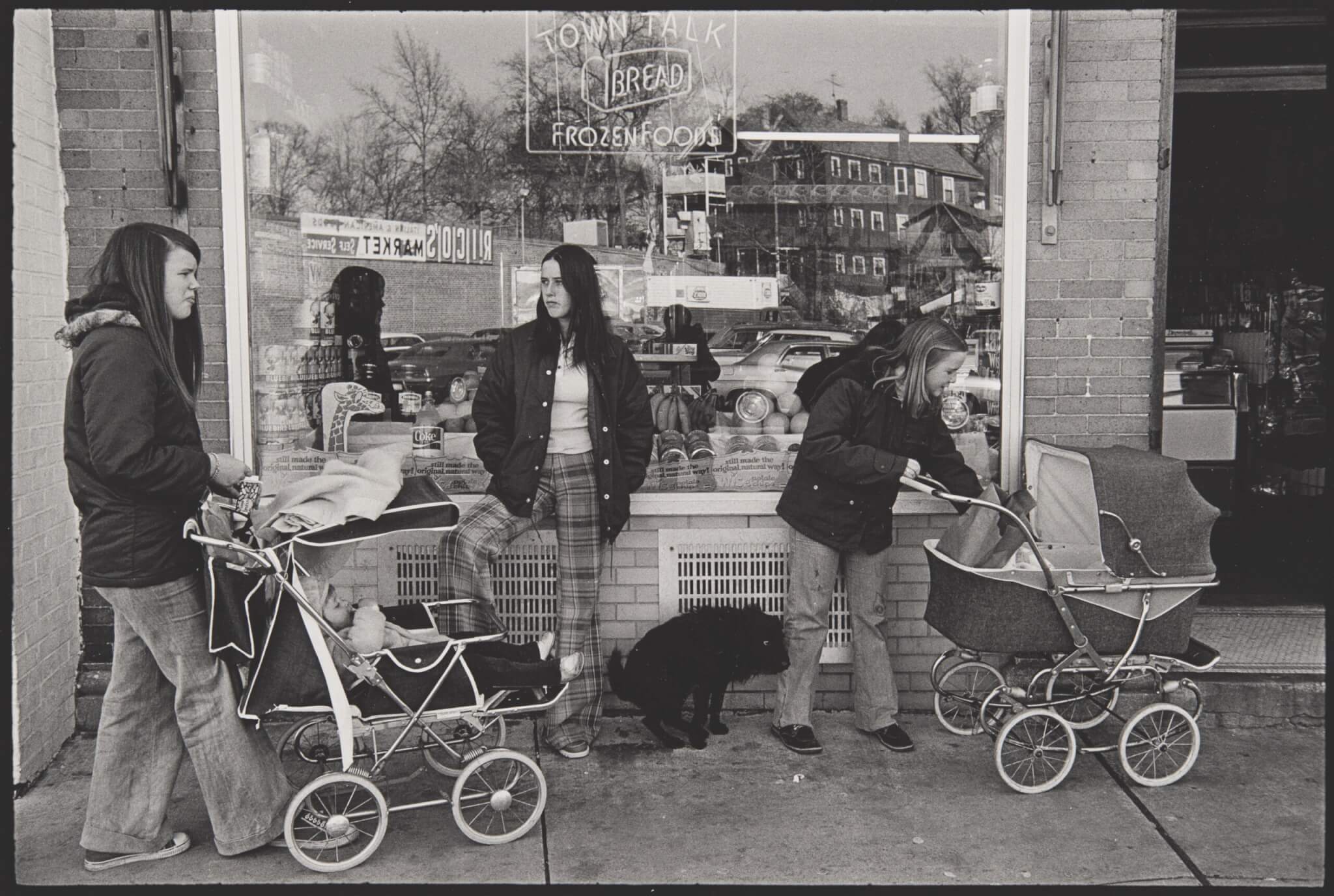
Constantine Manos, Girls with baby carriages at neighborhood grocery, Mattapan, 1974. Courtesy of the Boston Athenaeum.
To identify the people in the photographs, Graves spent over a year searching. She shared Manos’s images on the Athenaeum’s website and through its social media channels. She worked with the City of Boston’s Age Strong Commission as well as the Boston Public Library to set up in-person events at its various branches and at community centers in Dorchester and Charlestown. At these events, she laid the photos out on tables, inviting passersby to stop in, take a look, tell her what they might know. At the tabling events, especially, Graves noticed how much people wanted to connect with the photographs. I’ve walked by there, someone would say, or I was once there, or I went to school not far from there, or Maybe that person is connected to so and so. She felt that these face-to-face interactions were an important step to helping the public see the Athenaeum as a community-centered institution.
Graves managed to identify twenty-seven people who had either been photographed by Manos or were directly connected to the people and places that he had photographed. For the next phase of the project, Graves solicited the help of oral historian Lilly Havstad. Together they conducted and recorded fourteen interviews, which visitors to the exhibit will be able to access via touch screen or an app. This is a way, Graves said, for the photographs to speak back, to layer in new perspectives.
I spoke with Havstad over the phone on a weekday afternoon, and she shared some highlights from the featured conversations. She told me how when they asked Clara Wainwright, who started the Kite & Bike Festival in 1969, about the challenges of being a female artist in the ’70s, she replied, “I chase the light, and if I can’t find it, I create it.” Pedro Santiago, who now runs the annual Puerto Rican Festival (started in 1967 by Jorge “Chico” Muñoz) believes that by creating a sense of belonging, a sense of civic duty and engagement follows. Rosanne Solomon talked about her church’s migration from the South End to Roslindale and insisted on being called “American Lebanese,” not “Lebanese American.”
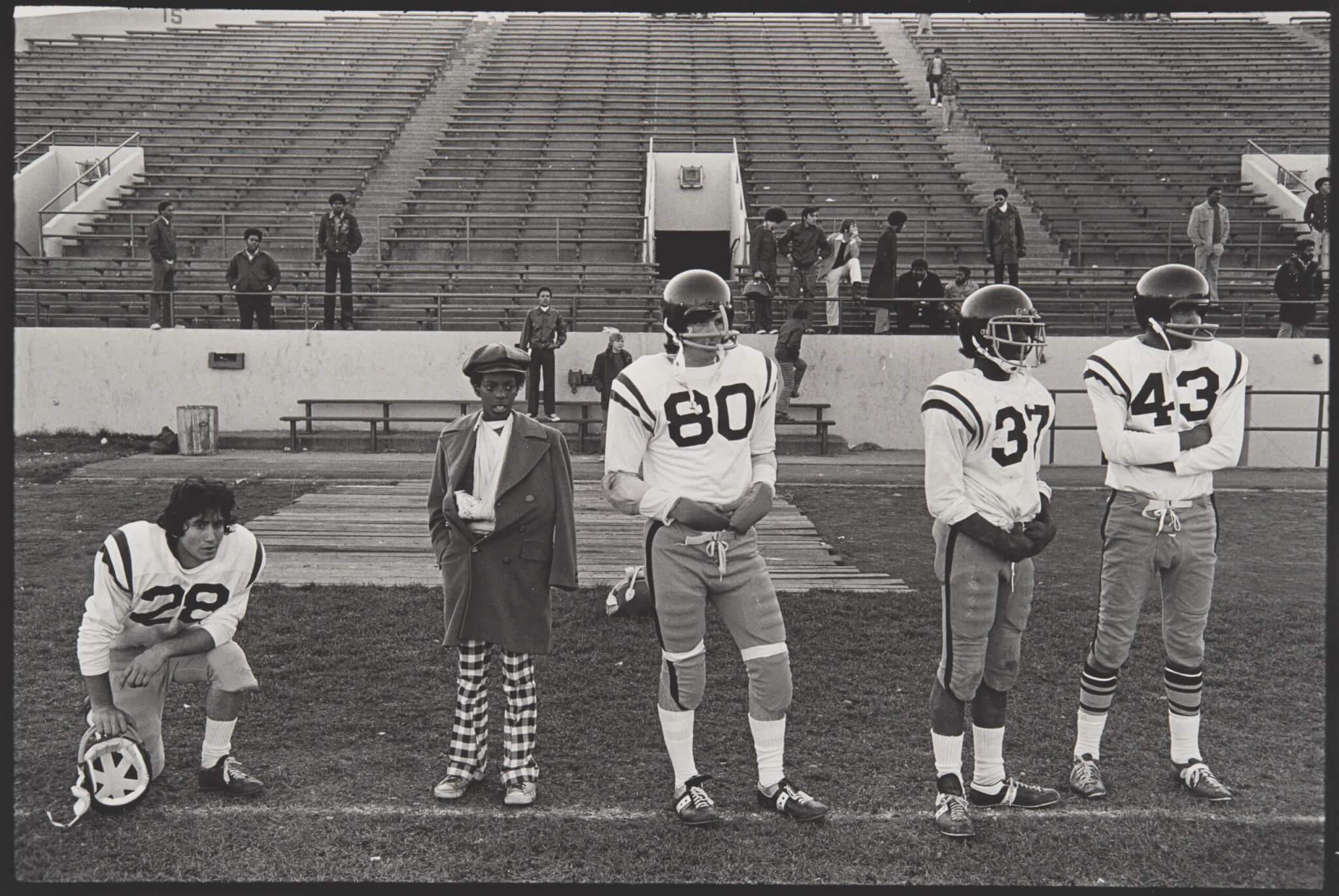
Constantine Manos, High school football game, White Stadium, 1974. Courtesy of the Boston Athenaeum.
Havstad recalled, in detail, three conversations around busing. The first was with a couple, George and Carolyn Moran, teachers who lived in South Boston; Manos had photographed their third daughter’s christening. The other two were with men who played for the English High football team; Manos had photographed them on the sidelines, in front of empty bleachers. Jim Stewart, who is white, spoke of the camaraderie on the football team. Havstad found it hard to reconcile his testimony with her understanding of the social upheaval at the time. But when she spoke to Cedric Turner, who is Black, he reinforced what Stewart said. The young men on the team did support one another. Turner was more explicit about the physical violence the team endured—rocks being thrown at them from the stands—but also felt they were pawns in a game the adults were playing. She realized then how much popular history had flattened this time in Boston’s history. Manos’s photographs played an essential role in troubling this narrative. She told me: “When you have a core theme tying together the conversation and you’re able to get at it from multiple perspectives, such an incredible and complex story emerges.”
At one point in our conversation, Havstad gently corrected me. I had been using the terms interviewer and interviewee. She said the preferred terms are researcher and narrator, which equalize the relationship and emphasize the co-creation of an oral history. As a writer and editor, I especially loved hearing her use the word narrator—a person who tells a story that will only ever be their version of the truth. Was Constantine Manos, over those nine months and across those 19,000 photographs, in a way, narrating a story of Boston? Was he now, posthumously, the third co-creator of these oral histories? How are we, as viewers, participating in this process of co-creation?
I had the chance to meet George and Carolyn Moran in person. They’re my neighbors in Roslindale, and when I asked them if I might speak to them about Manos, they invited me to their house for a coffee on a Sunday morning. They’re both extraordinary narrators—natural storytellers, precise with details, checking one another for accuracy. Their story could have easily been categorized as one of white flight. But they didn’t leave because of the Black kids being bused into their neighborhood. They left because of the few “rabble-rousers”—encouraged by infamously incendiary US Representative Louise Day Hicks—who had upturned the neighborhood. George shared how returning home one day he noticed cars triple parked up and down his street. Around the corner people were running, screaming, and being chased by cops on horses, bearing clubs. Shortly after, they left South Boston and moved to Brookline, where they lived for the next forty years.
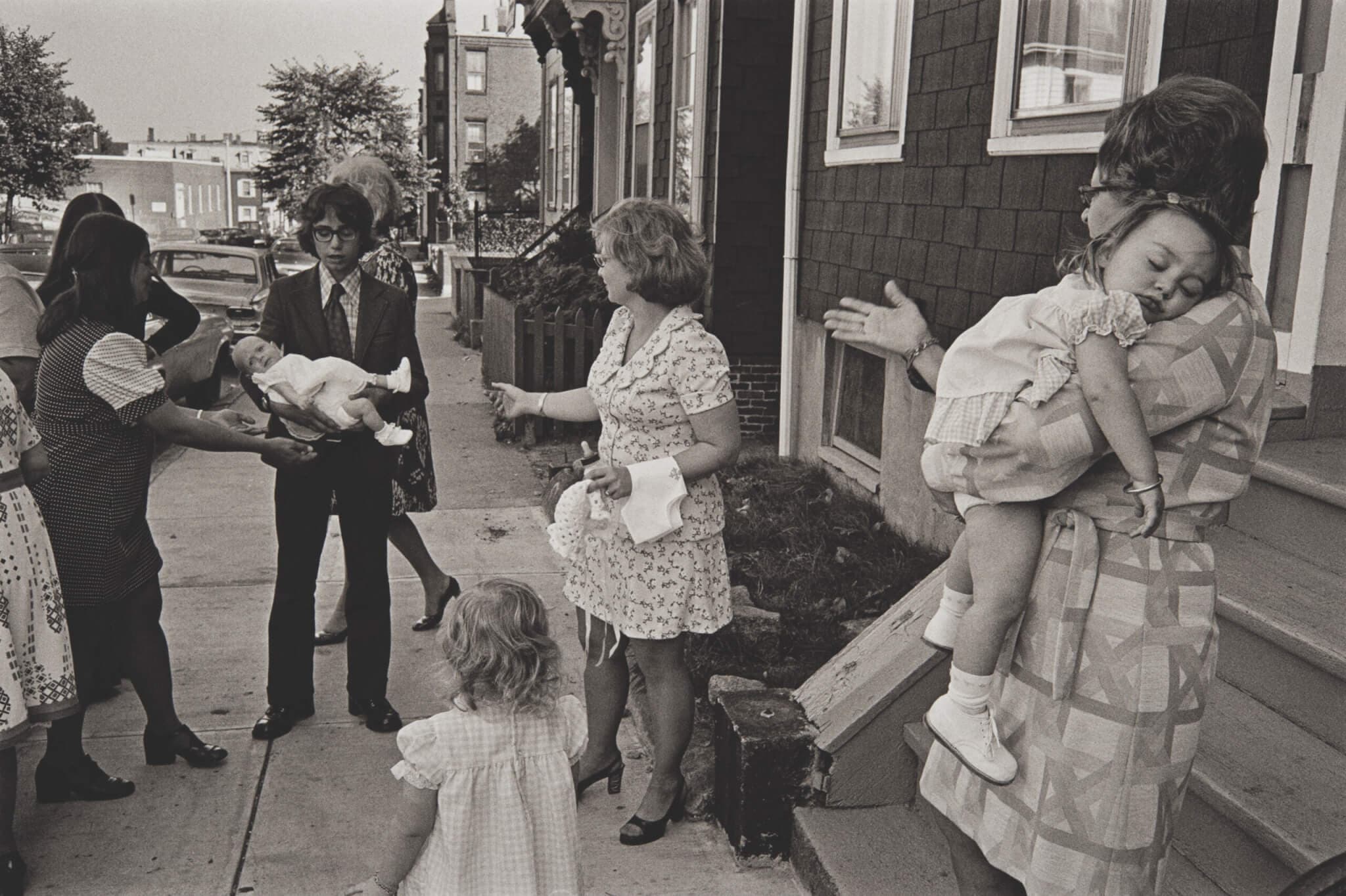
Constantine Manos, Moran family baptism, South Boston, 1974. Courtesy of the Boston Athenaeum.
They had met Manos when they still lived in South Boston, through Carolyn’s sister, who worked for the Boston 200 Bicentennial committee. He was looking for an event to photograph, and he ended up spending the whole day with the Morans for the celebration of their third daughter’s christening (one of these photographs was included on the outside of the exhibition pavilion in 1976 and will be part of the Athenaeum’s exhibition this summer). George remembered Manos fondly. They spent hours together, walking around South Boston. Manos wanted to learn more about the neighborhood, and George went along with him, carrying his camera bags. “The press was hated,” George told me. “I was his bodyguard the whole time, because with me he would be safe.” Manos, of course, wasn’t part of the press; he was an artist, trying to get under the surface story, searching for a deeper one. I sensed from George’s remarks that they trusted Manos, the care he took in his process. Manos had earned their trust, but the Morans were also trusting people. I felt this at their house that Sunday morning, a full spread laid out in front of us, the winter Olympics on but muted. That this trust and faith in the good intentions of a stranger meant a great deal then, and maybe even more so now.
Some of the energy of Manos’s careful, community-centered process, his neighborliness, seems to have found its way into the creation of “Where’s Boston? 50 Years Later”—Graves and her year-long and ongoing search for people in fifty-year-old photographs; Havstad and Graves co-creating all those oral histories; the Morans, wonderful narrators, opening their home to a stranger. There’s a gentle intimacy encouraged by Manos’s photographs—and the accompanying oral histories remind us that there’s always another and more complicated story of this city we consider our home.