This interview originally appeared in Issue 16, published May 16, 2026. You can read this piece and more by purchasing a copy of or subscription to the magazine.
Inside the Indigo Arts Alliance studio where Benjamin Spalding is a 2025 David C. Driskell Fellow, larger-than-life sculptures greet me immediately. The building opens into a generous shared makers’ space buzzing with the focused energy of work nearly completed. Here, Spalding is putting the final touches on sculptures destined for his solo exhibition, running through September 20 at the Farnsworth Art Museum.
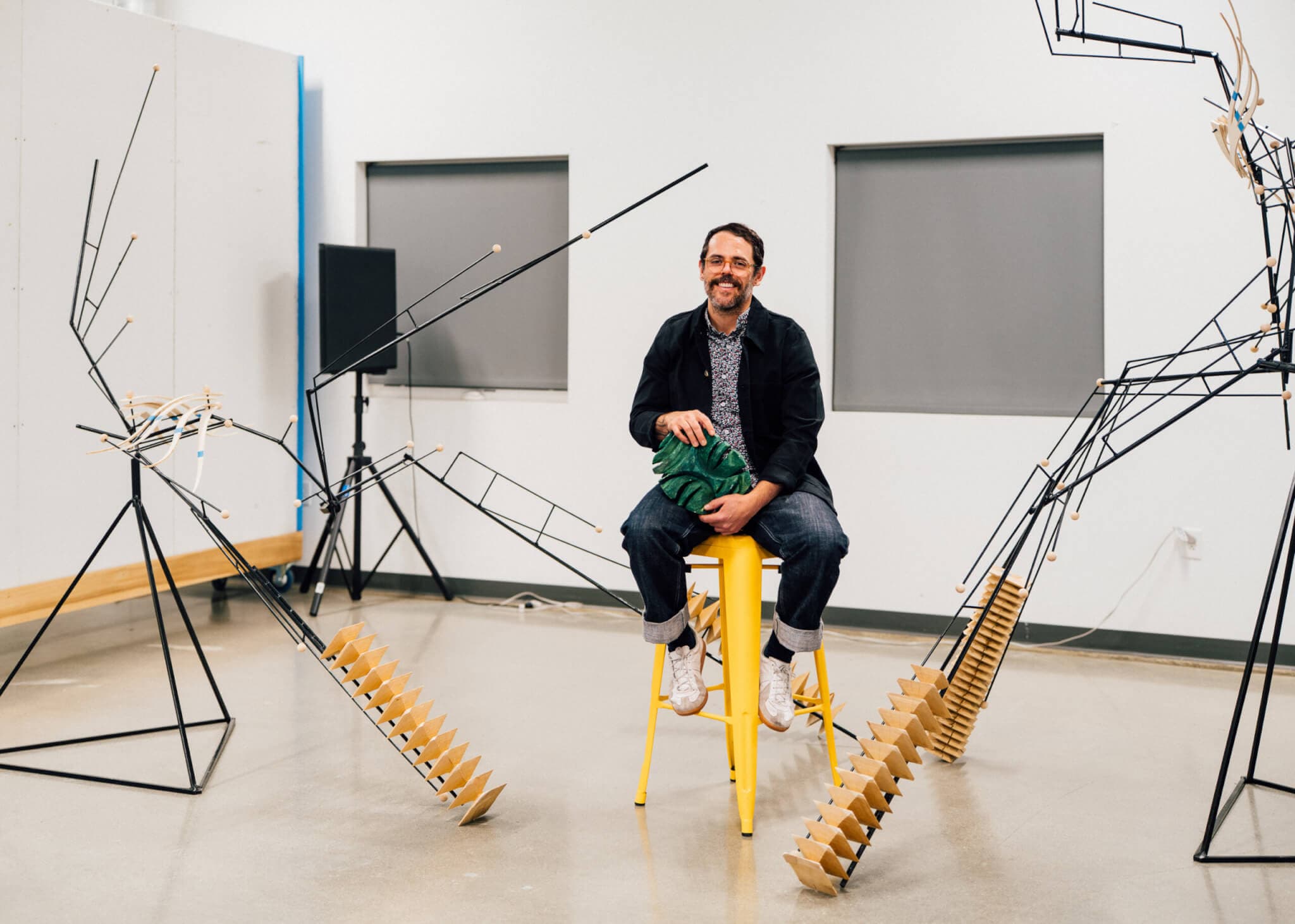
In the center of the polished concrete floor stand two tall skeletal structures. Their thin, black metal rods, anchored in angular, tripod-like bases, rise and branch outward. The forms feel airy, as if swaying to an imaginary beat.
A rolling partition wall pinned with sketches and notes hints at the thinking that is embedded in the work. Spalding left Maine to attend New York University, later spending eight years in Berlin immersed in club culture before returning to Maine in 2015 to earn his MFA at Maine College of Art & Design. Spalding translates decades of moving between dance floors into sculptural form. But his family lineage is also present: His Puerto Rican grandfather was a big band leader. Thinking through rhythm, pacing, and crescendo is part of his DNA. The sculptures hold this arc of memories: queer dance parties, family ties, and local ecology.
A second grouping of sculptures are more than skeletal—they bloom with organic forms saturated in red, purple, and green to evoke leaves, petals, limbs, or anatomical fragments. Their scale amplifies the emotional charge of collective energy on a dance floor. The sculptures feel like animated, embodied presences that command the room, poised between construction and performance. Together, they generate their own club and become extensions of bodies shaped by music and movement.
Our conversation moves through these worlds, between sculpture and sound, Maine and Berlin, the studio and the dance floor, to consider how joy, assembly, and embodied rhythm become material.
The following conversation has been edited and condensed.
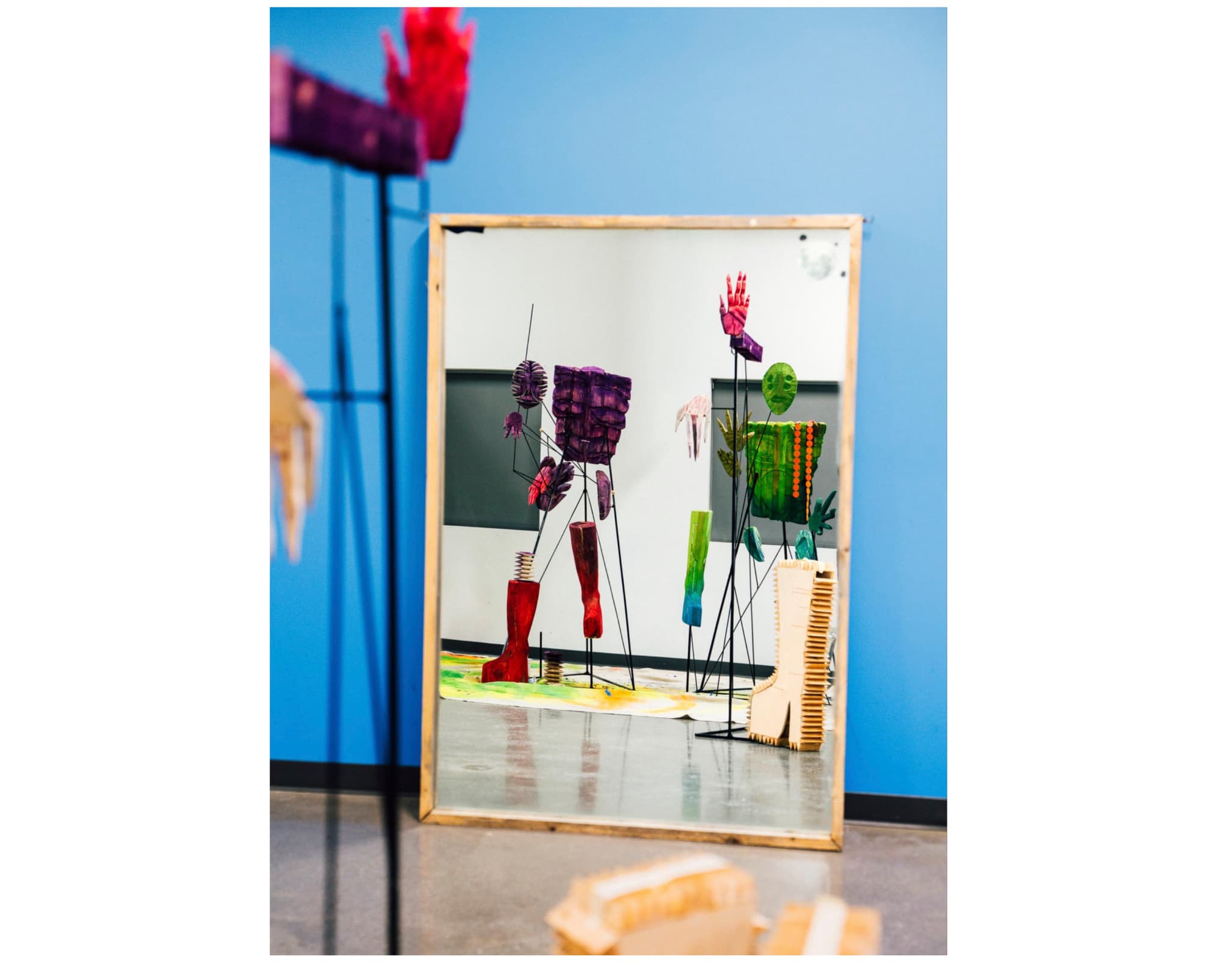
Works-in-progress inside Spalding’s studio space at Indigo Arts Alliance, Portland, ME, 2026. Photo by Joel Tsui for Boston Art Review.
Kaitlyn Ovett Clark: You grew up in Maine and are now based back in Portland. How has returning to this place influenced what you’re making?
Benjamin Spalding: As a child, I thought I would never live in Maine. My mother’s a New York, Puerto Rican woman, and so I went to New York City. I lived in Germany, but family brought me back, and I’m so happy to be back. As I get older, my capacity to appreciate Maine has grown. I involve myself in community. I am happy being in Maine, a strange surprise to my eighteen-year-old self.
KOC: When you moved back, did anything shift in what you were making?
BS: There is something about Maine; there’s an aspect of moving slowly, both in terms of the culture and the weather. In Maine, my capacity to experience wonder was heightened. Whenever I was in these other cities and I’d come home for a little while, I always felt this relief. There’s ways to let the wonder wash over you.
KOC: You have your first solo museum exhibition coming up at the Farnsworth Art Museum, as their Momentum 2026 artist. How does this show relate to or depart from previous projects you’ve worked on?
BS: The show feels like a strange homecoming of many different ideas, materials, and processes that I have been playing with consistently throughout my practice. Making art took a little bit of a back seat the past couple of years. I was making work about dance club culture or the feeling of dancing. I was like, “You also DJ; why don’t you just make people dance instead?” I’m excited to find this throughway between music, rhythm, body, and place in the work.
KOC: The title of the show also comes from music: Arthur Russell’s “Go Bang! #5.” That song is about an intense sense of joy and connection. Could you speak to how the ephemerality of being on the dance floor—being part of the music, creating a kind of space—translates into a sculpture or your installation?
BS: Both music and sculpture set a tone in space, but music has the ability to get under our skin in a way that perhaps our art brain or our capacity-to-judge brain doesn’t allow us. The community comes together for a specific, limited time. There’s a huge range of emotions that come out, but you leave with the residual sort of essence of it. The same thing happens when you go and see artwork and let it wash over you. It’s not to say that you don’t use judgment to go look at this work, but to allow yourself to enjoy the color or the texture or the form or the rhythmic quality. There will be music at this show too. I’m curious to see how sound shifts how people relate to the work.
KOC: Will the music be ongoing, or will there be moments where you come in and activate it?
BS: I think it’s going to be ongoing. There is going to be some programming. Every two months, there may be a movement or a dance [performance], or poetry or reading of text that relates to the show. I would like to do some “learn to DJ” workshops as well.
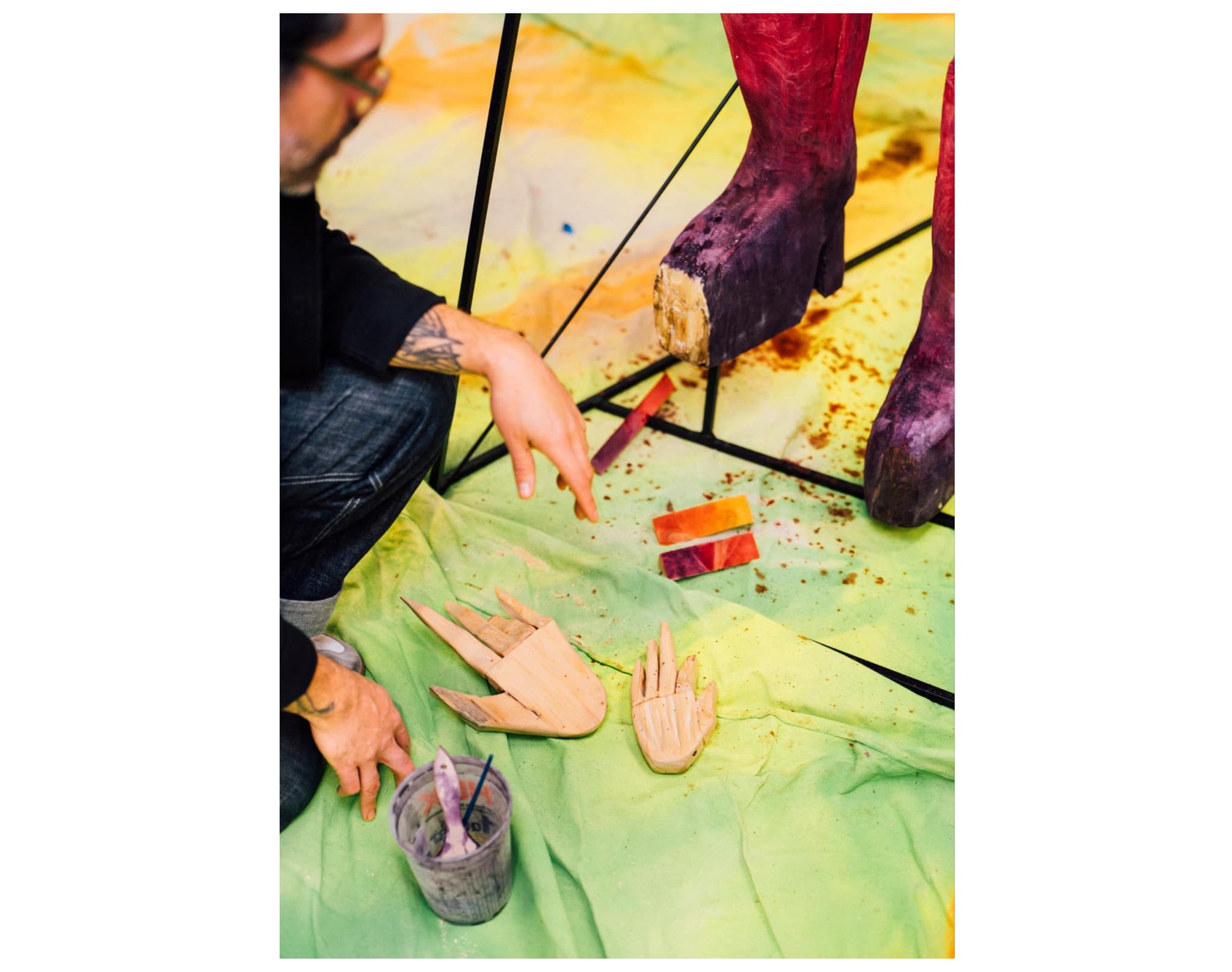
Works-in-progress inside Spalding’s studio space at Indigo Arts Alliance, Portland, ME, 2026. Photo by Joel Tsui for Boston Art Review.
KOC: As you’re speaking about DJing, one thing required is that you read the room, that you make adjustments in real time. Does that sensibility also shape how you approach making art?
BS: The timescale is much longer, and I have to think about the place. I have to think about the attendees. I can either go with these ideas or I can flip them on their head. The big part about the show is that the Farnsworth, as an institution, is steeped in the history of Maine artwork. We have beautiful seaside and woodland paintings of these places. But there’s more to Maine than that. As a young, queer Puerto Rican growing up in southern Maine, I was always wondering what existed beyond this. So I’m using this as an opportunity to look at aspects of Maine and remix this a little bit, both in terms of showing difference and celebrating where we are.
KOC: You were part of Visceral, a queer techno night in Boston. What did queer nightlife teach you about community, care, and collective energy?
BS: It taught me so much. I was able to understand my sense of self through these communities. You can make magic happen with minimal resources. It talked about community; it talked about the importance of collaboration with these events, and I was proud of New England for this. I did a lot of work for a couple of years organizing, designing, and installing a lot of their party setups. It was a huge amount of work for a temporary thing. It only lasted six hours, but when you saw people dancing at its height, it was beautiful.
KOC: The amount of labor sometimes stops people from doing something “short-lived,” but they don’t realize that feeling stays with someone after they leave an event, and they can take that with them to do their own version or create their own space. There can be a real ripple effect.
BS: Absolutely, and that ripple effect is not linear either. Knowing it’s temporal is important. Doing it for a community is also important. Partially why I’ve struggled with art-making is it feels so singular. My practice, my work, and no artist’s success is based on them alone. It’s based on the references of the work or the lineage of our history that they’re mining. It’s based on the collectors, the people who support their work. I’ve been trying to look at art-making from a DJing perspective. I can bring community together and I can pay homage.
KOC: Your work lives in clubs, galleries, and museums. Do you think about how different audiences across those spaces interact with your work?
BS: I do think about audiences. I think a lot about the circulation of the work. When we go and see an exhibition, we are primed to look at it and judge it a certain way. Our education has instilled a way of relating to what’s in front of us, and that means that some people won’t go and see it. Some people may be put off by the language of it. I am interested in creating spaces where the circulation and the capacity to interact with them is different. I like the idea of workshops along with the show. It has people come in, and it gets through the sort of wall of judgment and allows people to either see this in tandem with language or with movement or to see the research behind it. It feels enriching and has more impact when something involves community to make it happen.
KOC: “Go Bang!” is going to ask for a lot of togetherness, which is especially poignant in our current world. What kind of social space are you hoping this exhibition creates?
BS: Iwant people to be inspired to go, to bring people together, and to share as well. The research I do is based in the history of queer nightlife culture, specifically through music. You realize that historically, in times of duress, people have come together and found community, and also found the capacity to be resilient and resistant back in their day-to-day lives. To dance is not just an act of hedonism; it’s an act of getting into your own body and recognizing there are bodies around it. I think about the AIDS crisis, where people were able to dance and party at night and still care for each other and rally and protest during the day. These things are not mutually exclusive, but you have to allow the processing space to handle the other.
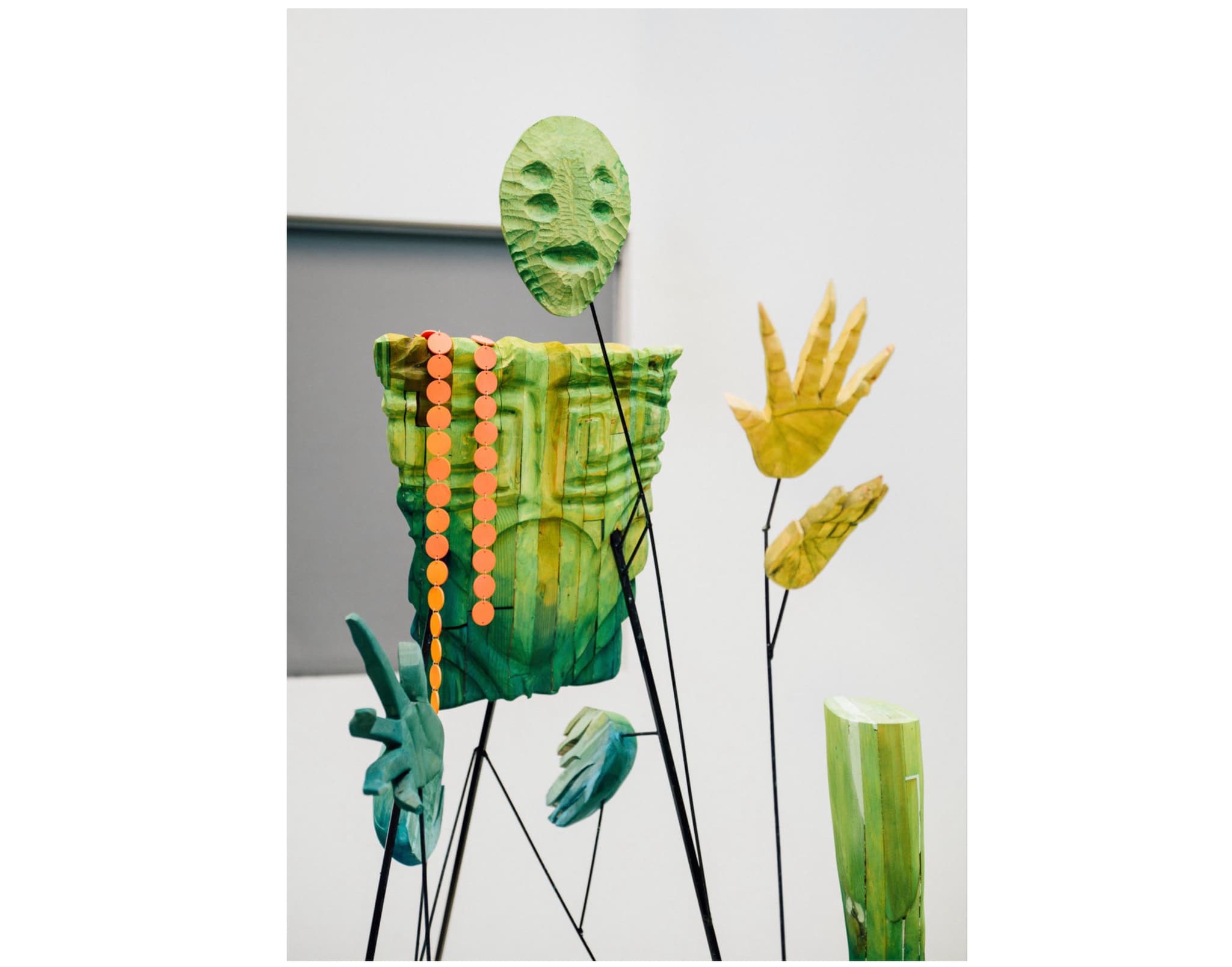
A work-in-progress inside Spalding’s studio space at Indigo Arts Alliance, Portland, ME, 2026. Photo by Joel Tsui for Boston Art Review.
KOC: You’re working with figures. How do the bodies function? Are they stand-ins for specific people? Are they archetypes or do they represent emotional states?
BS: I thought they were people and archetypes initially, and then they began to take on characters of their own. A practical consideration was how to translate aspects of rhythm, music, and musicality into form. Figuration is such an effective way of working with sculpture because seeing it makes you aware of your body immediately. They are all in different states of movement. Some of them feel a bit more compressed; some feel as if they’re moving around constantly. Others feel like the body as a nucleus is exploding and then coming out of itself.
KOC: After “Go Bang!,” what directions or questions are you excited to explore next in your practice?
BS: I’ve been toying with the idea on and off for a while about a conceptual record label being the umbrella where events are produced or exhibitions occur. [Maybe] a rural Maine DJ tour. So instead of big cities, what happens if I go to Grange Halls in rural Maine? Can I get people to dance in these spaces?
I want to present something that people know and can latch onto and expose them to something different. I also want to begin making and producing my own music as well.
KOC: If you could describe your practice as a kind of mix or playlist, what would some of the key elements or influences be right now?
BS: The mix would be a variety of dance music ranging from disco to house to techno, but always with a nod to history. Chicago house, a little bit grittier and sexier, some Detroit techno, and then a big percussion would add a lot of color to it as well. The mix would start on the slower side, lull you in, and before you know it, you’d be dancing. I like this idea of starting a bit slow and then getting people moving and sweating before they’re even aware of it.
But “Go Bang!” feels like an explosive thing. There will be peak time energy to it, which doesn’t always have to be so boom, boom, boom. There can be an ethereal or effervescent lightness to it. Joy is a huge part of it, and I don’t mean joy as in a frivolous emotion. I mean the capacity to feel embodied. You are at these nightclubs and you see all these people—drag queens and other characters—wearing their wild club kid outfits. A friend of mine once said to me, “Look at all this beauty, all the strangeness, all because of trauma.” The capacity to feel fabulous or the ability to pivot into something that feels fabulous, fierce, or sexy is someone moving away from a point of trauma and using that as a way of self-empowerment.