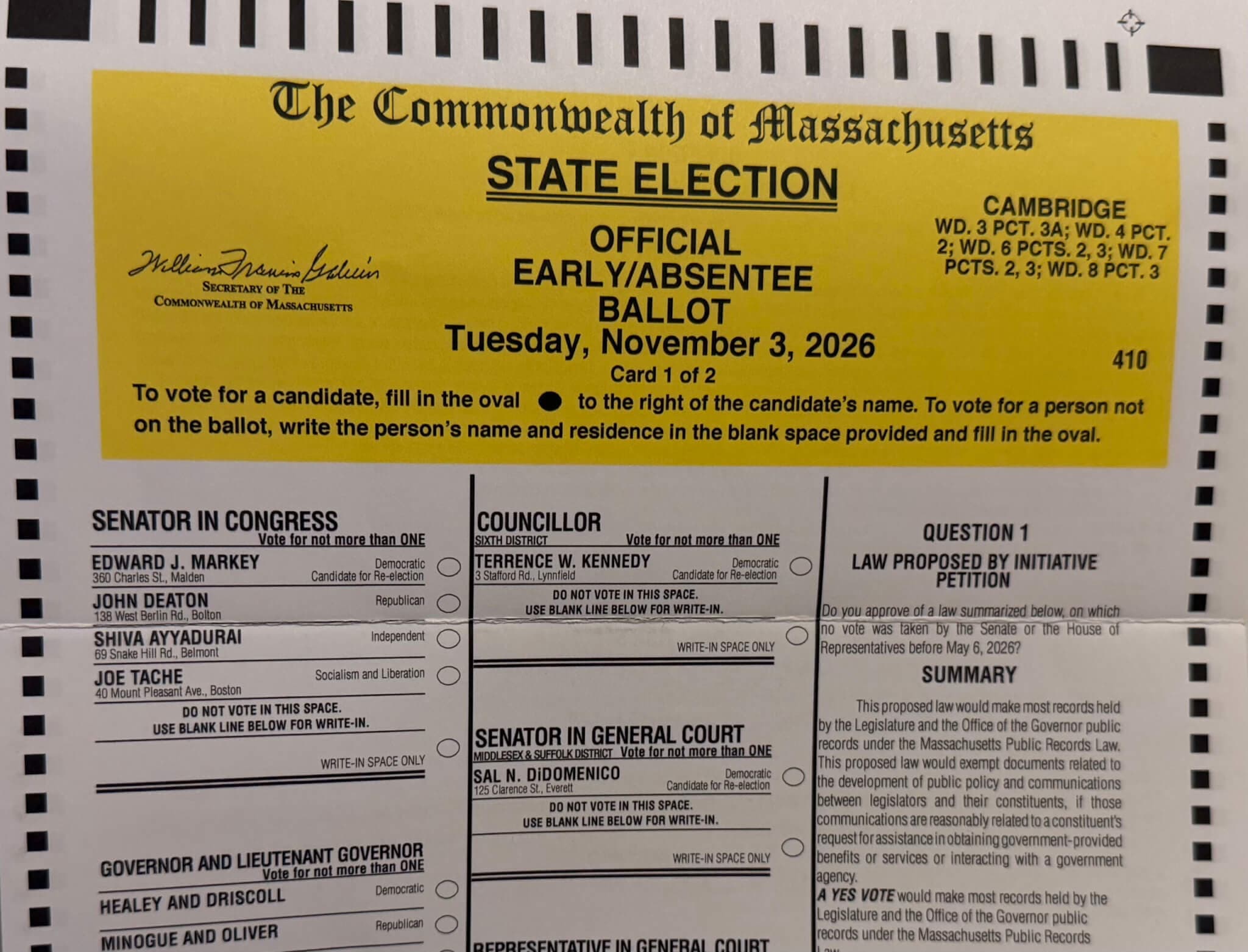
What else can we talk about? On Tuesday, voters across the US delivered a stunning—if not entirely unexpected—rebuke to Trump and the GOP, triggering a blue wave that carried down the ballot. Watched around the world, this wave reflected currents in the global system that affect artists operating within a highly internationalized arts ecosystem.
But as the results—including several historic firsts—sink in, it’s important to remember that voter repudiation does not mean a policy reversal. The time between now and January 3, 2027, when the newly elected are sworn in, sets a perilous clock ticking, against which the administration and the Republican-controlled Congress will likely move as much policy through as possible. There are troubling historical precedents for this, including, as one pundit recently cited, Nixon’s 1972 Christmas bombings in North Vietnam, which were rushed ahead before the new session of Congress convened in January 1973. Newly elected members had vowed to end funding for the Vietnam War.
After January 3, gridlock is all but guaranteed for the remaining two years of the Trump administration. Signaling this intent, Trump posted a photo of a red MAGA hat emblazoned with “VETO” to Truth Social late Tuesday. The following day, the White House posted on Instagram a photo of Trump behind the Resolute Desk with text overlay reading, “PSA: TRUMP IS STILL YOUR PRESIDENT.” These posts convey that, although the Democrats took the House and Senate by considerable margins, they still will not have enough power to override presidential vetoes during the latter half of Trump’s term—to do so would require a two-thirds vote in both the House and the Senate. Democrats taking Congress, and therefore controlling the purse, may slow Trump down, but the president’s policies have revealed how much of government runs on norms and traditions rather than law (all of which he has proved more than willing to disregard).
Aside from how a Democrat-led Congress might attempt to curtail the administration’s attacks on Iran, one of the first places we can expect this clash of separation of powers to halt progress is the budget. Congress passed a bipartisan spending package to fund the federal government through December 11, but a funding showdown is likely in the final days of the Republican Congress.
Budgets articulate the government’s priorities, so one thing to watch as the fights and national debt debates unfold is what will happen to the National Endowment for the Humanities, the National Endowment for the Arts, and the Institute of Museum and Library Services, all of which Trump has proposed eliminating but that Congress has continued to fund. Other appropriations to watch include those earmarked for the Smithsonian Institution and the Kennedy Center. Then there are legislative changes, such as Section 106 of the National Historic Preservation Act of 1996, which would curtail protections for historic properties, and new census rules, which would change the ways populations are counted, with the intention of funneling federal funding from historically blue to historically red states—a move decried by local elected officials. Together, all will have downstream consequences for the arts.
We’ve written extensively about how arts and culture, like capital and politics, are part of globally connected ecosystems. So this week’s blue wave may be better understood as a local crest within broader global political and social groundswells around common crises.
Student protests across Europe, triggered by the cost-of-living crisis, a collapsing job market, and frustration with austerity budgets that undermine the quality of education and starve museums and cultural institutions of funds, show a volatile sociopolitical environment in which voters—primarily millennials and younger—struggle to see a future for themselves. (A photography exhibition at the Weatherhead Center for International Affairs at Harvard University underscores how political currents spill over across geographies.)
This youth engagement seems to be driving an electoral shift to the left. In Brazil, leftist Luiz Inácio Lula da Silva defeated right-wing Flávio Bolsonaro, whose father, Jair Bolsonaro, remains imprisoned for attempting to incite a coup after losing the previous election to Lula. The Lula administration, along with Claudia Sheinbaum’s administration in Mexico, remains one of the few left-leaning spots on the LATAM map—and one of the few administrations that have stood up to Trump’s overtures of power. It also helps that these administrations represent some of the region’s largest economies and, by extension, its art markets.
In Europe, after months of Flamingo Revolution protests triggered by Jared Kushner and Ivanka Trump’s attempts to purchase a nature preserve to turn it into a resort, protesters in Albania stormed parliament and demanded the resignation of (artist) and longtime Prime Minister Edi Rama, who had preliminarily approved the Kushner deal. Student-led protests in Serbia resulted in the electoral defeat of authoritarian president Aleksandar Vučić. And while the Israeli elections didn’t decisively tip power to the opposition, they suggest Netanyahu’s grip on power is weakening. It appears unlikely, however, that either side will be able to form a government, which will most likely trigger new elections. Overall, the momentum created by this left tide builds cautious optimism for upcoming elections in Spain, France (for which Kushner’s father serves as the US ambassador), and Germany, which have seen the rise of far-right parties.
Given cuts to government funding for the arts, philanthropy will be an important space to watch. Last month, the Ford Foundation announced a “seismic” shift in its giving to focus on democracy building. In developing seven “interconnected funding areas,” the organization’s new framework eliminates areas expressly focused on funding arts and culture. The restructuring follows a strategic plan launched after the Ford Foundation announced its new president in July 2025. The Ford Foundation is one of the major foundations in international giving and therefore wields significant industry sway. Several other philanthropic foundations have also undergone leadership changes: In roughly the last year, the Barr Foundation and the Boston Foundation both announced leadership transitions. As cities and states face continued economic crises and budget cutbacks, the looming question is whether other foundations will follow the Ford Foundation’s lead and pull back their support for the arts. Or will they take the blue wave as a sign that democracy is safe and keep funding arts and culture?
The arts are good at contorting into whatever shape is needed to fit the grant. But the downstream effect of any change in philanthropy’s priorities, such as those at the Ford Foundation, is a change in the shape of arts and cultural offerings vis-à-vis the purse. If we see a shift in grantmaking at large toward funding art that strengthens democracy, will the tradeoff be a decrease in funding art for art’s sake?
As the confetti settles on this week’s electoral wins, Democrats will need to coalesce around a policy agenda that meets the demands of the societal and cultural shifts underlying these political ones. There is a difference between winning an election because voters are buying into a policy agenda grounded in a vision of the future and simply casting a protest vote against a party that has built itself around a cult of personality, centered on a president with historically low approval ratings. Given that the arts in the US have never really managed to build a political coalition and that cultural policy is written and implemented in a disparate way, many questions about how newly elected officials will deliver on voters’ expectations—for the arts and otherwise—will play out through local politics.
Politics is one vector of power, and while the elections changed the party controlling Congress, the underlying market conditions and contradictions driving the cost-of-living crisis and the collapsing job market won’t be solved with politics as usual. In the 1970s, youth movements declared they had “No Future” and ushered in punk music and DIY art and culture scenes. Today, bootstrapped alternative movements don’t pack the same alternative punch in a context that lacks a monocultural set of referents but in which culture and politics are increasingly captured by corporate interests.
By all means, ride this high and enjoy the invigoration of hope that pushback is possible. But for change to occur, it will be critical to see this election as a start, not a referendum on democracy and the arts.
Local Headlines
Somerville Cultural Trust
Art Stays Here is working with the City of Somerville to keep studios and rehearsal spaces available to local artists by purchasing properties through a trust. Somerville plans to file a petition with the state legislature asking for permission to establish the trust.
Ché Anderson Elected to NASAA Board of Directors
Ché Anderson, chair of the Mass Cultural Council, has been elected to the Board of Directors for the National Assembly of State Arts Agencies.
agriCultural Artist/Farmer Residency Project
A new arts initiative by the Southeastern Massachusetts Agricultural Partnership is pairing artists and farmers to work on projects that tell foodways stories and help slow the loss of agricultural land in Massachusetts to urban development.
National Headlines
Kennedy Center Honorees Announced
The Kennedy Center has announced this year’s arts honorees. The 2026 show honoring the selected class will be unusual: The ceremony will be held offsite due to the ongoing battle over the Kennedy Center’s closure, renovation, and attempted renaming.
Where Is All the Anti-War Art?
Julia Halperin has written for The New York Times Style Magazine about museums shying away from exhibiting works by artists who criticize global conflicts.
Epstein Survivor Puts MoMA on Blast
Danielle Benskey has penned an op-ed about her fight to recover from abuse by Jeffrey Epstein, in which she calls for the Museum of Modern Art (MoMA) to sever ties with board member and Epstein associate Leon Black. Benskey cites institutions’ association with him as legitimizing “people whose conduct warrants serious investigations.”
Art For…um
Travis Jeppesen, former senior web editor for Artforum, is letting the bridges he burns light the way with a long-form overview of what happened to the art magazine. Going well beyond “the Velasco fiasco,” the piece offers a peek into the backroom politics that tripped up the vaunted magazine.
International Headlines
MoMA, M+, and the Centre Pompidou Announce Partnership
In a historic first, the MoMA, Hong Kong’s M+, and Paris’s Centre Pompidou will share collections and collaborate on exhibitions.
Judge Rules Works Must Be Reinstalled at the National Museum of Colombia
Last week, for Artnet, I covered Colombian President Abelardo de la Espriella’s “culture war” on “wokeism,” including how he sent the secretary general of the Ministry of Culture to select for immediate removal dozens of artworks and historical objects (including a special ballot used to vote for the 1991 Constitution and a melted-down bullet used to sign the 2016 peace agreement, which ended more than fifty years of armed conflict) at the National Museum of Colombia. The censorship scandal triggered protests and prompted the courts to weigh in. On October 28, a Bogotá court ordered the works to be reinstalled.
Engagement Opportunities
Have a Say in MASSCreative’s Next Legislative Cycle Agenda
MASSCreative is hosting a series of listening sessions across the state. The organization is asking members of the arts community to weigh in on issues important to them to help set the next legislative cycle’s arts advocacy agenda. Check the schedule to find a session in your area.
Cultivating Support for Arts and Culture Journalism: A Convening
BAR’s Jameson Johnson will speak with other leaders in the field at “Cultivating Support for Arts and Culture Journalism,” a convening hosted by the Dorothea and Leo Rabkin Foundation, on November 17. The organization will present findings from its recent study on the state of independent arts and culture journalism. RSVP here.