How does an arts institution represent and reflect on 150 years of arts pedagogy? The School of the Museum of Fine Arts (SMFA) in Boston has undertaken such an ambitious endeavor in celebration of the 150th anniversary of the school’s founding in 1876. As part of commemorating this moment, Tufts University Art Galleries (TUAG) has organized a two-part exhibition examining the SMFA’s impact on the local, national, and international arts stage: “SMFA at 150: Looking Back,” currently on view in the galleries at 230 The Fenway through November 8, and “SMFA at 150: Looking Forward,” forthcoming in January 2027.
“Looking Back” is not an exhibition of notable artworks produced by the school’s renowned faculty and alumni, although there are numerous good examples; rather, it is a visual chronicle of the SMFA’s shifting pedagogical frameworks and the mark made by its faculty on generations of students over the last century and a half. Coordinated by a collective of alumni, staff, and past faculty, many of whom prefer the term organizer over curator, as well as Dina Deitsch, former TUAG director and chief curator, the exhibition is not only a history of the SMFA as a singular institution, but also tangentially speaks to the relationship of the school to the Greater Boston art scene over the decades. I can argue that without the city’s art schools and university art departments, the city would be home to far fewer artists. But as the exhibition successfully posits, the SMFA’s permissive cultural environment and leanings toward artistic experimentation have shaped generations of artists, some who have stayed and built their artistic careers here and others who have carried their educational experiences in Boston into careers made elsewhere.
To outline its pedagogical development, the exhibition is installed across two galleries and split between two chronologies: The Early Years: An Overview, 1876–1960, presented in the smaller gallery, and The Revolution and Its Antecedents held in the larger atrium gallery. Although visitors may view the galleries in either order, the division is nonetheless important and intentional, aiming to clarify distinct trajectories in the school’s history: first founded on an academic model rooted in the traditions of painting, drawing, and sculpture, and later, the radical transformation of its pedagogy, in the 1960s, that emphasized an interdisciplinary and unstructured curriculum.
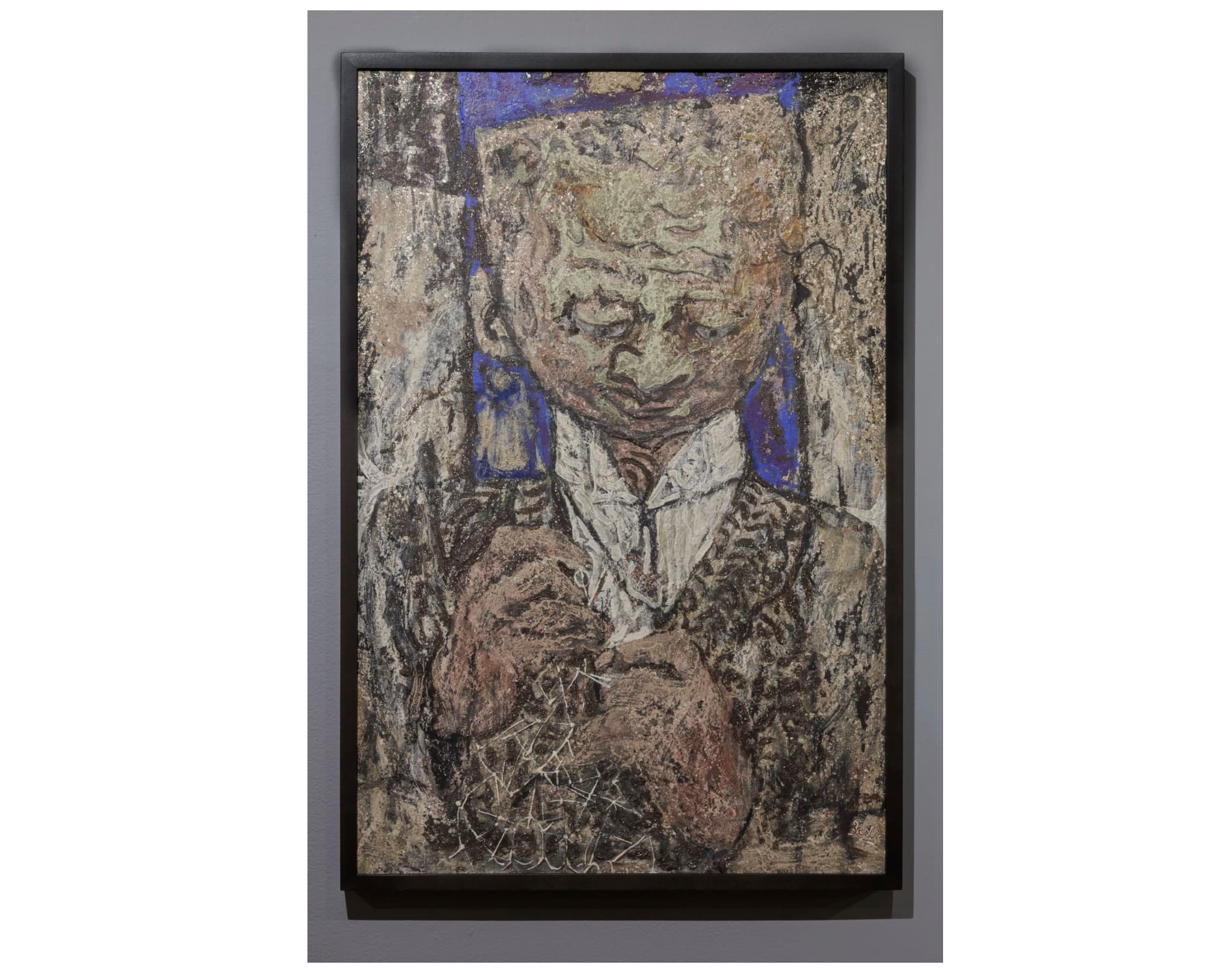
Karl Zerbe, The Inventor, 1951. Polymer tempera on canvas. Courtesy of Tufts University Art Galleries.
The first several decades of the SMFA stylistically paralleled developments in painting and sculpture in the region, as well as the dominance of portraiture and landscape genres until the 1930s, when Alexandre Jacovleff and later Karl Zerbe, Russian and German immigrants respectively, joined the SMFA painting faculty. Together, they introduced an expressionistic aesthetic program influenced by German Expressionism and European artists such as Oskar Kokoschka, Max Beckmann, and George Grosz. Zerbe led the Department of Painting and Drawing starting in 1937, rendering a formal end to the academy model. The local strain of figurative expressionism advanced by Zerbe and Jacovleff, known as Boston Expressionism, extended throughout the region and among other notable artists in Boston, including David Aronson, who studied under Zerbe and later went on to head Boston University’s School of Fine and Applied Arts (now the College of Fine Arts). One such example in the exhibition is Zerbe’s The Inventor (1951), which depicts a slightly distorted male figure made using a polymer tempera, a technique that, according to the accompanying wall label, allowed him to create multiple dense layers of color and texture. The painting’s encrusted and cracked surface in mainly earth tones lends dimension to the figure, but its dense materiality also makes the painting feel like a recently unearthed relic from the past. Zerbe’s ongoing material and conceptual experimentation exemplifies Boston Expressionism’s tendencies toward dark and gritty tonalities and abstracted figurative compositions, which stood in contrast to the increasingly dominant Abstract Expressionism of the New York School. As a regional style, Boston Expressionism has had its supporters and detractors since. But it is noteworthy that, as immigrant artists, Jacovleff and particularly Zerbe brought the European avant-garde to Boston, disrupting the conservative tendencies in painting at the time.
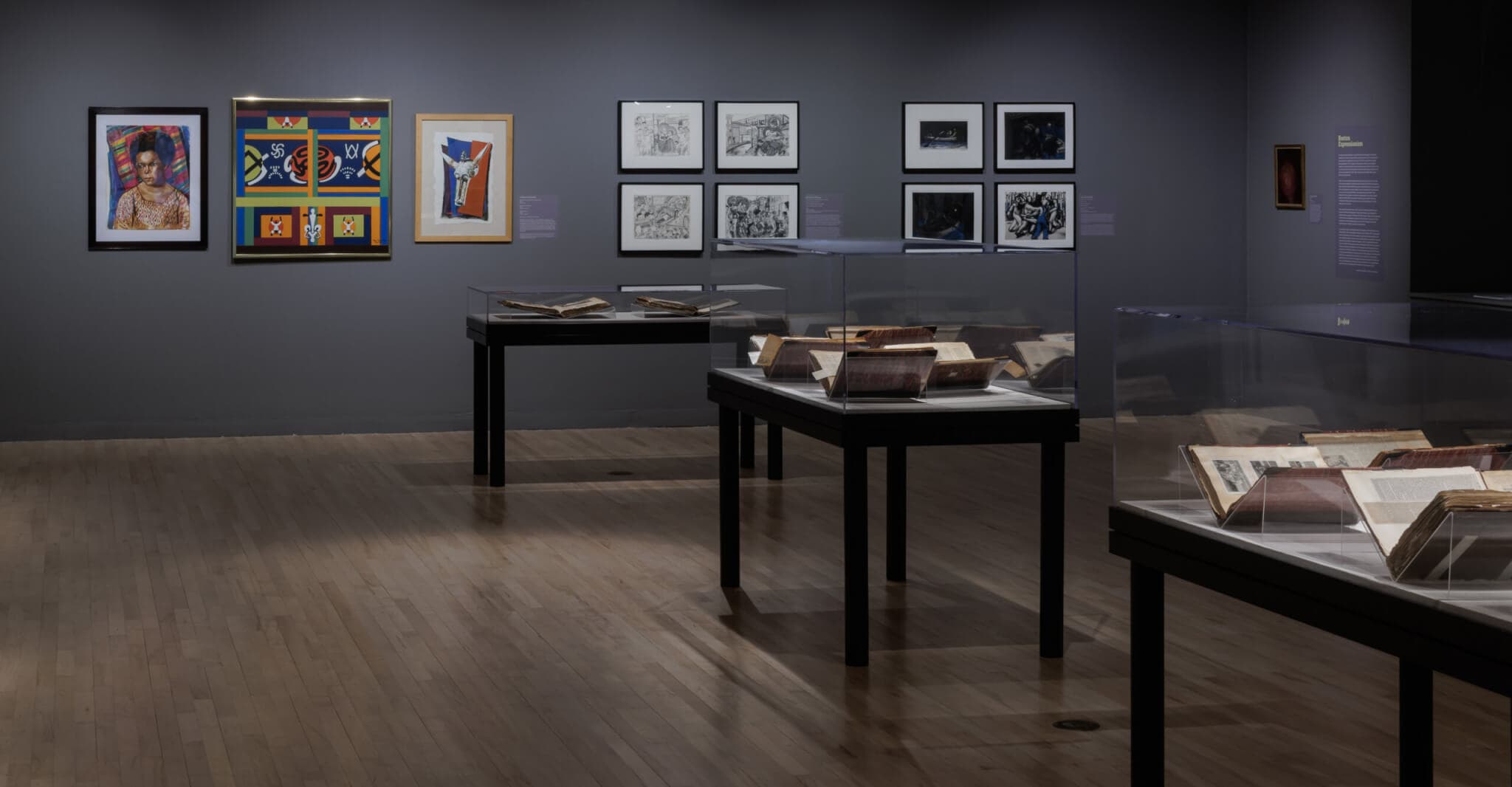
Installation view, “SMFA at 150: Looking Back,” Tufts University Art Galleries, Boston. July 28–November 8, 2026. Photo by Tim Correira. Courtesy of Tufts University Art Galleries.
The Museum School, as it was affectionately called from the 1960s onward, took shape in 1968 with the hiring of Bill Bagnell as dean of students, who helmed what is colloquially referred to as “the great changeover”: the transition from a structured and disciplinary pedagogical model to an unstructured one that enabled students to carve their own educational paths. As head of the Department of Painting until the mid-1950s, Zerbe shifted the parameters of painting, but it was Bagnell and collaborating faculty and administrators that reshaped the entire SMFA curriculum. The second half of “Looking Back” emphasizes this transformation from painting as the dominant medium of instruction to photography and performance as core aspects of the school’s artistic ethos. In the decades immediately following Bagnell’s arrival, student artists embraced experimentation and an anything-goes approach, pushing the boundaries of their respective practices in ways that were often collaborative and unencumbered by media specificity.
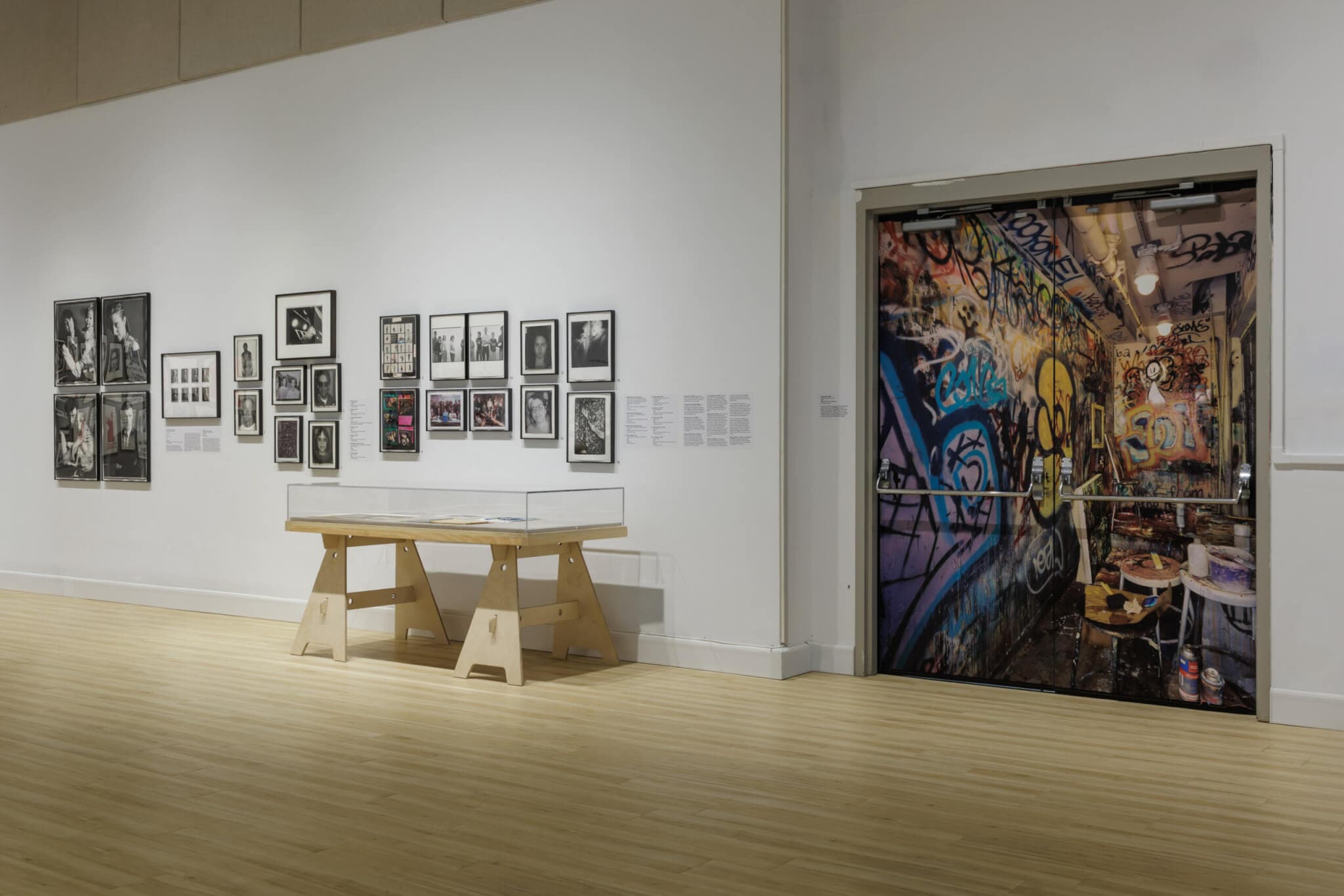
The photography department embraced the experimental in the rejection of modernist conventions and ideas of the pristine print by some of its practitioners. Many of the department’s early faculty, including Bill Burke and Jim Dow, whose practices engaged with social documentary traditions, undoubtedly encouraged their students to think about photography in more conceptual and material terms. The subsection “Artists with Cameras,” presented in the larger gallery and organized by emeriti faculty Dow, Burke, and Shellburne Thurber, focuses on the diverse community of students and faculty that revolved around the darkrooms, bringing them together in a collage of photographic portraits of faculty by students, students by faculty, and students by their peers. This approach enriches ideas of community and collaboration while also diplomatically sidestepping the privileging of some artworks over others. However, there are missed opportunities in this section to show the depth of photographic experimentation by students from the late 1970s onward. There are some rewards in this vein, including Thurber’s Edinburgh, IN: My grandmother’s portrait with matching chairs and footstools (1976), a sumptuous black-and-white photograph of an uninhabited interior for which Thurber has become known.
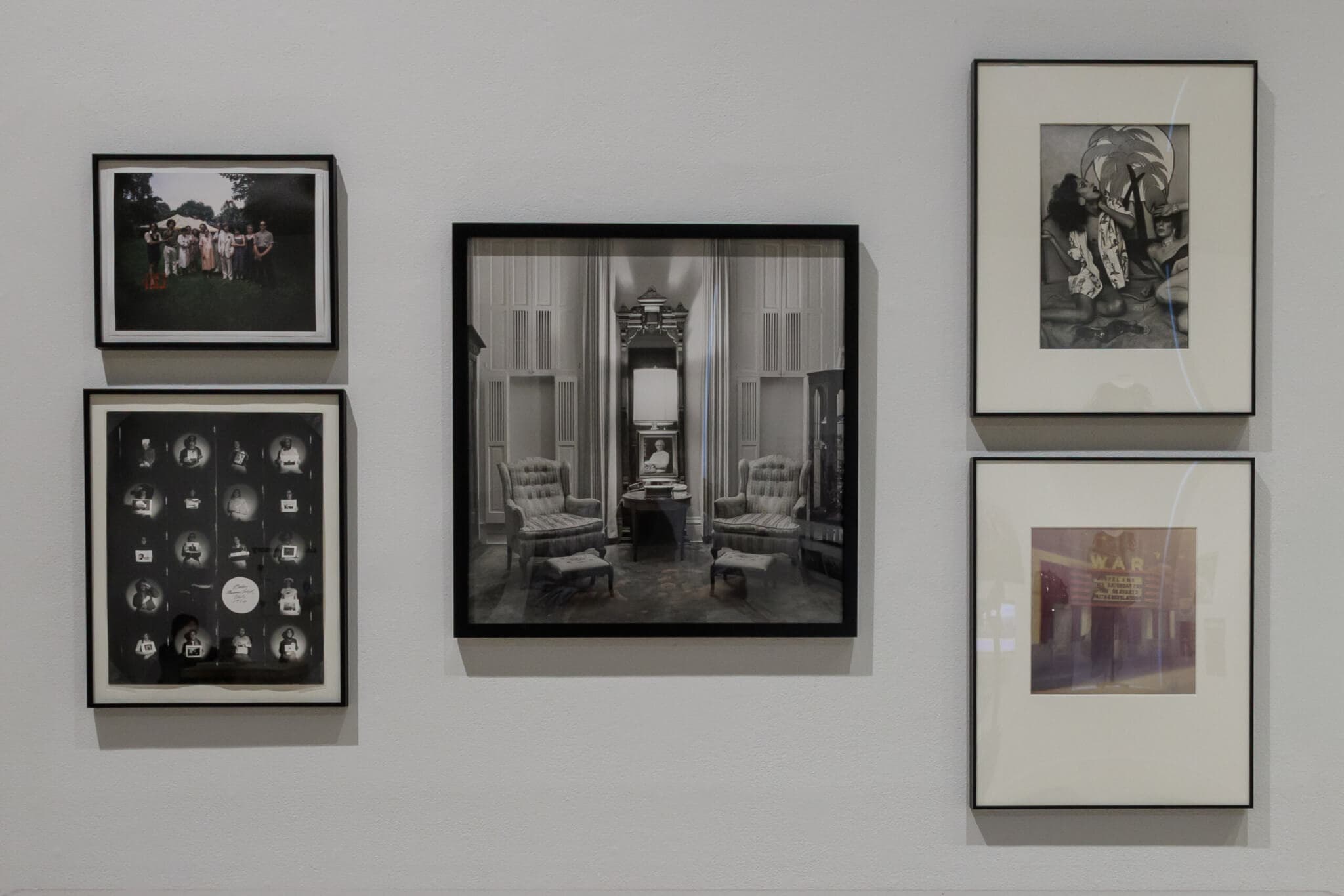
(center) ShelIburne Thurber, Edinburgh, IN: My grandmother’s portrait with matching chairs and footstools, 1976. Installation view, “SMFA at 150: Looking Back,” Tufts University Art Galleries, Boston, July 28–November 8, 2026. Photo by Tim Correira. Courtesy of Tufts University Art Galleries.
In an adjacent case, there is a selection of what appears to be work prints by Philip-Lorca diCorcia, a series from the 1970s documenting a chance exercise in which diCorcia tossed objects into the air and photographed them as they fell. Selfishly, I would have also liked to see Mike and Doug Starn’s work from their student years in the early 1980s. The Starn Twins, as they were then known, challenged conventional concepts of photography by taping together torn fragments of printed photographs (using Scotch commercial tape) into a unified large-scale image. Or, maybe the inclusion of one of Mark Morrisroe’s “sandwich prints,” a process he created by first producing a color print, photographing it in black and white, then putting the two negatives together to create a new photograph, allowing the blur and imperfections of each iteration to become part of the image.
Cultivating artistic legacy through teaching is most tangible in the subsection “Instruction: Performance + Teaching Legacies,” which follows the photography section, and is a series of video works organized by Dell Marie Hamilton. Here, Hamilton takes a deeply personal approach that relates to her own artistic development. Centered on social relationships and the artistic lineages of three seminal educators and performance art practitioners—Danielle Abrams, Marilyn Arsem, and María Magdalena Campos-Pons—Hamilton weaves together performances made by these faculty and their students that explore performance as a conduit for site, memory, storytelling, and identity.
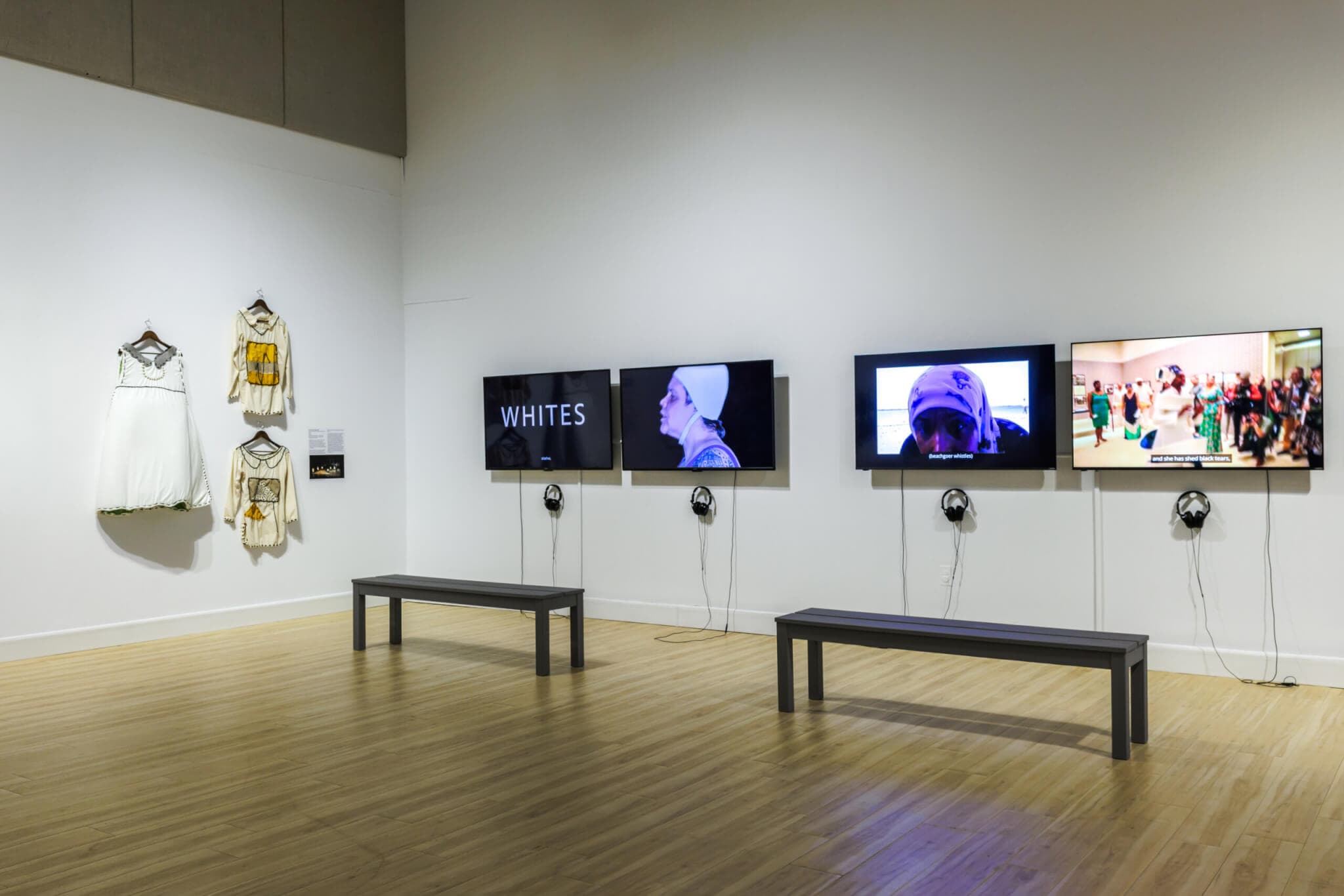
Installation view, “SMFA at 150: Looking Back,” Tufts University Art Galleries, Boston, July 28–November 8, 2026. Photo by Tim Correira. Courtesy of Tufts University Art Galleries.
The nuanced intersections of race and gender are at play in one compilation featuring performances by Campos-Pons, Hamilton, Angela Counts, and Helina Metaferia. In Campos-Pons’s seminal work Hable La Madre, performed in 2014 in the rotunda of the Guggenheim Museum, she dons a sculptural dress echoing the famed spiral architecture of Frank Lloyd Wright’s building and leads a procession of Black women through the museum, inserting Black female presence into the historically white institution. Hamilton, who was a participant in this performance, cites this engagement as pivotal to her own practice. Thus, she further connects ideas of artistic lineage in her performance Jackson Pollock, Two Figurative Alternatives (2021), which takes the form of an art history lecture on the artist Jackson Pollock given by Hamilton in the guise of Susan Denker, a former SMFA professor and one of Hamilton’s mentors. In Metaferia’s The Willing (2023–25), echoes of Campos-Pon are palpable as the artist leads her own procession of collaborators through various locales, engaging in song and movement, and sharing the stories of familial, artistic, and political ancestors.
“SMFA at 150: Looking Back” is a surprisingly quiet exhibition, although there are moments of theatricality, such as the displays of Kaiju Big Battel and the Art School Cheerleaders that revel in the performative spectacle of the 1990s and early 2000s. The strength of the exhibition, however, is how it conveys the importance and necessity of arts education at a time when higher education and art schools, in particular, are under threat. The second part of the exhibition, “SMFA at 150: Looking Forward” will undoubtedly continue the idea of arts education as a critical force in social and cultural life.
“SMFA at 150: Looking Back” is on view through November 8, 2026, at the SMFA at Tufts, 230 The Fenway, Boston, MA. Part two of the exhibition, “SMFA at 150: Looking Forward,” will be on view January 28–April 18, 2027.