Wôpanâak cosmologies and ontologies position our bodies as inseparable from our homelands and homewaters. This relationship between self and land is encoded in our language, as Mashpee Wampanoag linguist jessie little doe baird attests, and animates many of the projects that contemporary Wampanoag artists, knowledge keepers, and cultural workers are presently undertaking.1 It is perhaps this understanding—that the stories of our lives are inextricably linked to the places that our blood and bones come from—that informs Tess Lukey’s curatorial thinking. Lukey, a citizen of the Wampanoag Tribe of Gay Head Aquinnah, is the associate curator of Native American art for the Trustees of Reservations, a conservation organization that owns over 27,000 acres of land and holds conservation restrictions over an additional 20,500 acres. When I spoke with her in September, Lukey referred to “The Land Tells Our Stories” as the show she’s been preparing for her whole life.
“The Land Tells Our Stories,” on view through October 31, activates three Trustees properties with the works of visual artists—May Babcock, Ella Mahoney (Aquinnah Wampanoag), and Posey Moulton—who have grounded relationships to the coastal Northeast.2 As Lukey describes in the exhibition’s introductory video, the show is guided by “principles of placemaking” that encourage the viewer to work toward “‘placekeeping’: not only preserving land, but sustaining the people, histories, and meaning it holds.”
I was struck by Lukey’s framing of the show with these terms, which emerge from urban planning and environmental management discourses. Whereas “placemaking” tends to treat an environment as a tabula rasa or terra nullius in need of improvement, “placekeeping” gestures toward practices that amplify and preserve deep histories of human relationship to that place. Within the context of a conservation organization, a curatorial approach that emphasizes placekeeping is significant. A longstanding body of scholarship critiques binaristic views of “human” and “nature” that fail to recognize people as integral components of their ecosystems.3 Moreover, recent work by decolonial and Indigenous scholars asserts that mainstream conservationism’s impulse to decouple the people from the land has accelerated forms of Indigenous dispossession.4 Thus, as Lukey frames it, “The Land Tells Our Stories” is meant to push back against an understanding of Trustees properties as siloed-off spaces. Rather, the exhibition is meant to inspire the viewer to reflect upon human relationships to these three specific sites and to work toward more livable futures for both people and place.
This summer, I visited the three sites activated by “The Land Tells Our Stories” as well as the seasonal gallery at Fruitlands Museum that serves as the anchor for Lukey’s latest exhibition. As a Black and Mashpee Wampanoag educator and cultural worker with close kinship ties to the Wampanoag Tribe of Gay Head Aquinnah, I relished the opportunity to spend time with the work of members of my community and to be introduced to the works of other artists that they are in community with. After visiting the sites, I was struck by the sheer scope and scale of the Trustees’ landholdings, the profundity of the interventions that Lukey and the exhibiting artists made upon this portfolio of properties, and the work that remains to be done. A post-visit interview with Lukey illuminated her curatorial practice and the unique role that she plays at the Trustees as a fluid intermediary between the organization, artists, and Indigenous communities whose placekeeping practices have been impacted by dispossession and displacement across the lands that are today commonly referred to as the Commonwealth of Massachusetts.
“The Land Needed to Be a Part of It”: The Evolution of a Place-Based Curator
Massachusetts cultural institutions have an uneven history of hiring knowledge carriers from local Native nations; this is perhaps what makes Lukey’s ascendancy within the local art scene so significant. Beginning in the 1970s, some local institutions began centering local Indigenous knowledge and histories through the creation of new exhibits, Native American advisory boards, and internship programs for emerging Native American museum professionals. Lukey and curators such as myself inherit the legacy of that first cohort of local Indigenous cultural workers who entered these institutions—many of whom went on to play critical roles in cultural preservation and institution-building within their own communities.
And yet, Lukey’s career is still marked by “firsts.” She is, to my knowledge, the only art curator from a local Indigenous nation presently employed in a full-time capacity by a non-Native institution in Massachusetts, and one of few curators from a local tribal nation employed in a full-time capacity at any non-Native institution in the region.5 At the Trustees, where she has worked since 2022, Lukey is the organization’s first associate curator of Native American art. She was also the curator of the inaugural Boston Public Art Triennial in 2025.
After receiving a BFA in ceramics and art history from MassArt and an MA in art history from the University of New Mexico, Lukey worked as a curatorial research associate at the Museum of Fine Arts (MFA), Boston, an institution that, as a child, she called “my museum.” Ultimately, Lukey left her position at the MFA before her contract ended and recalls that she was ready to change directions after feeling let down by the curatorial field. A nine-month stint as the lead horticulture interpreter at Old Sturbridge Village enabled Lukey to “go back to the land” and to realize that for her to be the person she “wanted to be in the museum field and as a curator, the land needed to be a part of it.”
Lukey did not initially apply for her current position when it was posted due to misgivings about past decisions that the Trustees had made when collaborating with local Indigenous communities as well as fear of “the potential for criticism” of both her curatorial vision and her community more broadly, and fear of making a mistake. However, upon the encouragement of a mentor, she applied, conceiving the curatorship as a potential pathway through which she could bring transformative change and build bridges between the organization and local Indigenous communities. Encouragingly, Lukey shares, she has been met with the opportunity to “do anything and everything that I could have ever wanted related to curatorial [work]. [The Trustees] believes in my perspective and they listen.” In addition to curating exhibitions, Lukey consults “on the landscapes and access—everything from naming of new properties and acknowledging tribal presence to helping rewrite interpretation on sites that are important to our [local Native] communities to representing Native voices and works and peoples in our museum spaces.”
Lukey has curated six exhibitions at the Trustees since 2022, of which “The Land Tells Our Stories” is the latest. Lukey was clear that she wanted all featured artists to be from the region and for at least one artist to be from a “local community in Massachusetts” because “it was important that the people that are from here are working with the land that’s here.” After conducting studio visits and selecting Babcock, Mahoney, and Moulton to be featured artists, Lukey spent time on the land with each of them to select the sites. The exhibition’s name, Lukey explains, “is deliberately plural,” as “‘our stories’ implies that there’s not one authoritative history [of any given place]—different peoples, different communities, different spaces, different generations—all of us experience it differently.” Moreover, as Lukey elaborates, the exhibition does not treat the landscape as “a passive backdrop” but rather as a “participant” and “collaborator” that has memory and functions as an archive. Ultimately, Lukey identifies loss as a through line in “The Land Tells Our Stories”—“the loss of a species; the loss of presence on the space; the loss of a landscape—but also the hope for the future.”
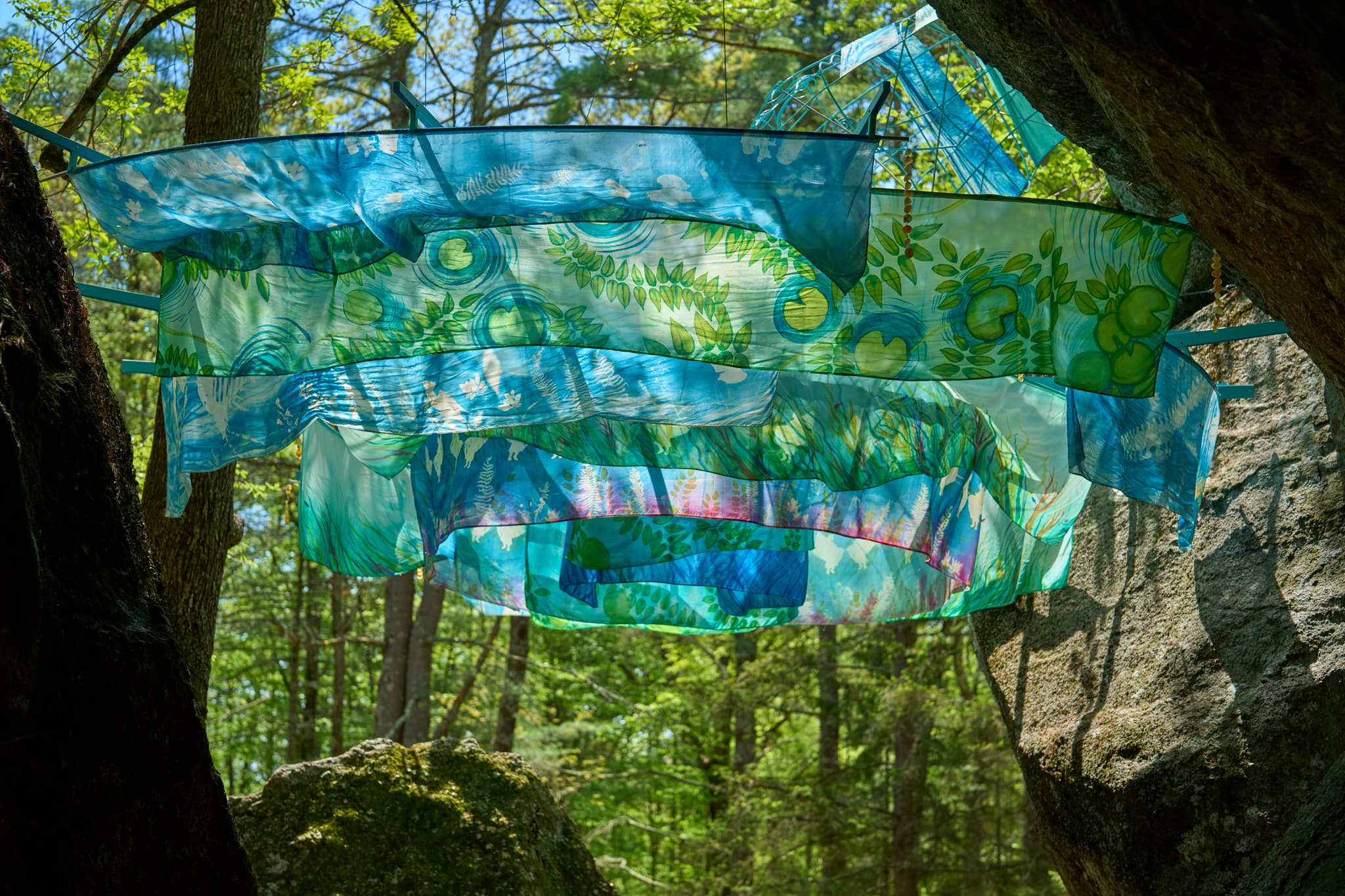
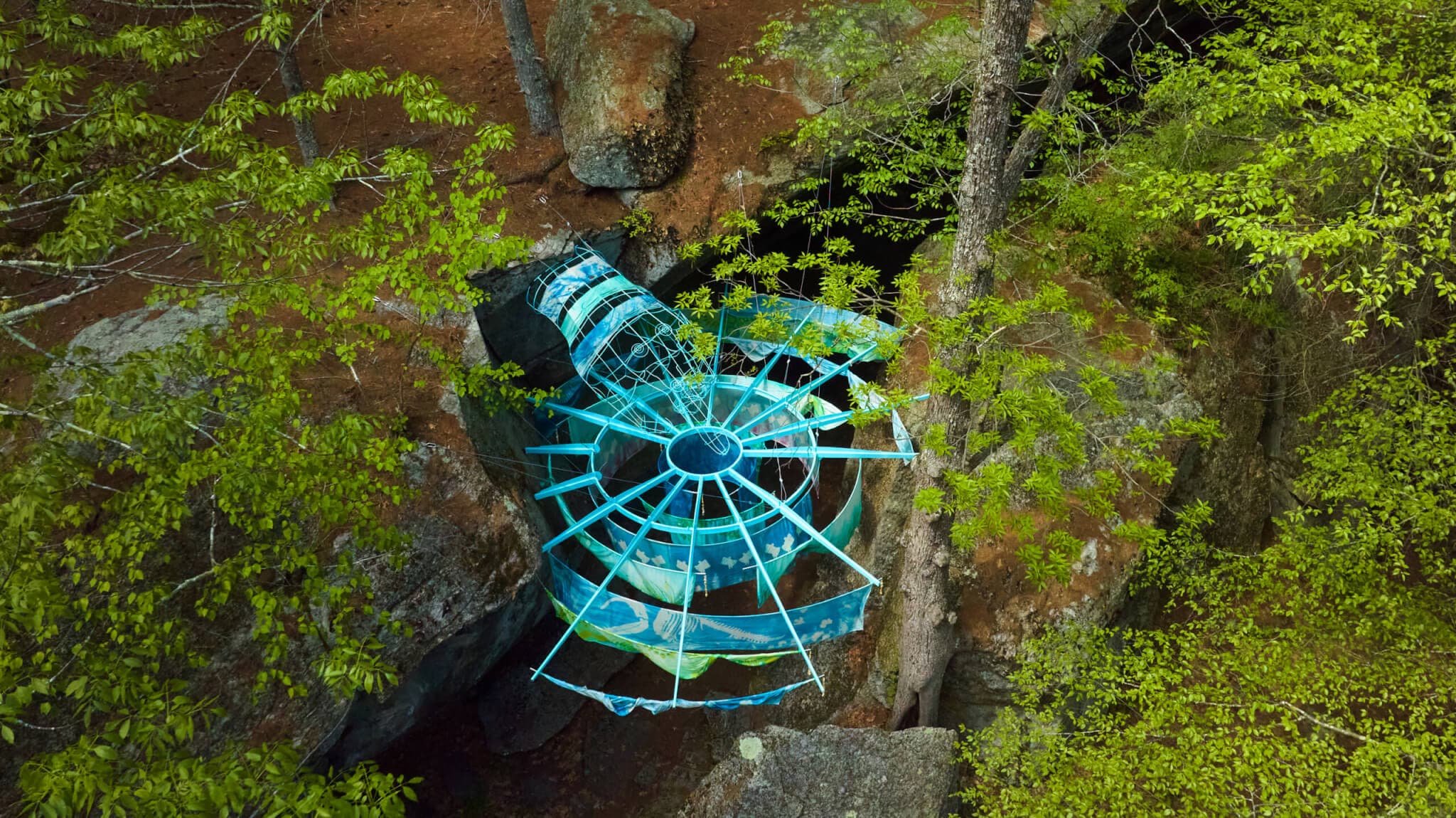
Ella Mahoney (b. 1995, lives and works in Brooklyn, NY and Aquinnah, MA), Moshup’s Hand, 2026. Silk painted cyanotype, silk, dye, steel, mermaid’s toenails (Anomia ephippium), and resin, installed at Rock House Reservation, West Brookfield, MA. Photo by Chris Cardoza, Doza Visuals. Courtesy of the artist.
“Connecting the Glacial Movement” at Rock House Reservation
Situated within Nipmuc country, Rock House Reservation is verdant and lush, covered with pine-, birch-, and fern-lined trails that lead to a man-made pond. The 135-acre Trustees property in West Brookfield is named after an imposing rock enclosure, which sits directly above the pond. Made from glacial outcroppings, this “rock house” once provided winter refuge for Indigenous people. Today, it serves as the focal point for Aquinnah Wampanoag artist Ella Mahoney’s sculpture Moshup’s Hand (2026). A large fabricated armature of a hand hangs over the opening at the top of the shelter, a spiral emanating from the tip of its pointed finger. Mahoney hung painted and cyanotype silk panels from the spiral which evoke water, local foliage, and the silhouettes of powwow dancers, as well as strings of mermaid’s toenail shells.
Moshup’s Hand re-stories the landscape with Indigenous presence and cosmologies, pushing back against the relegation of Indigenous relationships to this place to the pre-colonial past. To do so, Mahoney draws connections between sister tribes’ cosmologies and respective landscapes through her sculpture’s invocation of Môshup, a giant who brought the first Wampanoag people to the island of Nôepe (or Martha’s Vineyard, as it is often called) sometime after he separated the island from the continent with his toe. According to the Mohegan Tribe, Môshup stories are found among tribal nations across the region, with further inland stories emphasizing the rocky impressions that his presence left on the landscape. As Mahoney recounts in the exhibition’s video, she “thought about … connecting the glacial movement,” which created this rocky site of shelter on Nipmuc lands, “to Môshup, this giant in our Aquinnah Wampanoag stories” because “the way he’s described, to me, feels like a glacier.” Moreover, the jingling of the shells hung from the spiral and the ways in which the wind makes the silk panels dance produces a kineticism which we might regard as operating as a portal between past and present. If, as Lukey says, “Land has memory,” then we might imagine the present activation of the land through jingling shells and dancing silks as calling to the land to remember past gatherings of its original people, and to Indigenes in the present to make relationships anew with this place and with each other.
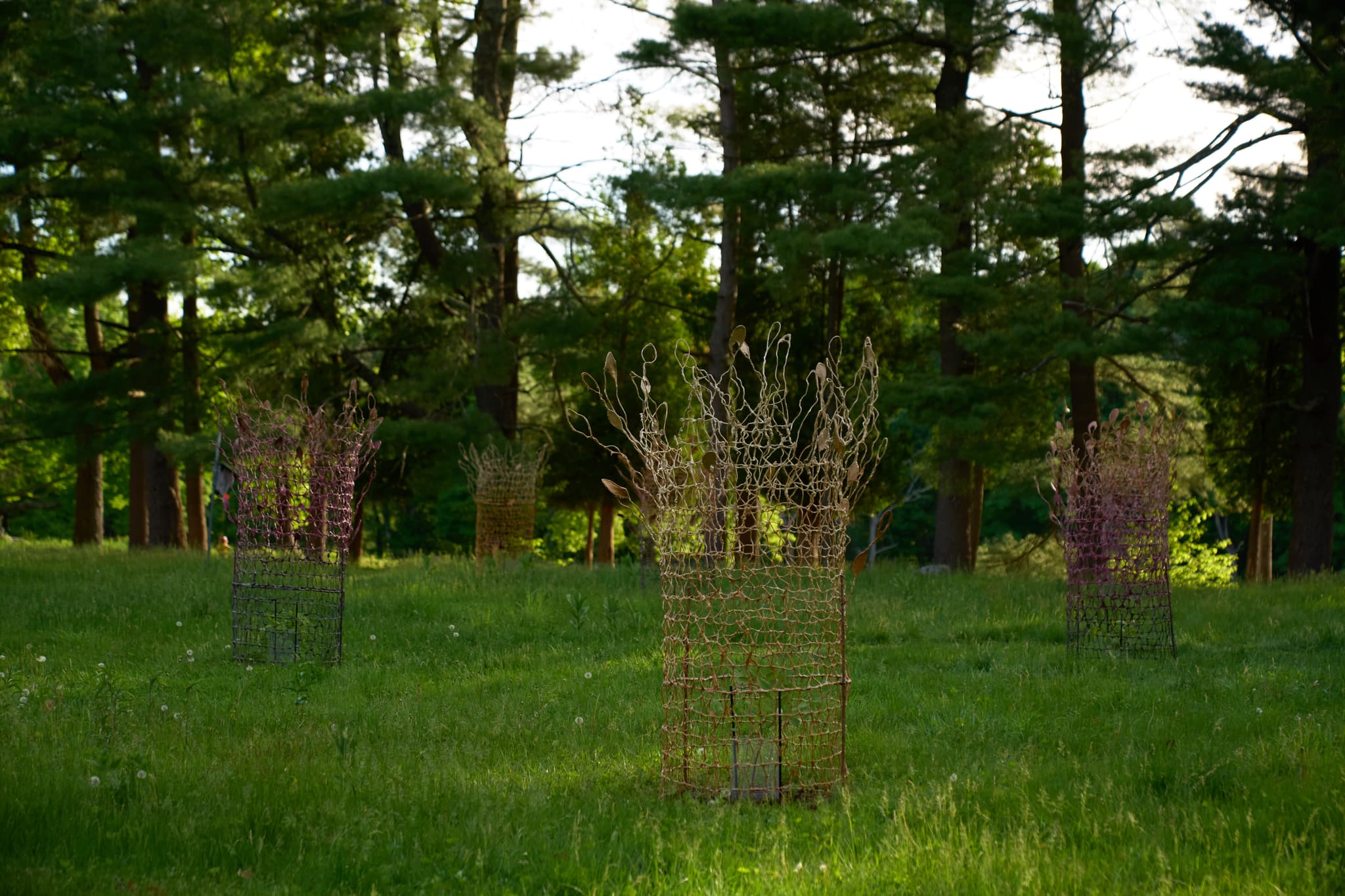
May Babcock (b. 1986 in MA, lives and works in Pawtucket, RI), Seaside Chestnuts, 2026. Flax, recycled fencing, milkweed, black walnut, goldenrod, and beeswax, installed at Moose Hill Farm, Sharon, MA. Photo by Chris Cardoza, Doza Visuals. Courtesy of the artist.
Hybridization, Sea Level Rise, and the Survival of a Species at Moose Hill Farm
Whereas the Indigenes with which Moshup’s Hand contends are people and cosmological beings, at Moose Hill Farm in Sharon, MA, May Babcock’s installation, Seaside Chestnuts (2026), turns to the continuance of native plant species as well as themes of hybridity and transformation. A 346-acre Trustees property that comprises six miles of trails, a nature-based preschool, and a community garden, Moose Hill Farm is noteworthy for two reasons related to Babcock’s work: It is home to rare mature specimens of the American Chestnut tree, and it is the second-highest elevation between Boston and Providence. As Babcock notes in the introductory video, the farm has been projected to become coastline by 2100 if the polar ice caps melt. Babcock constellates all of these place-based particularities through her work and stages her own future-oriented intervention.
Seaside Chestnuts is probably the most accessible of the three installations that comprise “The Land Tells Our Stories,” as the majority of Babcock’s intervention is installed in a tree-lined field that lies directly in front of Moose Hill Farm’s parking lot. When I visited the site in late July, a snaking path had been mowed into the meadow that hosts Babcock’s sculptures alongside the milkweed, goldenrod, and yarrow that grow there. Utilizing surplus fencing from Moose Hill Farm, Babcock fabricated eleven wire sculptures, covering them in a mixture of wax and pulp made and dyed using plant materials foraged from the site. The sculptures, fuchsia and orange cylinders with seaweed-like appendages flowing from the top, serve as protective cages for immature American chestnut, Chinese chestnut, and American Chinese chestnut hybrid trees that Babcock planted with support from the American Chestnut Foundation.
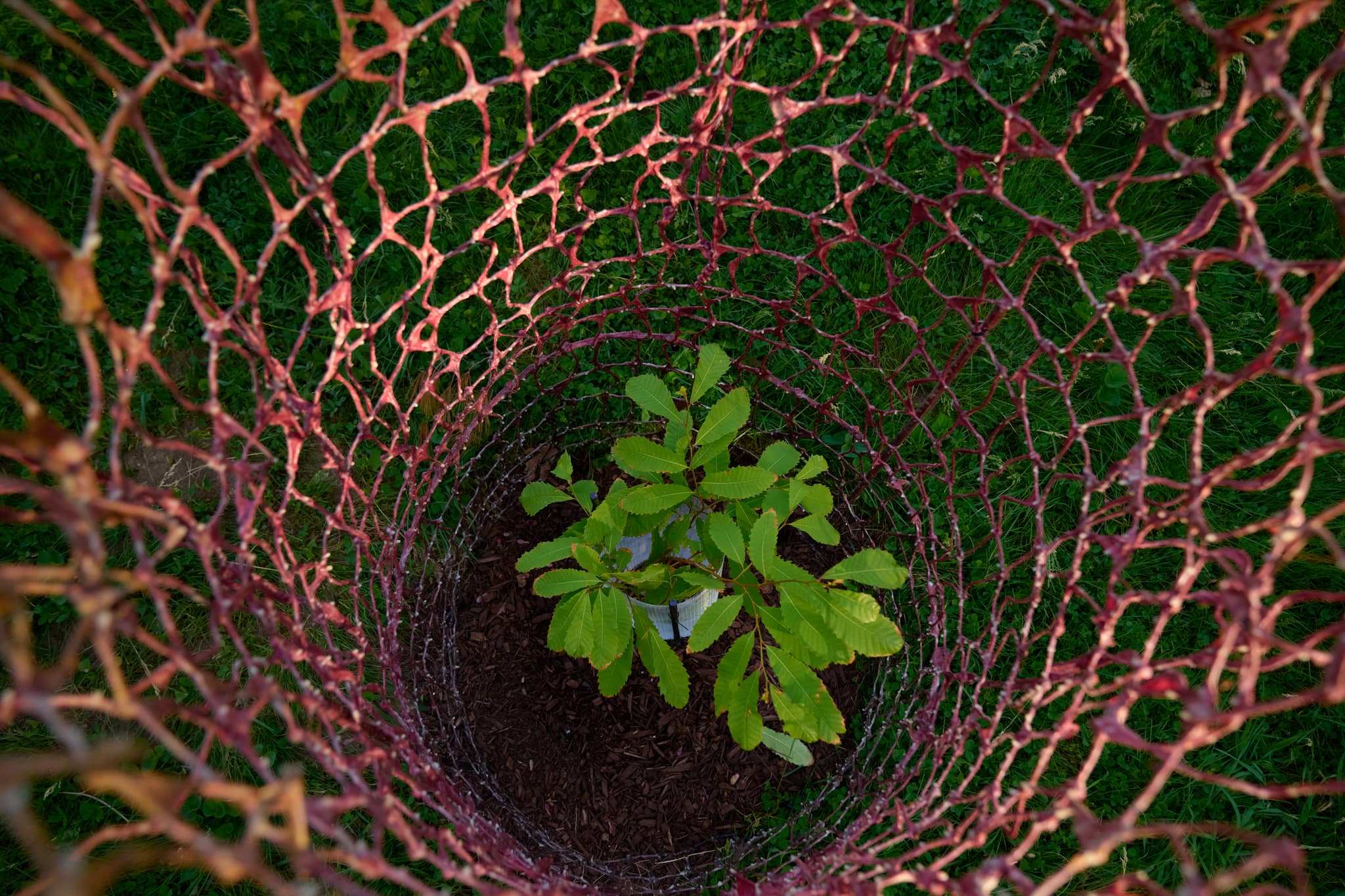
May Babcock (b. 1986 in MA, lives and works in Pawtucket, RI), Seaside Chestnuts, detail, 2026. Flax, recycled fencing, milkweed, black walnut, goldenrod, and beeswax, installed at Moose Hill Farm, Sharon, MA. Photo by Chris Cardoza, Doza Visuals. Courtesy of the artist.
A self-described “multiracial artist of Taiwanese Chinese descent” whose primary medium is plant-based pulp, Babcock describes her work as “a search for belonging” and her papermaking practice as “a collaborative process guided by material, water, time, and a spiritual extension of self, where natural materials become emanations of place.”6 Fabricated almost wholly from materials found at Moose Hill Farm, Seaside Chestnuts is guided by this articulated philosophy of papermaking. Moreover, as an installation that looks both backward and forward, Seaside Chestnuts is grounded in the particularities of the Trustees property. Looking backward, the installation’s forms evoke the pre-colonial American chestnut forests which predominated so-called “southern New England.” Looking forward, the form’s interiors—immature trees—pragmatically respond to the decimation of this species in the early twentieth century by blight.
Notably, Seaside Chestnuts’ looking forward does not envision a landscape unimpacted by global climate change; Babcock remarks that portions of her sculptural forms “reference that [projected] future coastline” by “echo[ing] different seaweed species.” Nor does Seaside Chestnuts envision a future that clings to notions of genomic purity for the American chestnut. As she notes, the American Chestnut Foundation’s work of “hybridizing American chestnut with Chinese chestnut [trees] to create a more resilient species” spoke to her “as a biracial artist.” The inclusion of some of these hybrids alongside their parent species in Seaside Chestnuts creates a subtle yet powerful statement—striking a delicate balance between a commitment to the longevity of the chestnuts native to this place and the potentialities of cross-fertilization and hybridity in revitalizing local populations.
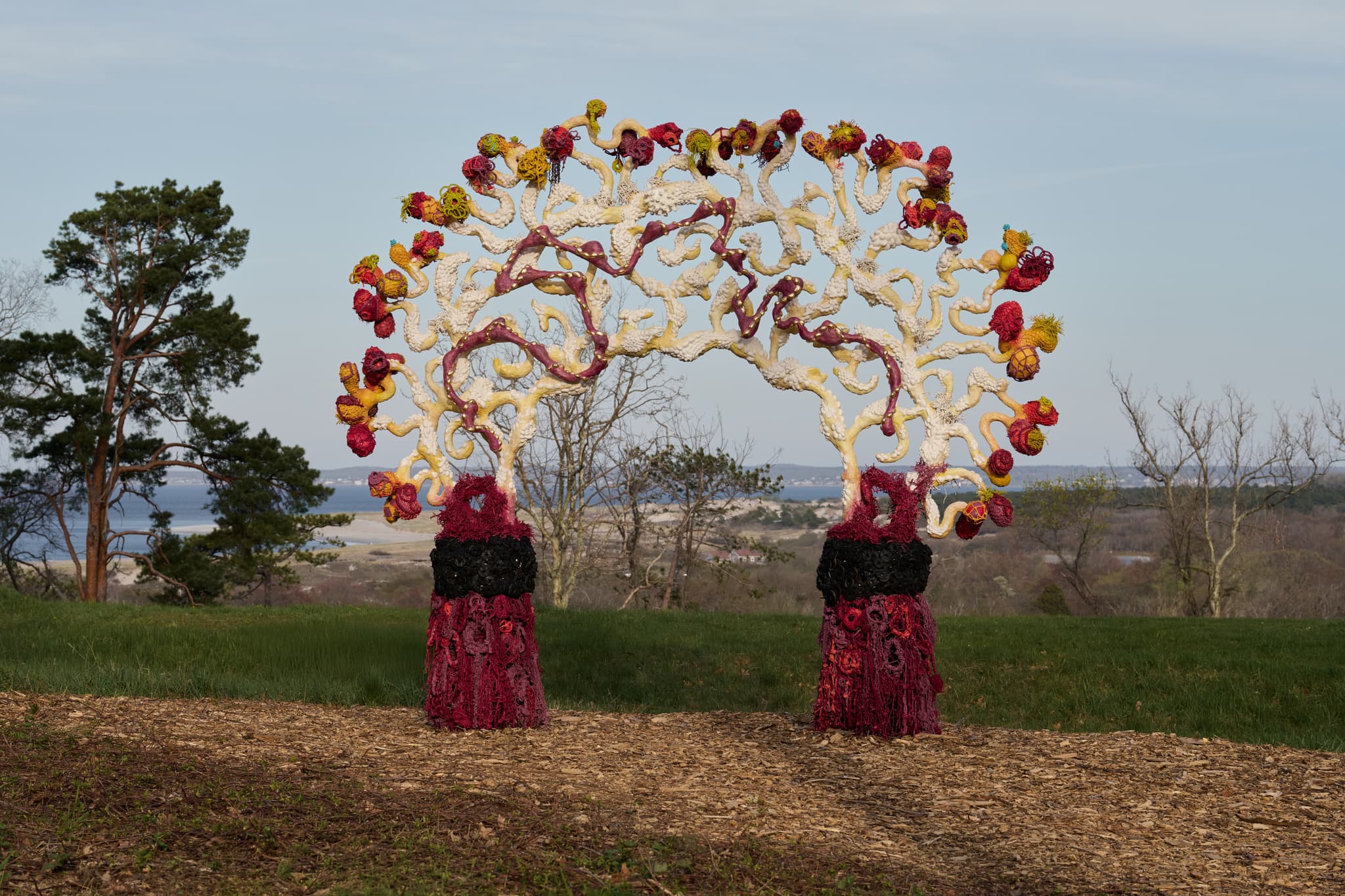
Pamela “Posey” Moulton (b. 1961 in Abington, PA, lives and works in North Bridgton, ME), Second Wind, 2026. Galvanized steel, cement-based sculpting medium, resin shells, industrial exterior coatings and adhesives, abandoned fishing gear, and stainless-steel hog rings, installed at Castle Hill on the Crane Estate, Ipswich, MA. Photo by Chris Cardoza, Doza Visuals. Courtesy of the artist.
The Lungs of Crane Hill Estate
Despite the beauty of each respective site and the interventions centering Indigenous peoples, other-than-human beings, and plants made by Mahoney and Babcock, both Rock House Reservation and Moose Hill Farm are imbricated in histories of settler-colonialism through their histories as eighteenth- and nineteenth-century homesteads. Scholars of “New England” history have noted that the imposition of European-style farming in this place accelerated Indigenous dispossession, upended Indigenous modes of agriculture and caretaking, and framed human-land relationships within a grammar of patriarchal dominion.7 Rock House Reservation’s “wildness” and Moose Hill Farm’s pastoral quality, which we enjoy as visitors, can occlude these histories of settlement.
The same cannot be said for the Crane Estate on Castle Hill, a sprawling 165-acre property in Ipswich that overlooks a portion of the Great Marsh. Built by Richard T. Crane Jr., a Chicago-based industrial heir, the site is home to one of the United States’ most renowned “Country Place Era” estates.8 Crane Estate, as managed by the Trustees, conserves the site as a celebration of capital’s accrual. Hence, I struggled with the ways in which its flashiness occludes other relationships to the land. Indeed, upon arriving, I remarked to my visiting companion that by virtue of Castle Hill’s elevation alone, it would have been a site of significance for the Indigenous peoples who called this area home. A cursory Google search confirmed this hypothesis, situating the Estate and the rest of Ipswich as Agawam—Pawtucket land beyond the marsh.9 After paying admission (the Crane Estate at Castle Hill is the exhibition’s only site that was not free to the public), I navigated a throng of visitors enjoying the beautiful weather and taking pictures with their loved ones. Shortly thereafter, I found Posey Moulton’s Second Wind (2026).
Moulton describes herself as a “multi-disciplinary environmental artist rooted in world-building and collaboration.” Her contribution to “The Land Tells Our Stories” is an imposing portal that evokes a lung and overlooks the Great Marsh.10 Archway columns covered in fuchsia and crimson “ghost-gear”—netting and black rubber rings that are remnants of the commercial fishing industry—hauled out of the Gulf of Maine, lead to Second Wind’s arch, which evokes a bronchial system with its twisted branches covered in cast seashells—some gold-leafed. The archway’s bronchioles end in alveolar bulbs made of brightly colored ghost gear, creating a halo of sorts over the piece. Its architectural quality and dramatic coloration is in keeping with the grandiosity of the Crane Estate, while the organic quality of its arch starkly juxtaposes the highly angular and ordered nature of the property.
If the ocean functions as the lungs of our planet, then Second Wind asks us to reckon with those forces which impede its—and by extension, our—breath. This seems to be the through line of Moulton’s work, as evidenced by her materials of choice. As Moulton elaborates in the exhibition’s video, she’s spent the better part of six years collaborating with scientists to understand the findings they are trying to communicate and consider how she might translate them into works of art that elevates the issues at hand. Second Wind is a response to the sinking of the Great Marsh and a reflection upon the critical role that this ecosystem plays in the sequestration of carbon and the protection of coastal biodiversity. As such, it is an important intervention at a site like the Crane Estate on Castle Hill, which, unsettlingly, seems to celebrate the very forms of production and consumption that are at least partially responsible for our present ecological crisis.
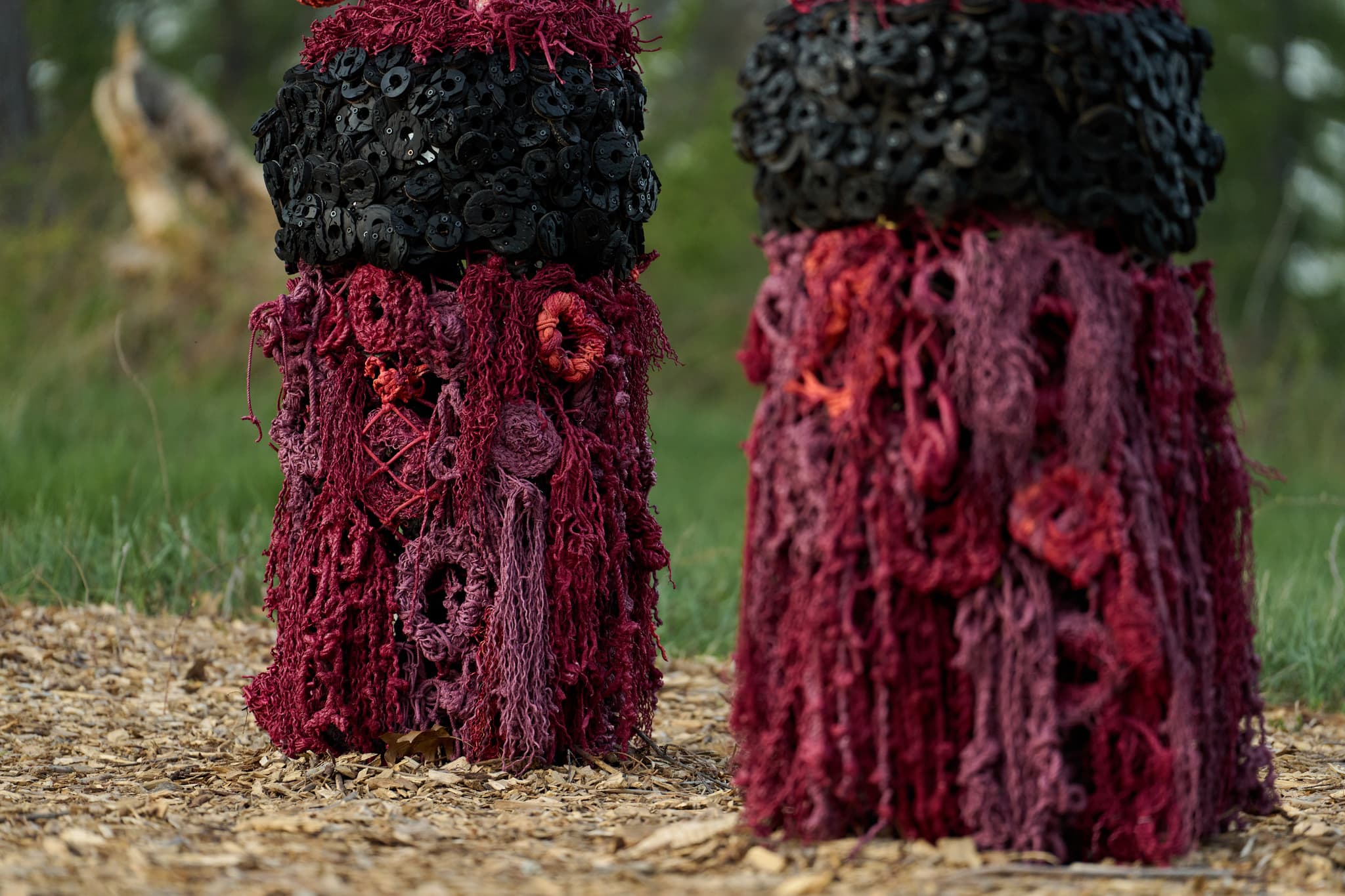
Pamela “Posey” Moulton (b. 1961 in Abington, PA, lives and works in North Bridgton, ME), Second Wind, detail, 2026. Galvanized steel, cement-based sculpting medium, resin shells, industrial exterior coatings and adhesives, abandoned fishing gear, and stainless-steel hog rings, installed at Castle Hill on the Crane Estate, Ipswich, MA. Photo by Chris Cardoza, Doza Visuals. Courtesy of the artist.
In addition to engaging the works of members of my community and the dynamic work of artists that were new to me, my time visiting the sites that comprise “The Land Tells Our Stories” afforded me the opportunity to wrestle with my own complicated feelings about conservation organizations. Across the Commonwealth, citizens of local tribal nations contend with an affordable housing crisis that threatens, and oftentimes effectuates, our continued dispossession and displacement from our homelands and homewaters. The Trustees of Reservations describes itself as “the nation’s first and Massachusetts’s largest preservation and conservation nonprofit,” and owns outright over thirty times the amount of land that the Mashpee Wampanoag Tribe and the Wampanoag Tribe of Gay Head Aquinnah—Massachusetts’s two federally recognized tribal nations—currently have in federal trust, combined.11 The Trustees are not the only conservation organization in the Commonwealth that hold the title to significantly more acres of land than local tribal nations; in fact, this feels more like the rule, rather than the exception. This is a difficult fact to sit with when I go home and see loved ones struggle to secure affordable, year-round housing in our traditional territories, or I am able to access certain culturally meaningful places only because some millionaire has finally decided to sell or deed their land to a local conservation organization.
These “felt” knowledges and experiences—some my own, some shared with me by loved ones—illuminate the stakes of Indigenous cultural workers who operate within conservation spaces.12 For those who work within the structures of tribal government or Indigenous-helmed organizations, conservation work can be an act of rematriation—the restoration of relationships and caretaking responsibilities between our bodies and the places that we come from.13 For those operating within mainstream conservation organizations and governmental agencies, their presence pushes critical conversations about the responsibilities that these entities have to the original people of the lands that are held as properties in a portfolio.
Thus, I am heartened by the Trustees’ decision to hire and retain Lukey as a full-time curator of Native American art. Lukey’s presence represents, for the Trustees, an investment in honoring both Indigenous knowledges and the relationships that local Native nations have with these lands. Her presence provides, for me, a more comfortable experience of navigating the lands currently in the Trustees’ portfolio.
As Erin Genia (Sisseton Wahpeton Oyate) asserts, “working in the public realm is an opportunity [for Indigenous artists and cultural workers] to bring our distinctive world views to the forefront of discussions … and create openings that can bring profound physical, psychological, and symbolic healing to colonized people and places.”14 Shows like “The Land Tells Our Stories,” curated by cultural workers such as Lukey, create such openings for Indigenous and non-Indigenous viewers alike. From visually indexing Indigenous cosmological figures’ shaping of the land to repopulating scapes with species that were once abundant up and down the coast to reminding viewers of the interdependence of our breath and the breath of the Great Marsh, “The Land Tells Our Stories” moves toward placekeeping in a way that emphasizes the land as an animate and dynamic actor, as well as the heterogeneous relationships it has fostered with human and other-than-human beings. Standing atop a hill overlooking the Great Marsh or in the center of a rock house, or amid forms protecting the regeneration of a species, I was afforded the opportunity to wrestle with what has happened and what is happening in these places while imagining a future where all people and places are cared for and relationships ruptured by colonialism and capitalism are restored.
—1 We Still Live Here: Âs Nutayuneân, directed by Anne Makepeace (Makepeace Productions/Independent Television Service, 2011).
—2 In alignment with other local Indigenous scholars and knowledge carriers who use terms such as “Dawnland” to describe the region in which our homelands and homewaters are situated, I use “coastal Northeast” to describe this region without implicitly naturalizing colonial settlement through the use of “New England.”
—3 Environmental historian William Cronon famously critiques this binaristic formulation in the introduction to his landmark text, Changes in the Land. See William Cronon, Changes in the Land: Indians, Colonists, and the Ecology of New England (Hill and Wang, 1983).
—4 See Mark David Spence, Dispossessing the Wilderness: Indian Removal and the Making of the National Parks (Oxford University Press, 1999); Dana Gilio-Whitaker, As Long as Grass Grows: The Indigenous Fight for Environmental Justice, from Colonization to Standing Rock (Beacon Press, 2019); Ashley Dawson, Fiore Longo, and Survival International, eds., Decolonize Conservation: Global Voices for Indigenous Self-Determination, Land, and a World in Common (Common Notions Press, 2023).
—5 Kimberly Toney (Hassanamisco Nipmuc) is Brown University’s inaugural coordinating curator of Native American and Indigenous collections, while Leah Hopkins (Narragansett) left her position as manager of museum education and programming at Brown University’s Haffenreffer Museum of Anthropology in 2024 to take on a new role as Massachusetts’s Department of Conservation and Recreation’s first Indigenous peoples partnership coordinator. See Mount Grace Land Trust, “Centering Reciprocity in Land Trust and Indigenous Community Relationships,” December 13, 2024, https://www.mountgrace.org/about/news/post/centering-reciprocity-in-land-trust-and-indigenous-community-relationships; Department of Convservation and Recreation, “Press Release: DCR Recognizes Native American Heritage Month with Announcement of New Indigenous Peoples Partnership Coordinator,” November 13, 2024, https://www.mass.gov/news/dcr-recognizes-native-american-heritage-month-with-announcement-of-new-indigenous-peoples-partnership-coordinator.
—6 May Babcock, “About,” https://www.maybabcock.com/about.
—7 See Jean O’Brien, “Divorced from the Land: Resistance and Survival of Indian Women in Eighteenth Century New England,” in Native Women’s History in Eastern North America before 1900: A Guide to Research and Writing, ed. Rebecca Kugel and Lucy Eldersverd Murphy (University of Nebraska Press, 2007), 333–367; Michael D. Wise, Native Foods: Agriculture, Indigeneity, and Settler Colonialism in American History (University of Arkansas Press, 2023).
—8 The Trustees of Reservations, “Castle Hill on the Crane Estate,” https://thetrustees.org/place/castle-hill-on-the-crane-estate/.
—9 Mary Ellen Lepionka, “Who Were the Agawam Indians, Really?” Historic Ipswich, https://historicipswich.net/2021/04/21/who-were-the-agawam-indians-really/; The Trustees of Reservations, “Castle Hill on the Crane Estate,” https://thetrustees.org/place/castle-hill-on-the-crane-estate/.
—10 Pamela Posey Moulton, “About,” https://www.poseyart.com/about.
—11 According to their website, the Wampanoag Tribe of Gay Head Aquinnah holds 500 acres of land in federal trust, while the Mashpee Wampanoag Tribe holds approximately 321 acres of land in federal trust. See Wampanoag Tribe of Gay Head Aquinnah, “Tribal Lands,” https://wampanoagtribe-nsn.gov/lands; U.S. Department of Justice, “Justice Department’s Successsful Defense of Lands in Trust Case will Preserve Land in Massachusetts for the Mashpee Wampanoag Tribe,” April 11, 2024, https://www.justice.gov/archives/opa/blog/justice-departments-successful-defense-lands-trust-case-will-preserve-land-massachusetts.
—12 Dian Million, “Felt Theory: An Indigenous Feminist Approach to Affect and History,” Wicazo Sa Review vol. 24 no. 2 (Fall 2009): 53–76.
—13 Native Land Conservancy, “Our Story,” https://www.nativelandconservancy.org/story; Aquinnah Land Initiative, “Returning Land to Wampanoag Care,” https://aquinnahland.org/.
—14 Erin Genia, “Unseen Dimensions of Public Space: Disrupting Colonial Narratives,” Boston Art Review iss. 4 (October 9, 2019), https://www.bostonartreview.com/read/issue-04-public-art-issue-erin-genia.