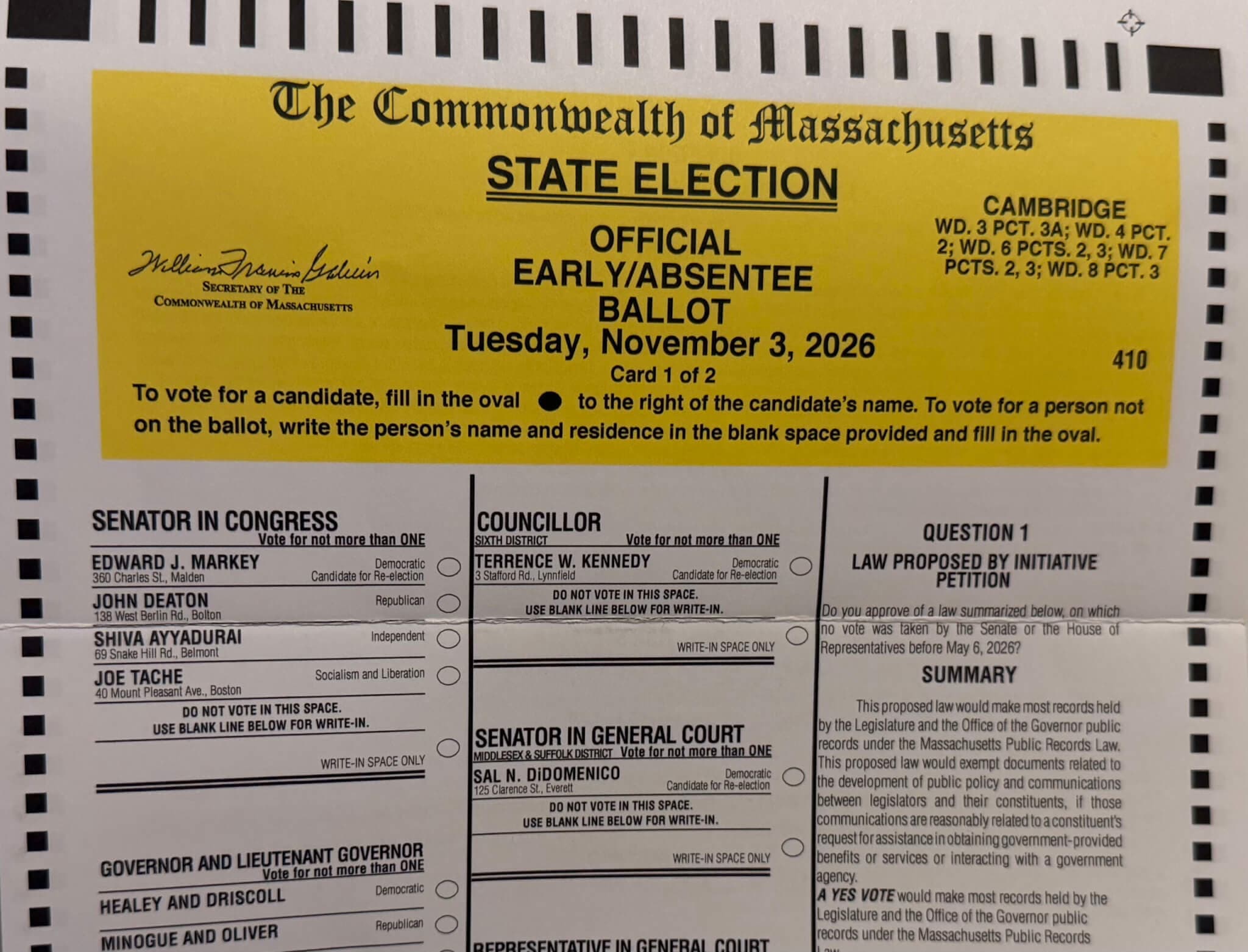
Lost in the national news coverage of the November 3 midterm elections, Massachusetts voters will also face nine statewide ballot questions that will shape the future of state politics.
During a recent Zoom webinar organized by MASSCreative, campaigns on both sides of Questions 3 and 5, along with supporters of Question 4, presented their cases.
What do these questions have to do with the arts? Although none specifically address cultural policy, their outcomes could influence who participates in elections, how candidates compete for office, and how much money the state has for public spending. For artists and cultural workers, whose livelihoods are shaped by housing costs, public investment, and decisions made at the State House, those questions have consequences beyond the ballot box.
MASSCreative is a nonpartisan organization, so it did not endorse either side of any ballot question. It also did not explain why or how it considers these measures’ effects on the arts, other than mentioning that these questions “feel aligned with how [the organization thinks] about the role of arts and culture and cultural organizations in terms of promoting and advancing more civic dialogue and a stronger democracy,” says Emily Ruddock, MASSCreative’s executive director.
Without further ado, your ballot question explainer:
Question 3: Top-Two Primaries
What it does: This proposed law would replace the individual-party primary system with all-party primaries for statewide elections (including governor), federal congressional races (the U.S. House and Senate), and the Governor’s Council and county/district offices such as district attorney. It would not affect municipal or presidential elections. The top two vote-getters of the primary, regardless of party, would advance to the general election. Party affiliation and endorsements could be listed on the ballot. Presidential and municipal elections would not change.
Yes: Jesse Littlewood, the campaign manager for the Coalition for Healthy Democracy (Yes on 3), says Massachusetts has “the least competitive electoral landscape in the country.” He says 90 percent of legislative races this fall have no candidate from the other party, so low-turnout September primaries decide most seats. Moving the deciding race to November, he argues, would make officials earn votes from everyone, including the two-thirds of voters who aren’t enrolled in a party.
No: Jonathan Cohen, the policy director of Progressive Massachusetts, says private equity executives provided 71 percent of the funding for the pro–Question 3 campaign. He argues that running twice raises costs and favors well-funded candidates. He also says the system pressures candidates in crowded fields to drop out early, and lets any group of fifty people get its endorsements printed on the ballot.
Question 4: Same-Day Voter Registration
What it does: This proposed law would allow individuals eligible to vote to register, or update their voter registration address, at their polling place on Election Day. Prospective voters would need proof of residency (such as a current utility bill), though it does not have to be a photo ID.
Yes: Liv Santoro, the deputy field director at the ACLU of Massachusetts, says the current ten-day registration deadline trips up people who move, especially renters moving around September 1, a day of famously high lease turnover in a college city. During the 2024 election, she says, more than 3,000 of the 5,000-plus provisional ballots cast were rejected. Twenty-three other states (plus Washington, DC) already allow Election Day registration.
No: No one opposing Question 4 presented.
Question 5: Changing the State Revenue Cap
What it does: This proposed law would update a 1986 law that refunds taxpayers when state revenue exceeds a set limit. The cap would be based on what the state actually collected in recent years and would count money from the Fair Share “millionaires tax.”
Yes: Chris Keohan, the campaign manager for Taxpayers for an Affordable Massachusetts (Yes on 5), frames the proposed law as a limit on growth, not a budget cut. The refunds mechanism has only been triggered twice in the past forty years, he says. Under the new formula, there would have been sixteen to twenty-four refunds. Every taxpayer would receive the same refund amount, regardless of how much they pay in taxes, which he says would help middle- and lower-income families.
No: Cohen of Progressive Massachusetts cites an estimate from the Massachusetts Budget and Policy Center of about $2 billion in lost revenue per year, just as federal cuts are set to hit next year. He argues this would drain rainy-day reserves and lead to cuts in arts and culture spending, as well as the programs creative workers depend on.
The main takeaway: However you choose to vote on these ballot measures—and for the candidates up for election on November 3—vote and vote early.