This interview originally appeared in Issue 16, published May 16, 2026. You can read this piece and more by purchasing a copy of or subscription to the magazine.
The room smells like sawdust and oil, the wood-handled musk of a hardware store. The table saw sits quiet; it’ll start its rumble soon. Tools are neatly slotted and shelved, each in its own place—the chisels, the clamps, the big jugs of glue, a level, a hammer, the hand planes and draw knives and rasps and awls and saws. Late winter light strains through two tall windows. On the shelves between them: a jade plant, a Christmas cactus, The Mirror Book, Machine Woodworking, Southern Furniture 1680–1830. And here in her woodshop studio in Rochester, New Hampshire, Aspen Golann stands at her workbench making measures.
She’s working on a piece for the inaugural Metropolitan Museum of Art and Vacheron Constantin Artisan Residency. Three international artisans were selected for the eighteen-month residency for work that preserves “traditional methods while incorporating inventive reimaginings or reinterpretations of the craft,” according to the Met’s site. Golann is making a massive vessel out of wood; a plywood mock-up sits nearby. It looks like a great big Greek amphora. “It’ll be as tall as I am,” she says (that’s about five foot three), and the end result will look extruded. “The other residents are staying within their proficiencies. I decided I’m going to take the opportunity to try to do something that may not be physically possible.”
She likes a challenge. She likes coming up against the limits of things. And this morning, she’s feeling the pressure of it, too—the consuming questions: Can I do it? Will it work? Humming underneath, the fear that the answer is maybe not. But here we go anyway, trusting that time and mistakes and experiments and others’ input will bring those good sudden moments of an answer delivered, a problem solved, a new way forward revealed.
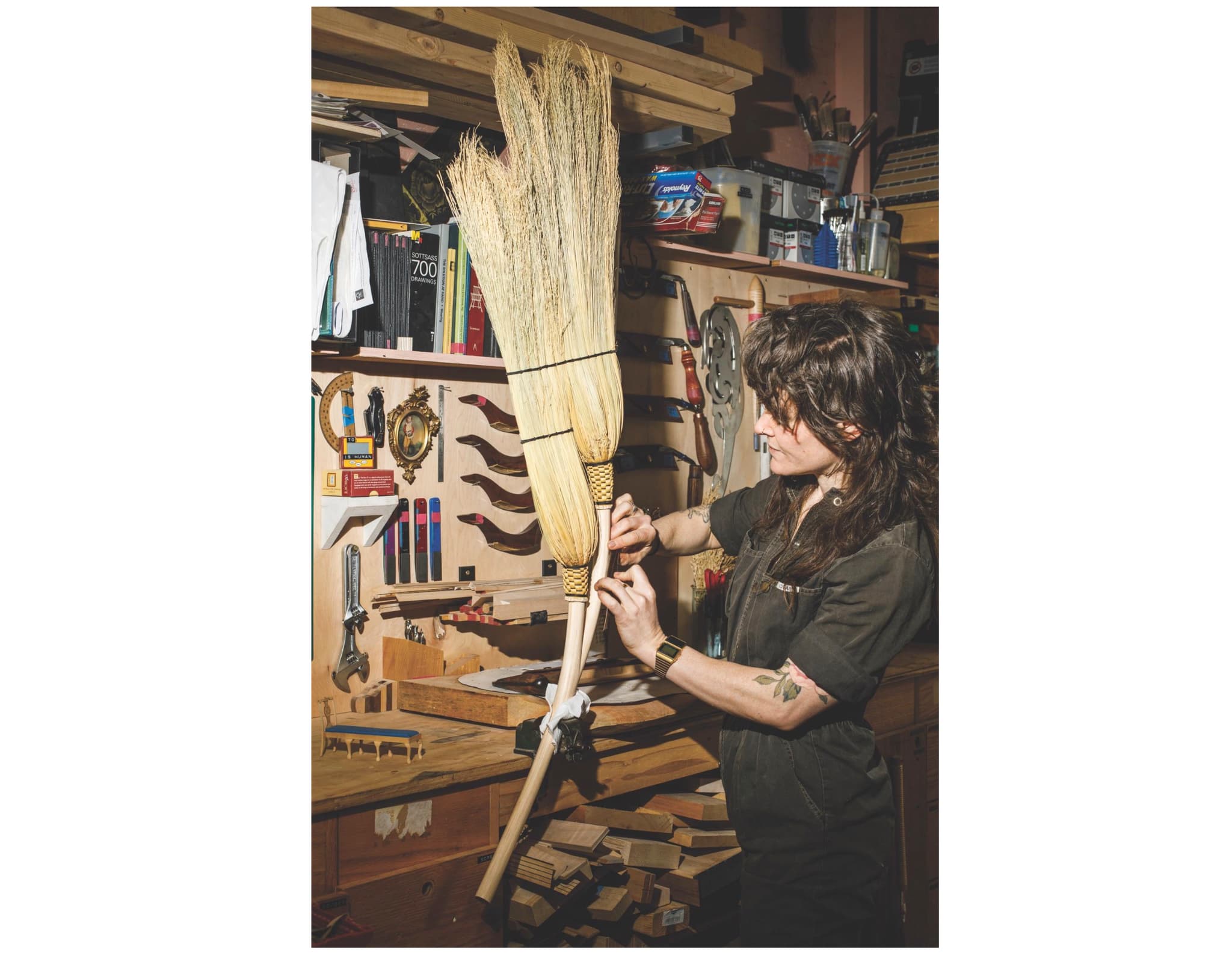
Golann spokeshaping the handle of a wheat broom. Photo by Bonnie Durham for Boston Art Review.
Golann, thirty-nine, is a maker—a woodworker and an artist—and an educator. She grew up outside Boston and sat in the stacks at libraries hunched over manuals on welding and architectural drawing. Between high school and college she lived on a sailboat, earning coastal navigation and sailing licenses. She spent a year after college working on a Texas farm. Then she started teaching at private schools in Santa Barbara, California, and Putney, Vermont. She’d studied art at Kenyon, but there was something missing in it for her. It was all a little conceptual, a little boundaryless. She doesn’t like the blank page. Constraint appeals to her. Constraint inspires her. It’s when she started envisioning a use for her pieces—a sculpture you could sit on, sit at, store things in—that things started to come into sharper focus. Art merging with function—here was a path toward a creative life.
And maybe that attunement toward use was there in her bones from the start. Her paternal grandfather and great-grandfather were inventors. Her great-grandfather designed a compact 35mm movie camera; her grandfather updated the pacemaker. While she was still teaching, someone asked her a version of the “Where do you see yourself in five years?” question. She realized she didn’t see herself in a classroom; she saw herself in a woodshop. And a new way forward was revealed.
Creeping toward thirty, Golann quit her teaching job and enrolled at the North Bennet Street School (NBSS), Boston’s vaunted vocational institute. She had so many ideas, but lacked the skills to bring them into being, the know-how to give the ideas form. She wanted to learn the language of craft.
“I wanted all the words,” she says as we sit in a breakroom down the hall from her studio, away from the roar of the table saw. “That’s the most freedom.” So she learned them. She learned furniture making in the seventeenth- to nineteenth-century tradition—dovetails and marquetry, ogees and paterae. She became fluent.
She earned her degree from North Bennet and as she did, she learned, too, the history. The objects she was making couldn’t be separated from the cultures of power they came from—the colonialism, racism, classism, and misogyny embedded in the forms. Once you’re fluent—once you know the words and the grammar and have that underskin sense of rhythm and layer—you know how to push the language, how to bend it beyond where you thought it could go. This is where poetry comes from. This is where the art is. “Once you learn a language,” Golann says, “you can say whatever you want.”
With humor, mischief, smarts, and that mysterious interior force that some people possess that is something like determination but stronger, stranger, and braver, she took the traditions and started to subvert them. “I love traditional craft,” she says. “I have a deep reverence for material and for tradition. My grammar is excellent. And the stuff I’m saying is weird.”
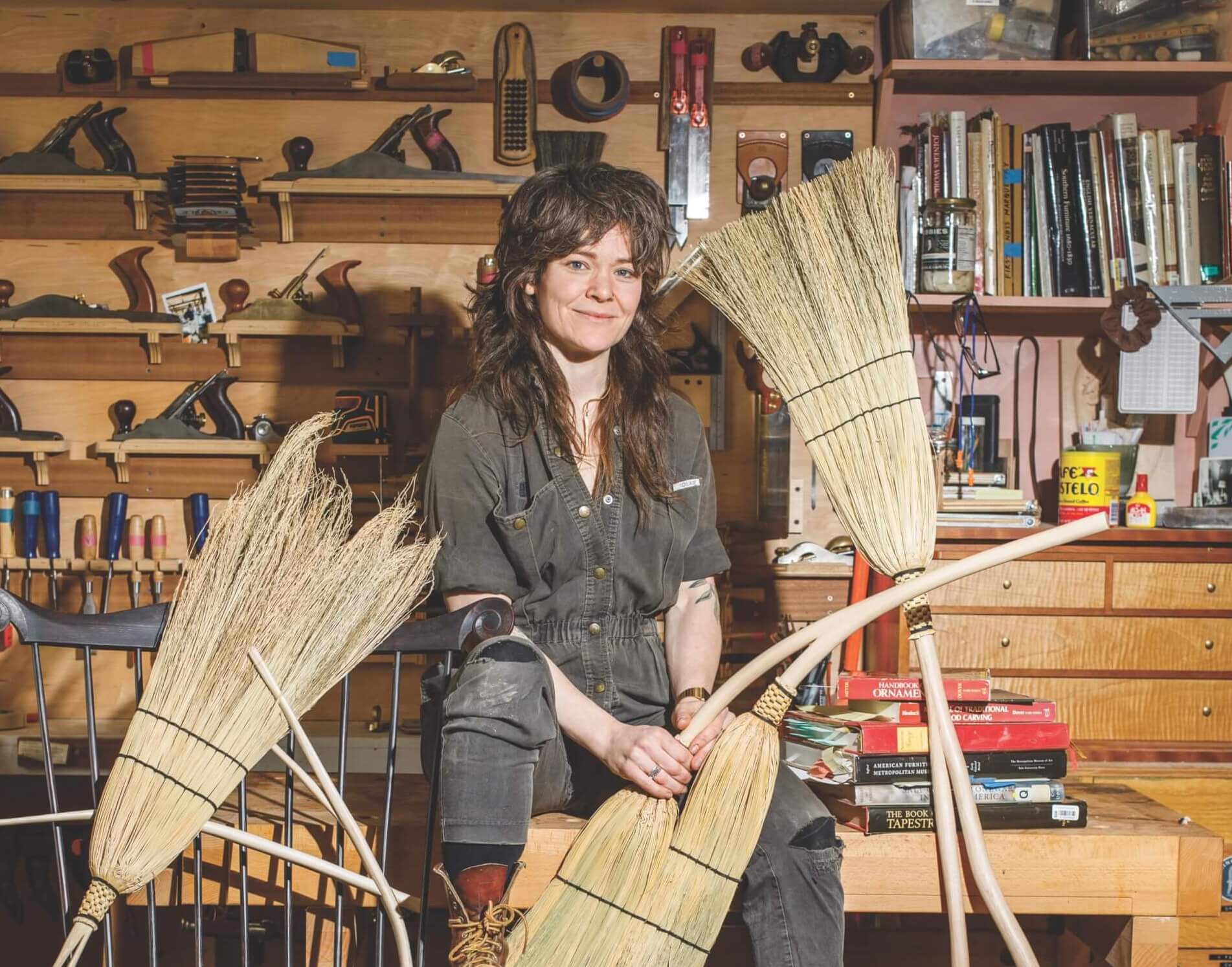
What’s she saying? At NBSS, some fuss was made about her being a woman; woodworking remains a heavily male-dominated pursuit (though Golann is working to widen the field, and we’ll get to that soon). She hadn’t put much thought into her womanhood before, but the attention to it brought an elevated awareness and she began exploring gender roles and invisible labor. She’s made a series of brushes and brooms. The brooms gesture at the basic form—wooden handle, broomcorn, linen thread cinching it together, so familiar. But this one’s handle is divided. This one is two brooms conjoined, two handles rising like those trees that grow so close together they absorb each other. And this one has five heads gathered as one, with a bending, branching handle—a broom out of a Shaker’s fairytale dream of function and adornment.
We can’t use them, but they wake us up to what we do use, and how. Who sweeps the floor? We hear the scritching of brush on wood. Who collects the dust, fingernails, stray threads, all the scrapings from our living into the pan? What’s swept under the rug? What goes unsaid? Golann draws out these underlayers, letting us hear what’s whispering in the forms—who made them, who they were made for, how they speak to notions of power, labor, gender, class. These are serious questions, and Golann gives playful ways of teasing out the answers.
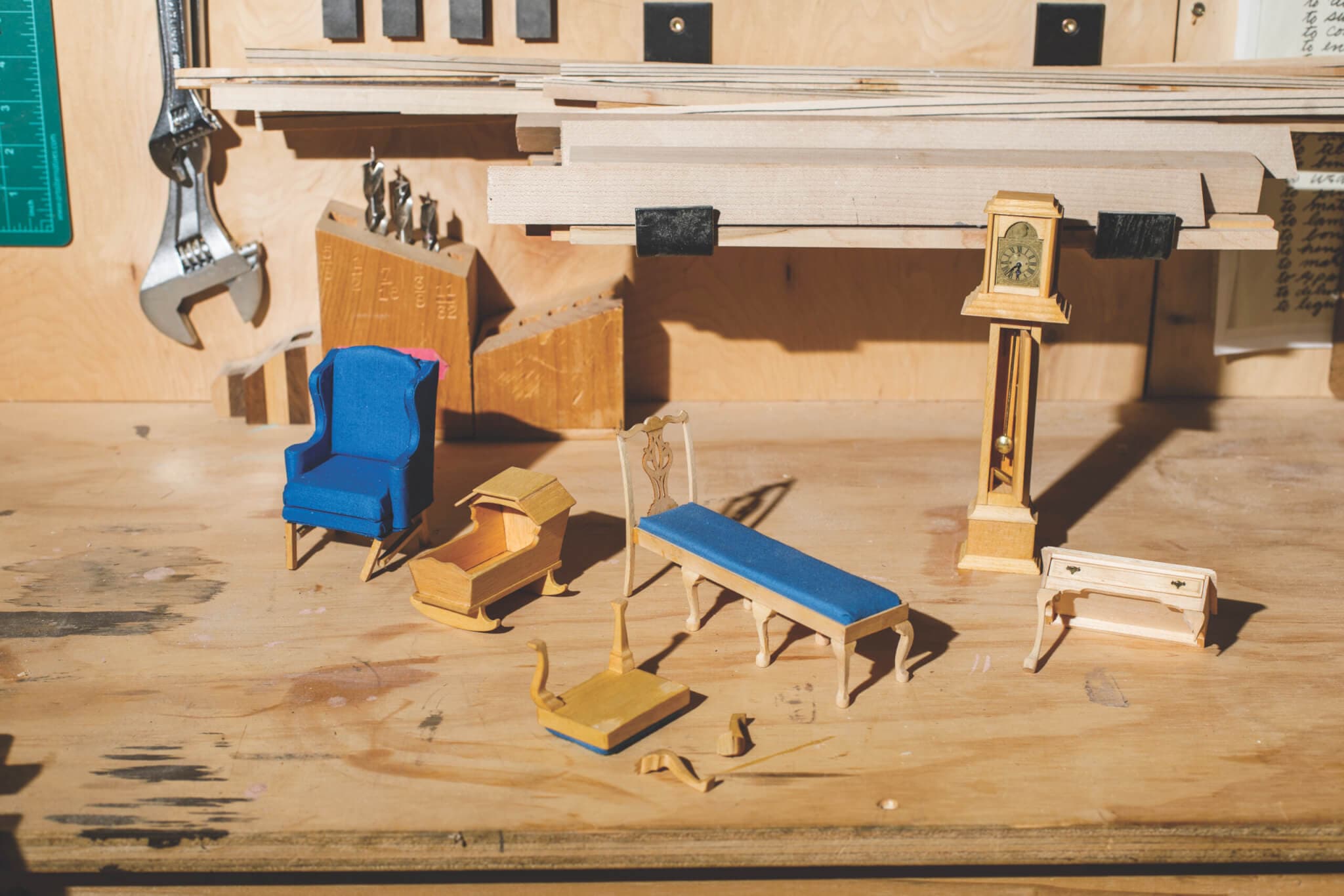
Golann assembles 1970s DIY kits of miniature eighteenth-century furniture pieces as a means of play and inspiration.Photo by Bonnie Durham for Boston Art Review.
If her brooms are disruptions, a bench she made with furniture maker Peter Galbert serves as prompt. The Meeting Bench (2025), an L-shaped, dark-green Windsor–style seat, was commissioned by the Museum of Fine Arts, Boston, in celebration of the fiftieth anniversary of the museum’s Please Be Seated program, which invites artists and makers to create seating for visitors that’s accessioned into the museum’s permanent collection. Golann met Galbert at NBSS when he was a guest instructor; they became collaborators and pals.
The overlapping crest rails, the most striking feature of the bench, were an accident. Galbert was moving fast while sketching the crest; the two ends didn’t meet in the drawing, passing each other instead. It was a fortuitous error, and one he and Golann agreed was worth exploring. The overlap is reflected in the stretchers below the bench as well. “There is no roadmap for designing,” Galbert wrote of how they arrived at the form and the importance of being able to stay in the place where you don’t know the answers yet. Golann had wanted the spindles to pass through the seat. It wasn’t until the crest rail accident that they were able to see a way forward to integrate that into the design. Another new path forward revealed.
In a corner of the entrance to the Linde Family Wing, it’s a bench as we recognize it. Shift around, view it from a different angle, and the lines interplay in unexpected harmonies. The history of every Windsor chair breathes in the space between each spindle made of hickory.
Golann’s education at NBSS served her deeply, in what she learned and who she encountered, and it had its challenges. As a queer woman, she felt like an outsider. Someone scratched the word “cunt” into her toolbox. She remembers some of the smaller-minded people there—the ones threatened by her skill—and what she knew even then: “What they didn’t know is that I’m not gonna stop.”
And she hasn’t. In the seven years since she graduated, she has reached some of the highest heights in the craft world. In 2020, she was awarded a $25,000 John D. Mineck Fellowship; in 2022, she was an artist-in-residence at the San Diego State University School of Art and Design; in 2023, she won the $100,000 Maxwell/Hanrahan Award in Craft; and in 2025, she was a finalist for the prestigious Loewe Craft Prize.
That five-headed broom she made, her entry for the Loewe Prize, is called Group Work (2024). The title speaks to Golann’s main subject, the thing that radiates from all her brooms and benches and mirrors and chairs and clocks and vessels: collectivity. Craft, like language, doesn’t come from one mind toiling away in isolation. It’s the history of hands and minds working together over time to refine forms and create new ones.
How do you make the work relevant? How do you make it accessible? How do you reflect the perspectives of the communities who practice the craft and use what’s made? These are some of the questions that guide Golann. And the individual pieces ask us: What is it to bear weight? To labor? To hold? The objects are a means of storytelling, she explains. “I have a way of wanting people to see,” she says, “to be able to rediscover these histories that underpin every aesthetic decision in their home.” A broom, a three-seated stool, sensual, draping imagery in the glass doors of a cabinet, a spoon with a flower-shaped head—all this craftwork she does—asks that we look with fresh eyes at what is and was.
“The handcrafts stand to perpetuate the living experience of contact with natural elements,” writes M.C. Richards in her 1989 book Centering, “something primal, immediate, personal, material, a dialogue between our dreams and the forces of nature.”1
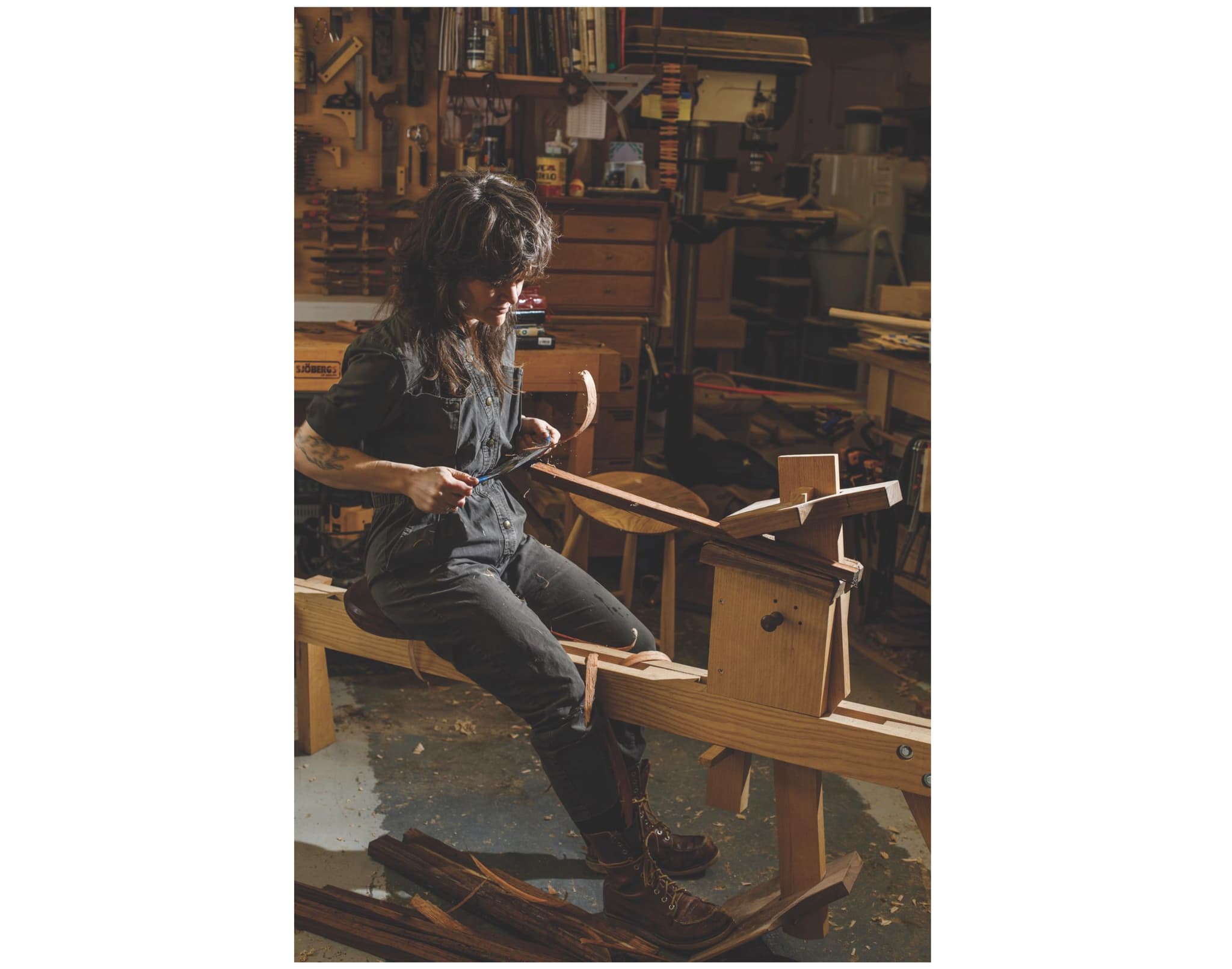
Golann at work on the shave horse, a device used for shaping wood and preparing spindles. Photo by Bonnie Durham for Boston Art Review.
There is something of the dream in Golann’s work, the uncanny familiar-disfamiliar. And the forces of nature are there—seed to tree to trunk to seat. And there’s more than that, too. Not just the dream and the natural forces, but our human history. Her interventions show us what was, who we were, and show us what is, right now, who we are. And, in their most powerful moments, who we might become.
She thinks a lot about the future of this work. She talks of the “collective genius” of craft, comparing it to a river stone “that’s worn into the most beautiful and efficient shape.” And she talks of the importance of her community. Growing that community has been a major part of Golann’s efforts over the last eight years with an ethos of “sharing as much as we fucking can.” Or, put another way, “my friend’s skillset is my skillset.” In 2020, she founded the Chairmaker’s Toolbox, an organization that works to widen access to chairmaking and green woodworking to historically excluded makers.
Golann wants to create “a structure in which more people can join.” Because she sees what happens in the classes she teaches at RISD and workshops she leads around the world. “I’m witnessing champagne bubbles of joy,” she says. “There’s so much crying. To suddenly feel like you can speak.” She remembers what it felt like to have all those ideas and not know how to put them into the world.
Money from the Mineck Fellowship made the Chairmaker’s Toolbox possible, and so did a combination of rage and optimism. “You need both,” she says. “The anger helps you break away and the optimism allows you to move forward.” That combination fuels all her work now, she says. “When you’re denied community and connection, what do you do? You build it yourself.” And so she has, fostering an intimate community of makers who share and support each other. For her, it’s not a matter of men versus women, but us versus them, and her “us” includes the people “endorsing everyone’s ability to access these languages and use them as flagrantly and joyfully as possible.”
That intimacy connects to the place she lives, too. She knows “the good domestic New England trees” and speaks to how deeply rooted craft is to location. The exchange between a body, a tool, and a piece of wood is its own collaboration, its own back-and-forth, an intimate act of listening and response. “My practice would change in California,” she says. She talks of the froe, a handtool used to split sections of a log. “You use it to split,” she says, “not bluntly, but with control.” Where a table saw rips through the grain, a froe follows the fibers of the tree without cutting across those fibers. It allows you to “completely dominate the tree but also use hand intelligence to work collaboratively with it.” In other words, to see what’s there, to follow the grain, and then to change it.
In making something with your body that is meant for use by other bodies—a spoon, a stool, a broom—the outcome is at risk at every moment in the process of the making. This is the nature of craftwork, in every measure, in every press of the blade against the wood. We are error-prone and faltering. We are human. And what we have in mind when we begin may not be what we hold in our hands when we are done.
The vessel for the Met Fellowship will be decorated with carved flowers and ribbons, intricate looping, blooming designs. There’s an exuberance to it, a playful intricacy. Sketches are spread on a workbench, and a few initial try-out pieces are in the first phases of carving. Golann talked of her discomfort, the strain of being in something new, of what it is to metabolize that pain. “Not knowing is on a continuum with knowing,” she says. “The work gets weirder the more open I am about what I don’t know.” Golann keeps pressing the edges and refinds the boundaries. “I only fail if I quit,” she says, “and I’m not going to quit.”
—1 M.C. Richards, Centering: In Pottery, Poetry, and the Person (Wesleyan University Press, 1989), 27.