Last week was dominated by New York thanks to the one-two arts-and-policy punch of the Armory Show and the 81st session of the United Nations General Assembly (UNGA). I attended neither. This left things a little quiet on the home front.
Here in Greater Boston, artist Josh Kline spoke at MIT, and Spanish Prime Minister Pedro Sánchez spoke at Harvard. Surprisingly, their presentations shared several parallels.
Sánchez’s Harvard Kennedy School talk about the “technoligarch threat to democracy” made the case for combating increasing wealth concentration and regulating AI companies, arguing that states are, for now, still more powerful than AI companies—but only for now. “We have to abandon the fable of self-regulation,” he said during the September 24 talk. “The age of gods and feudal lords is long over. We are not placing the future of humanity in the hands of a few billionaires. We are going to place it where it belongs: in our own hands, in our democratic institutions.” His point, it seems, was that every generation has faced “tycoons” seeking to consolidate and control wealth, and that it’s the job of government and civic society to push back. Now, with AI, the threats posed by wealth concentration spell risks across all levels of society, from the local to the global. What happens in the US doesn’t stay within our borders. The mass immiseration of the working and middle class in the US, Sánchez seemed to imply, is a threat to global order. The previous day, artist Josh Kline’s talk (hosted by MIT’s List Visual Arts Center) about his practice, which focuses on labor, seemed largely aligned with Sánchez’s points, though phrased a la edgelord diplomacy: “The precarity never goes away. You know, even for someone like me, it just never fucking ends.”
Kline pointed out that wealth concentration affects artists in the US by driving up the cost of exhibiting their work. When a curator evaluates whether to include work by a US-based artist or by an artist working somewhere with lower production and shipping costs, they think twice. This puts us in a globalist competition that leaves US-based artists out of the conversation, even if these artists don’t realize it.
Both talks touched on something I have been thinking about a lot over the past few years: What kind of shared risks are created when people are priced out of participating in society?
A year ago, I was on a research trip in Ankara, Turkiÿe, with the German Marshall Fund of the United States, a DC-based think tank. At a meeting with the think tank’s local team, research fellows described a social phenomenon that had them worried: Because of the cost-of-living crisis, “a job is no longer a path out of poverty.” They worried that the situation was causing social instability, as people felt they were falling behind even as they worked, and were priced out of hanging out or dating, let alone major life milestones.
This situation is increasingly similar in the US—and in Boston. The city has one of the widest racial wealth gaps in the nation, a gap that becomes especially striking among underrepresented populations. A recent study found that Black Bostonians born in the US have an overall median net wealth of just $7,800. In 2015, a similar study found that Black Bostonians’ net worth was only $8. While signals suggest things are improving marginally, the significant and growing unmet community needs that arise from Boston’s “tale of two economies” dynamic are often out of sync with the city’s moneyed external reputation.
Creative Labor, Creative Conditions, a national campaign, picked up this affordability-crisis thread during a recent cultural policy event that it hosted in Boston. The summit was part of Company One Theatre’s multiday Boston convening for Creative Labor, Creative Conditions, a local activation of the Doris Duke Foundation’s national initiative focused on the future of artistic labor. The programming mixed closed-door and public sessions, including an invite-only national summit for theater leaders to discuss new models for nonprofit theater and its role in civic life. I attended on September 18, when the focus turned specifically to Boston with “Creative Labor: A Boston Cultural Policy Summit,” developed in collaboration with Arts Activate Boston, a newly launched coalition of local artists and cultural leaders working in arts policy and organizing around arts funding and cultural policy in the city. Notably absent were the local arts power players: the Boston Symphony Orchestra, the Institute of Contemporary Art, the Museum of Fine Arts, and university museums. I also didn’t see anyone from the labor movement.
The program featured Karthik Subramanian, managing director of Company One; David Leonard, president of the Boston Public Library; Ashley Ferro-Murray, program director for the Arts at the Doris Duke Foundation; Giles Li, director of arts + creativity at the Barr Foundation; and Julia Ryan, chief of staff in the Mayor’s Office of Arts and Culture. It also featured a scene from Company One’s play A New Era.
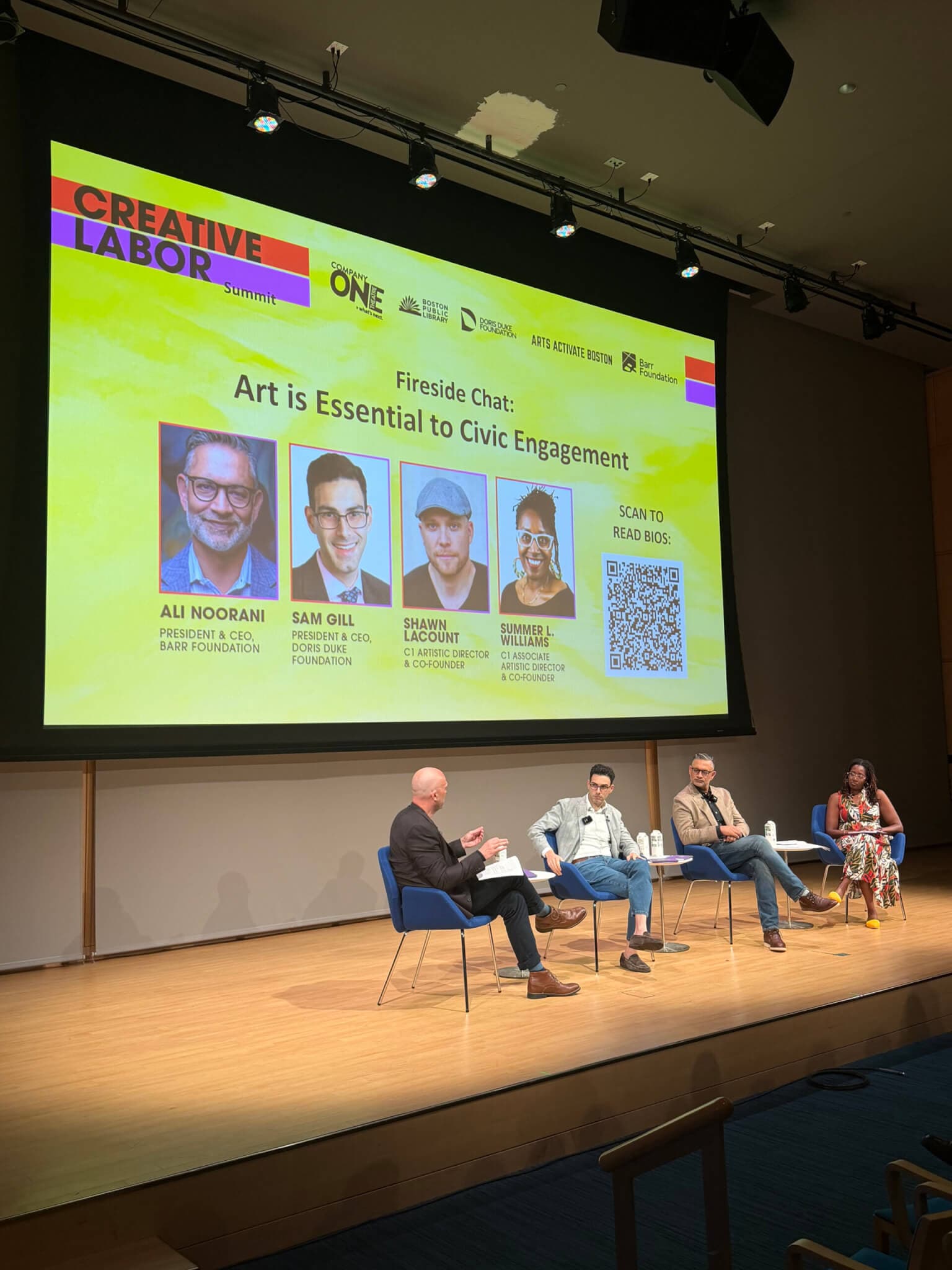
The plenary was a “fireside” conversation between Doris Duke Foundation President and CEO Sam Gill and Barr Foundation President and CEO Ali Noorani, with Company One’s cofounders Summer L. Williams and Shawn LaCount.
It’s fairly rare to hear the heads of philanthropic foundations speak so candidly. I think two points are worth raising.
The first is from Gill: “One of the really challenging economic dislocations that faces the arts is that we want it to be like air and water, and yet we finance it by excluding people from it, through a ticket. I think the answer to getting out of that is to make the arts more essential—is to make it so that we are banging on the doors of the halls of power, saying, ‘We want more of this thing,’” he noted during the conversation. I had to wonder: As young people leave the state, functional unemployment rises, and birth rates decline, are we not seeing people bang on the doors of power? Maybe the banging just isn’t being delivered in a way leaders are hearing it.
The Barr Foundation supports Boston Art Review and my role. Duly disclosed, you may discount the following as you will, but (other than quoting the Breitbart Doctrine’s repackaging of Gramsci, which I wrote about in my inaugural piece for this column), Noorani said something that struck me as a useful unlock for some of the sticking points that have plagued the arts policy space for decades:
“The entire—as I understand it—purpose of this gathering is to start to put a range of stakeholders within the arts sector and beyond the arts sector in a room to start to think about, OK, what is a collective agenda to pressure philanthropy—the private sector—and the public sector to really invest in the arts in the ways that the arts are essential to Boston? It is hard for any one of those sources of capital to say, ‘OK, we will do it this way, if we are sensing … that there is division within the ranks.’”
This is why it’s a problem to have an arts policy agenda—not just at this event, but in the broader context of organizing for the arts—that lacks participation by legacy arts institutions. It signals to the powers of the purse and to policymakers the reality of the field: that the ranks are indeed divided.
After the plenary, three working groups met. The one I attended focused on the Living Wage for All Act, legislation introduced by Rep. Delia Ramirez of Illinois to increase the federal minimum wage to $25 an hour. The working group’s leaders passed out a one-pager about the act. According to MIT’s living wage calculator, the explainer cited, a single person in Boston needs a salary of $125,000 to live comfortably, while artists earn a median of just $15,000 from their main jobs.
I’m not sure what the expectation was for a roughly two-hour talking session, or what the takeaway was supposed to be. But the conversations about the difficulty of passing this act—should tipped workers also receive $25 an hour?—reminded me of the Equal Rights Amendment. Yes, I know passing a constitutional amendment is a totally different process than passing legislation, but I couldn’t help thinking about how legislation supporting something most folks agree with can languish for ages.
The organizers of Creative Labor, Creative Conditions said they will host another convening in December, though it’s unclear how constituents can get involved in the agenda or planning in the meantime. For now, perhaps the aforementioned “banging on the door” should be directed at the stalwart institutions that often set the salary benchmarks in the arts industry.
Local Headlines
Will News of a Dropped Corruption Investigation Upend Susan Collins’s Midterm Senate Campaign?
While not exactly art-related—but certainly relevant to civic life in New England—recent reporting on Republican Sen. Susan Collins of Maine is turning up the heat on the midterm Senate elections. ProPublica reported last week that the FBI sought to launch an investigation into interactions from 2019 onward between Collins’s campaign and executives from military contractor Navatek. According to ProPublica, in a meeting with Collins and her staff, Navatek CEO Martin Kao pitched an $8 million research project for the company and the University of Maine. Collins later included $8 million for the proposal in the defense budget. When Trump came into office, he reportedly “derailed” the FBI’s inquiry. Accusations of corruption are intensifying as Maine remains a battleground state in the Democrats’ fight to flip the Senate.
Former WGBH President Jonathan Abbott Named Director of MOCA LA
Los Angeles’s Museum of Contemporary Art named Jonathan Abbott as its sixth director since 2008. Abbott moved to LA four years ago and served as president and CEO of WGBH Boston for fifteen years. His appointment comes as the museum continues to steady the ship after a tumultuous period marked by several high-profile exits of directors and senior curators.
Isenberg Projects Reviews Waterfront Impact Study
Creative consulting agency Isenberg Projects published a follow-up to its 2024 study of waterfront civic and cultural spaces, focusing on Dorchester, Fort Point, Charlestown, and East Boston. The 2024 study was produced in collaboration with Agency Landscape + Planning on behalf of the Mayor’s Office of Arts and Culture and the Boston Planning & Development Agency. Nearly three years later, the team cites many of the same findings: Boston has a “severe” shortage of cultural space and is losing more of it by the day.
SoWa’s LaiSun Keane Gallery Is Closing
Boston loses another arts space. Gallery LaiSun Keane has closed its doors after more than six years at 460 Harrison Avenue. In an email announcing the closure, owner LaiSun Keane cited family circumstances as the reason for sunsetting the project.
Librarians Allege Boston Library Isn’t Hiring
The Boston Librarians Union (BLU) is sounding the alarm that the City is moving too slowly in hiring new Boston Public Library staff. The union alleges that BLU positions remain vacant for an average of 352 days and that more than sixty positions remain open across the City’s library system.
Julia Child’s Home Is on the Market
My mom is particularly excited about this one: Julia Child’s Cambridge home is on the market for nearly $6.5 million. That’s a lot of butter. She donated her kitchen to the Smithsonian National Museum of American History, and it looks like the rest of the home underwent a significant—and bland—renovation. According to one of the listing agents, Ed Feijo, who has nothing to gain from saying this, “the feel of her is still in there.”
National Headlines
Whitney Museum Workers Declare Strike
Just ahead of the Whitney Museum’s upcoming Roy Lichtenstein exhibit, unionized staff members are preparing to strike beginning October 5. UAW Local 2110’s first contract with the museum expired in June. Employees are now asking the museum to meet City Hall’s improbable-sounding calculation that a single, childless adult must earn around $71,000 to live sustainably in New York City. (Notably, the City Hall report found that the only family type able to meet their median costs with their median resources is two adults with no children.) Staff also cite the skyrocketing cost of healthcare and its inaccessibility on a museum salary.
What Happened to US Arts Organizations After Trump’s Funding Cuts Took Effect? A Journalist Road Trips to Find Out.
About a year and a half after Trump cut funding to the arts, Jonathan Jones wanted to see what effect these cuts have had on local arts organizations. He is chronicling his findings on Reveal, a podcast by Mother Jones.
Global Headlines
Mexico and South Korea Continue Their Cultural Diplomacy Love Fest
Boston and Scotland weren’t the only fan communities to fall in (FIFA) love. Mexico and South Korea shared a similarly affectionate cultural exchange. Now, that mutual admiration is extending to the countries’ highest levels of governance. Mexican President Claudia Sheinbaum announced that K-pop group BTS would return to Mexico following its visit to the National Palace and her bilateral meeting with South Korean President Lee Jae Myung. Lee posted a video to Instagram featuring Mexican band Maná’s song “Muelle de San Blas,” and Sheinbaum announced during a morning press conference that K-pop band Stray Kids will also visit the National Palace.
An Art Gallery Hires An Economist?
This one is a bit of a throwback, but I think it’s worth a listen. For ArtNet, Margaret Carrigan spoke with Whitechapel Gallery Director Gilane Tawadros about why she hired economist and University College London professor Mariana Mazzucato to transform “our shared understanding of the value of culture, socially and politically.” Tawadros argues that, amid shrinking arts budgets, Whitechapel Gallery hopes to make the case for the arts as civic infrastructure, in part through work and programming that will result from this hire.
Engagement Opportunities
Somerville Community Arts Forum, organized by #ARTSTAYSHERE Coalition
October 27, 2026, 6:30–8:00 pm
More information and registration details can be found here.
Editor’s Note: Boston Art Review receives support from the Barr Foundation.