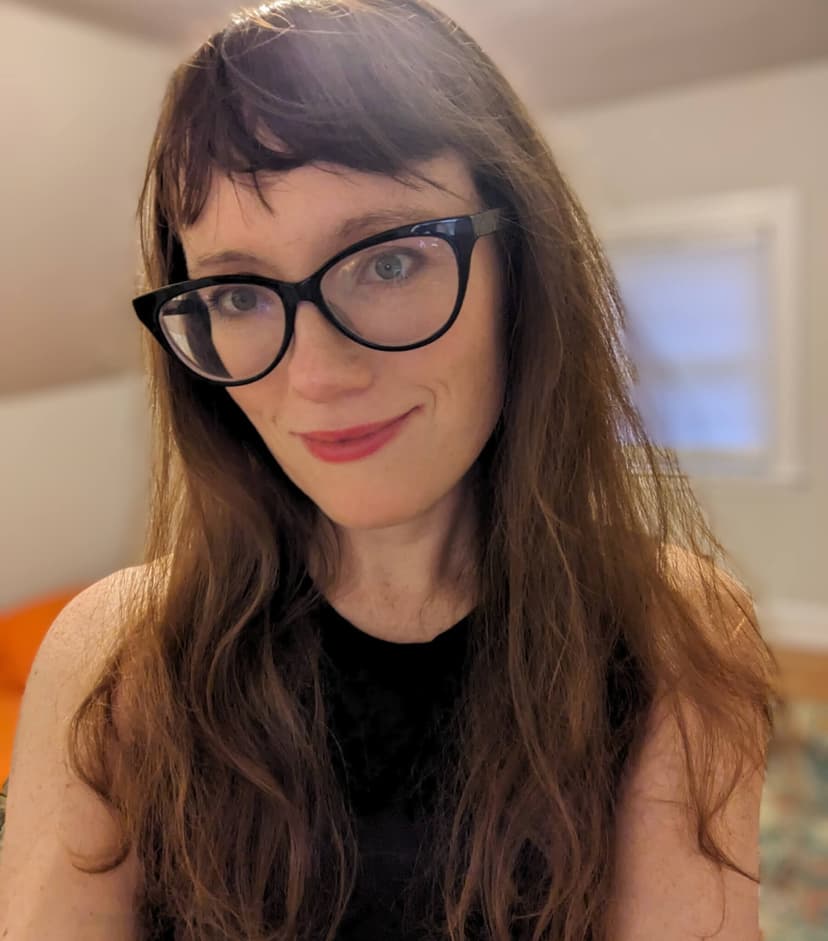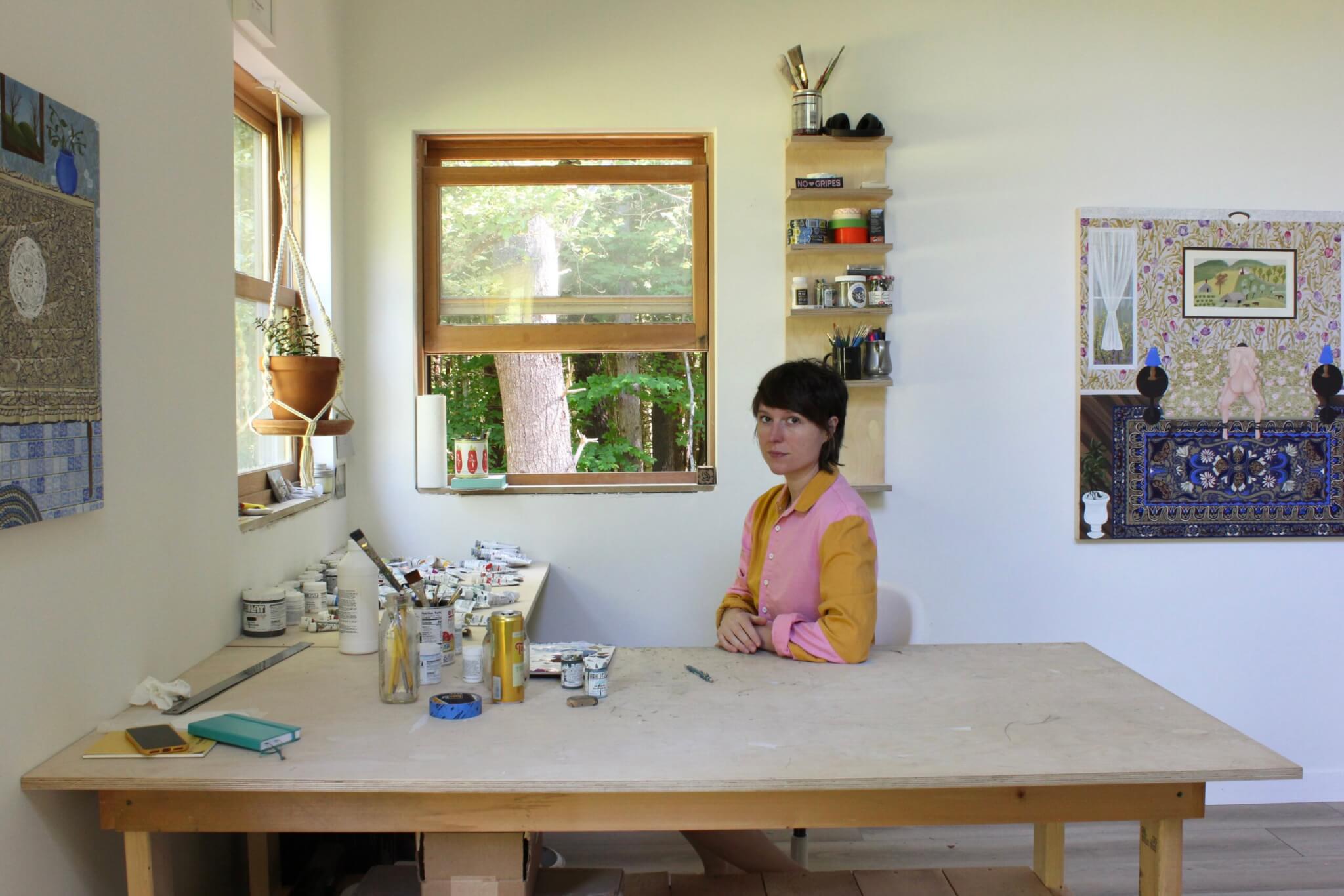
Anne Buckwalter’s paintings give new meaning to the phrase “domestic bliss.” Drawing on the folk art traditions of her Pennsylvania Dutch heritage, Buckwalter paints domestic interiors that feel cozy, homey, and wholesome. But in these rooms, an embroidery sampler might share a wall with erotic art. Gingham curtains part to give us a glimpse of a scene between two lovers in lingerie. A plate in a cheerful kitchen’s china cabinet depicts a sex act in Delft blue. And the ropework binding a figure on a bed is as pretty and precise as the pattern on the patchwork quilt beneath her.
At first, spotting the clues to the erotic lives of these imagined rooms’ inhabitants can feel like an R-rated spin on I Spy. But the more I look, the less the entwined bodies and amorous accoutrements seem at odds with the braided rugs and floral wallpaper. In fact, they start to feel right at home. Like the creature comforts and folk art furnishings that fill these interiors, sex is framed as an outlet for creative expression and an everyday source of delight.
Buckwalter is based in Durham, Maine, and earned her MFA at Maine College of Art and Design, but she’s originally from Lancaster County, Pennsylvania. “Anne Buckwalter: Heirloom,” on view at the Allentown Art Museum from November 21, 2026, through April 18, 2027, marks the first museum exhibition of her work in her home state. I spoke with the artist about her hopes for the show and a passion project she’s pursuing in her Maine studio.
The following conversation has been edited and condensed.
Jacqueline Houton: “Heirloom” is a homecoming of sorts for you, so I’d love to start by talking about the place where you grew up. What was that visual world like, and what were your early encounters with art and craft?
Anne Buckwalter: I grew up in Lancaster County, Pennsylvania, which is famous for being one of the epicenters of Pennsylvania Dutch or Pennsylvania German culture. The house I grew up in, which my parents still live in today, is adjacent to an Amish farm. And my family is Pennsylvania Dutch, so I grew up around a lot of Pennsylvania Dutch folk art and textiles and decorated furniture. There’s a really specific regional aesthetic that is particular to that area of Pennsylvania, and it involves a lot of highly decorated domestic objects—Amish quilts and embroidered samplers, painted furniture, and fraktur, which is kind of the Pennsylvania Dutch answer to the illuminated manuscript, with drawings that were made to commemorate significant life events, like marriages or births and baptisms, and a real focus on the domestic, on home and family life.
My dad taught me to draw from a young age. He was never a professional working artist, but he’s an amazing draftsman and also was a wood carver. He carved duck decoys, as did my grandfather. And both my mom and my grandma were amazing seamstresses. So I grew up around an elevated sense of domestic objects. And I’ve always been a homebody. My home now in Maine really draws on a lot of the traditions I grew up in, and I have a lot of heirloom furniture that came from my home in Pennsylvania.
JH: Speaking of your home in Maine, can you tell me about the studio you’re speaking from right now and what a typical day in the studio is like for you?
AB: I live in Durham, Maine, which is about twenty miles north of Portland, close to Brunswick. But it really feels like a very rural area. So aesthetically, I feel like it’s similar to Lancaster County. There’s a lot of farmland, a lot of beautiful nature, so I love living out here. I bought a house with my partner a couple years ago, and we actually bought this house from friends of ours, one of whom is an artist. So it feels like I inherited this artistic space. We have a little bit of land—our house is on a little over two acres—so last year I had a studio built on the property, which is something I’ve dreamed of doing for my whole life. It’s not a huge space, but I designed it myself and worked with a friend who’s an architect and did a lot of the finishing work and siding myself. So it feels really personal, and I just really love coming out here. I typically keep a nine-to-five schedule. I worked a nine-to-five job for a really long time before I was full-time in the studio, so that’s my default mode. I usually come out here in the mornings with my dog and take a lunch break and then work until five or six p.m.
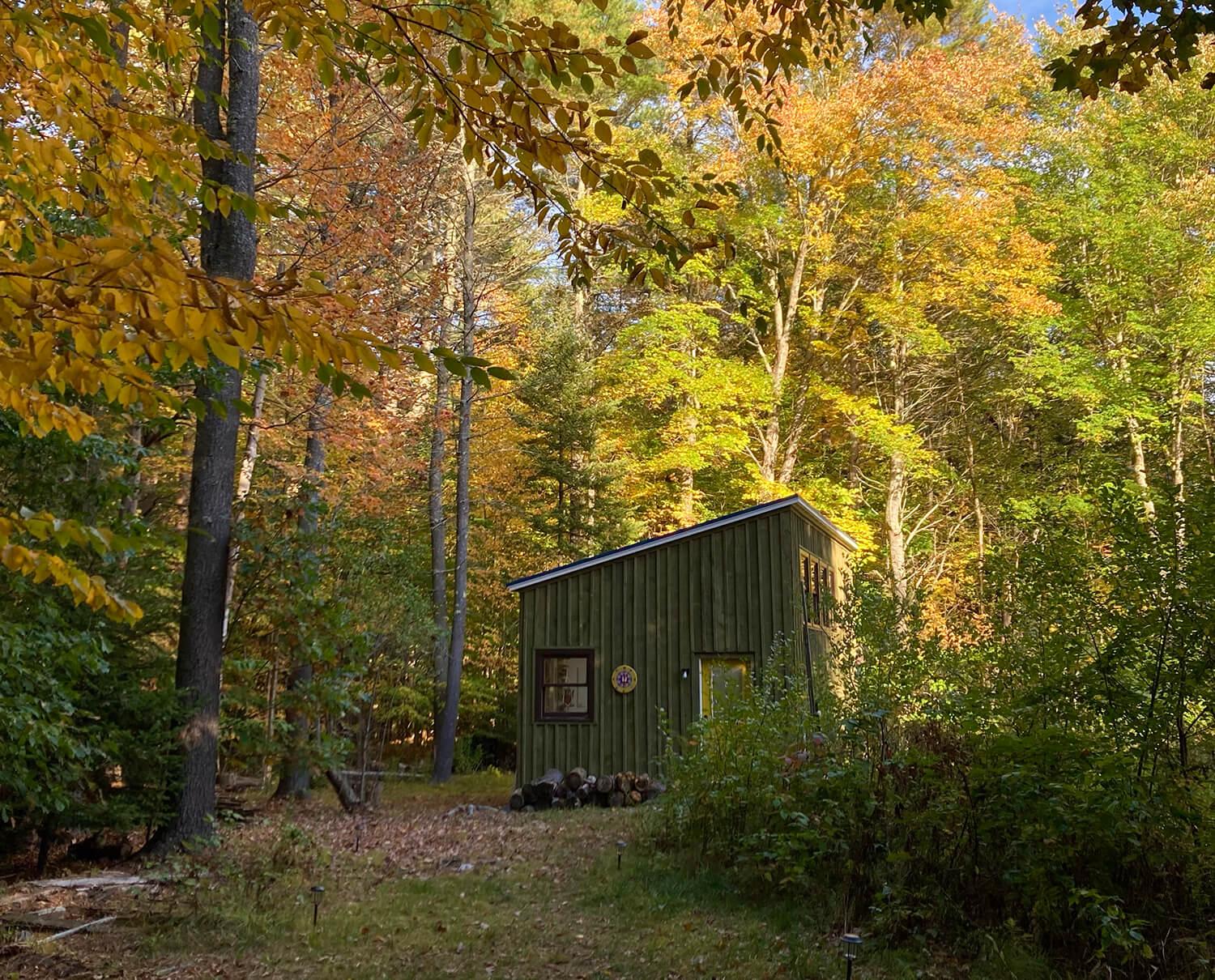
Anne Buckwalter’s studio in Maine. Photo courtesy of the artist.
JH: The paintings you’ve been working on depict highly decorated domestic interiors that harbor hints about their inhabitants’ erotic lives. When and how did you first start painting in this mode?
AB: I’ve been painting interiors for about eight years, and I’ve been interested in incorporating elements of sexuality and eroticism in my work for a really long time, probably since grad school. I think a big part of that is because I grew up in the ’90s in purity culture in a conservative town where sex was just not talked about. And I’ve always been really interested in love and sex and romance, so I’ve always been keen to include those things in my work. I pivoted to involving those things into interior spaces when I was doing a residency in Galveston, Texas, in 2019. I had arrived there to work on a series of drawings of beds. I was really thinking about the bed as a site of both wholesomeness and sexuality. It’s this place where we spend so much of our lives and so many important things happen. So I showed up with the idea of working on those drawings and then through my time there expanded away from the bed into the bedroom and then other interior spaces. I started thinking about domestic space as psychological space and as a place where these conflicting elements can coexist harmoniously. I’m interested in having these interiors combine elements of the erotic and the domestic, or the wholesome and the taboo. But I’m really interested in contradictions of all kinds.
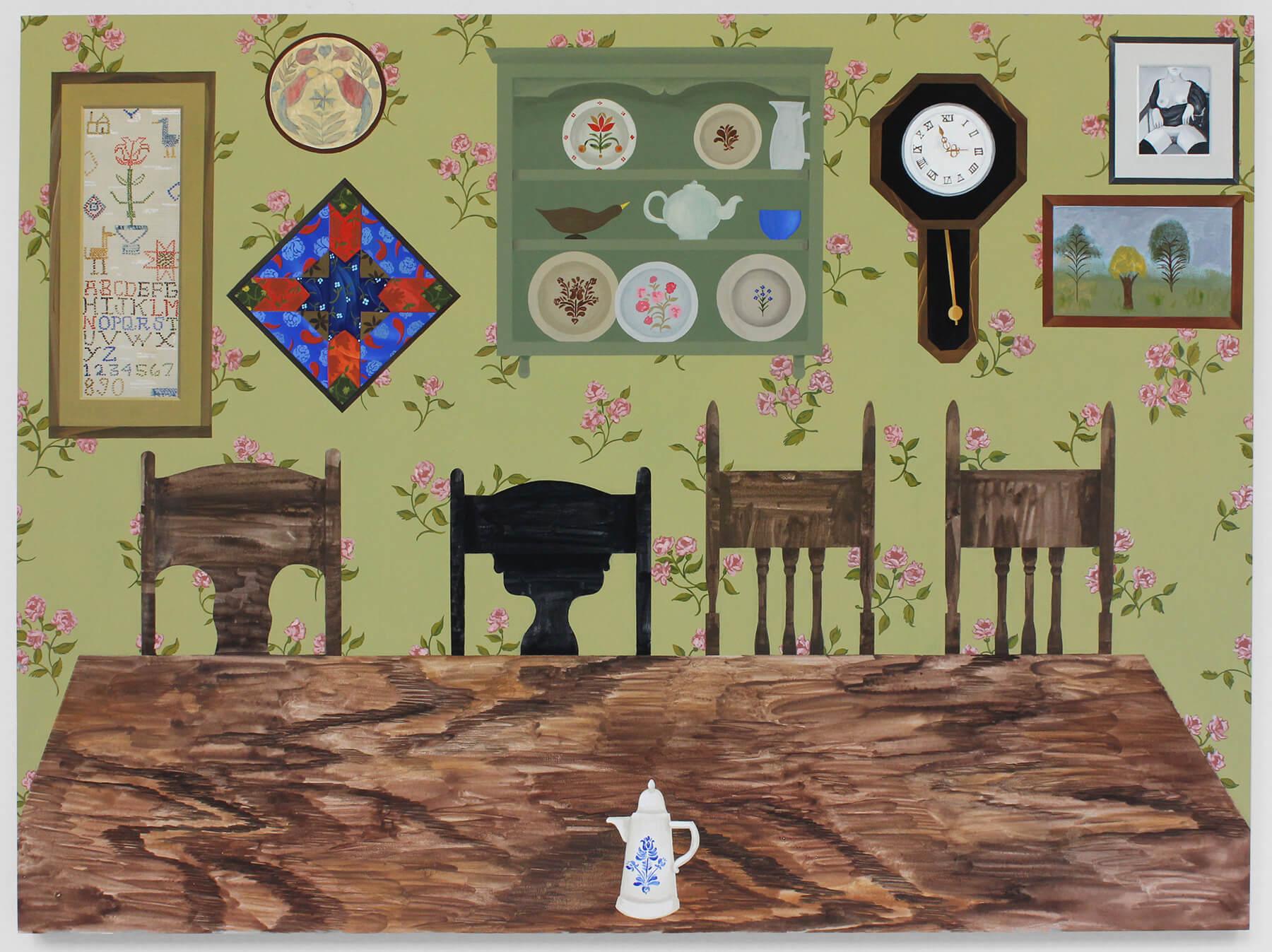
Anne Buckwalter, Dining Room Still Life, 2026. Gouache on panel, 30 x 40 inches. Photo courtesy of the artist.
JH: The furnishings in your paintings really dovetail with some of the Allentown Art Museum’s holdings. Could you talk about the connections visitors will see in the show?
AB: I worked with Claire McRee, who is the curator at the museum, to select specific works from the museum’s collection to show in dialogue with the new body of work that I made for the show. And there are even a few moments in the show where I’ve referenced those works from the collection in the paintings that I made, so it gets a little meta. There’s a quilt that’s going to be shown, and then there’s a painting that I made that has the quilt from the museum’s collection in the painting, so there’s that mirroring happening. Something I got kind of obsessed with in preparing for this show is Pennsylvania German show towels, which were embroidered samplers made by teenage girls to prove their readiness for marriage and domestic life. The museum has a number of these, mostly from the 1800s. So they’re quite old, and they’re in great condition, and they’re just really beautiful objects. Claire let me see a number of those works in the museum’s collection and take photos, and taught me a little bit about their histories. So I also made a series of drawings that reference those embroideries but incorporate some more erotic objects into the drawing. I’m excited about that because those will be shown in tandem with some of the show towels from the museum’s collection, so I feel like it’ll be a really nice contextualization.
JH: I’d love to do a deep dive into one painting in the exhibition. Can you tell me about a favorite that springs to mind for you?
AB: There’s one painting, called Angels (2026), that encapsulates my interest in heightening the intensity of the patterns in this body of work. Half of the composition of the painting is this quilt that has a traditional Pennsylvania Dutch tulip pattern. And then there’s also some patterned wallpaper, an embroidered sampler that is inspired by some of the samplers in the museum’s collection, and an American-folk-art-looking landscape. And then at the very bottom of the composition, there are two figures that are embracing naked. One of them has tattoos on their back, and because of the tattoos, they’re kind of camouflaged into the quilt. I was really interested in playing with the figure-ground relationship and allowing these figures to dissolve into the visual cacophony of the quilt. So I was really happy with how that one turned out. That’s also the image that the museum ended up using for a lot of promotion, so I feel like it’s a pretty good touchstone for the whole show.
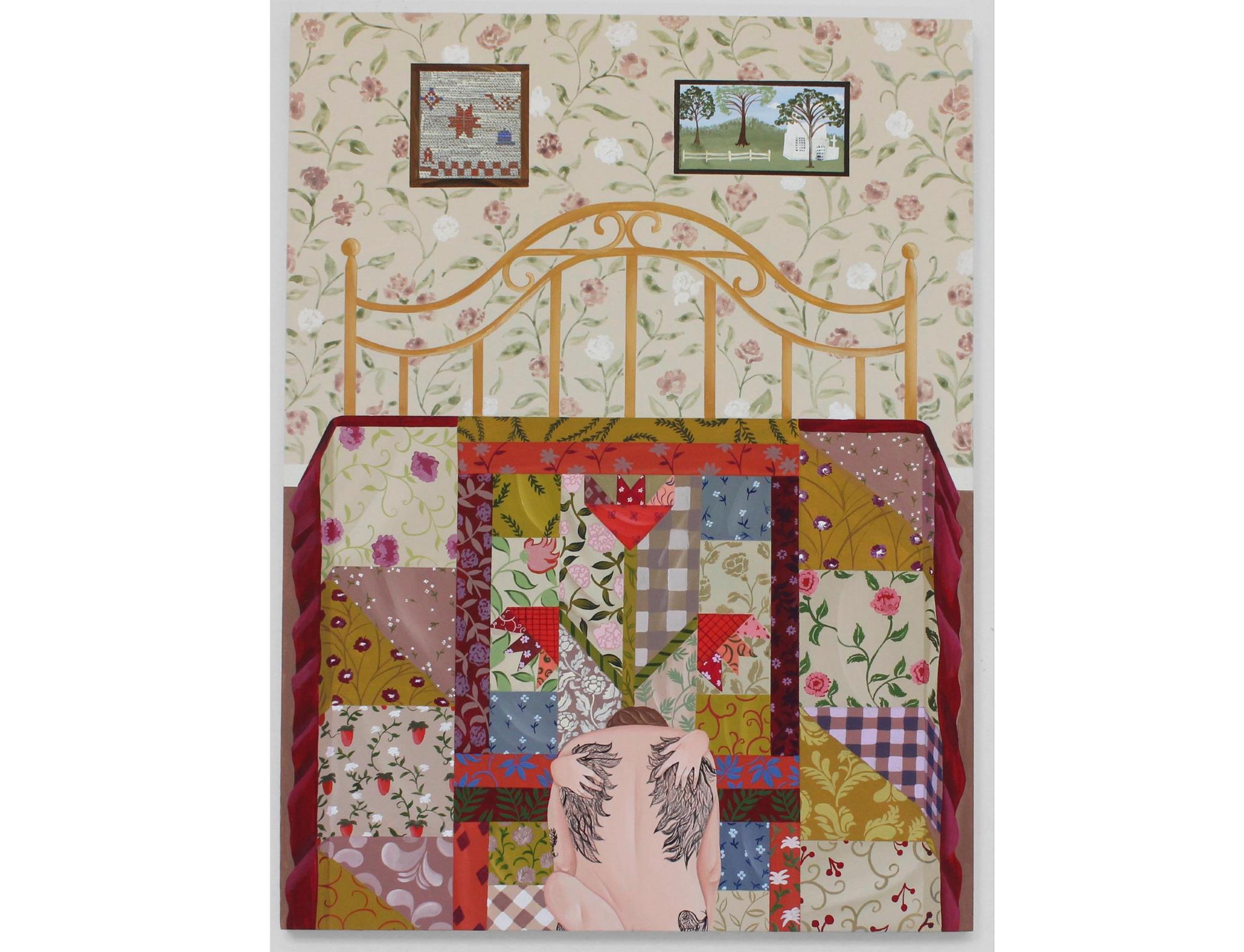
Anne Buckwalter, Angels, 2026. Gouache on panel, 24 x 18 inches. Photo courtesy of the artist.
JH: Is there anything that you hope visitors take away from the show?
AB: I’m intending a lot of joy and positivity with this show. For me, my work is really about celebrating eroticism and sexual diversity and queer sexuality and just acceptance of bodies and what they do. I see my work as a way of reconciling that part of myself with these more traditional, conservative values that I was raised in. So I would love it if people could walk away with the idea that those sorts of things that feel like they might be in conflict with each other can actually live together. Maybe that’s a sappy thing to say, but that is really how I see my work and how I want it to function in the world.
JH: On a related note, I understand that you are the head and only librarian of the Erotic Library and Archives of Maine, a project you started earlier this year. It has a range of different materials that you’ve helpfully cataloged online and that can be accessed in person by appointment. I get the sense that perhaps this started as a personal collection and then at some point you decided to share it with the wider world. Can you tell me more about that project?
AB: This is very much my passion project, and it sort of came about as you said. I’ve amassed this big collection of erotic material that I use for reference when I’m making my work, with different kinds of books covering all kinds of sexuality. Some of it is straight-up pornographic magazines. Some of it is more academic texts, like queer theory, books on nontraditional relationships, historical and vintage erotica. There’s a real sweeping collection just existing in my studio. But I got really interested in visiting various LGBT and queer archives during residencies. I did a residency in London last year and ended up spending a lot of time at the Bishopsgate Institute, which holds this collection called the UK Leather and Fetish Archive. It’s just this amazing treasure trove of digital and physical material that documents the history of sexual subcultures in the UK and beyond. I ended up going there a lot to hang out and look through the archive, and the people were really nice. It just felt like a really welcoming, inclusive place. I think it started this interest of mine in how we are preserving the histories of sexuality. I see those histories as really important to humanity and the human condition. And yet that subject is tricky for a lot of people and often surrounded with a lot of shame.
I got kind of obsessed with looking for sexuality archives in the US, and there’s not a lot of them. I mean, the Kinsey Institute has an impressive collection. There’s the Carter Johnson Library, which is somewhere in the Midwest. There’s the Chicago Leather Archives. But it’s not a topic that is easily embraced. And so I was like, “I wish Maine had something like this. And because they don’t, I’m going to start a tiny one in my studio.” And it’s been fun. I’ve been cataloging all the titles that I have. I’ve created a website, and I’ve gotten a couple of requests from people who want to come and look through the books. And then over the summer, I had a little erotic film series at my studio. I’ve been dreaming about doing more programming in that way, but it’s very, very DIY. It’s very small. It’s just a bunch of bookshelves in my studio essentially. But I just wanted there to be some kind of a presence in Maine.