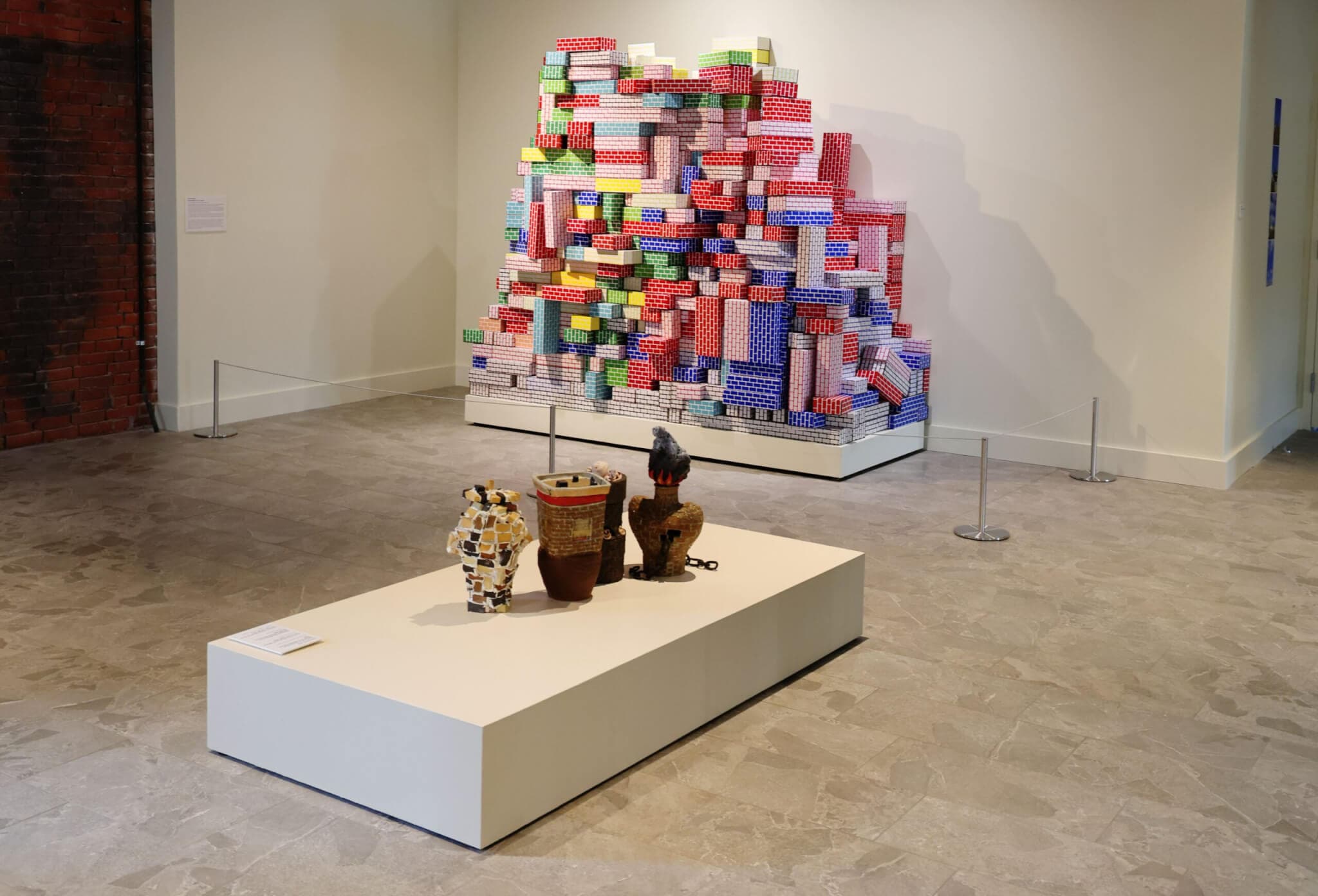
“A Common Bond: The Brick Journal” is the inaugural rotating exhibition at the newly opened Museum of Innovation, Learning and Labor (Maine MILL) in Lewiston, Maine. Organized by artist, curator, and Journal editor Alexis Iammarino, the group exhibition takes the brick as its central subject. Sited in a recently renovated building, the MILL contains a collection of over 10,000 industrial artifacts of current and past materials of manufacturing and labor. A true community space—featuring classrooms, activities, and robust programming—it is dedicated to preserving the area’s labor history and celebrating current “untold stories of workers.”
“A Common Bond” grows out of The Brick Journal, issue 1 (2023). Both the show and the 148-page periodical demonstrate that, as the Journal puts it, “a brick is the backdrop of a shared social history,” with the artwork presented in the second-floor gallery space making clear that shared social history hinges on land, labor, migration, and the shaping of the material world. Upon entering the exhibition, viewers are presented with a long vitrine housing the Journal itself. Iammarino’s editorial and curatorial instincts are expansive: Beyond the artworks, the gallery houses mini ceramic and acrylic bricks, a puzzle, Will Quam’s 2026 book Fire and Clay: How Bricks Reveal the Hidden History of Chicago, and a pencil pouch bearing an image of a brick. These objects are actively used by gallery visitors, enacting the ethos of the exhibition and the culture of a museum that welcomes the community.
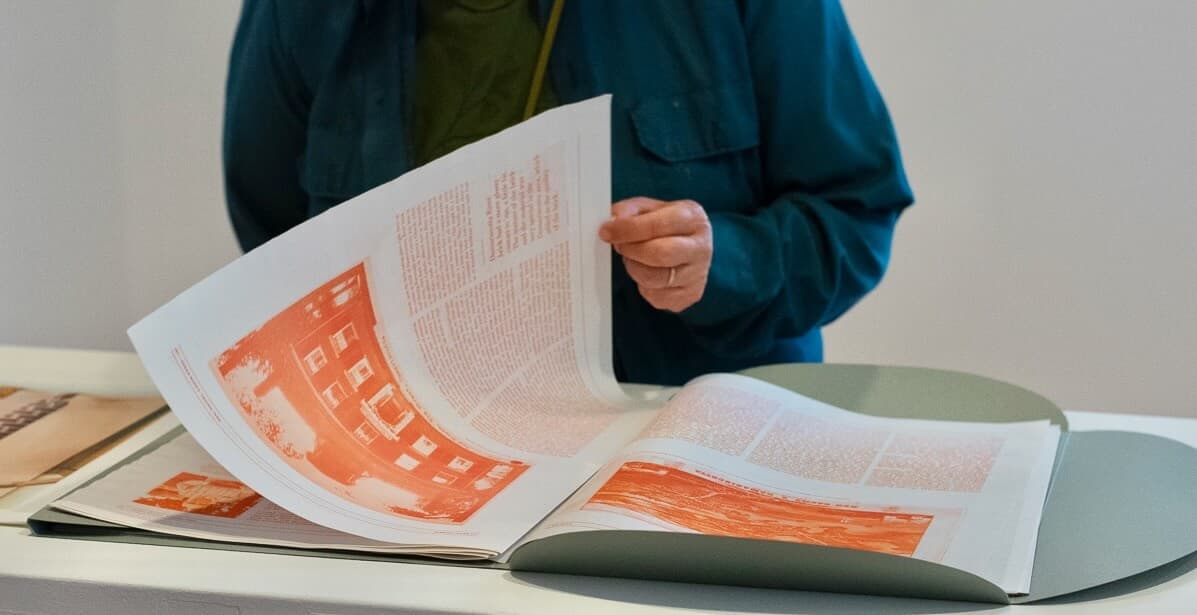
A copy of The Brick Journal, issue 1, on view in “A Common Bond: The Brick Journal,” Maine MILL, Lewiston, ME, 2026.
Located within a district of brick buildings, the museum abuts the Androscoggin River, whose name derives from the Indigenous communities that live in the area. The waterway was part of the localized brick industry that took advantage of the natural clay deposits that dot the Maine landscape. Bricks from the area were key to Maine’s shipyards, manufacturing industry, and export trade, and can be found in buildings as far away as Boston and Chicago. Wall texts throughout the first floor’s permanent exhibition acknowledge colonial occupation, land speculation, and the exploitation of workers that gave rise to local manufacturing that in turn fed national and international industry.
Both the exhibition and the Journal address the complexity of this past through contemporary art, design, and storytelling. The work of artists E. Saffronia Downing, Sam Finkelstein, Tara Morin, Luis Vasquez La Roche, Reniel Del Rosario, Jennifer Schmidt, Colin Sullivan-Stevens, Janis Vogel, and Emma N. Young can be found in both. The historical connections weave through the presentation, while the artwork’s material presence in the museum expands our understanding of the workhorse block. A showpiece loom occupies a prominent position within the first floor’s gallery, complicating the exhibition’s layout. The glass box encasing the upper reaches of the loom are laden with extravagantly displayed textiles that are not part of the exhibition and take up significant visual space within it. To negotiate this spatial interruption, Iammarino works hard to lead the viewer through “A Common Bond” with strategically placed artworks on pedestals and walls.
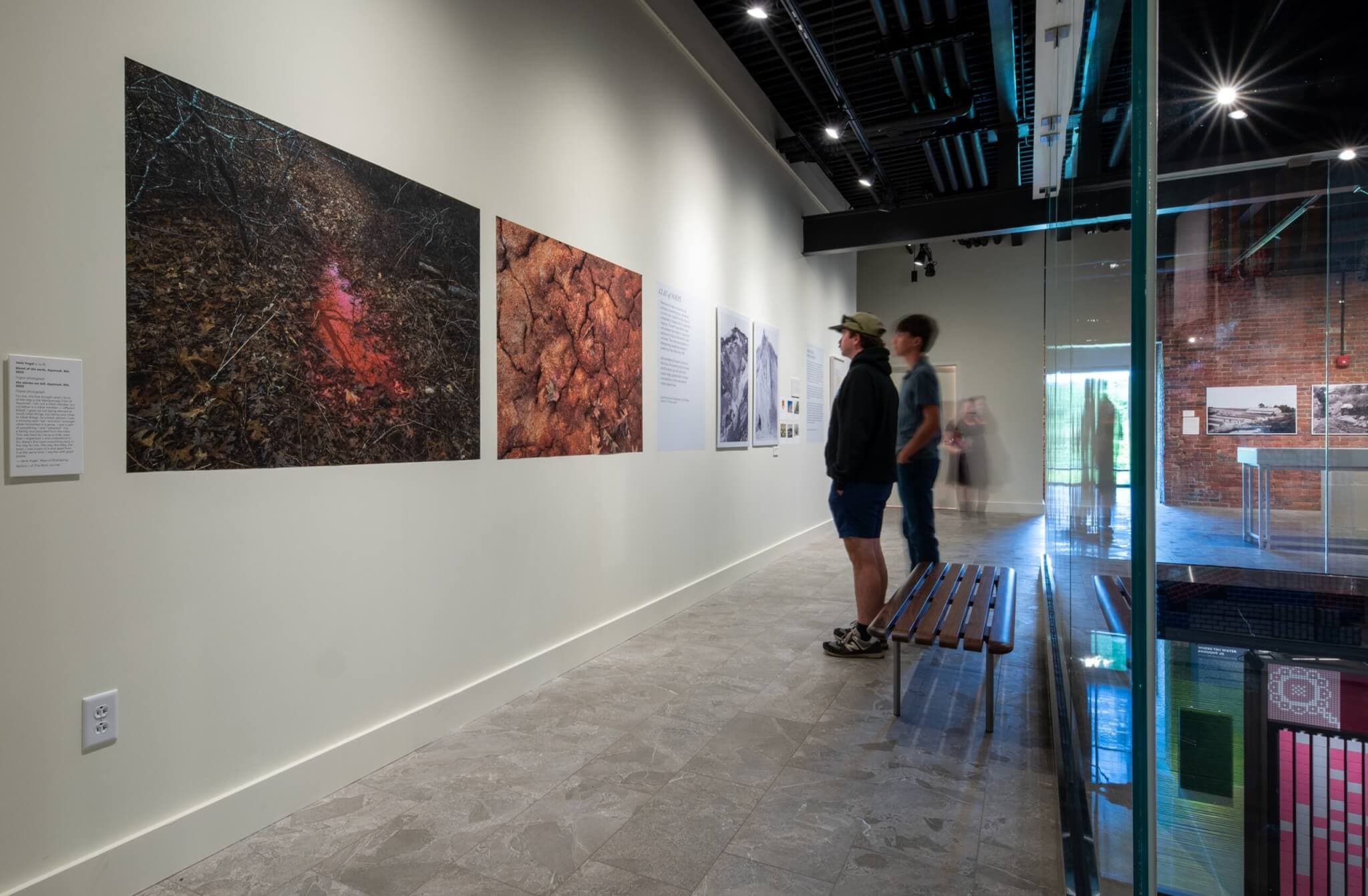
Janis Vogel, The blood of the earth and The stories we tell, Aquinnah, MA, both 2022. Installation view, “A Common Bond: The Brick Journal,” Maine MILL, Lewiston, ME, 2026. Photo by Bret Woodard. Courtesy of Maine MILL.
Like the Journal, the exhibition is a project fitted together from various voices in diverse registers to form what the curator calls a “discursive geography.” The tone of the exhibition is set by black-and-white archival images selected by Young from the Martha’s Vineyard Museum collection paired with Janis Vogel’s recent color photographs of wild clay. These photographs balance the uninterrupted wall: Vogel’s land-based photographs are on the left while Young’s selected landscapes, which include figures on the cliffs cutting clay, are situated to the right. Vogel’s photographs, taken during the long tail of the pandemic, picture a puddle that stains the graying forest floor red alongside another image of a field of dried, cracked, rusty earth. This diptych, The blood of the earth and The stories we tell, Aquinnah, MA (both 2022), locates clay as the home of the Wampanoag Tribe of Aquinnah on Martha’s Vineyard. The island was also home to Iammarino, Young, and Vogel; they grew up together visiting the Aquinnah Cliffs as teenagers.
This is complex territory for Vogel, who is not a member of the tribe, but whose father, as she notes in the wall text, is from “different blood.” Vogel was not allowed to touch tribal objects as she was growing up but nevertheless felt close to them. She “respected and understood the way things were,” sharing that there is a “…heart-wrenching story in the clay for me … the clay, the tribe, the town, I was a part of it and apart from it at the same time. I say this with great peace.” Between the color and black-and-white images is an excerpt of a text authored by Young, titled “Clay of Noepe,” from Section I of the Journal. It reads in part, “Remnants of native culture are not artifacts of something lost, something no more, but a signal that this culture is embedded so deeply that it is assuredly ongoing. … The continued presence of the Wampanoag people has assisted in preserving Aquinnah’s clay cliffs.”
The deep attachment and perhaps similar ambivalence of their island home is present in Afro-Trinidadian-Venezuelan artist Luis Vasquez La Roche’s work that appears on the opposite wall. Vasquez La Roche’s video and performance work grapples with histories of slavery and extraction, represented by a large-scale still from their video El Amarillo Representa el Oro (2017/2018). The image shows a glowing face and shoulders turned toward the sun. The artist stands on the north face of Tobago, skin sparkling with gold glitter adhered with raw palm oil. Their performance and participatory installations address the transatlantic slave trade and its persistant resonance in time, environment, and the exploitation of people and natural resources. Represented by this singular still, the glistening gold calls across the gallery to Vogel’s wet, red island clay.
The materials of the world—clay, palm oil—and their deep connection to place are linked to Downing’s zine-like publication, Call for Clay (2026). Produced during a period when Downing moved from residency to residency, the publication traces her gathering of clay from across landscapes. Displayed on a shelf alongside her sculptures, Call for Clay documents crowd-sourced collections of wild clay described as a “material embodiment of place and memory.” Forty participants across the US and beyond sent packages of clay, images, and descriptions of where the clay was dug, which was then test-fired and photographed by Downing. The publication reveals a broad assortment of conditions, landscapes, and stories from people who answered Downing’s call. One contributor describes how they had learned to identify surface deposits in rural Oshkosh, Wisconsin, by paying close attention to deer paths and ant hills, while others described the processes of refining and firing their wild clay.
For Downing, foraging for clay grounds her practice as she travels. In the Journal, she asks, “Where am I? What is the material world of this landscape?” She notes that her practice relates to the Earth’s own geologic events on a radically different timescale. The development of ceramics is considered one of the first large-scale technologies that lead to manufacturing of bricks, vessels, and countless other innovations. Downing describes the firing process “as this crazy time-capsule-future-rock-maker,” one that has allowed people to transform the landscape through labor and industry.
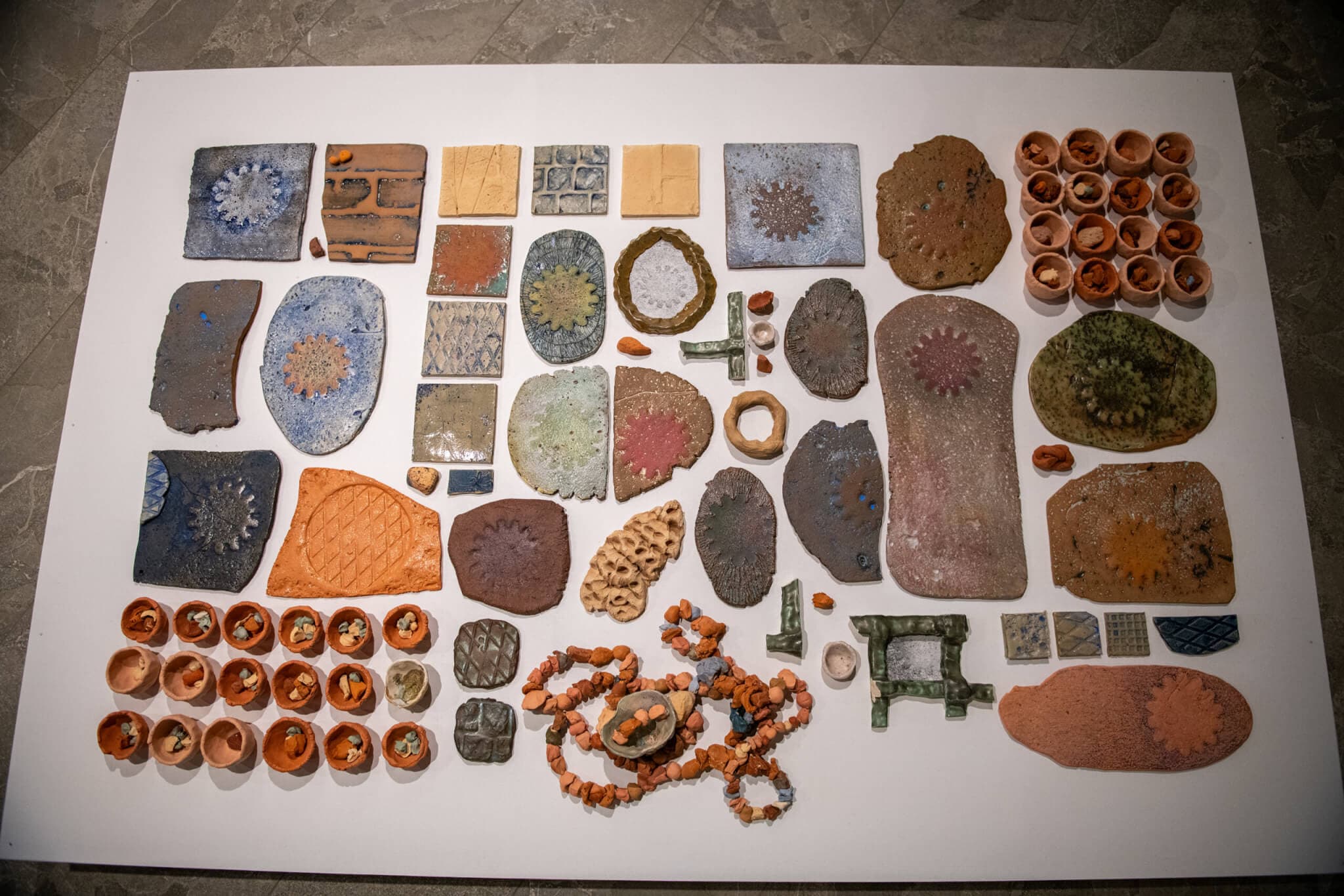
E. Saffronia Downing, earthenware, stoneware, porcelain, glaze, colored pencil. Photo by Bret Woodard. Courtesy of Maine MILL.
Across the gallery is Schmidt’s installation, Cardboard Blocks: 3 (2015–). An artwork that reenacts industrial processes consisting of 1,200 cardboard blocks, this work, presented as a tall, stable, multicolored stack, is inspired by the screenprinted blocks from Schmidt’s children’s play room. To make the blocks, Schmidt followed the same process as the production of the toy: She screenprinted cardboard with the toy’s surface pattern, had them die cut, assembled, and transported to her studio to finally be “played with.” Her process is documented with photographs in the Journal that include glimpses of Schmidt and her children at work and play among machinery and in industrial spaces. The apparent simplicity of the stack belies the complexity of Schmidt’s practice. The labor and manufacturing processes taken on by Schmidt while she was caring for her children underscores forms of work that women, in particular, are responsible for.
Like Vasquez La Roche, Schmidt’s Cardboard Blocks is durational and responsive to the conditions of labor. Consider the steps that Schmidt took to create the artwork: the noticing of the toy among the others, the subsequent artistic reproduction of the block’s form, its construction, storage, and activation and re-activation in multiple gallery settings. Key to this work is noticing—a significant and time-consuming act that is largely unseen and unrewarded for parents and artists. Schmidt’s “self-manufactured” Cardboard Blocks are not a plaything for her children: Their making and display are a revelation of labor and reproduction under the state of capitalism.
“A Common Bond” follows the brick from material to meaning, exploring, in Iammarino’s words, its “visual language, social, geologic histories, and cultural production.” The MILL is an inspired setting for the exhibition’s relevant histories and inheritances of colonialism and capitalism, while the accompanying Journal traces the lived experiences, relationships, and conversations that gave rise to the project. Beginning with Iammarino’s experiences growing up on the island of Noepe (Martha’s Vineyard) and on the ancestral lands of the Wabanaki (Maine), where she now lives, these histories have shaped the exhibition as much as the form of the brick itself. The places, people, and relationships that formed the Journal and exhibition inspired her to “set out to thread and deepen … connections from which [a] discursive geography of [the] project expanded, from one illuminating conversation dovetailing into the next.” That expanding network of connections ultimately becomes the exhibition’s subject as much as the brick itself.
“A Common Bond: The Brick Journal” was on view through October 25, 2026, at Maine MILL, 1 Beech Street, Lewiston, ME.