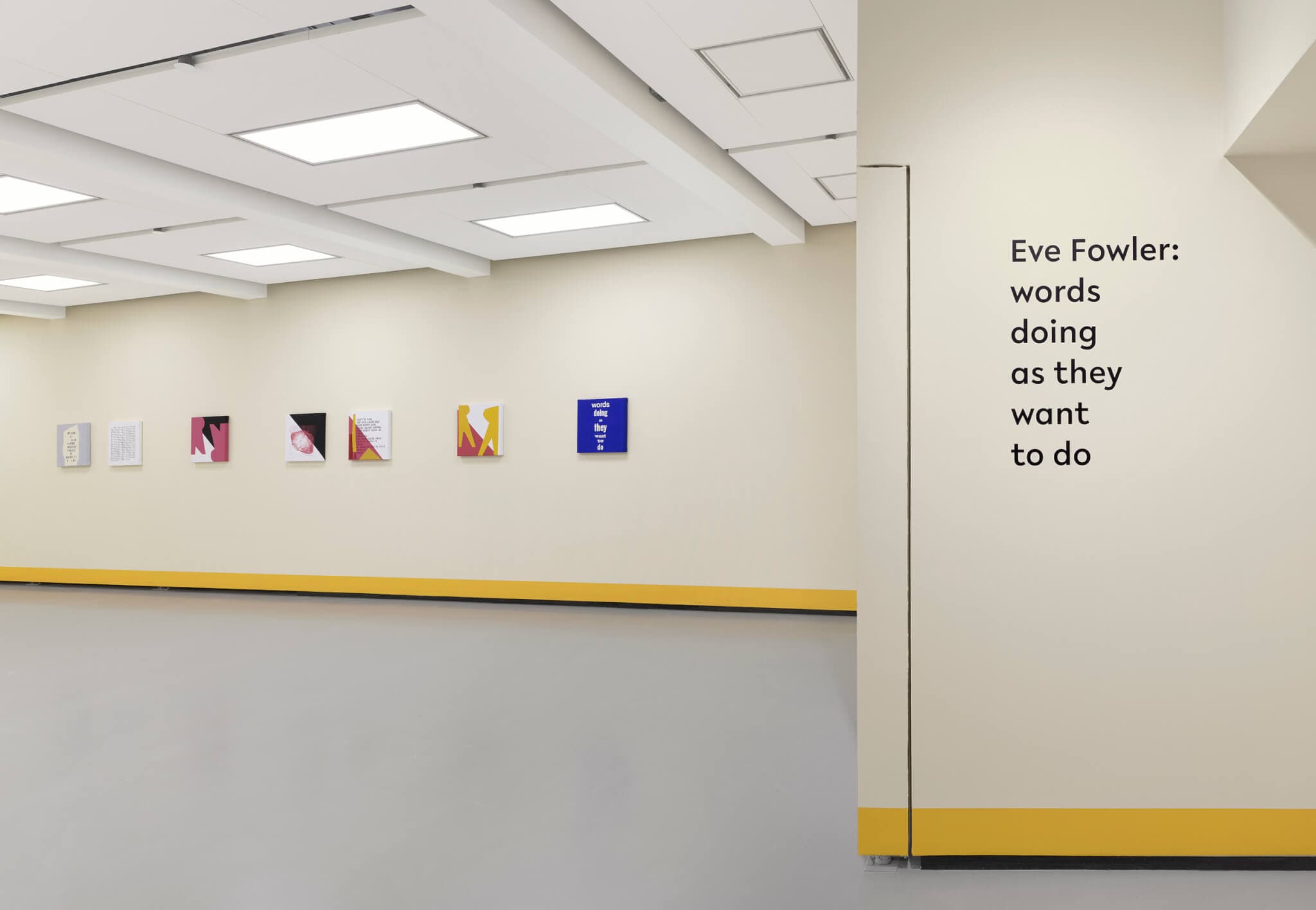
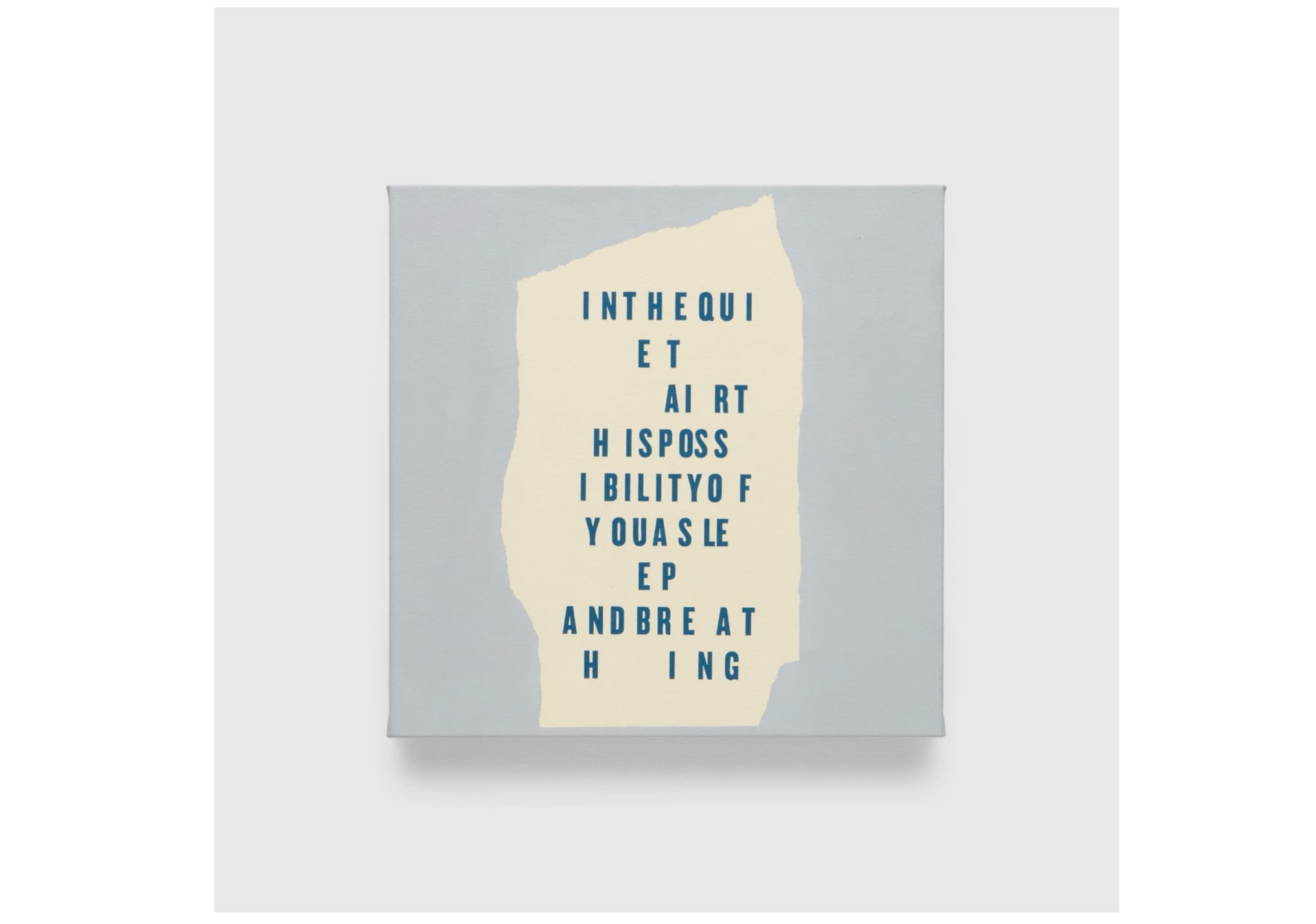
Words are patterns and letters are shapes. Through Flashe and acrylic ink, “Eve Fowler: words doing as they want to do,” curated by Meg Rotzel at Harvard Radcliffe Institute, distills this simple truth. Inside the one-room Johnson-Kulukundis Family Gallery, square canvases line the two long parallel walls. From afar, each canvas offers vivid graphics; coming closer, one can discern more intricate layers that make up the work. This dual visual, the macro and the micro, is illustrative of Fowler’s approach to undertaking a feminist ethic; one has to see things from many valences to truly get the full picture. The Los Angeles-based artist and former Radcliffe fellow is a queer feminist impassioned by studies in the archives of queer activists and writers before her. The theoretical and aesthetic qualities of the show align her work with that of other feminist artists, such as Jenny Holzer (HEAP, 2012) and Adrian Piper (Political Self Portrait, 1978)—artists who call into question the perfunctory mechanics of just how we read and who explore what erupts when we dare to do so differently.
It would make sense, then, that there are no wall labels in the show, although the gallery assistant will offer a pamphlet with artwork information. The show calls on visitors to parse through its interrelated layers and embrace meanings of our own.
The floor of the brightly lit gallery is wide open save for a table with a small stool on the back wall. The barrenness of the room is critical. There is no respite in sitting down on a bench or anything architecturally competing; one must be with the works alone and directly. quiet words (Artist’s Book) (2025), a large compilation of acrylic screenprints on newsprint, lies flat atop the single table. The thin paper is likely familiar to an artist in the early stages of an idea, as the material allows for quick and affordable experimentation. Stapled together, the book felt a bit scrappy, but still like a profound glimpse into Fowler’s process. Carefully flipping through the pages, I recognized many of the same images on the walls that surrounded me, albeit with some tweaks between the newsprint editions and the canvases in their present form. For instance, above the table on a small piece of wall of its own between two windows hangs Ouija (James Merrill) (2025), Fowler’s remaking of the spirit board with which poet James Merrill famously held séances to aid in his creative process. Inside Fowler’s artist book, another rendition of the Ouija board print is layered over a page of text from a letter Fowler uncovered in the poet’s archives at Yale University.
Fowler also pulls inspiration from queer American writer Gertrude Stein; the title of the exhibition borrows lines from Stein’s 1935 lecture series Narration at the University of Chicago. Stein, a towering figure of modernism, was known to employ traditionally visual styles like cubism in her poetry, and thus allowing words to “do as they want to do” characterizes her own experimental style of writing. Fowler draws from Stein’s style and then mirrors it in her own work; the canvas takes up text to transgress its typical function.
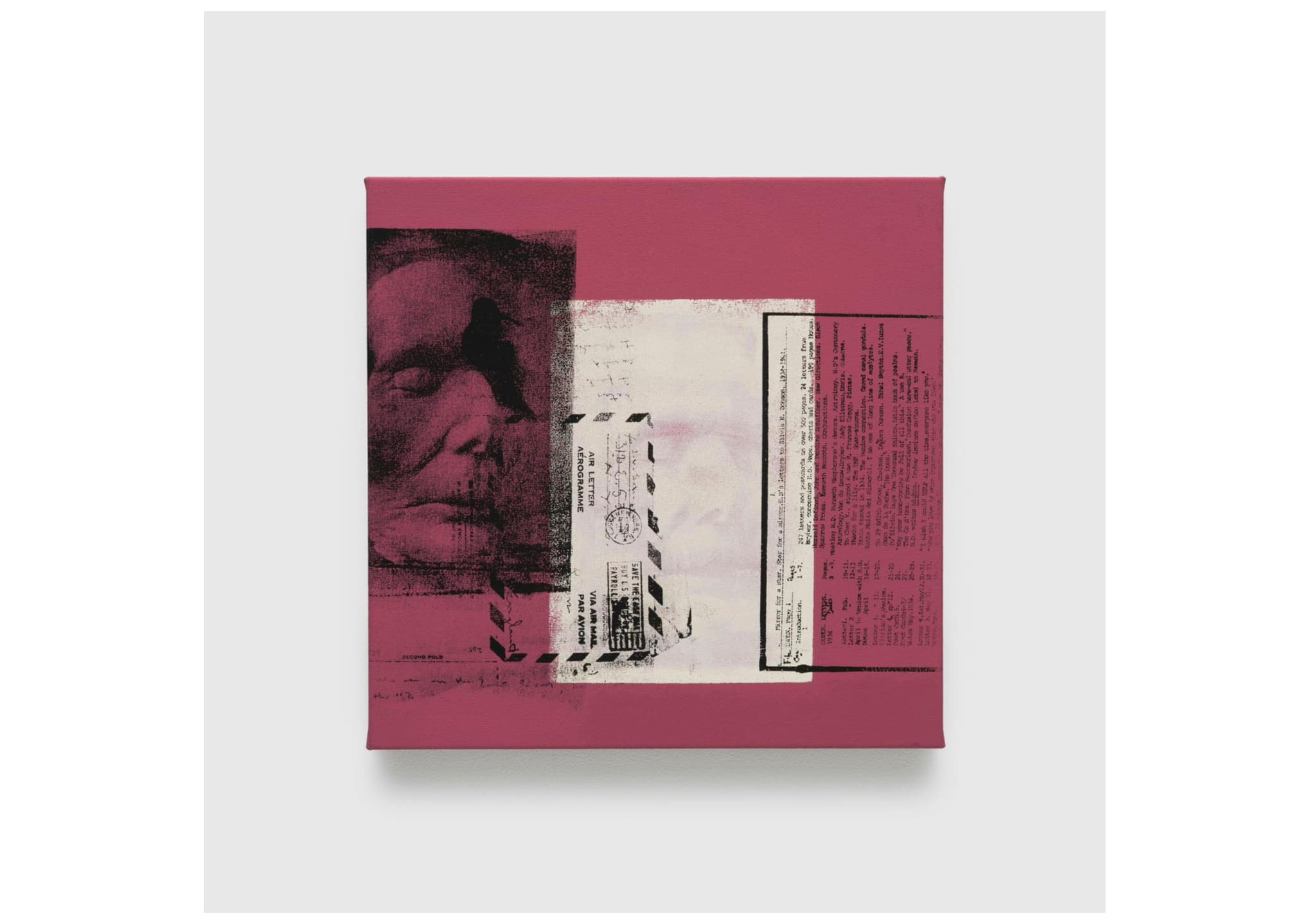
Eve Fowler, Mirror for a Star. Star for a Mirror., 2025. Flashe and acrylic ink on canvas. Courtesy of Harvard Radcliffe Institute.
June Jordan and Frank O’Hara (audio) (2026) resounds throughout the show. Words by the titular poets are read by a group of artists, writers, and gallery owners, including Math Bass and others. As visitors look and listen to Fowler’s work, certain words repeat across the canvases, the artist book, and the recording. Hanging across from one another in the gallery are Roll back your eyes, a pool (blue) (2025) and Roll back your eyes, a pool (green) (2025), which borrow their title from the Frank O’Hara poem “Mayakovsky.” The lines “roll back your eyes, a pool” repeat with equal spaces between each letter and word to form an almost perfect square grid. The effect is similar to a word search puzzle, except that through the repetition of the words, each letter eventually aligns with itself on a diagonal. These words are a part of the looping audio as well. There, auditorily, they sit in context of the full poem where O’Hara famously laments the “catastrophe of his personality” and longs to feel modern again.
In 2008, Fowler founded Artist Curated Projects in Los Angeles with Lucas Michael to amp up artists’ agency in the presentation of their own work. The duo recognized that curators and collectors sometimes have values that are misaligned with those of artists, and they wanted to build a space where artists could lead. This principle seems to guide this show as well. Prior to this exhibition at Harvard, Fowler’s new works were presented at Gordon Robichaux. There, they were configured in a distinct sequence, allowing the flow between each canvas to conjure new meaning in a new space.
Ultimately, even when words do as they want to do, they desire to be read, but perhaps not as we’re accustomed. Fowler’s translations of archival material offer bold and radiant textual art that makes us aware of the ways that things that are oft conflated—such as literacy and comprehension or literal and concrete—are not so alike. The real want for words appears to be to transform the viewer’s, the reader’s, very approach to something seen as rudimentary. Words want to be read in new ways. By queering the fundamental act of reading, Fowler unearths the queer potential of everything.
“Eve Fowler: words doing as they want to do” is on view through June 5, 2026, at Harvard Radcliffe Institute, 8 Garden Street, Cambridge, MA.