I want more alternative art spaces. I’m tired of the same-old sterile, white cubes and yearning to experience art in an environment that can lend some character to the conversation. Art isn’t created in a vacuum; it’s the result of countless interactions between people, things, and ideas, and of being recklessly candid with ourselves and our humanity. Shouldn’t the places we exhibit art reflect that same humanity?
That’s why I was excited to learn of deiner, opened earlier this year by artist Charlie Crowell in his Arlington apartment. Formerly his dining room, it’s a cozy, lived-in space that draws you in with its round architecture, natural light, and curious quirks. The project is a labor of love for Crowell, who acts as curator, preparator, and installer, flipping the space for every exhibition and touring visitors by appointment for a one-on-one experience.
“I want the focus of the space to be on the person who comes to visit, like somebody you would invite to your home for dinner,” says Crowell.
What makes deiner so special is the value it places on intimacy, sociability, and slowness. Unlike traditional curatorial models with wall texts, press releases, and pre-written essays, Crowell’s practice is slow-baked. He lives with the artwork over the course of the show (usually two months), writes about this experience, then shares his writing at a small closing dinner with the artists and other local creatives. The goal of these gatherings is to engage in deep dialogue about the exhibiting artist’s work, while cross-pollinating people and ideas and building a creative community. This generative approach to not just showing but sharing art creates space for new connections and meanings to unfold over time and conversation.
Rather than solo shows (which can come with a lot of pressure) or group exhibitions (which can feel reductive), denier has found a sweet spot with the duo-show model, often pairing two artists who don’t know each other, but share common interests in their practices. “Because of that freshness, artists are able to make really novel connections between each other’s works really quickly, and I feel like that often creates a mood of collaboration,” says Crowell.
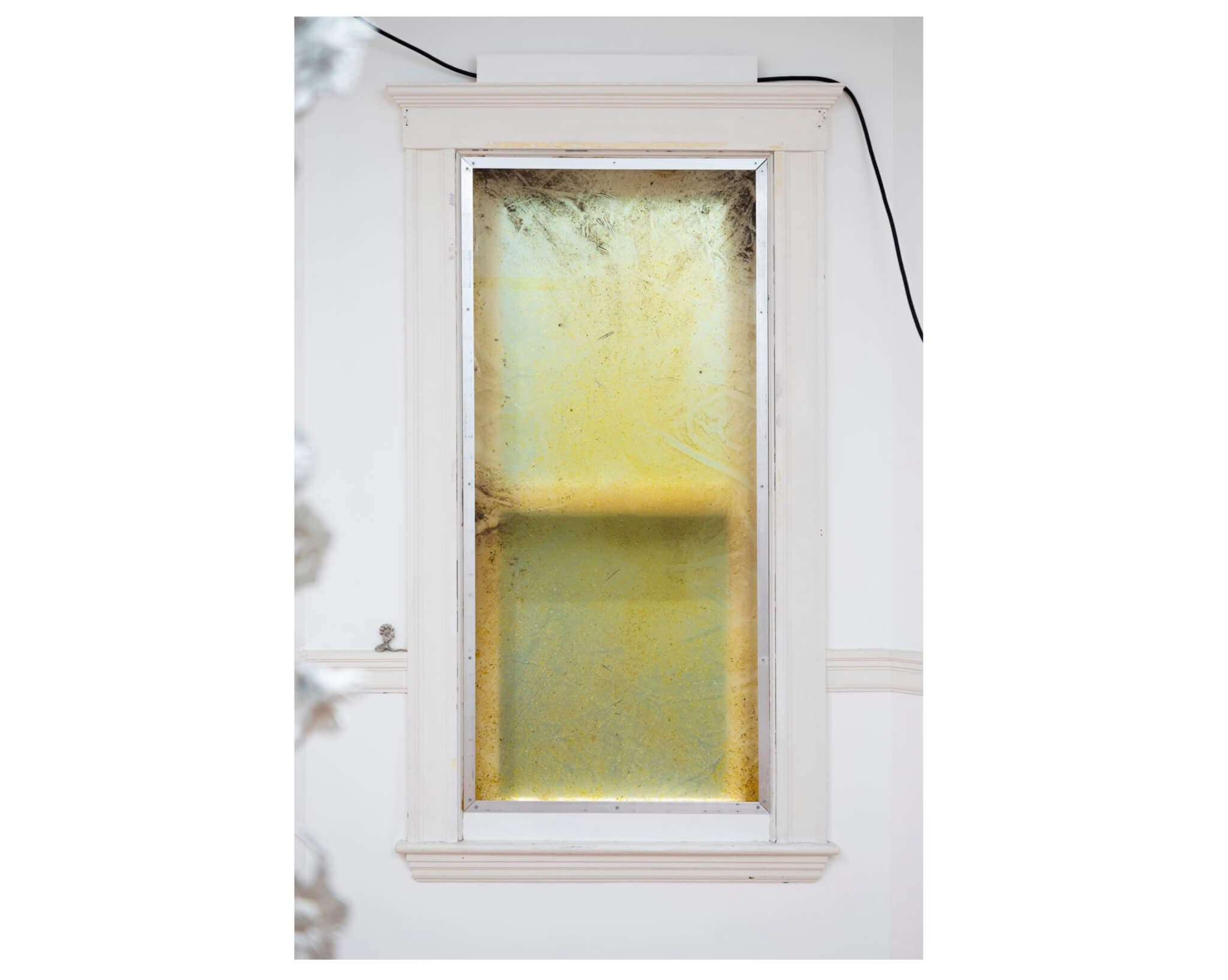
Ena Kantardžić, echo 2 (orpheus, shadow), 2025. Narcissus pseudonarcissus and clay dirt bioplastic. Each piece approx. 59.25 in x 26.75 inches. Photo courtesy of deiner gallery.
deiner’s current show, “hope of suggestion,” is an experiential installation between artists Ena Kantardžić and Maggie Wong. Visiting the gallery felt a lot like coming over for dinner, with Crowell as the generous host. He welcomed me warmly at his door; I removed my shoes before entering and spent the rest of the visit in my socks, which helped ground me in the experience. The floors creaked a little as I approached the gallery, and the first thing I noticed when I walked inside was the smell—woodsy, kind of earthy, a little grassy?
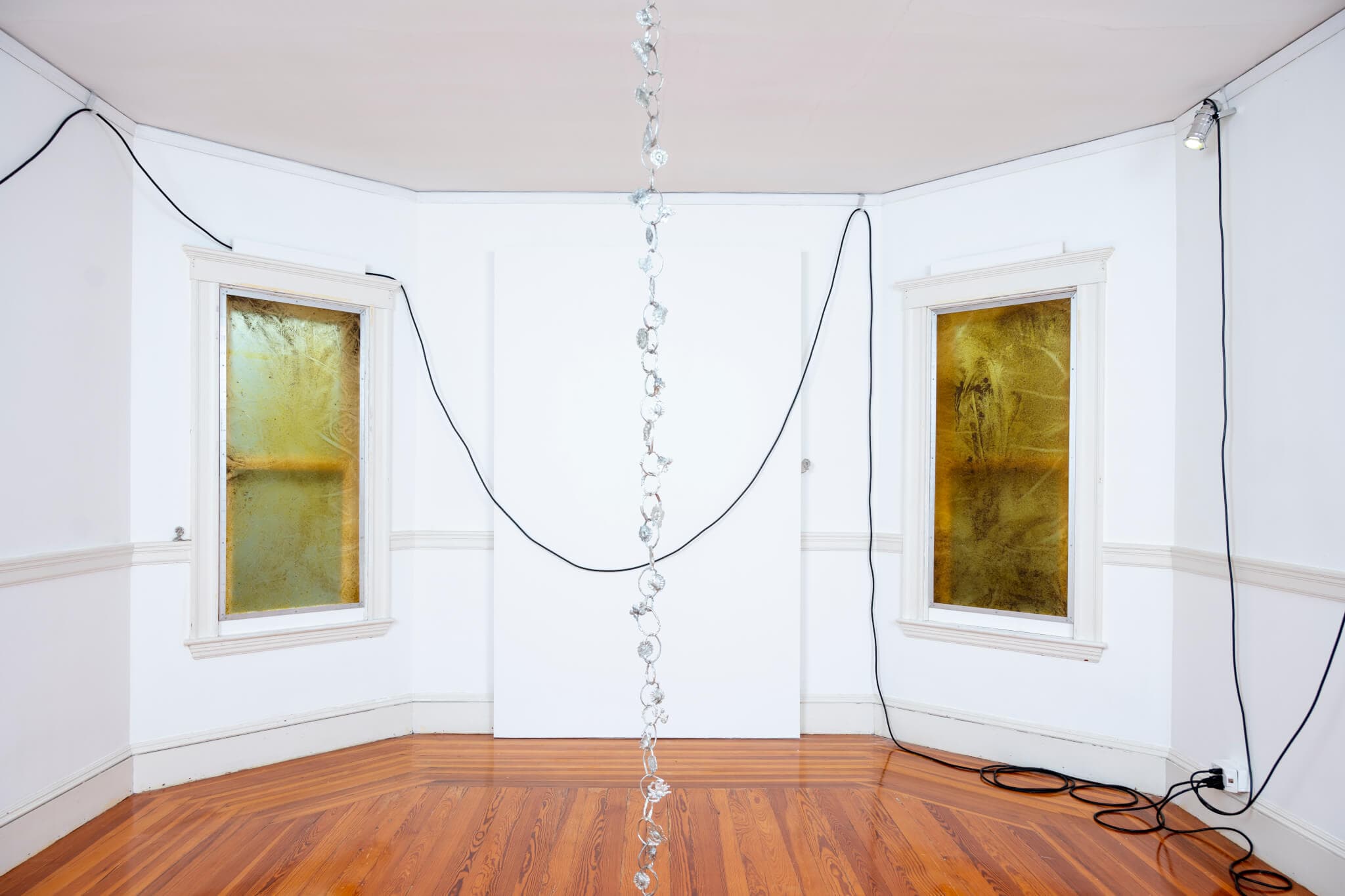
That’s when I learned that all of the work is made from flowers. Covering the two windows in the space, Kantardžić’s echo 2 (orpheus, shadow) (2025) are translucent bioplastic films made from pulverized daffodils and soil, with a very pungent, grassy scent. Another work by Kantardžić, echo in memoriam (2023), is a series of spotlights with yellow-tinted gels, dyed using an alcohol ink made from daffodil petals. These pieces filter all the light in the space with a subtle yellow tinge, completely shaping the experience and producing a mellow-yellow effect that I found irresistible, like a fly drawn to a lightbulb. Both pieces stem from Kantardžić’s larger, ongoing echo series, begun in 2022 when they planted daffodils in a field in the shape of the word “DROWN.” This gesture is partly inspired by Ovid’s story of Echo and Narcissus (the genus name for daffodil), in which Narcissus, a mortal cursed with excessive vanity, transforms into a daffodil after dying by a pool bearing his own reflection. It’s a tragic, cautionary tale of the dual nature of beauty, its ability to arouse both ecstasy and agony.
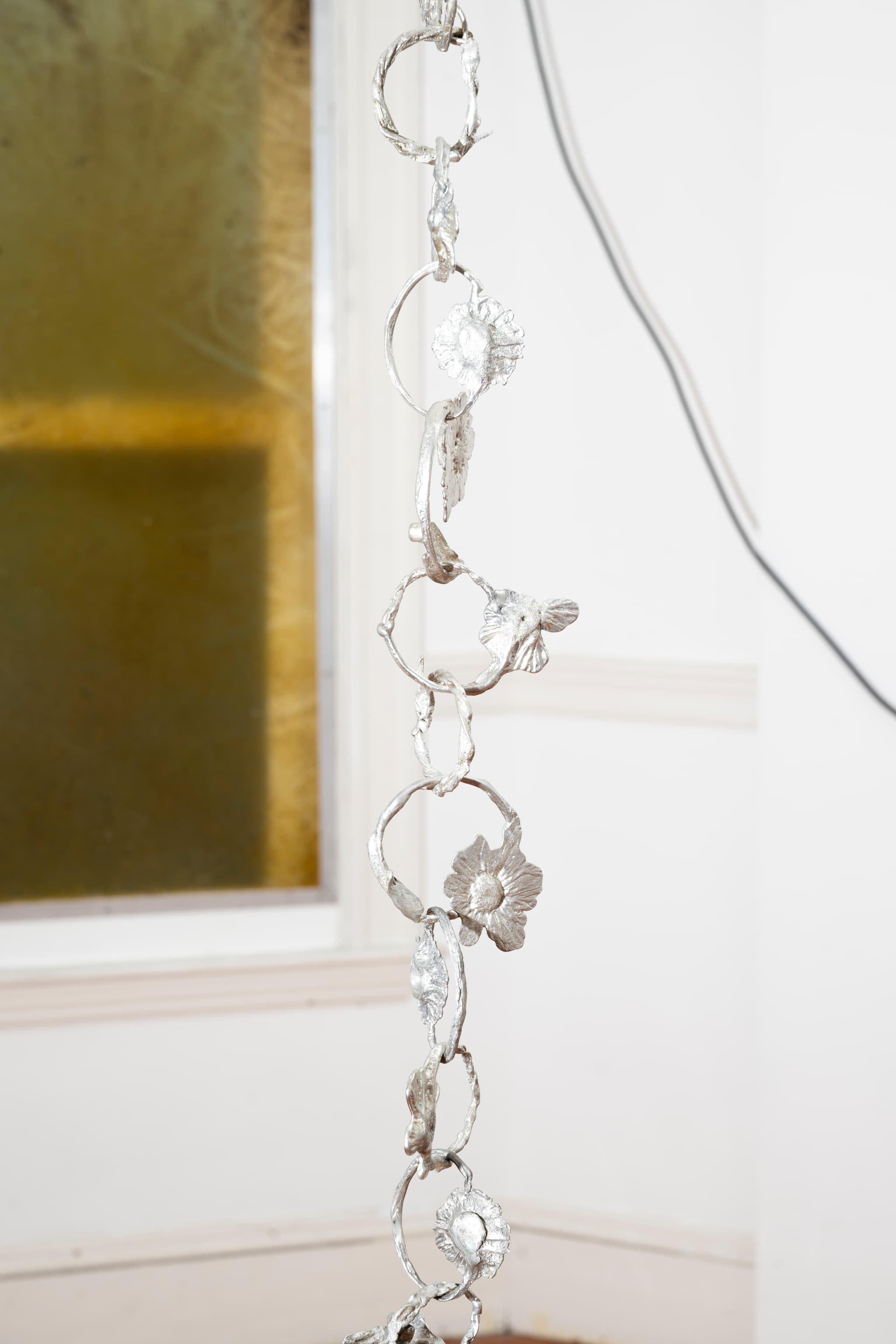
Maggie Wong, Grounding Cord, detail, 2025. Cast and soldered pewter. 3.5 in. x 3.5 in. x 9 ft., dimensions variable with installation of single casts or small links. Photo courtesy of deiner gallery.
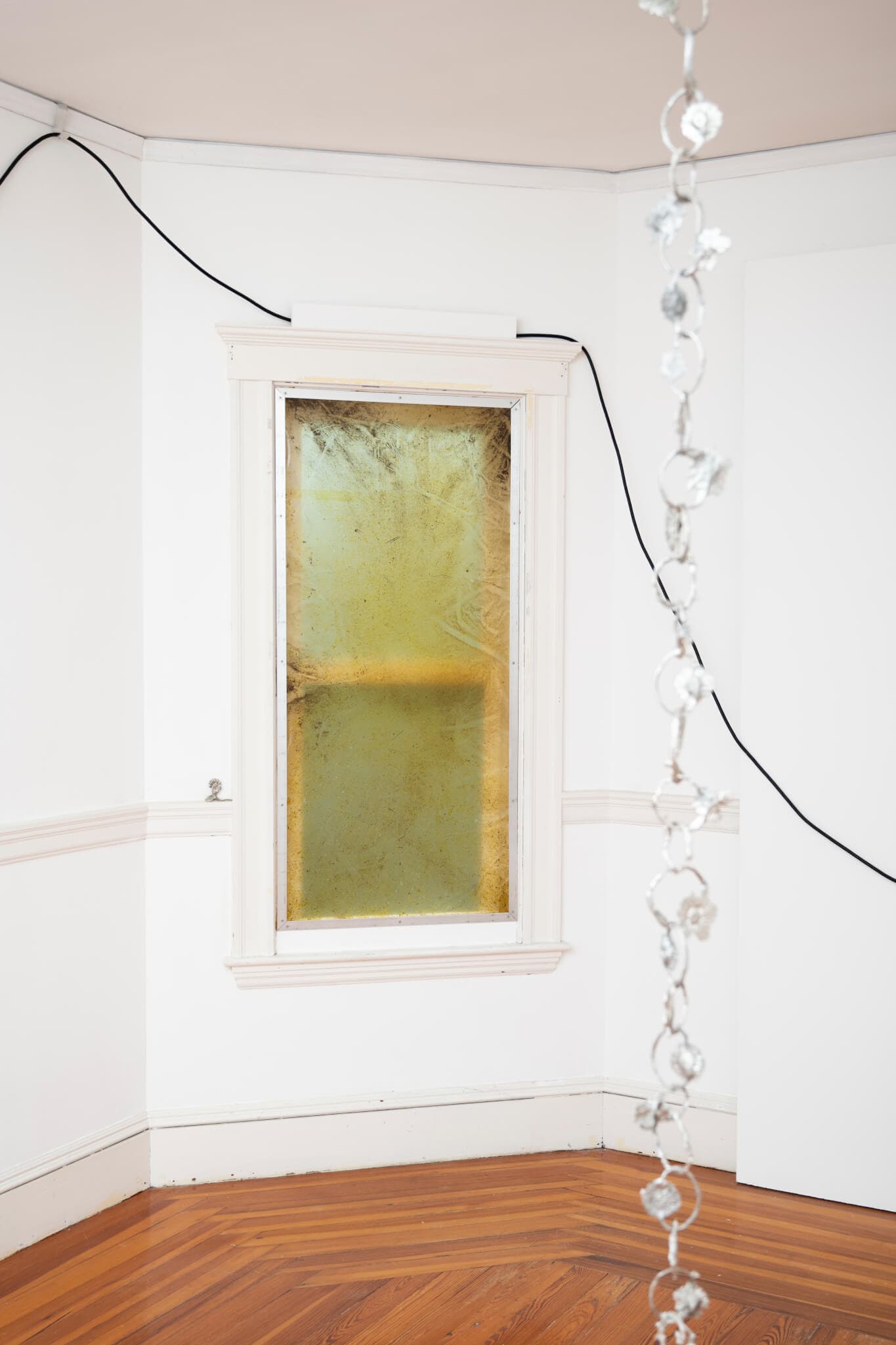
Installation view, Ena Kantardžić and Maggie Wong, “hope of suggestion,” deiner gallery, 2025. Photo courtesy of deiner gallery.
Maggie Wong’s sculpture Grounding Cord (2025) is the show’s centerpiece: a chain of pewter-cast daisies dangling delicately from the ceiling to the floor. Wong used sand molds to create burnout casts of each daisy, leaving behind a “ghost” of the flower for the liquid pewter to fill. Wong’s practice is typically very research-based, as exemplified by Volume 15 of her Unity Newspaper risograph series, also exhibited in the gallery. In between the slow, rigorous work of archival research, original reporting, and designing the publication, Wong found a reprieve in the sculpture, gradually adding new segments to the chain over time. Glinting in the golden light of Kantardžić’s works, the piece is enticing but also a bit foreboding, evoking barbed wire and the feeling that it could prick you if touched. As I watched it sway gently like a pendulum across the floor, I could almost feel the earth moving.
Turning to one of the nooks in the room, I notice a fresh flower emerging from a pipe embedded in the wall. This piece by Wong—an auxiliary “Easter egg” resulting from the artists’ conversations while preparing the show—is inspired by Bernie Boston’s Flower Power photograph, which depicts a peaceful protester at the 1967 March on the Pentagon placing flowers in the barrels of soldiers’ rifles. In this current moment of intensifying resistance and protest, this gesture feels particularly beautiful and resonant.
But this exhibition is more than a sensory room of springtime delights. It’s a call to embrace the slow burn and to soak up the quiet beauty of experience. Daffodils, I learn, are fleeting—in the spring they are the first to bloom, and the first to go. “hope of suggestion” wrestles with these temporary bursts of beauty, all-consuming yet somehow just beyond our grasp, but forever in our memory—the feeling of the sun on your skin; the embrace of a loved one; the smell of spring. Kantardžić and Wong’s attempts to preserve that beauty, that complexity, are extremely moving and dazzling. In this age of hyper speed and disconnection, there’s something to be said for slowing down and smelling the roses, as so elegantly exhibited in these artists’ practices and the show’s presentation.
“hope of suggestion” is on view at deiner until July 12, 2025 (by appointment only).