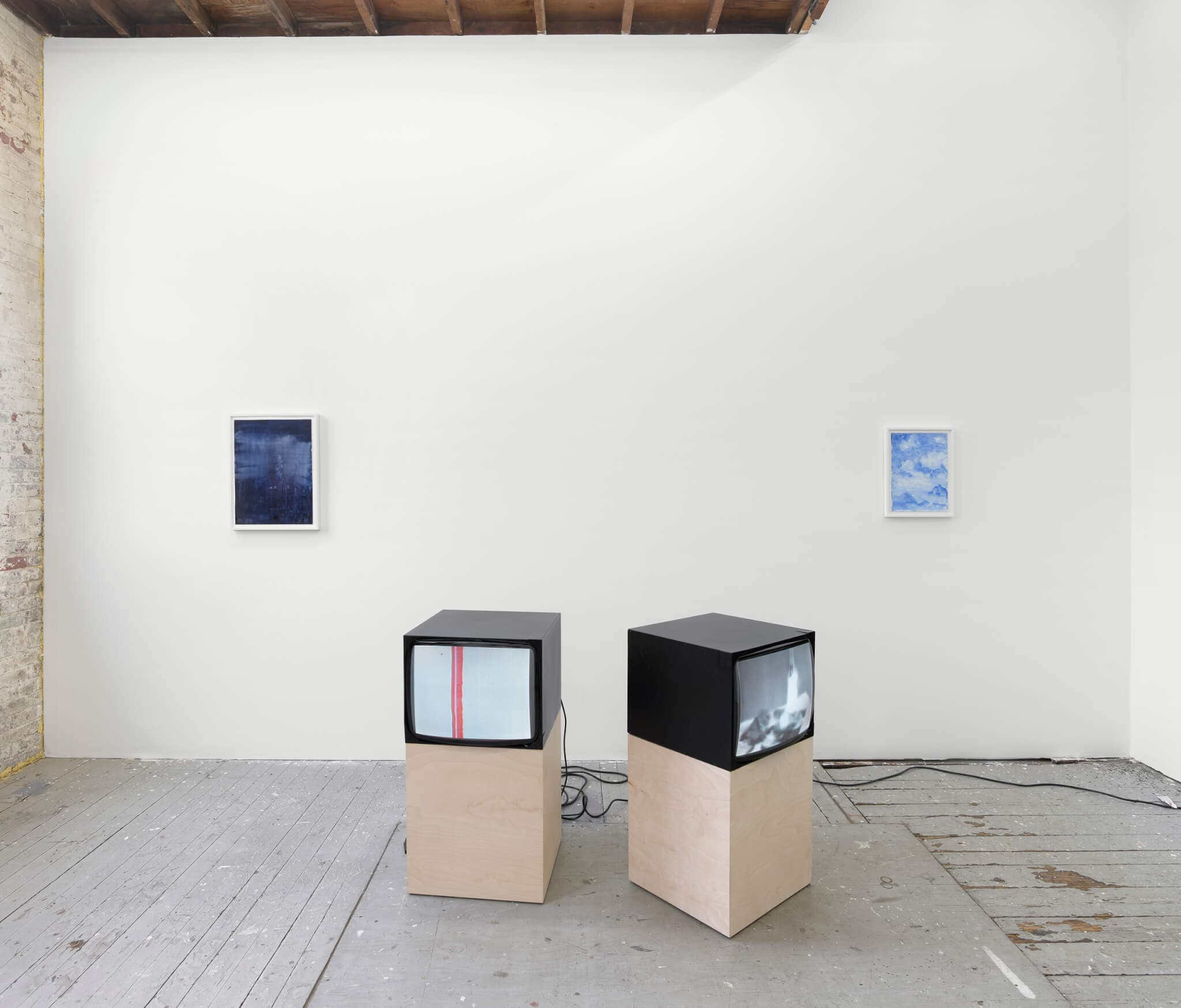
Eight years ago, Suara Welitoff’s last exhibition at Anthony Greaney included a print of a gloomy sky facing the narrow entrance of the gallery. In her return to the space with “Tonight the Sky,” a hazy, uneven field of clouds, laid in overlapping washes of blue watercolor, occupies that same position. I watched a visitor pause before the exact spot. Struck by the similarity, they asked whether the work had been shown before, then quickly exclaimed, “Ah, it’s all coming back to me now.” This tingling instance of déjà vu aptly registers within Welitoff’s ongoing treatment of time.
Images move through Welitoff’s work in successive acts of mediation. Working from a repository of fragments gathered largely from films, she gravitates toward oblique moments: tacit gestures, discrete objects, atmospheric passages, what appears as mere detail. Such moments seem to exceed their place within narrative, surfacing at the seams where linear sequence begins to loosen. The artist lingers precisely at these points, extending their presence across shifting formats and materials.
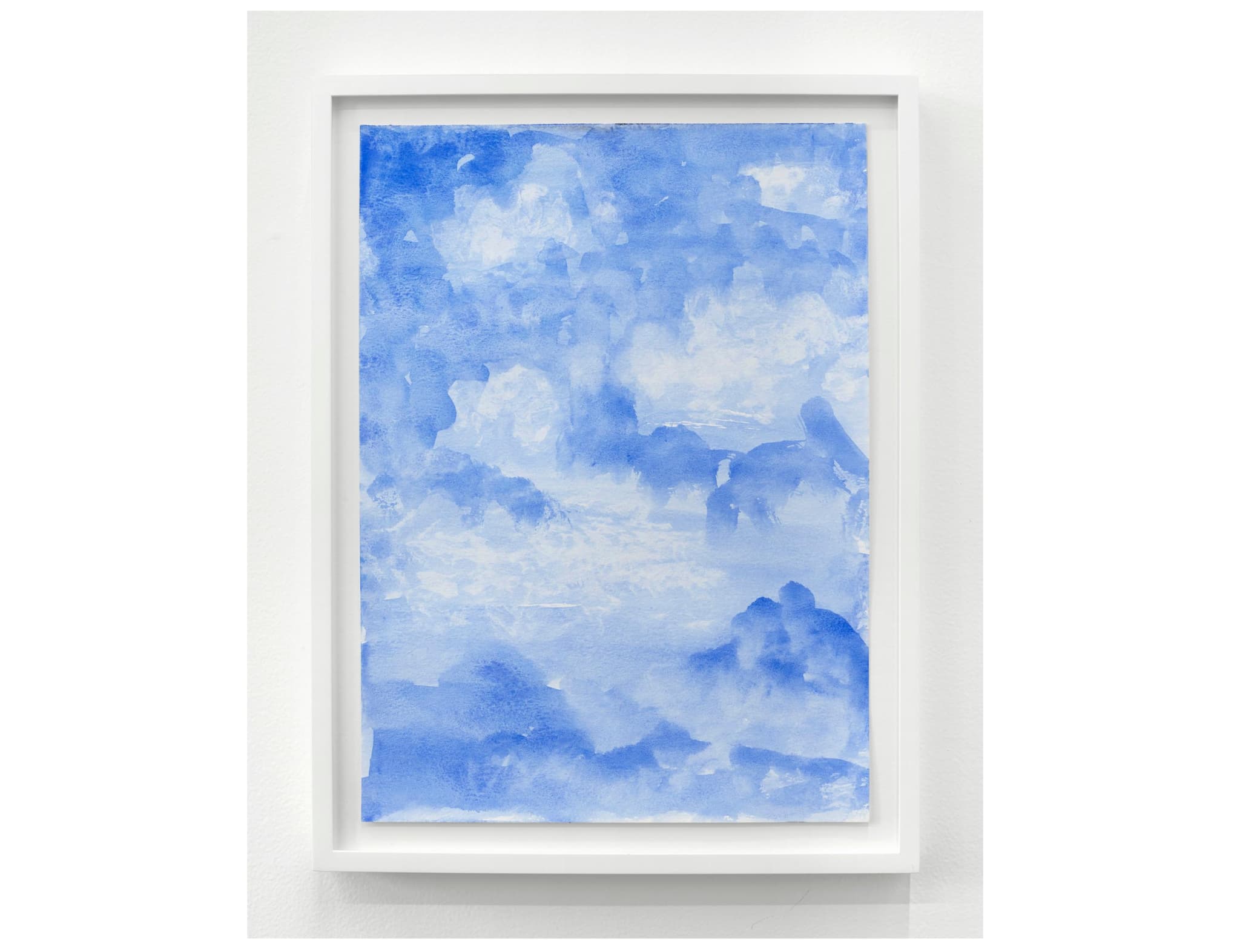
Suara Welitoff, There was a huge snow storm, C Akerman was there… we watched it pile up on the glass roof… people started pushing it over to one side and we could see the blue sky, 2025. Watercolor paint on watercolor paper, 14 x 11 inches. Courtesy of Anthony Greaney.
At the center of the gallery, two CRT monitors rest on low wooden pedestals. Facing outward, Still Life w Clouds (2025) extends a brief passage of blurred footage in which an arrangement of objects softens into ever-fading forms. The image captures a transient moment within a largely static composition—when a glimmer of sunlight intrudes upon the atmosphere, cutting through the center of the frame. Its tone slowly cascades between negative and positive values as the fragment is reconfigured and drawn into a continuous loop. This momentary flash is held open, suspended above any fixed tense.
Just beside it, Fountain (2025) shows a vertical red streak, sliding off center in a fragile stream. The image reveals a length of Super 8 film leader—the blank strip at the beginning and end of a reel used to protect the film’s surface. When projected, the leader marks the intervals before and after the image appears—its limits. Detached and placed in a continuous loop, the work displaces the leader’s technical function and extends it into an open structure, rendering an interval visible both as subject and as material trace.
On the gallery’s far wall, Already Two (2025) enters the unstable domain of language. Extracted from a Godard film and reassembled by the artist, the text appears two words at a time: “Already Two / Two Years / Years Earlier.” The sequence forms a looping chain, with the second word in each pair carried over into the following unit. Meaning is generated at the threshold between phrases as the progression rhythmically forms an ambiguous syntax. The specificity of a temporal span (two years) opens into indeterminate relations (years earlier), drawing out the volatility inherent in the representation of time.
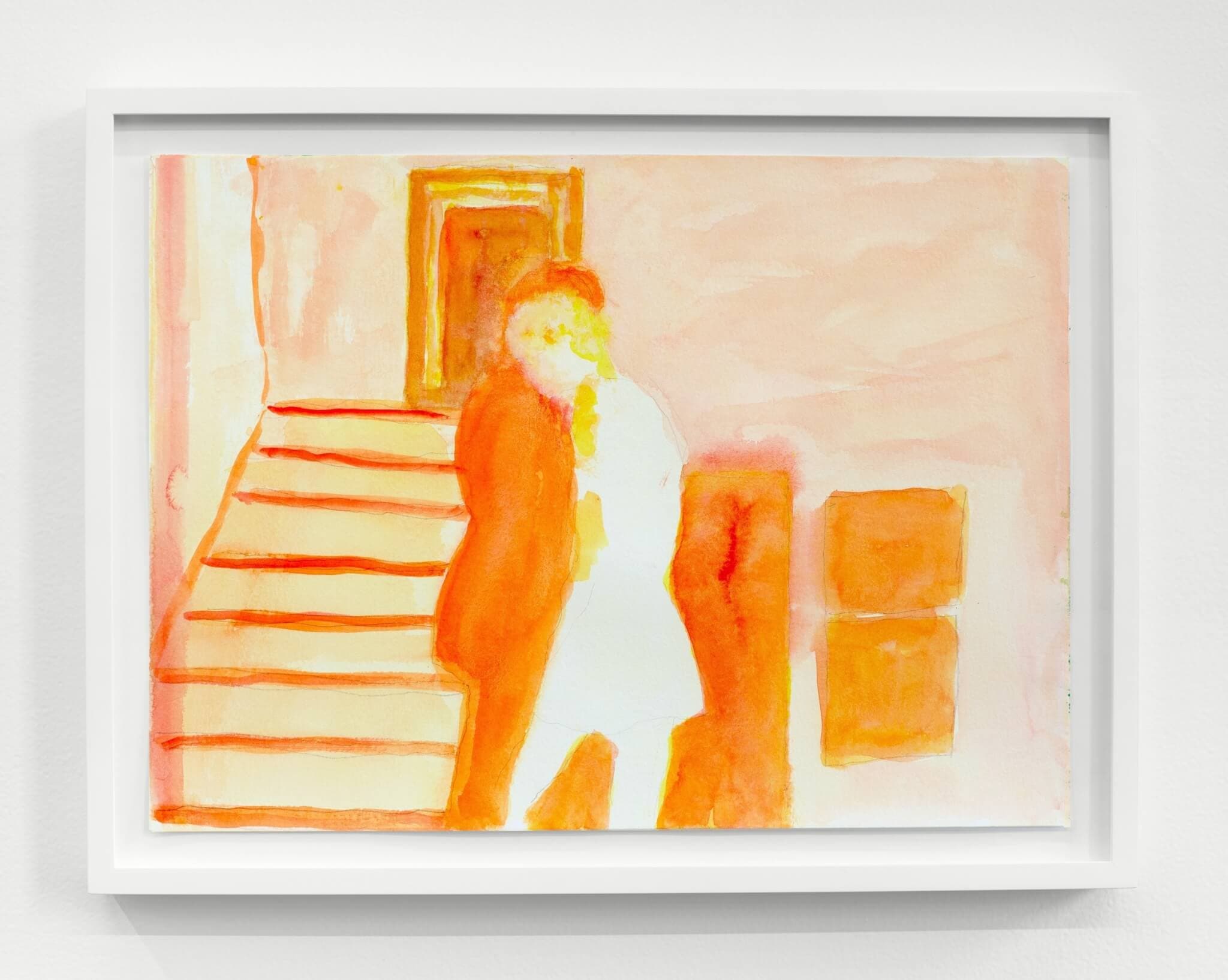
Suara Welitoff, I Watched the Sun Come Up, 2025. Watercolor paint on watercolor paper, 11 x 14 inches. Courtesy of Anthony Greaney.
I Watched the Sun Come Up (2025), a bright watercolor, sits across the room in near isolation. It depicts two figures in tender proximity, one seeming to rest their head on the other’s shoulder. Drawn from a Fassbinder film, the image was previously transformed by Welitoff in her video Everything is Different (2017), where the clip was filtered through a blazing distortion of orange and pink. Returning yet again, the image is reworked through the fragile composure of the medium—where edges fail to come into definition and each brushstroke indexes a visible gesture. Rendered still in luminous shades of orange, the image quietly pulses. A cognitive lapse occurs as we stay with it. We are left with pure sensation, responding to a shifting cadence, feeling the weight of an intimate touch.
Moving through the slips of art historical association, it is difficult to encounter Welitoff’s work without recalling the artists who, beginning in the late 1970s, turned to the appropriation of “pictures” and their systems of representation. Considered along this lineage, her work reorients the conditions of reception—expanding, contracting, and revealing the temporal structure between an image and its arrival at signification. In “Tonight the Sky,” affect spills through the edges of comprehension.
“Tonight the Sky” was on view April 4–June 6, 2026, at Anthony Greaney, 438 Somerville Avenue, Somerville, MA.