Viewing “Lucy Raven: Rounds” at the ICA Watershed in East Boston, open through September 27, begins and ends with water. Transported across Boston Harbor using the ICA’s water taxi, I was initially inattentive to the material and structural composition of the harbor, perhaps even ignorant to its histories of industrial development and subsequent environmental collapse and renewal.
But the role of human intervention in the landscape and the shaping of waterways, specifically in the American West, is the central theme of the current installation at the ICA’s seasonal outpost. Immersive yet minimal, “Lucy Raven: Rounds” transforms the industrial space of the Watershed into a cavern of moving image and sound centered around two large-scale multimedia works: the kinetic sculpture Hardpan (2025), which makes its US debut here, and the moving-image installation Murderers Bar (2025).
Situated just beyond the gallery entrance, Hardpan is a first and striking encounter. A colossal aluminum drum containing a spinning motorized arm holding an LED light, Hardpan resembles something between a mechanized lighthouse beacon and a mysterious scientific experiment, radiating an intense rush of air and flash of light that pulsates through space, creating a kind of industrial echo chamber.
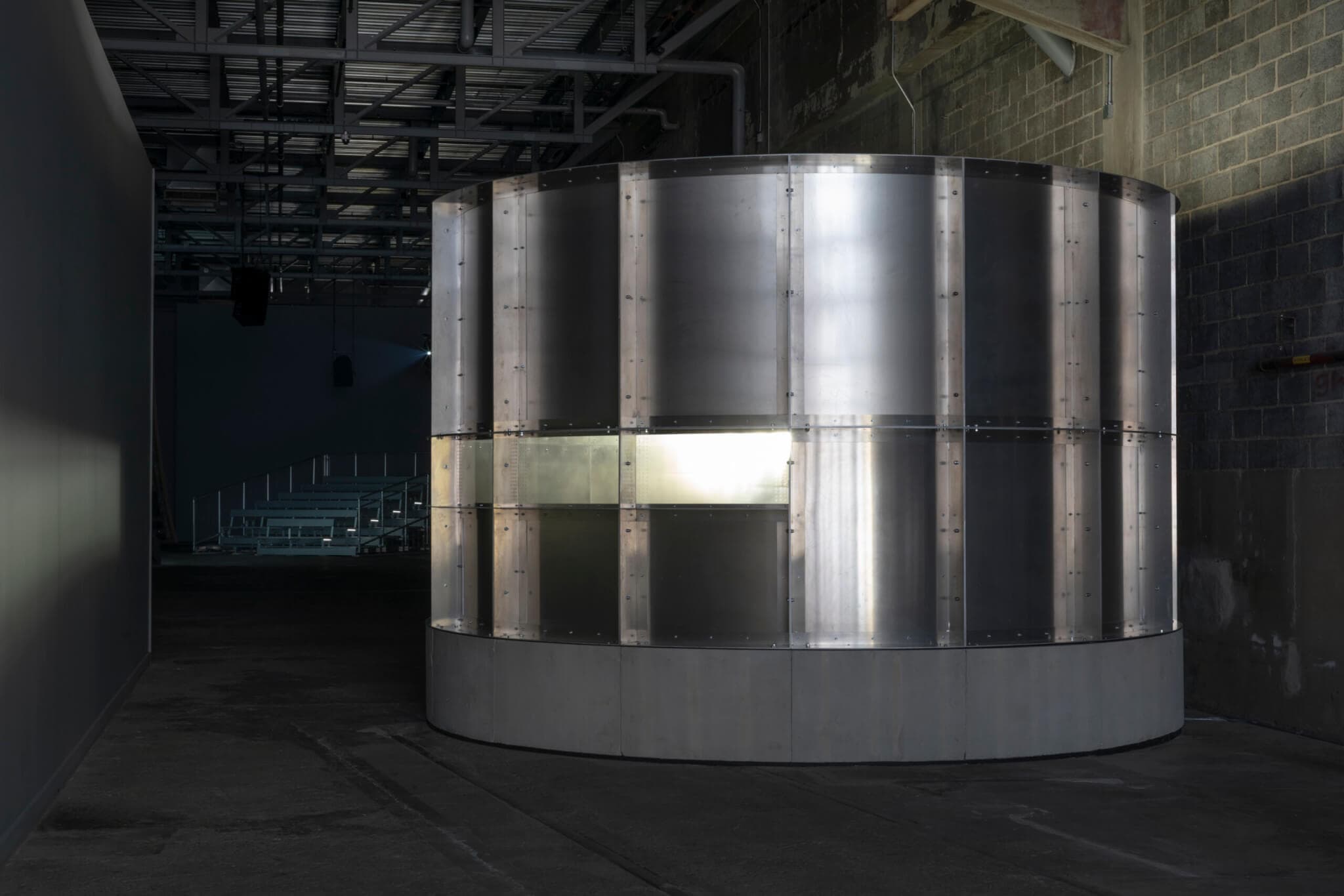
Installation view, “Lucy Raven: Rounds,” the Institute of Contemporary Art/Boston, 2026. Photo by Mel Taing. Courtesy of the Institute of Contemporary Art/Boston.
While Hardpan forcefully controls and displaces air, Murderers Bar, the final installation in Raven’s series The Drumfire (2020–25), explores the control and displacement of water. Over the three films that make up The Drumfire, Raven investigates how matter under pressure and force transforms material. In other words, how natural and man-made forces convert material from one state to another, such as from a liquid to a solid. Narratively, Murderers Bar traces the historic removal of Copco 1, one of four dams demolished between 2023 and 2024 along the Klamath River, which runs from Oregon through Northern California. From 1902 to 1962, a series of six dams were constructed on the Klamath to provide hydroelectric power and irrigation to the growing population and industry in the region. As much as the dams facilitated the expansion of agriculture and commerce, their construction also came at a cost. The dams decimated the salmon populations and the health of the river, harming the lifeways of the Yurok, Karuk, Klamath, and Hoopa tribes that rely on the river’s resources. Native activists and local governments eventually and successfully pushed for the dams’ removal.
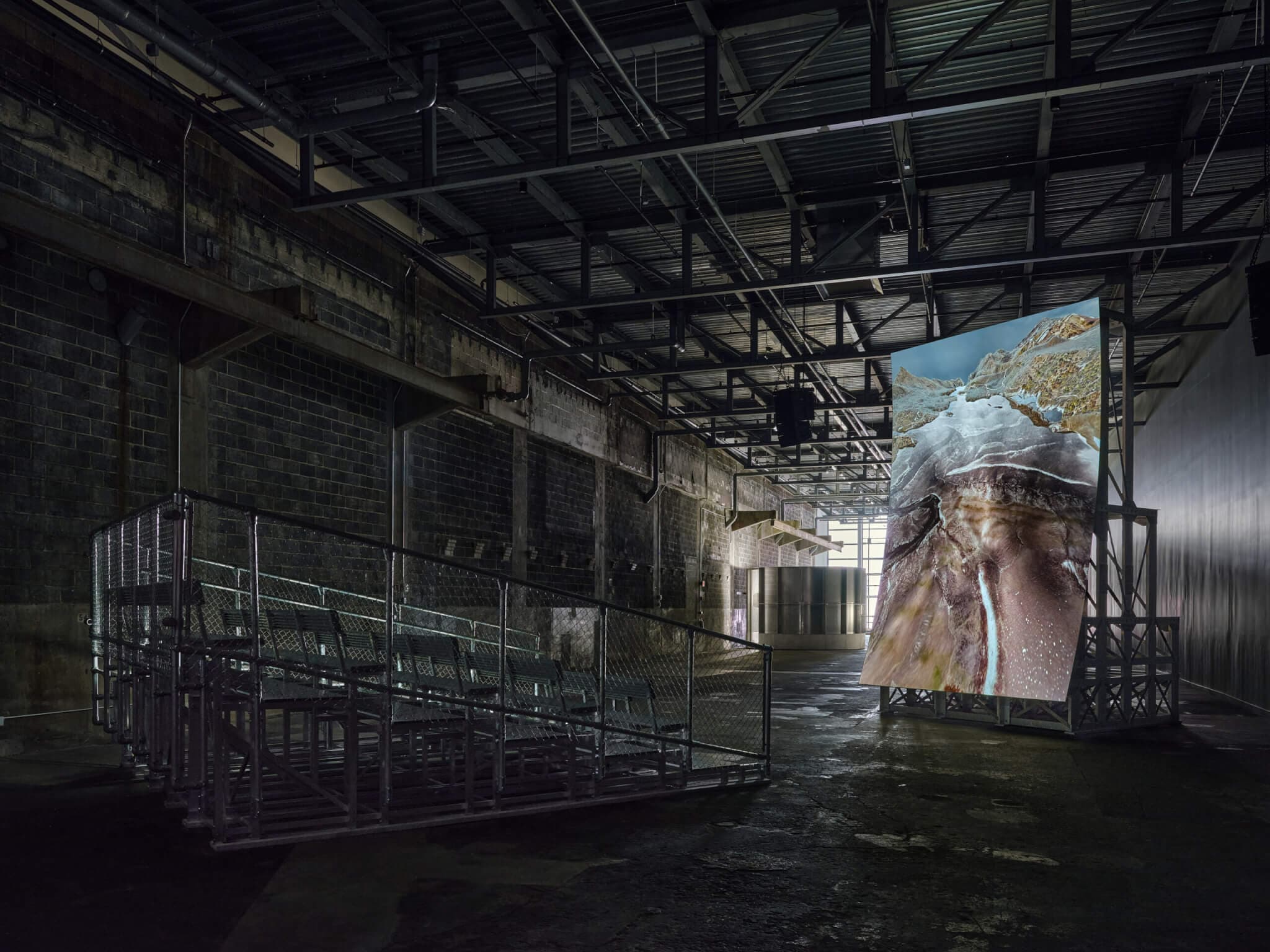
Murderers Bar is projected onto a large, free-standing screen that curves forward at the top and bottom, functioning as both a sculptural object and a two-dimensional surface. Its portrait orientation functions mimetically, nearly mirroring the vertical contours and scale of the Klamath. The screen is accompanied by metal stadium-style seating, reminiscent of that used in sporting events or theme parks, and viewers contribute their own industrial acoustics as they step, walk, and shift in their seats. If immersive viewing is popular in commercial contexts (such as in IMAX or drive-in movie theaters), Raven uses strategies of cinematic spectacle to intensify the film’s narrative and visual effects. The monumental scale and bend of the sculpture-cum-screen is imposing, a feeling that is amplified by the reverberation of sound generated from the film’s soundtrack by Raven’s longtime collaborator, Deantoni Parks. Raven builds palpable tension by filming from above, using cameras attached to drones and helicopters. Unsteady bird’s-eye views and unstable horizon lines simulate the cinematic effects of horror and suspense films (Raven has stated in interviews that the opening sequence in Stanley Kubrick’s 1980 film, The Shining, was one inspiration). In dizzying fashion, Raven’s camera dives, dips, and glides over the varied surfaces of the water, as if from the point of view of the water itself, capturing the political, cultural, and ecological power of the river.
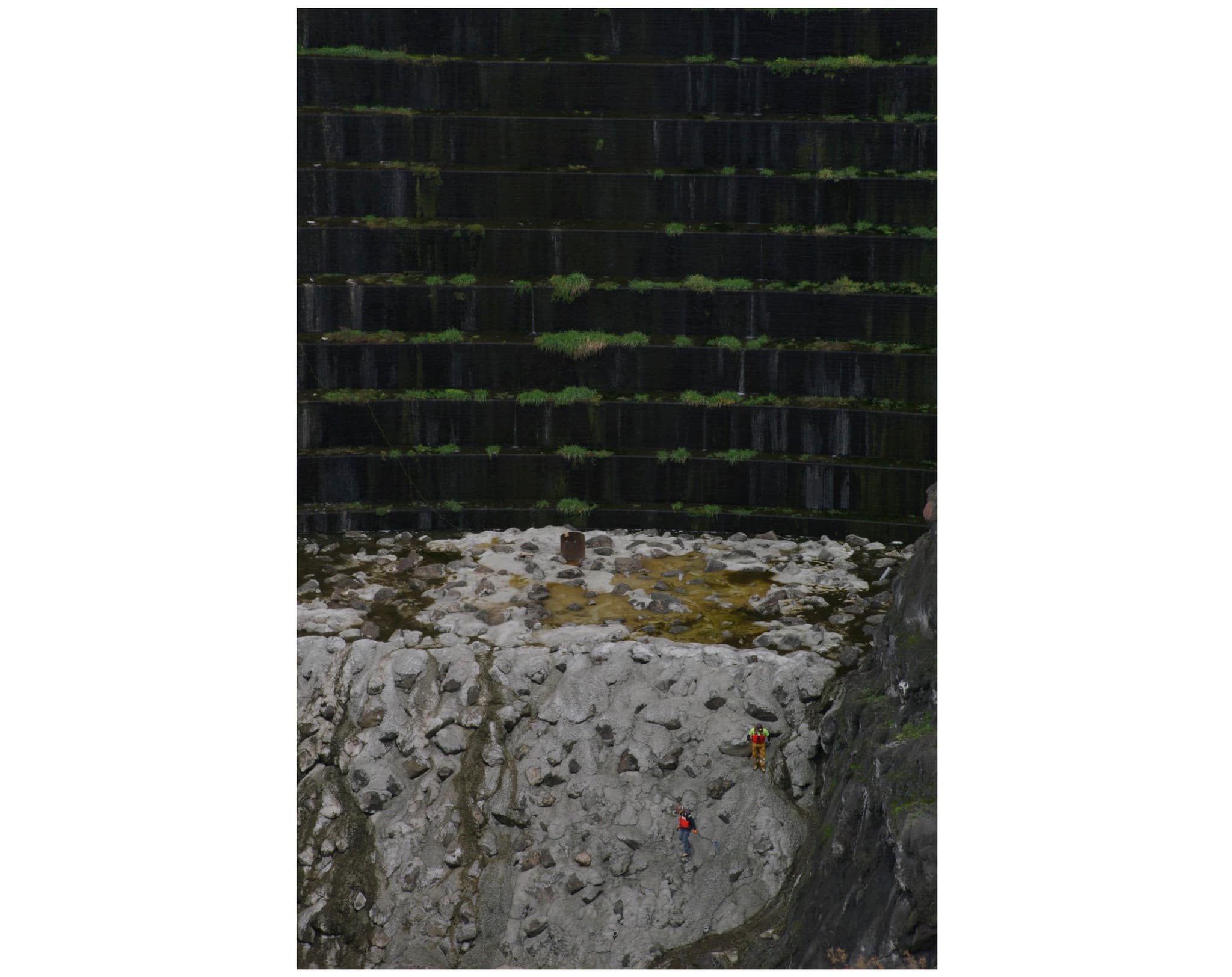
Lucy Raven, Murderers Bar (still), 2025. Video (color, quadraphonic sound; 41:40 minutes), aluminum and plywood screen, and aluminum seating structure. Courtesy the artist and Lisson Gallery. © Lucy Raven
Determining the start and end point of Murderers Bar is tangential to the installation’s overall sensorial experience. At certain points in the film’s continuous forty-two-minute loop, Raven flips the camera 360 degrees, tracks back, changes from color to black and white, disorienting our sense of figure and ground, history and time. In one sequence, the camera hovers above the filled reservoir behind the dam, eventually passing over Copco 1, a mammoth stone structure materializing on screen like a relic of a lost civilization. The immense scale of Copco 1 contrasts with the detonation crew, who appear in a brief moment as miniature figures atop the large concrete structure, before we are given a first-person perspective of the placement of dynamite in the dam’s tunnels. The sudden blasts of explosives release a rush of water and nearly a century’s worth of silt and debris rapidly refills the Klamath’s rocky bed. Jump cuts and aerial footage follow the river downstream, revealing the various colors and textures of the replenished river that is quite painterly in appearance. This sequence is accompanied by thunderous sounds scored by Park, as the explosive reach of the released water reverberates downstream. The river finally meets the ocean, and the camera unexpectedly widens into an abstract expanse of open water. The film then flips again. We are now following the river at close range, dipping and diving, as if from the perspective of the salmon retracing their path upstream. Finally, we encounter the drained reservoir, an alien and deformed landscape left behind.
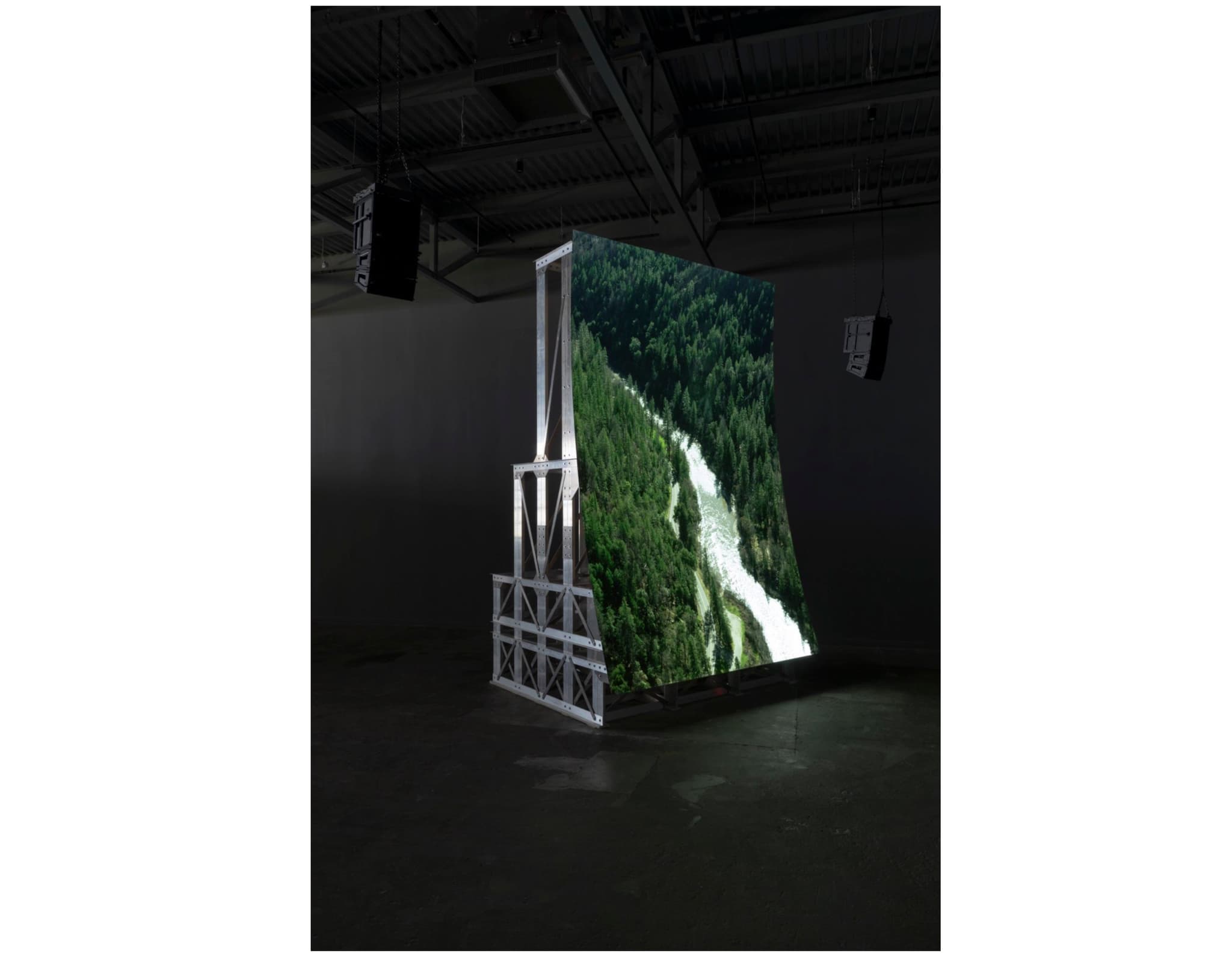
Installation view, “Lucy Raven: Rounds,” the Institute of Contemporary Art/Boston, 2026. Photo by Mel Taing. Courtesy of the Institute of Contemporary Art/Boston.
Art history is rich in expansionist ideologies and mythologizing representations of the American West. I think of the nineteenth-century Hudson River School painters, who illustrated westward movement and ideologies of Manifest Destiny through juxtapositions of untamed nature and cultivated terrain. Photographic and cinematic depictions of the West in the first half of the twentieth century, from Western film genres (from which Raven also takes inspiration) to photographers like Ansel Adams, captured the supposed uninhabited and pristine vastness of the Western landscape. While Murderers Bar doesn’t directly quote art history, Raven’s cinematic approach is certainly conversant with aestheticized, visceral, and even painterly representations of the Western landscape, such as in the sequences that trace the path of the renewed, flowing river like a line rendered across a canvas. But Raven is deeply attentive to historical contexts; the title Murderers Bar, for example, is said to refer to the Gold Rush-era camp where violent conflicts took place between white settlers and Indigenous peoples. While background knowledge facilitates entry into the work, it is not essential to its viewing. Raven’s scenery is seductive and she builds her narrative arc via visual metaphors related to changes in material states—water builds and is forcefully released, cement explosively disintegrates and becomes powder. Concepts of pressure and release, which also stem from the fields of physics, thermodynamics, and geology, are central to Raven’s, as well as our understanding of how years of industrial exploitation and human intervention have dramatically altered the composition of the American West.
Returning on the water taxi to the ICA after my visit, I purposefully reflect on local histories of water, industrial exploitation, and renewal efforts, such as the Elm Street Dam removal and restoration project in Kingston, MA, in 2019. Out on the water, I also consider Boston Harbor itself, the connection point between the museum and outpost, and the cleanup effort in the 1980s after decades of neglect and pollution. As the title alludes, “Lucy Raven: Rounds” reminds us, beautifully and viscerally, that we cyclically create and destroy, and although work is done to correct the past, we could, at any time, flip backward and find ourselves fighting upstream again.
“Lucy Raven: Rounds” is on view through September 27, 2026, at the ICA / Watershed, 256 Marginal Street, East Boston.