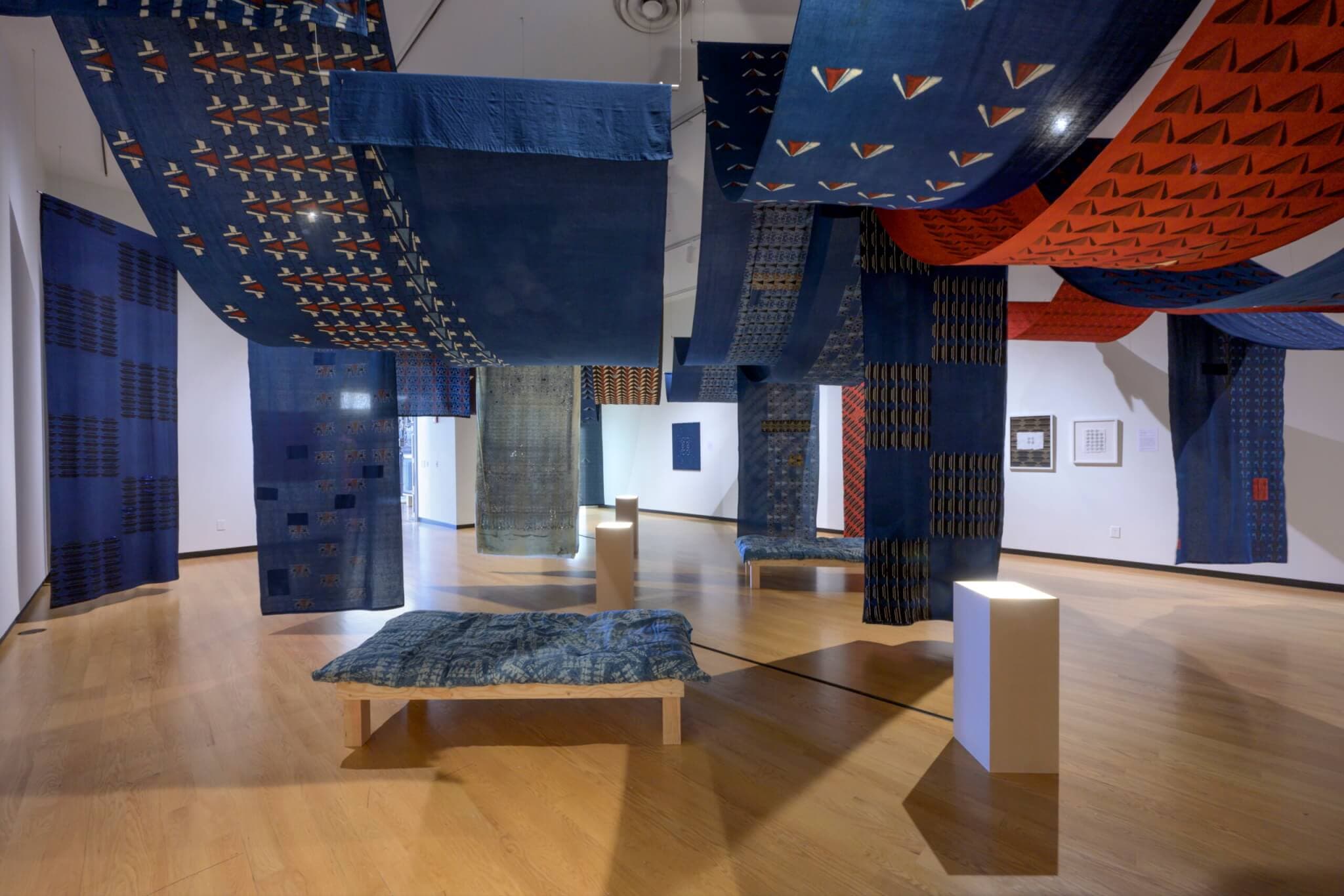
When you enter “Swapnaa Tamhane: Spaces That Hold,” curated by Siddhartha V. Shah and on view at the Mead Art Museum, you are invited into a space, a structure, a place. The implied fabric structure is constructed from multiple suspended ajrakh textiles—long yardages of block-printed fabric featuring geometric patterns and natural dyes. The form of the shape created via the fabric itself evokes the domestic, with its pointed roof and allusions to rooms or room dividers, yet it transcends the home through the austere nature of the space and the quietude of the museum, suggesting instead a sacred environment.
Museums are often quiet, but the installation Mobile Palace (2021–2022) feels particularly hushed. The scale of the structure and the way it filters the gallery’s lights contribute to this reverent atmosphere. Underneath, two simple bed-like benches appear both inviting in their simplicity and sculptural in their restraint. Three pedestals emit soft light upward, illuminating the fabric while also evoking the spiritual aspects of both making and witnessing art.
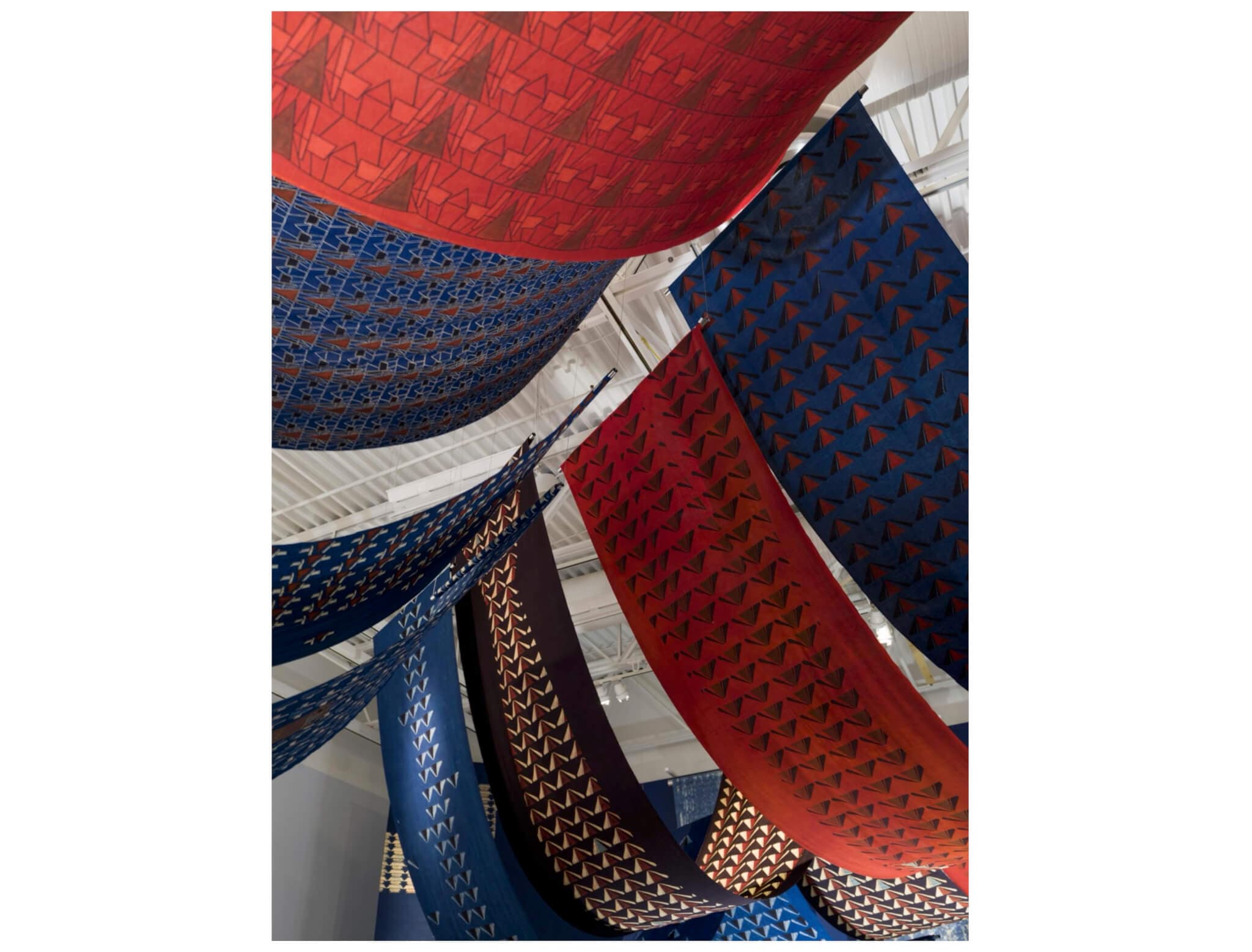
Swapnaa Tamhane, Mobile Palace, detail, 2020–2021. Block print on mill-made cotton, beading, appliqué. Made with Salemamad Khatri and Mukesh Prajapati. Photo by Dennis Ha. Courtesy of the artist and the Mead Art Museum.
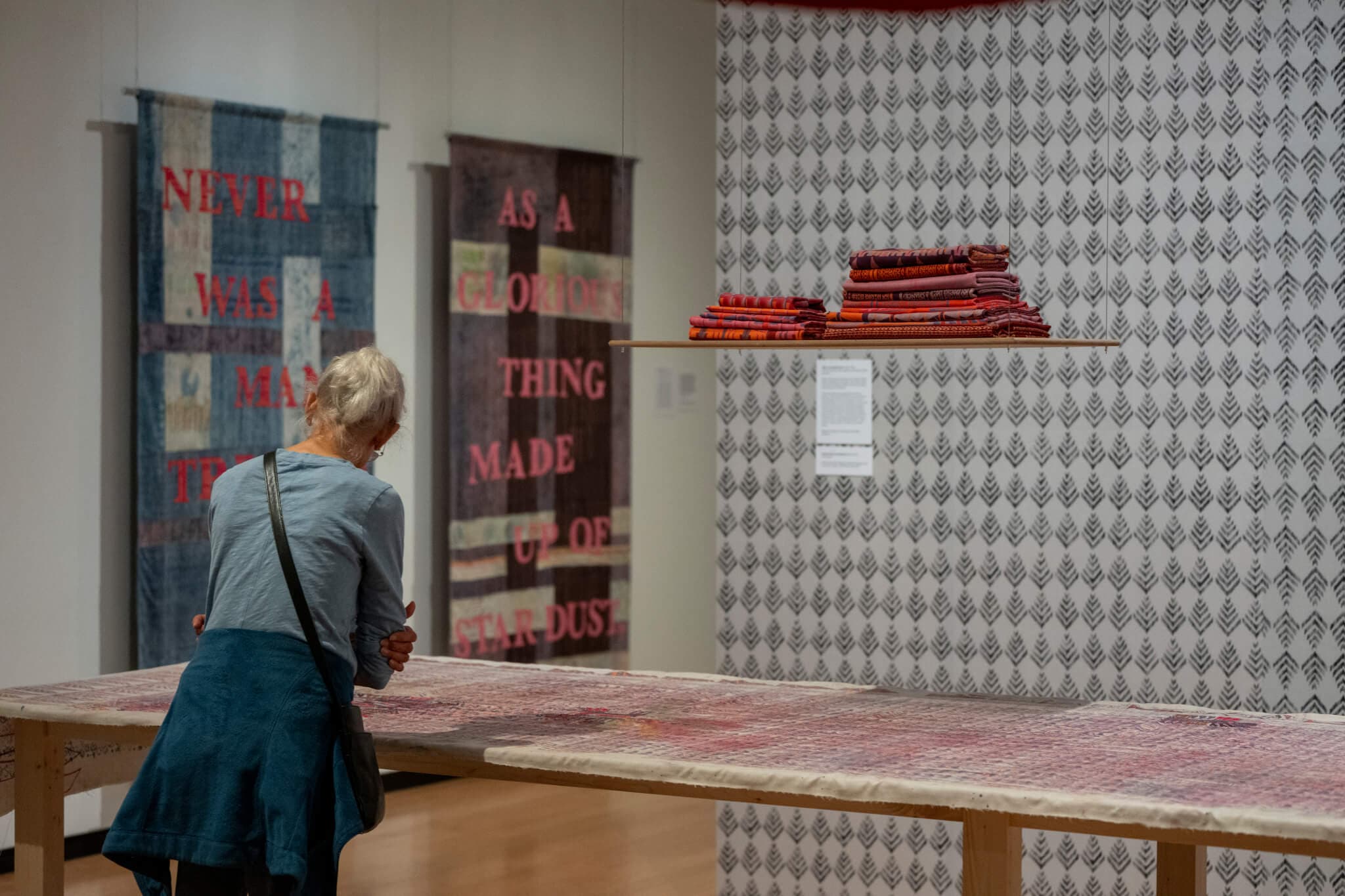
The fabric’s bolt-like scale, at approximately twenty-three feet long, evokes industry, while the decorative quality of the motif on the repeating indigo and red patterns recall domestic objects such as pillows or curtains. At the same time, the block-printing technique asserts the handmade, placing craft in direct conversation with these other associations. Across the exhibition, these layered spaces—the sacred or spiritual, the industrial or industrious, and the domestic—intersect through the fabric’s materiality and the forms it assumes. Consider Never Was a Man (2025), two twin-sized quilts bearing appliquéd text that reads “Never was a man treated as a mind” and “As a glorious thing made up of stardust.” The wall text reveals these as quotations from the suicide note of student Rohith Vemula, whose death brought caste-based discrimination in the Indian university system to international attention. Much of Tamhane’s work engages with the hierarchies and caste structures of her Indian ancestry. Born in Canada in 1976, yet culturally connected to India, she brings both an insider’s and outsider’s perspective. While her references are grounded in Indian history, the inquiry reaches further, examining broader systems of hierarchy: craft and industry, power and disenfranchisement, lineage and labor.
To the left of the main fabric installation—which occupies about three-quarters of the large gallery—is another installation, When was Modernism? (2023–2024), which refers to a seminal text on Indian art by Geeta Kapur. This is centered on a long, simply constructed worktable that recalls the type you might find in a block printer’s workshop. On its surface lies an achadiya—a drop cloth used in block printing—yet this one is itself printed with a repeating pattern based on the Mill Owners’ Association Building (a modern structure designed by Le Corbusier in Ahmedabad, India), juxtaposed with hand-embroidered and appliquéd motifs from the semi-nomadic Rabari community of western India. This combination compresses time, culture, and process. The cloth covers the tabletop precisely, without overhanging, emphasizing function over decoration. Beneath the table, neatly folded green cloths and a selection of wooden blocks used in the printing process rest on two shelves.
Installation view, “Swapnaa Tamhane: Spaces That Hold,” the Mead Art Museum, Amherst, MA, 2025. Photo by Shane Corcoran. Courtesy of the Mead Art Museum.
Suspended above one end of the table is a shelf—domestic in scale—holding several folded red fabrics. These appear printed but unfinished, as if waiting for the hands that will embroider and embellish them in keeping with ancient traditions. Nearby, wallpaper printed with a small, repeated drawing extends this visual rhythm across the adjacent wall.
In a neighboring gallery with dark gray walls, Surface Embellishment I and II (both 2024), composed of handmade kala cotton paper, hang suspended diagonally from the ceiling. Their textures and embedded mirrors catch the light, reflecting it outward like fragments of the cosmos. This motif repeats throughout the exhibition—mirrored surfaces appear in one of the large textile panels and in two embroidered works that, at first, seem purely decorative. Wall text reveals that these mirrors are based on aerial photographs of a village in Kutch renowned for its embroidery and handicraft traditions.
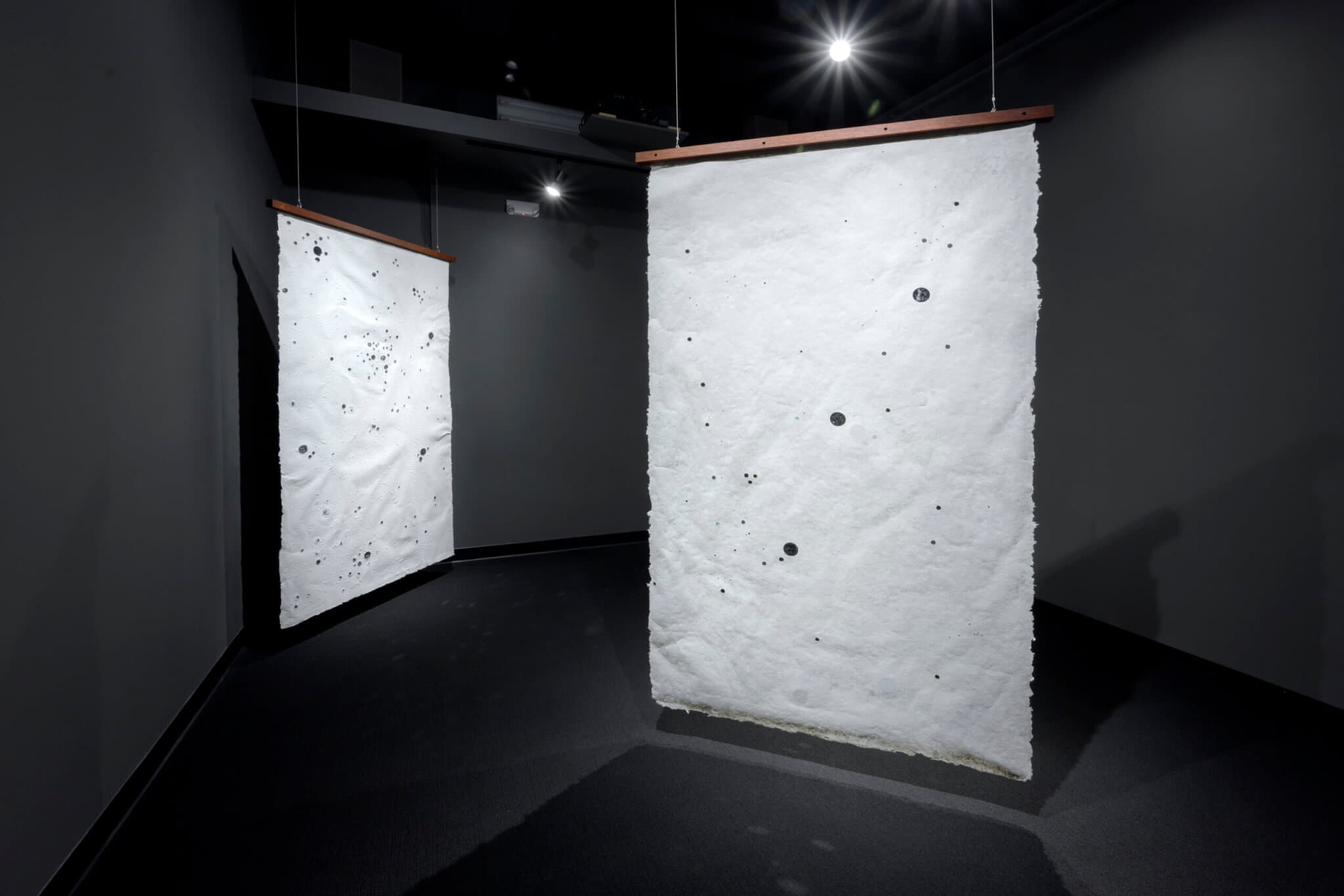
Swapnaa Tamhane, Surface Embellishments I and Surface Embellishments II, installation view, both 2024. Installation view, “Swapnaa Tamhane: Spaces That Hold,” the Mead Art Museum, Amherst, MA, 2025. Photo by Stephen Petegorsky. Courtesy of the Mead Art Museum.
Returning to the main gallery, a series of drawings from different bodies of work are displayed. The most striking is Mother Goddess (Mountain) (2024)—a monumental drawing based on a bronze artifact, dated between the thirteenth and fifteenth centuries BCE, rendered in hues echoing the natural dyes seen throughout the exhibition. Nearby, smaller graphite drawings from the series Maker Unknown (2024), based on images from Prithvi K. Agrawal’s 1977 book Early Indian Bronzes, are beautifully rendered but feel more like studies or reproductions; they lack the transformative touch that animates Tamhane’s other works.
At the far end of the gallery, the Rotherwas Room—a wood-paneled space reminiscent of a study—acts as a quiet respite. Here, Fred Wilson’s permanent chandelier installation Dramatis Personae (2022) provides a poignant counterpoint to Tamhane’s investigations of power and hierarchy. Beneath Wilson’s chandelier made of white and black glass, exploring the European construct of the idea of the “moor” or “black oriental,” sits Do Hands Have a Chance? (2023), a bright tent structure inspired by traditional sun umbrellas. The tent’s open doorway invites viewers inside, where a single bench and a set of headphones wait. The recording features Tamhane reading a text about the role of the hand in systems of labor and value. The tone of the reading is measured, even distant, yet the closing line—also quoted elsewhere in the gallery—resonates deeply: “We have always put the lower and higher skills in the same enclosure, so if we have to keep the scene going, we cannot do so by hitching them onto prevailing commercial trends. We shall have to make a more planned effort. Only then will hands have a chance.”
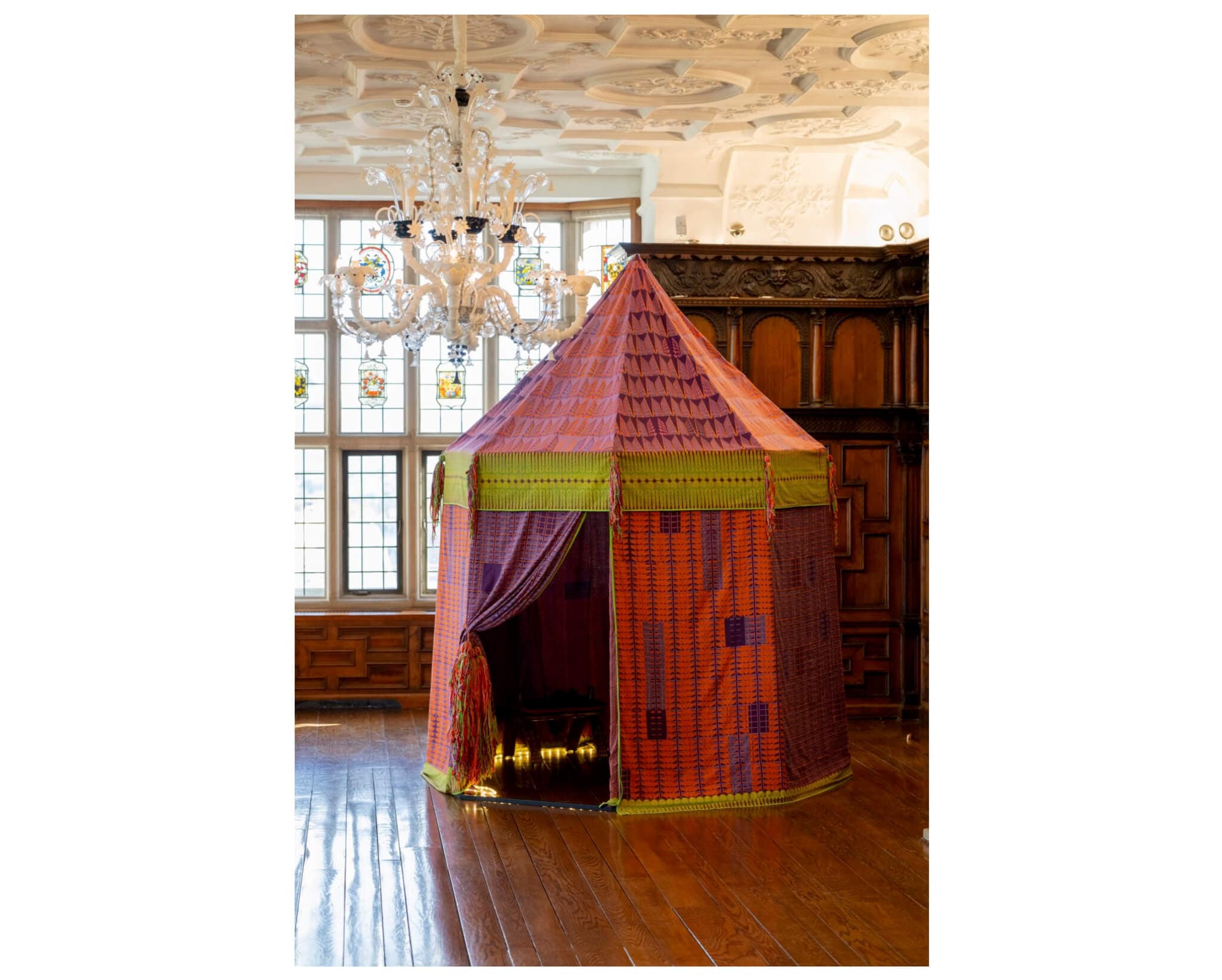
Swapnaa Tamhane, Do Hands have a Chance?, installation view, 2023. Installation view, “Swapnaa Tamhane: Spaces That Hold,” the Mead Art Museum, Amherst, MA, 2025. Photo by Shane Corcoran. Courtesy of the Mead Art Museum.
In a nearby, easily overlooked gallery that houses the museum’s permanent installation of Assyrian reliefs (883–859 BCE), Tamhane exhibits her work that explores jute production and its histories in India and Dundee, Scotland. Through printmaking and photography, the work highlights the labor of female workers, culminating in a grid of photo collages juxtaposing portraits of the women with jute fibers. For Tamhane, these unruly fibers symbolize resistance—a quiet protest against conformity and order. Like her own practice and the entire exhibition, they assert the power of craft and making as acts of both care and defiance.
“Swapnaa Tamhane: Spaces That Hold” is on view through January 4, 2026, at the Mead Art Museum at Amherst College, 41 Quadrangle Drive, Amherst, MA.