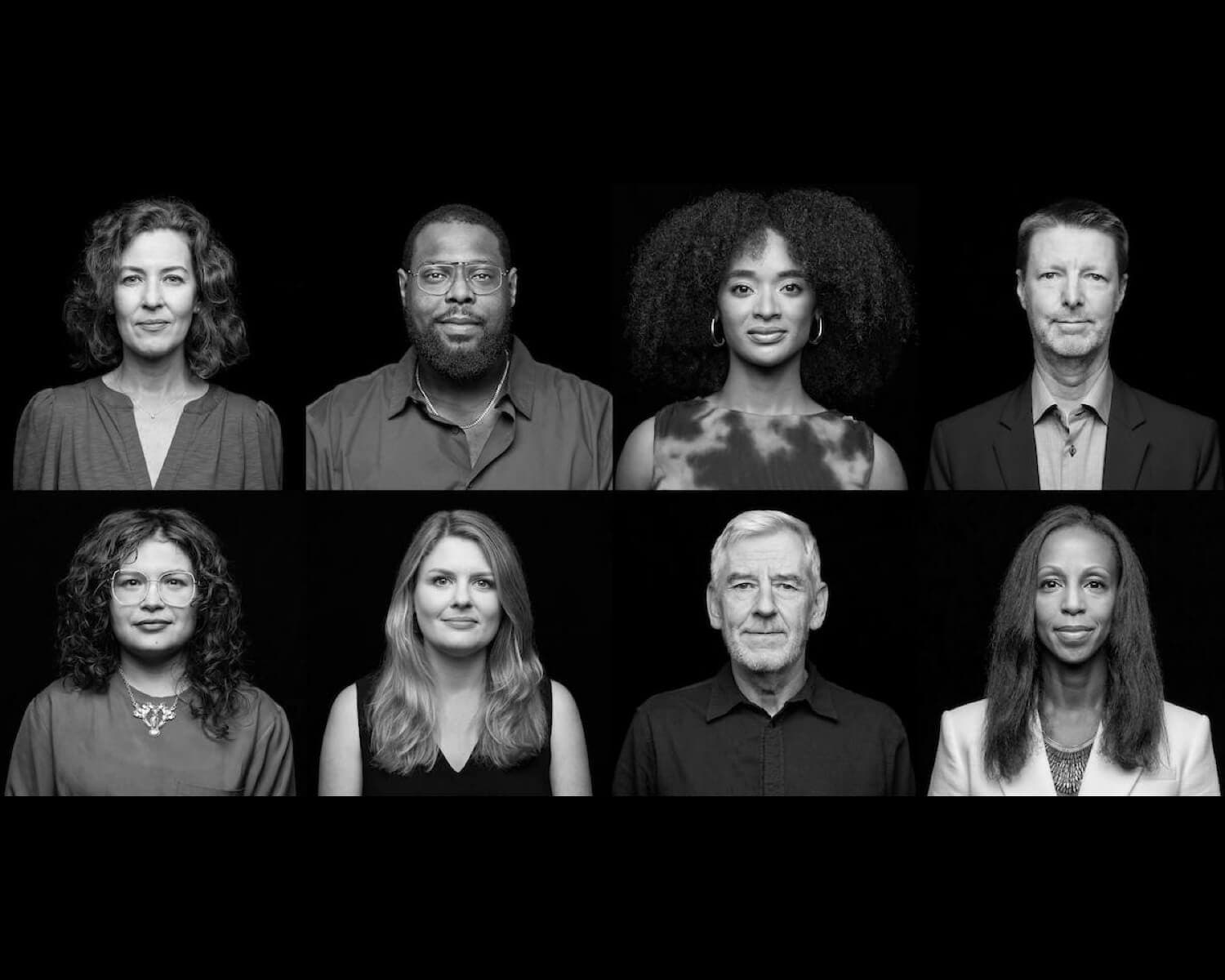
Portland, Maine, Sept. 10, 2026—Marking a decade of support for arts writers, the Rabkin Foundation has named its 2026 recipients of the Rabkin Prize, awarding eight visual arts journalists $50,000 each in recognition of their creative and intellectual contributions to the field.
The 2026 Rabkin Prize winners are: Damien Davis, an artist, educator, and writer whose work explores how power, race, and cultural narratives are constructed and circulated; Melaine Ferdinand-King, a cultural strategist, poet, and writer focused on historical and community narratives, and the inaugural curator of the African American Museum of Rhode Island; Tyler Green, a critic, author, and longtime host of The Modern Art Notes Podcast; Alicia Inez Guzmán, a critic and award-winning investigative journalist focused on culture and land use; Julia Halperin, a critic, editor, investigative data journalist, and co-founder of the Burns Halperin Report, which tracks equity and representation in the art world; Sarah Lewis, an award-winning author, associate professor of African and African American Studies at Harvard University, and founder of Vision & Justice, an initiative that reveals the role of culture in representational democracy; Jan Tumlir, an author, editor, educator, and founding editor of the Los Angeles-based contemporary art journal X-TRA; and Kaelen Wilson-Goldie, a journalist and critic with decades of international reporting experience who writes often about the relationship between art and politics.
This year’s prize winners are brilliant, world-building minds who are deeply interested in the forces that shape what we see—and what we don’t. Across a range of practices, they consider how art operates in the world, tracing its relationship to history, land, race, institutions, war, memory, and public life. At a moment when cultural narratives are intensely contested, these writers insist on close attention, deep research, complexity, independent thought, and a long view.
“History is the ground that we walk on,” Ferdinand-King says during her interview for this year’s Rabkin Interviews podcast. “It sets the conditions that art responds to. And art is where history and even identity and lived experience become legible, known to wider audiences.”
Guzmán similarly describes the broader forces she encounters through her cultural journalism: “When I’m writing about art, I’m very likely writing about histories of land use that are deeply tied to histories of colonialism … structures of power, state-sanctioned violence. How do all of those things come through in visualizations of landscape or of land across media?… What can this reveal to me that’s still a blind spot for me or for other people?”
Lewis, who describes cultural narratives as foundational to democracy, echoes that sentiment in her interview: “It was always going to take more than the work of laws to transform society. It was going to require the work of culture to push us past our blind spots.”
As is its tradition, the Dorothea and Leo Rabkin Foundation commissioned portraits of each Rabkin Prize winner in the spaces where they write and interviewed them about their work and ideas. Together, these portraits and conversations form a growing archive of arts writers and their thinking, documenting the field—and the cultural and political moment in which they are working—over time. The project, called the Rabkin Interviews, features conversations conducted by Mary Louise Schumacher, a journalist and the foundation’s executive director, and portraits by artist-photographer Kevin J. Miyazaki.
The Rabkin Interviews podcast will publish on Wednesdays, starting September 16, on Substack, podcasting platforms, and the foundation’s website.
The Rabkin Foundation has distributed $4.1 million in Rabkin Prize awards since 2017. Visual arts professionals across the country served as nominators, providing the list of potential winners, and the candidates for the prize submitted recent work samples and resumes. An independent jury selected the winners. Writers can be renominated and are eligible until they win a Rabkin Prize.
This year’s jurors are Irene Borger, a writer, teacher, and founding director of the Herb Alpert Award in the Arts; Jaime DeSimone, chief curator at the Farnsworth Art Museum in Rockland, Maine; and Legacy Russell, a curator, writer, and executive director and chief curator of The Kitchen, an artist-driven collective in New York City.
The Rabkin Prize is the central funding initiative of the Dorothea and Leo Rabkin Foundation, an artist-endowed foundation based in Portland, Maine. Leo Rabkin was an artist who worked and exhibited for decades in New York. He and his wife, Dorothea, valued art discussion and created a landmark collection of what has historically been termed folk and outsider art. The foundation’s headquarters serve as a destination gallery and study center focused on Rabkin’s work.
Trustees of the Dorothea and Leo Rabkin Foundation are Edgar Allen Beem, a journalist in Brunswick, Maine; Nancy Karlins Thoman, Ph.D., an art historian and writer in Santa Fe, N.M.; AX Mina, an arts writer, philanthropy officer, and filmmaker in Brooklyn and the San Francisco Bay Area; rashid shabazz, executive director of Critical Minded, in Baltimore; and new member Daniel Reid, associate director of the Getty Foundation and former executive director of the Whiting Foundation.
Read more about this year’s Rabkin Prize winners and previous recipients on the Rabkin Foundation’s website.