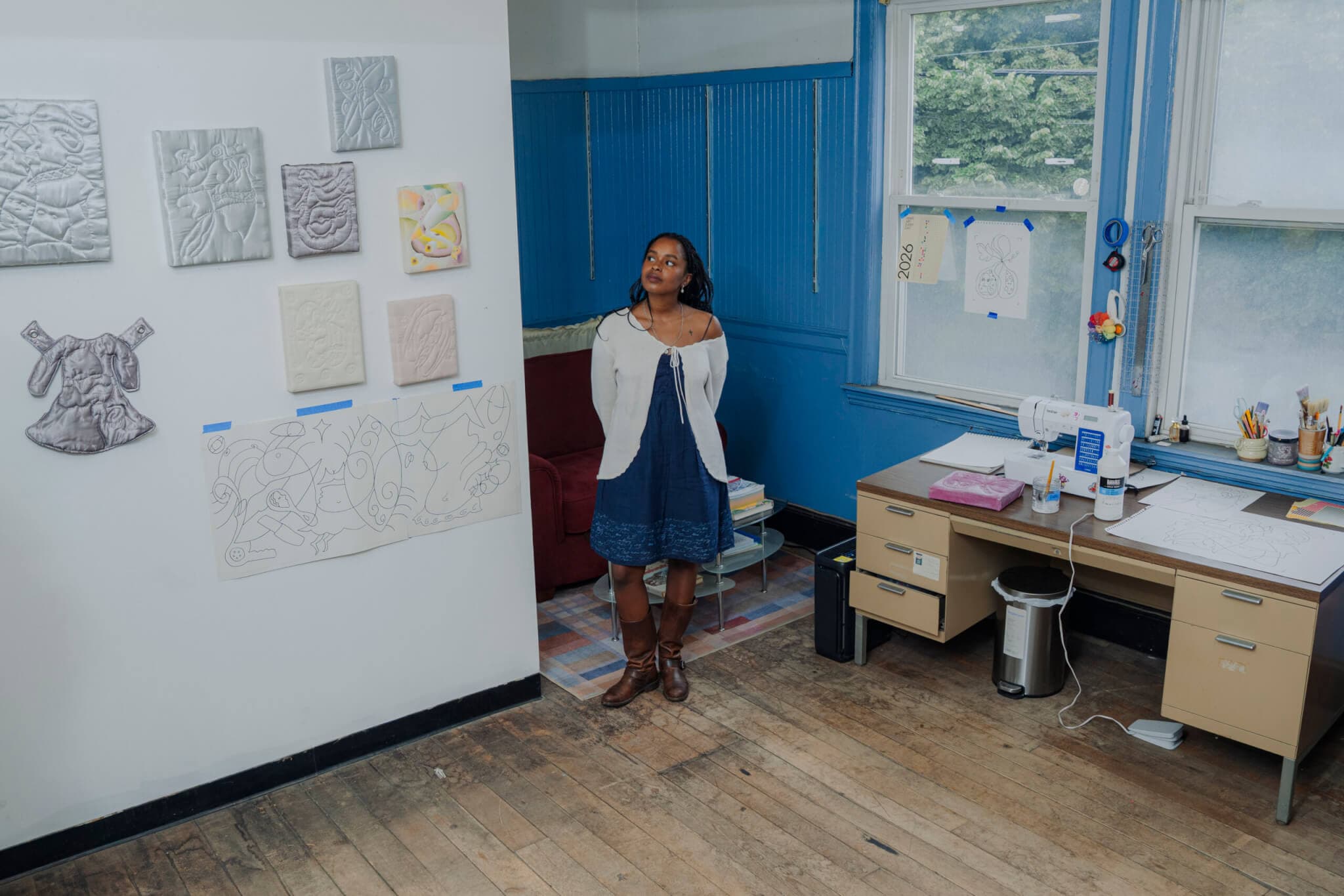
Opaque and inscrutable are charged descriptors, dark and illegible. This is especially true when describing the work of black artists, who have long faced a critical dragnet which demands that we put our art into familiar terms and forms. It is, for many black artists, the quintessence of being a professional to suffer demands that we lay ourselves bare, even while, as Boston-based Sudanese American textile artist Rania Abdalla Kadafour makes clear, our obscurity is the source of the good stuff, our form of productive difficulty.1 “My art,” Abdalla Kadafour says during our meeting at her studio, “has always been a little bit secretive. There’s a lot of things that I put in there that I don’t want to give away immediately.” It’s not that anything is closed off in Abdalla Kadafour’s dreamy textiles; it’s all available to those willing to carefully decipher.
At her studio in Jamaica Plain, Abdalla Kadafour specifically holds on to the things that have kept her curious as an artist and community organizer—back to her time as a student at Massachusetts College of Art and Design, where she graduated in 2024. From her “micro living room” —a cozy reading corner—she displays, alongside a book of work by pioneering abstractionist Hilma af Klint, The Complete Book of Stuffedwork (1978) by Toni Scott, a how-to guide for needlework. “I read it, I think, on my first day of being a fibers major,” she shared. It changed her practice forever, as she taught herself trapunto quilting, a form of quilting in which raised designs are quilted into fabric. “I saw all the ways that it could be subverted into different soft-sculpture pieces and I started with text,” she says, highlighting how textiles serve not just as a domestic practice but a rich visual language. “Textiles and needlework are things that are almost instinctive for us as humans to do. I feel like it’s so wrapped up and connected to our humanity. I feel our brains want to play with string, you know?”
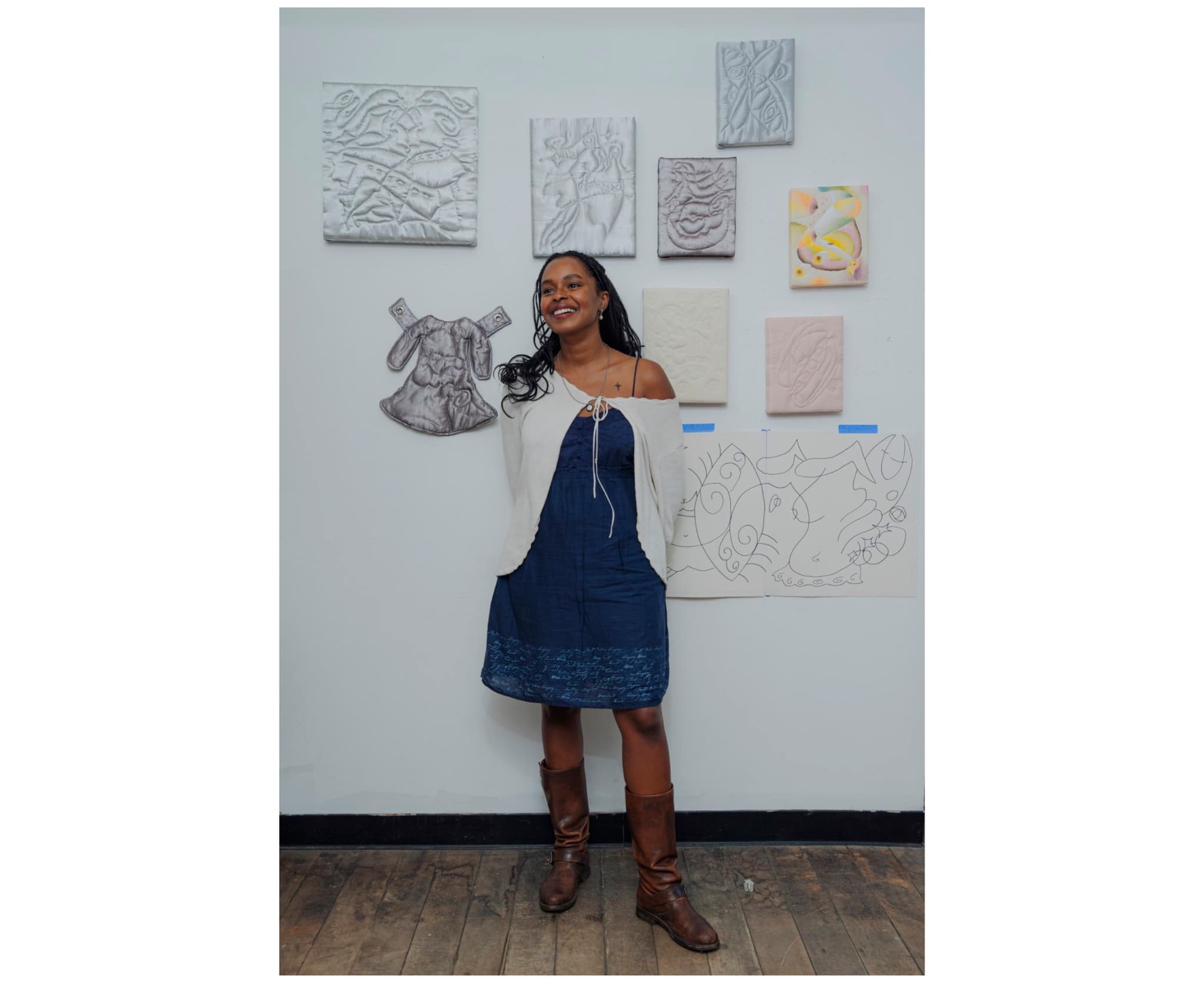
Rania Abdalla Kadafour in her Jamaica Plain studio, June 2026. Photo by Cameron Kincheloe for Boston Art Review.
Her piece face/gaze (2025) answers this rhetorical question through a silver satin plectrum stuffed with batting. The threaded details on its surface suggest an abstracted face whose indistinct features prevent the viewer from finding a stable point of reference, as though the face were constantly changing. One eye is in the form of a swirl, another in the form of two concentric circles. Detached from these eyes are two sets of eyelashes that swoop downward, calling into question how we could have perceived eyes there at all. One of these lashes also intersects with what might be a nose at the piece’s center—or perhaps the nose is instead the flourish at the end of a line that could just as easily be read as a mouth or a lip, stretched across the face’s lower left side. Likewise, if we are now open to the face changing itself before us, might these lines be abrasions, vestiges of this metamorphosis? Indeed, what we are left with is a face whose features transform before our eyes—a model for how we change our bodies. Made with material as soft as our skin, Abdalla Kadafour’s stitched abstractions embody the power of aesthetic opacity to open up an abundance of meaning.
Rather than yielding to the demand for transparency, Abdalla Kadafour’s soft-relief sculptures cultivate opacity through a combination of bas-relief and stuffed, painted needlework. The artist has refined this aesthetic of opacity across a practice now exhibited throughout Boston, greater Massachusetts, and, more recently, New York. As she explains, in an age when digital spectatorship compounds the scrutiny already directed toward black women and immigrant artists, soft-relief sculpture forces attention back onto her art. Her abstract stitching challenges viewers to make meaning with the artist and her work—to co-create—rather than reduce it, or its maker, to biography or demography. “I just want people to be curious,” she says. The invitation is to scrutinize: We have to be “curious and open” enough to translate the needlework.
Abdalla Kadafour’s remarks evoke the etymology that her work articulates: text and textile—text/ile—share the same Latin root, textere, meaning “to weave.” Her work recognizes an instinctive desire to string things together; her medium speaks in a language that we are primed to want to interpret. We might not all understand a piece of quilted work the same way, but most of us will find something in Abdalla Kadafour’s patterns.
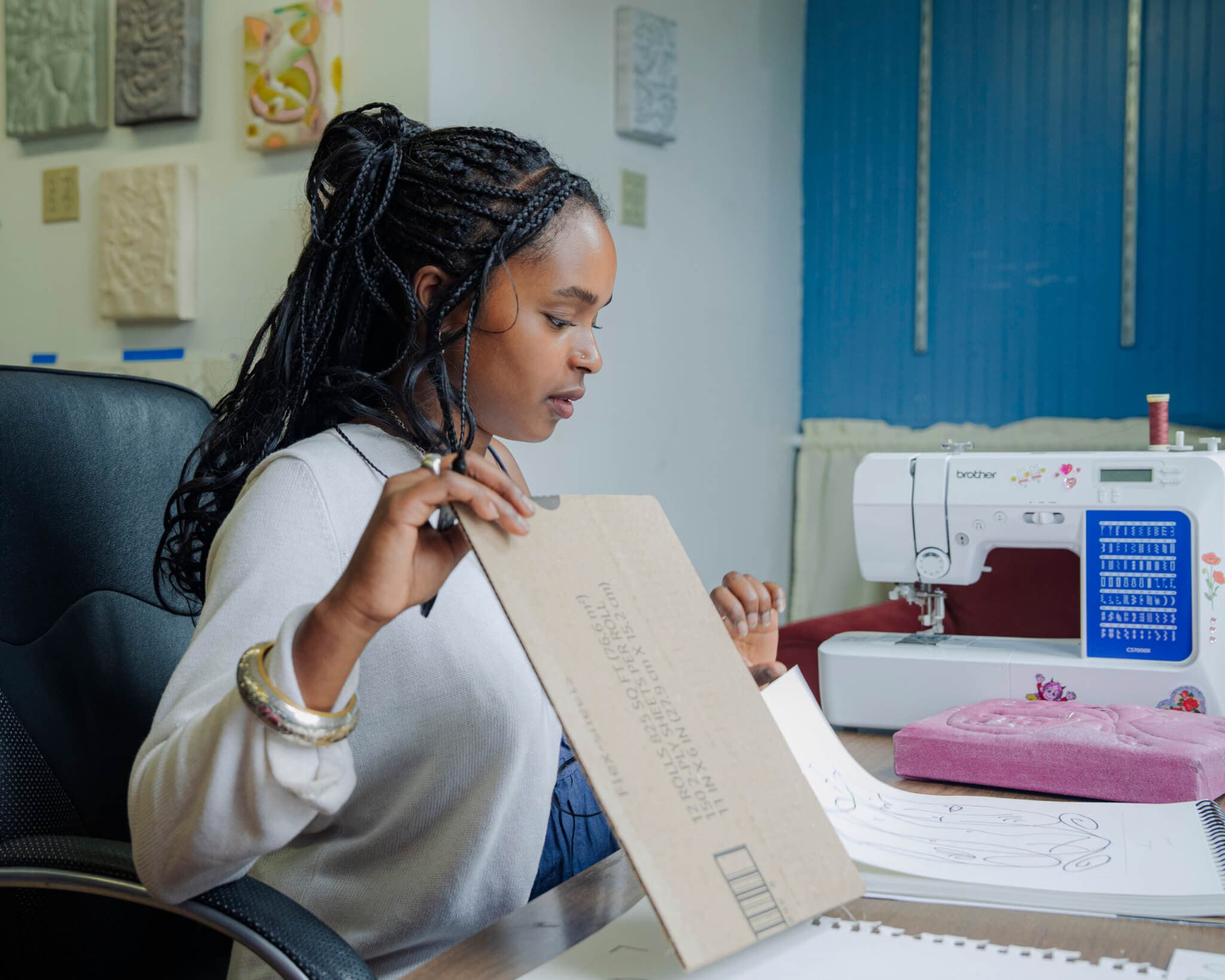
Rania Abdalla Kadafour in her Jamaica Plain studio, June 2026. Photo by Cameron Kincheloe for Boston Art Review.
The artist literalizes the connection between quilting and language in her piece ZOLA (2025). A series of four quilted cotton fabric squares oriented as diamonds and connected in a horizontal line, ZOLA uses braided hair as a frame—in this sense, the piece is visually contained within a marker of blackness. Inside the hair, the first panel on the left depicts a somber face, its right eye drooping downward. Abdalla Kadafour amplifies the melancholy with a queasy mix of pale yellow and spots of pink watercolor. The inclusion of two noses further unsettles the image: the lower nose is rounder, more Nubian, while the upper nose is smaller and angular. The subsequent squares spell “zola” in Arabic: zaa (ز) against a pink background, waw (و) on a red background, and laam (ل) and haa (ه) on a mix of pink and yellow. Because the fabric is rendered in watercolor and pencil, the letters and the face appear to be washing away. It is as if we are literally witnessing semantic bleaching—the process by which words lose specific meaning—and an image in which black language death and identity death are braided together.
These visuals parallel the word “zola” itself. A familiar greeting to Sudanese Arabs, zola has been misappropriated as a racial epithet for black people in the Arab world. According to Abdalla Kadafour, in Qatar, where she spent her childhood, for instance, non-Sudanese Arabs use the word mockingly, either to reference Sudanese culture or to ridicule it, hence the literal water(color)ing down of the face and characters in ZOLA. To Abdalla Kadafour, this slurring is also related to crises of assimilation and language loss that have followed the artist from Qatar into the West, where she has lost most of her Arabic altogether, thus making ZOLA a larger act of linguistic archiving. However, in keeping with abstraction, its significations do not end there. I shared with the artist one of my interpretations as a black American—that the title and braided hair conjure the infamous 2015 black Twitter scandal centering the exotic dancer A’ziah “Zola” King. It is poetic that a piece can contain such multitudes of blackness, a testament to the power of opaque meaning. Or rather, this is how opacity forces a viewer to co-create meaning with and through the work. This is the soul of Abdalla Kadafour’s practice.
Abdalla Kadafour also organizes sewing circles where members of her community create pieces together. She began facilitating the gatherings in 2024, in the wake of the state murder of Marcellus Williams. Led by Abdalla Kadafour, the group has become a space of catharsis and community for black Bostonians, who originally came together to sew Williams’s poetry, extending her practice into her personal and communal life. “It almost feels like group therapy for me.”
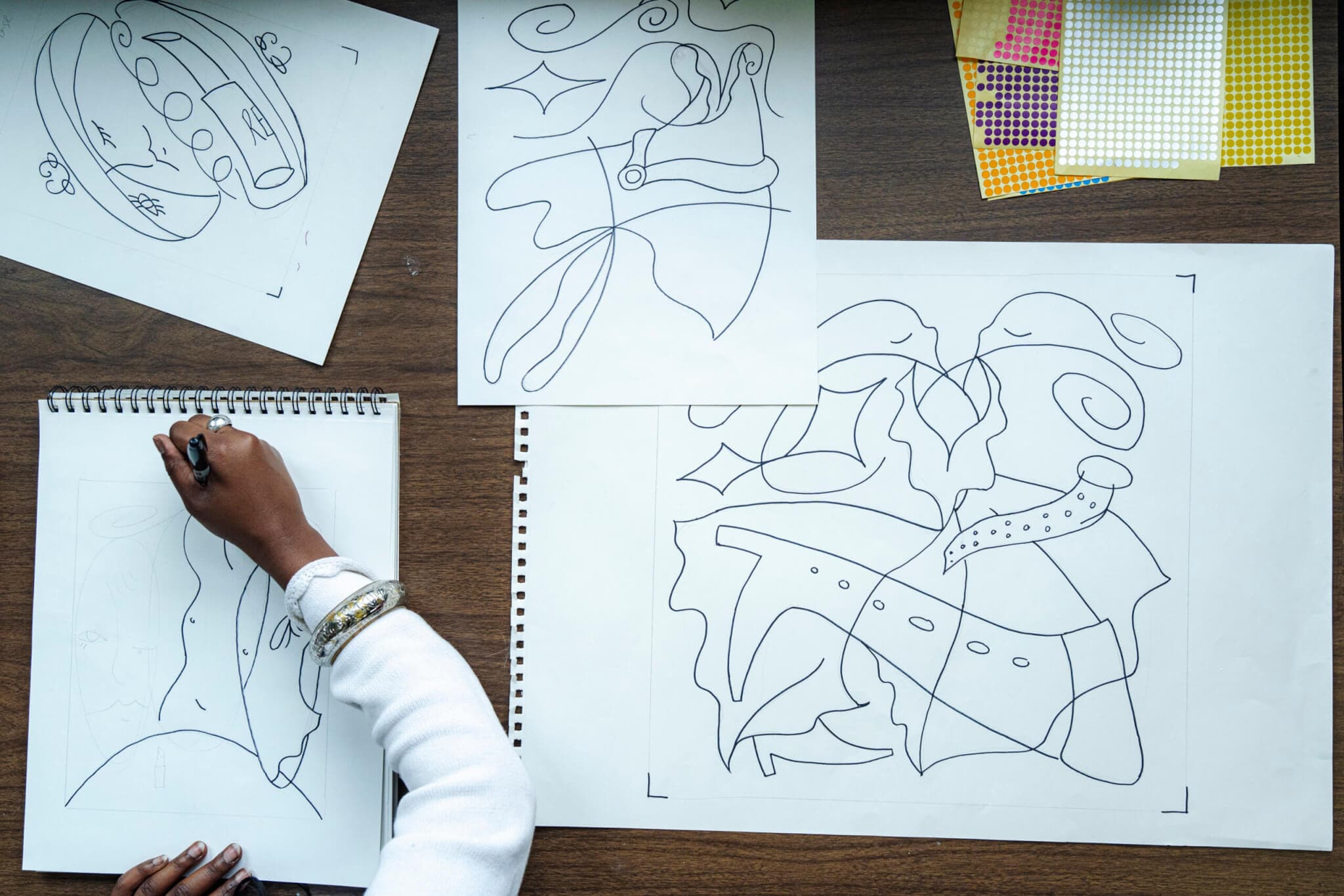
Rania Abdalla Kadafour in her Jamaica Plain studio, June 2026. Photo by Cameron Kincheloe for Boston Art Review.
The artist concedes a present separation between her community work and her personal artistic practice, though she is working on bringing all of her projects together. “I’m trying to look outwardly and take the things that are happening in the larger world around us and, especially with the sewing circle, take the feelings of frustration and hopelessness that we all feel and create a space where we can talk about those things,” she explained.
In her forthcoming show, opening in August at Lagoon New York in Brooklyn, Abdalla Kadafour is specifically working on an installation exploring how we articulate and abstract our bodies through clothing. It’s an idea she recently probed through one of her most recent pieces, Paper Doll Dress (2026), a piece in which a sewn, silver dress is stitched with multiple sets of gazing eyes. The dress is then overlaid on a paper doll, which, Abdalla Kadafour shares, is inspired by her childhood practice of using paper dolls as a form of self-expression through clothing. Nevertheless, while the work was originally centered around her experiences with restricted expression growing up outside of the West, the piece’s far-reaching impact has left her curious. “When I moved to the US, I learned that so many people of different faiths and backgrounds and families had such similar experiences to me, regardless of what their faith was or what their family was like growing up—that feeling of restriction,” she describes, also sharing that she hopes people will play with the doll.
Abdalla Kadafour connects this invitation to play with the affordances of her soft sculptures—their ability to unlock something for everyone. At the end of our conversation, she returns to the idea that viewers are given a kind of freedom in how they engage with the work. She refers specifically to the dress, but as is clear (though not necessarily transparent), her significations extend beyond that.
—1 This argument draws on West Indian philosopher Édouard Glissant’s theorization of black opacity in Poetics of Relation (University of Michigan Press, 1997).