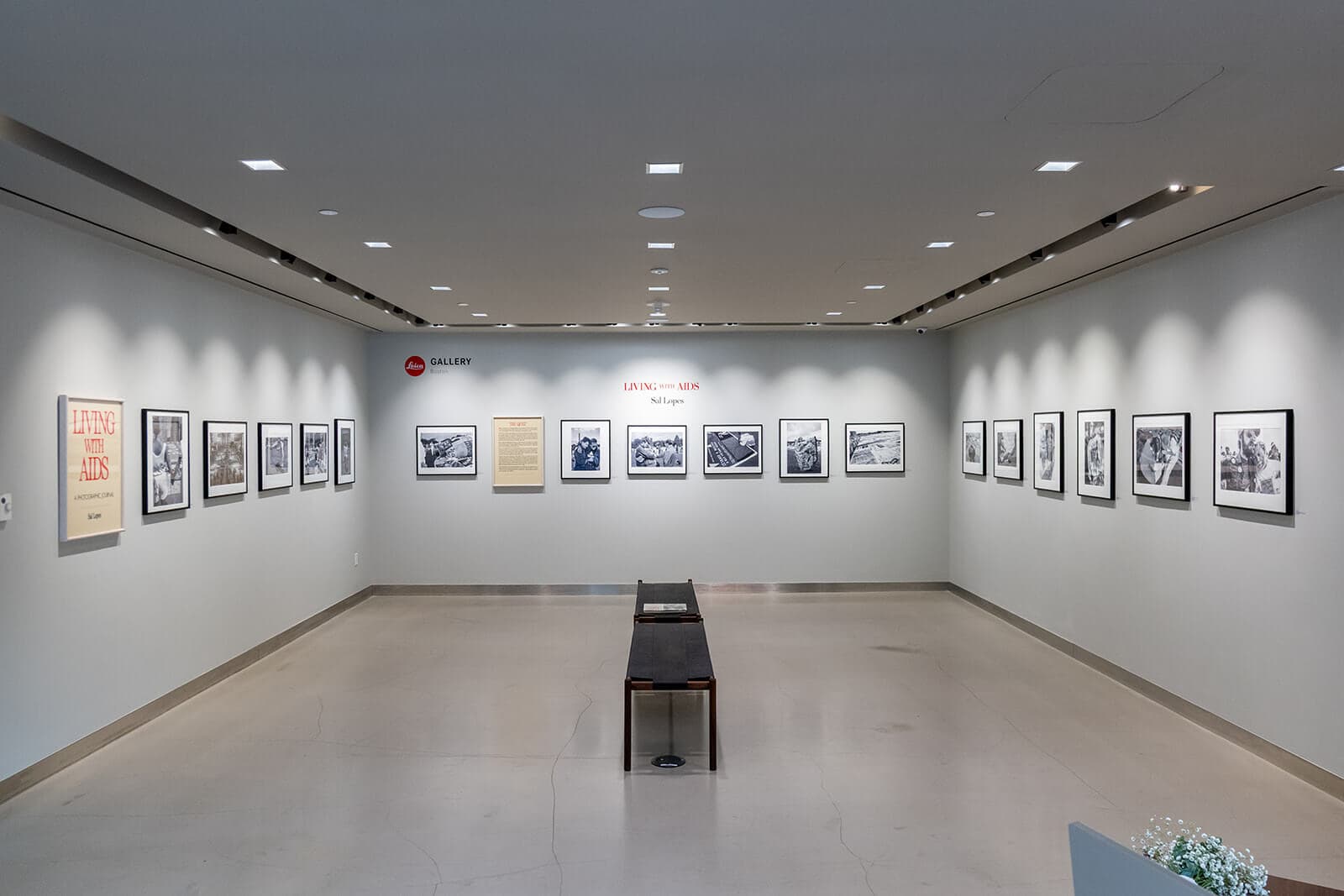
On view at Leica Gallery Boston, renowned photographer Sal Lopes’s unflinching look at the AIDS crisis plays out in striking black and white. “Living with AIDS” centers on the epidemic’s impact in Boston from 1988 to 1992, telling a narrative through Lopes’s documentary-driven approach to three distinct stories. The first is the NAMES Project AIDS Memorial Quilt, a massive piece of community art started in 1985 that comprises thousands of individual quilt squares, each in honor of an individual who lost their life to AIDS. The next documents the Buddy Program of the AIDS Action Committee of Massachusetts, through which trained volunteers were paired with a “buddy” living with AIDS to develop long-term relationships and provide meaningful support. The final section of the exhibition shares the unconditional love of John and Sharon Boyce and their adopted children—including two-year-old Brianna, who was already living with AIDS.
Upon entering the gallery, photographic prints of the AIDS Memorial Quilt hang in a line across three walls, each presented in a uniform twenty-four-by-twenty-inch mat. This series has the most images on view of the three, dominating the exhibition space. Inside the Saunders Castle (1988) depicts a gymnasium-style room inside the historical Boston building where the quilt was exhibited. The large room is filled with quilt sections covering the walls, ceiling, and floor, while the remaining areas are crowded with viewers. Blurred figures are scattered throughout, implying a movement of bodies and time, but also an echo of those lost. Ghostlike, but present, these lives are brought into the public space and consciousness through the act of memorialization.
Two volunteers comfort man who collapsed from grief (1992) offers a more intimate expression of loss. A man lies along the edge of the quilt, his eyes closed and face centered in the space between two figures as they lean toward him in comfort. Their expressions are not visible, yet their compassion is clear. As they hold him in his pain, the trio becomes a singular entity of human tenderness.
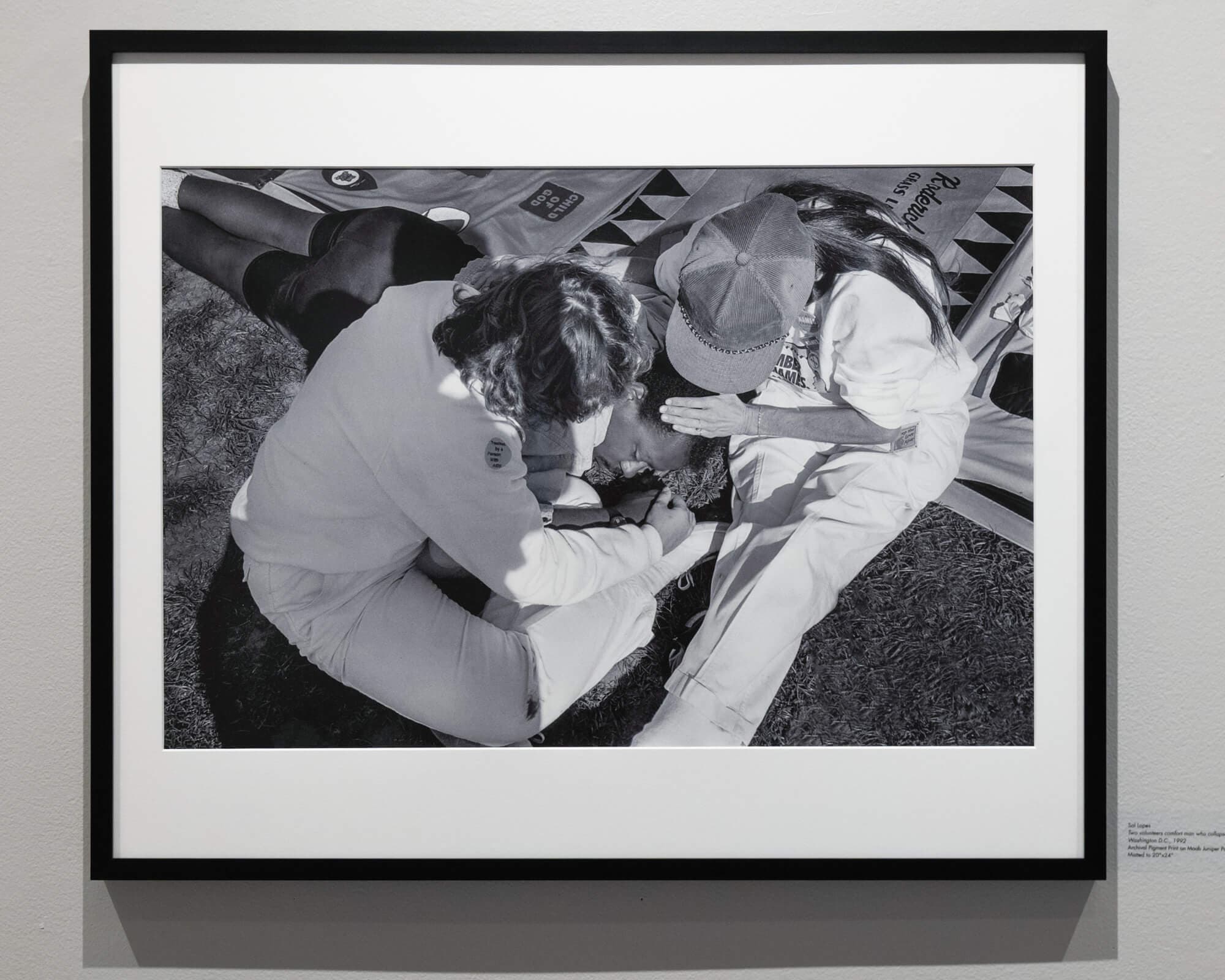
Sal Lopes, Two volunteers comfort man who collapsed from grief, Washington D.C., 1992. Archival pigment print on Moab juniper paper, matted to 20 x24 inches. Courtesy of Leica Gallery Boston
Around the corner, a small hallway is lined with a series of photographs showcasing Buddy Program participants. If the AIDS Memorial Quilt photographs tell a story of living with the loss of AIDS, these tell a story of truly living with AIDS, centering the individuals depicted and their relationships before death. In Larry & Ken (1990), one man sits on the edge of the other’s hospital bed, holding his arm and gazing intently at him. In Thom & Alan (1991), the confinement of the hospital is removed as one embraces the other from behind in the midst of a serene natural background.
The direct depictions of human touch are particularly resonant in the context of its taboo at the height of the crisis. The misinformed belief that HIV/AIDS could be spread through any physical touch, fueled further by stigma and hate, inherently politicized such gestures, inciting isolation at a time when connection was essential. In both of these photos, and many more, we see that connection in action—a powerful protest of love.
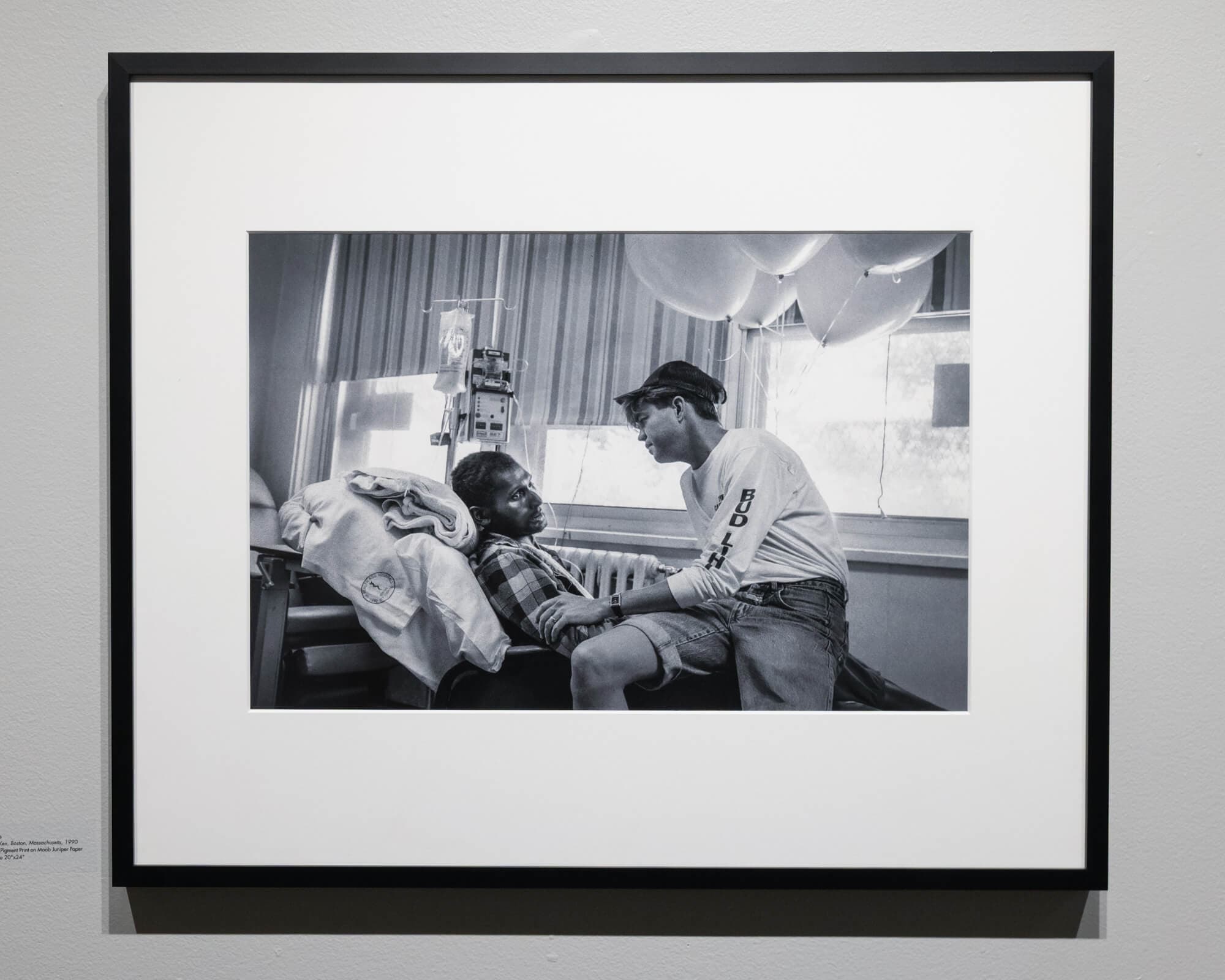
Sal Lopes, Larry & Ken, Boston, Massachusetts, 1990. Archival pigment print on Moab juniper paper, matted to 20 x24 inches. Courtesy of Leica Gallery Boston.
Beyond the Buddy Program photographs, a small corner of the gallery presents three photographs of the Boyce Family. The Boyce Family (1992) shows John and Sharon Boyce, Brianna, and their three other children—two of whom were living with HIV antibodies—gathered in a close embrace. Though posed, the photograph retains an organic quality as bodies overlap and faces press together. The other two images are tighter shots, focusing on Brianna alone. In Brianna at the kitchen table with her IV (1991), she sits in her home, the IV attached to her bare chest. Her expression is solemn, though largely unemotional, in a way that is out of place on a child’s face. There is a particular pain in seeing a child so young—normally a symbol of possibility and innocence—marred with the inevitability of death at such an early age. However, this reality does not detract from the familial bond depicted.
“Living with AIDS” brings a personal intimacy to the crisis in a way that even now often fails to be fully captured in public consciousness. Queer history has never been safe from censorship, but we are living in a time where it is being erased with renewed zealousness, giving these photographs particular significance. Today, people living with HIV can lead full and meaningful lives, yet we must continue to grapple with the fraught legacy of the AIDS crisis—a legacy that Lopes’s photographs bring back into view.
“Sal Lopes: Living with AIDS” is on view through August 9, 2026, at Leica Gallery Boston, 74 Arlington Street, Boston, MA.