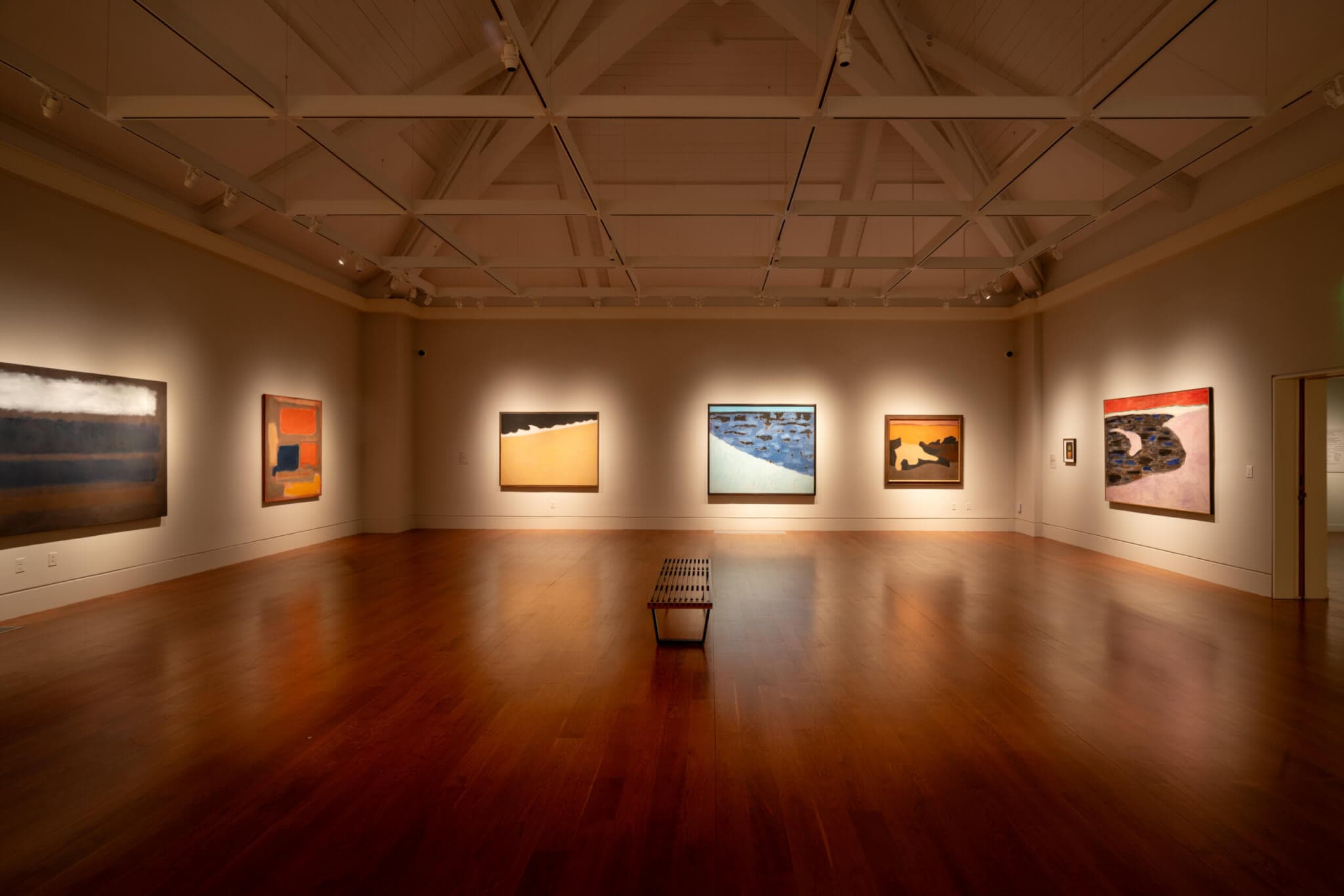
“Avery, Gottlieb & Rothko: By the Sea” at the Cape Ann Museum charts the evolution of the relationship of three artists—Milton Avery, Adolph Gottlieb, and Mark Rothko—over roughly twenty years, detailing the progression of the two future Abstract Expressionists as they absorbed and ultimately moved beyond Avery’s influence over the course of numerous creative dialogues while summering in Gloucester, Massachusetts.
The exhibition inaugurates the reopening of the Cape Ann Museum after a twenty-month closure. As the museum’s first blockbuster show, it’s a knockout, if not at times overly thorough with its more than eighty works. In tracing the development of three painters, the exhibition lingers over transitional periods that are often less compelling than their mature achievements. While this unevenness is inevitable across nearly three decades, the show is occasionally weighed down by its surfeit of work.
Equal space is given to each artist, but Avery’s presence dominates throughout. This is evident from the moment of entry, where a gathering of late masterpieces in subdued pastels and brooding blacks (notably 1945’s swirling and explosive watercolor Lone Rock and Surf ) roar and beckon in anticipation of the artist’s apotheosis before the exhibition commences in earnest with his early work of the 1920s.
While it is impossible to classify Avery as an Abstract Expressionist, his unflinching rejection of illusionistic depth in favor of broad expanses of color and simplified form led art critic Clement Greenberg to regard him as the movement’s unwitting progenitor.1 Rothko biographer James Breslin called him “the historical link between European modernism and the ‘color field’ wing of American Abstract Expressionism.”2 But the exhibition confirms Avery’s place as much more than just a precursor to the movement.
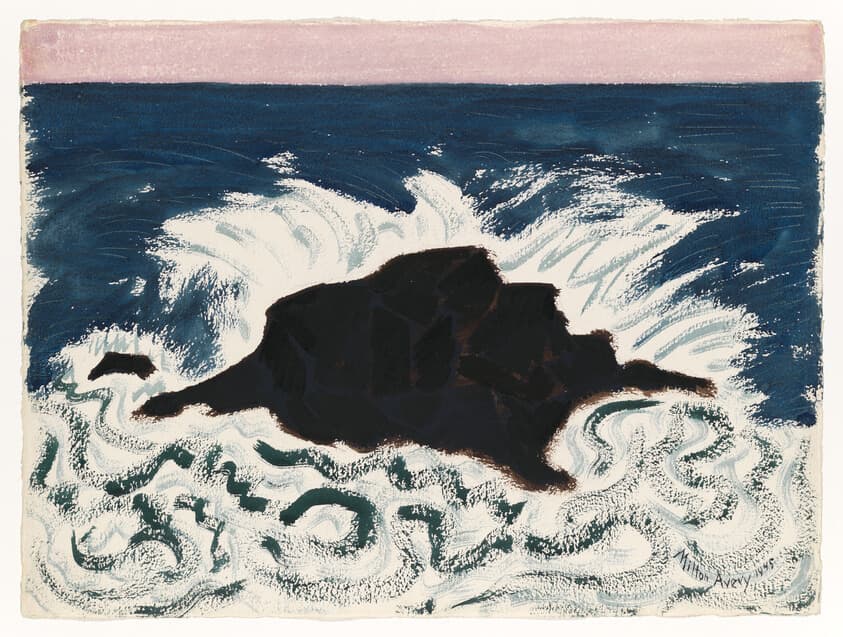
Milton Avery, Lone Rock and Surf, 1945. Watercolor and charcoal on paper, 22 1/2 x 30 1/4 in. Whitney Museum of American Art, New York. Purchase, with funds from S. Sidney Kahn and the Drawing Committee, 84.68. Digital image © Whitney Museum of American Art/Licensed by Scala/Art Resource, NY. © 2026 The Milton Avery Trust / Artists Rights Society (ARS), NY.
Shown alongside two giants that helped establish America as the heart of the postwar art world, he emerges as the exhibition’s cynosure, elucidating Rothko and Gottlieb’s gradual move to artistic independence. While it would take time for each of them to find their own visual language, Avery’s outsized influence can be measured as much by what Rothko and Gottlieb rejected as by what they absorbed.
Avery began summering in Gloucester during the early 1920s. Having rejected the expository principles of social realism that dominated 1930s American painting, he looked to European Modernism, where the decorative configurations of Henri Matisse suggested possibilities largely absent from contemporary American art.
Eighteen years older than his colleagues, Avery invited Rothko and Gottlieb to Gloucester in 1932 to paint side by side on the beaches of Cape Ann. Avery’s friend Louis Kaufman described the artist as teaching “not by what he said but what he did.”3 However, Rothko and Gottlieb resisted blind imitation as they preserved their artistic identities and gradually pulled away from Avery’s representational approach.
Rothko’s move toward psychological expression through color was already evident in his figurative work. One of the exhibition’s most revealing juxtapositions comes through two 1933 watercolors, both showing a woman seated on a sofa with a child on her lap. The quaint subject, portrayed twice in starkly different colors, exemplifies the artist’s early experiments with the ways in which color, when varied within the same composition, can manipulate mood. But the paintings themselves are dull, favoring explanation over visual punch, and the exhibit suffers from a profusion of watercolors that similarly serve as little more than didactic steppingstones.
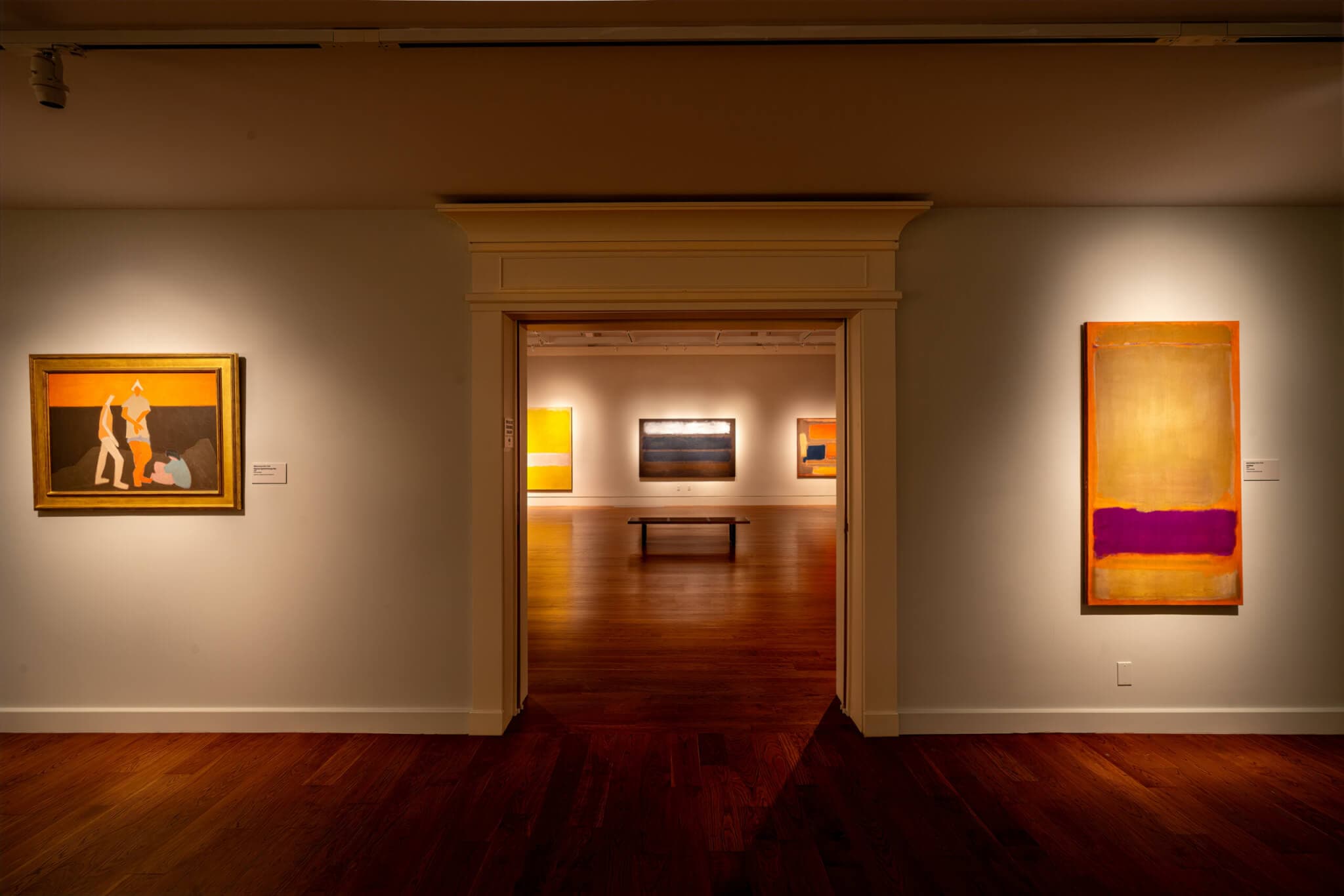
(left) Milton Avery, Figures Against Orange Sky, 1949. (right) Mark Rothko, Untitled, 1949. Installation view, “Avery, Gottlieb & Rothko: By the Sea,” Cape Ann Museum, Gloucester, MA, 2026. Photo by Steve Rosenthal. Courtesy of Cape Ann Museum.
From the start, Gottlieb turned his attention away from the beach to the working wharves, where he painted in the subdued palette of Ashcan Realism. Attuned to the blows sustained by the seaport town amid the Great Depression, his early work largely reflects the decade’s economic hardship. Nowhere is this more affecting than an untitled 1936 oil in which a dockworker sits in gloom amid the struggling fisheries. With subtle menace, the troubled cove and fading dusk forecast the artist’s compelling, forlorn Surrealism of the early 1940s.
Avery’s critical acclaim continued to soar during the 1940s as Rothko and Gottlieb intensified their exploration of an aesthetic language by paring their imagery down to what they jointly described as “flat forms [that] destroy illusion and reveal truth.”4 Here is the decade where the exhibition’s chronology allows the viewer to fully witness the divergence of the three artists’ paths.
In 1943’s Iphigenia and the Sea, Rothko dismantled both figure and ocean to leave them identifiable but fractured in a vague landscape where brushwork is pulled and stretched by a variety of vertical shapes and marks as though on an assembly line. But it is 1944’s Birth of Cephalopods, in which rounded vertical forms swirl and writhe within a warm, boundless framework, that signifies the spontaneity with which the artist attempted, as Avery said of his own work, “to eliminate and simplify, leaving apparently nothing but color and pattern.”5 These liminal paintings are among the most explanatory in tracing the artist’s move from representation to abstraction.
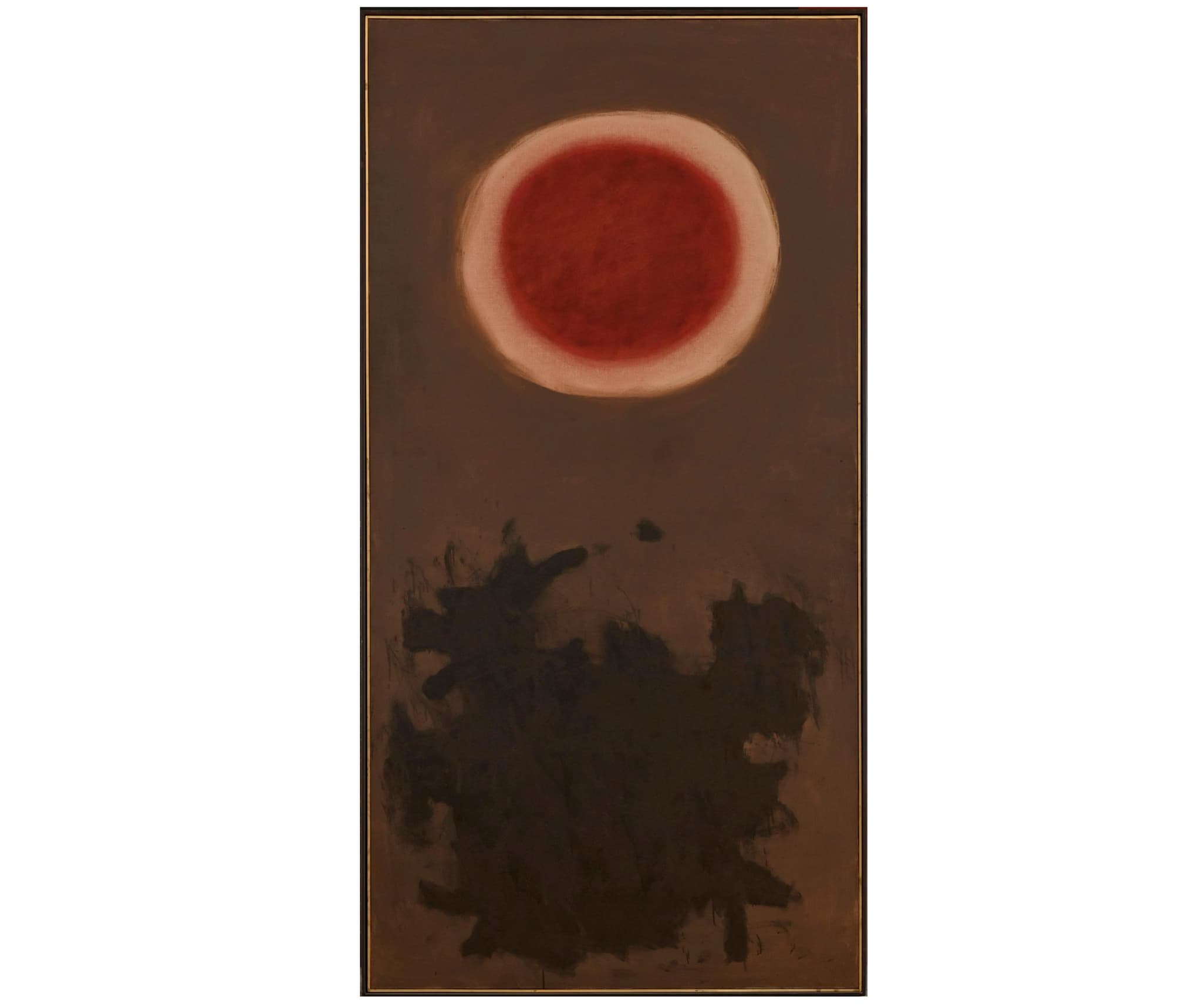
Adolph Gottlieb, Under and Over, 1959. Oil on canvas, 96 x 48 in. Wadsworth AtheneumMuseum of Art, Hartford, Connecticut, 1961.5. Photograph: Allen Phillips/Wadsworth Atheneum. © 2026 Adolph and Esther Gottlieb Foundation / Licensed by VAGA at Artists Rights Society (ARS), NY.
Admitting that “having a sympathetic commentator [in Avery] close at hand may be a form of self-indulgence,”6 Gottlieb moved in 1937 to Tucson, where he found new motivation in painting otherworldly objects vaguely resembling marine flotsam and jetsam. Placed before a lonely shoreline, the objects possess an uncanny familiarity evoking de Chirico’s haunted piazzas. Although the artist was a long way from the ocean, this brief immersion in Surrealism marks the apex of his creativity.
Upon his return to Gloucester in the 1940s, Gottlieb began experimenting with the invented symbols that populate his “Pictograph,” series, spanning 1941 to 1950, which the artist insisted were not abstractions but rather realism refurbished for the modern age. At their best, they emerge as urgent, opaque communications. However, their occasional tendency to veer into the figurative and oceanic realms, as in the 1946 oil Forgotten Dream, comes across as little more than clumsy shorthand for a philosophy that’s never realized.
Following a radical divergence in artistic direction, the trio reunited in Gloucester in the mid-1940s. A second move, this time to the artists’ colonies of Provincetown in the 1950s, signals the summit of their individual identities.
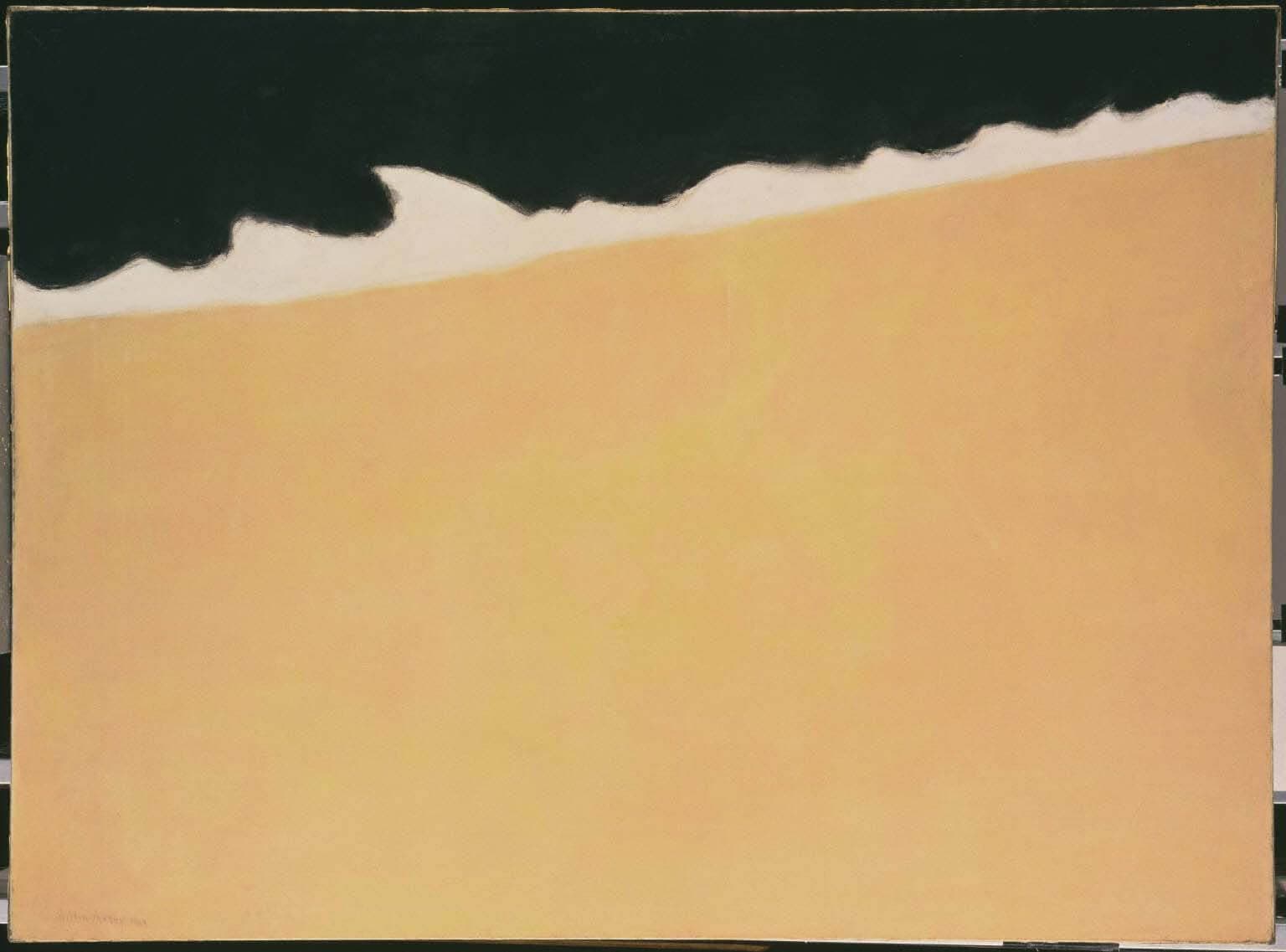
Milton Avery, Black Sea, 1959. Oil on canvas, 50 x 67 3/4 in. The Phillips Collection, Washington, DC. Acquired 1965, 0035. © 2026 The Milton Avery Trust / Artists Rights Society (ARS), New York.
Rothko’s throbbing 1955 canvas Untitled (Yellow, Pink, Yellow on Light Pink) showcases a fully matured artist at his most luminous and immersive. In a culmination of his search for painting at its most elemental, spatial illusion is dismantled entirely, leaving only stacked, rectangular fields of diffused color. Indistinct edges bring hazy depth to the subtle composition but never compromise its fundamental flatness. It is among the exhibition’s most compelling and contemplative works, in which Avery’s influence is fully absorbed on Rothko’s own terms.
Gottlieb’s so-called “Imaginary Landscapes” of the fifties are largely structured around bounded, circular forms hovering over unfettered, impulsive strokes. Deliberate contrasts that affirm flatness over illusory space, represented in 1959’s aptly titled Under and Over, ultimately read as a low-stakes competition between garbled form and something resembling chaos.
Avery continued to simplify his compositions by juxtaposing broad expanses of color. This is brilliantly realized in the almost entirely abstract Black Sea (1959), where a diagonal white stripe of breaking seafoam rises like teeth between a dominant orange-yellow and coal-black water. As Rothko and Gottlieb were creating wholly abstract languages, the masterpiece serves as a reminder that Avery’s heart remained forever bound to the edge of the sea.
—1 Heather Atwood, “Color of Light Screening: Joseph Solman” lecture, Sawyer Free Library, Gloucester, MA, July 10, 2026.
—2 James E. B. Breslin, Mark Rothko: A Biography (University of Chicago Press, 1993), 95.
—3 Breslin, 94
—4 Rathbone, Eliza, ed. Avery, Gottlieb & Rothko: By the Sea. (Rizzoli Electa, 2026), 35.
—5 Rathbone, 33
—6 Sanford Hirsch, The Beginning of Seeing: Tribal Art and the Pictographs of Adolph Gottlieb (New Britain Museum of American Art, 2002), 5.
“Avery, Gottlieb & Rothko: By the Sea” is on view through September 27, 2026, at the Cape Ann Museum, 27 Pleasant Street, Gloucester, MA.