Wonderland is a trail leading to a granite shoreline in Acadia National Park, a three-hour drive from Portland, Maine. In the wall text for artist Eve Biddle’s first institutional show, titled “Wonderlands” for this fabled place, now on view at the Portland Museum of Art, she describes the site as a “pilgrimage.” It’s a journey she’s committed to since infancy and one her own children now accompany her on. Biddle continues on to state that the shoreline evokes “a specific feeling each time I visit,” with its tide pools and crumbling beds of pink granite, its land that feels forever untouched.
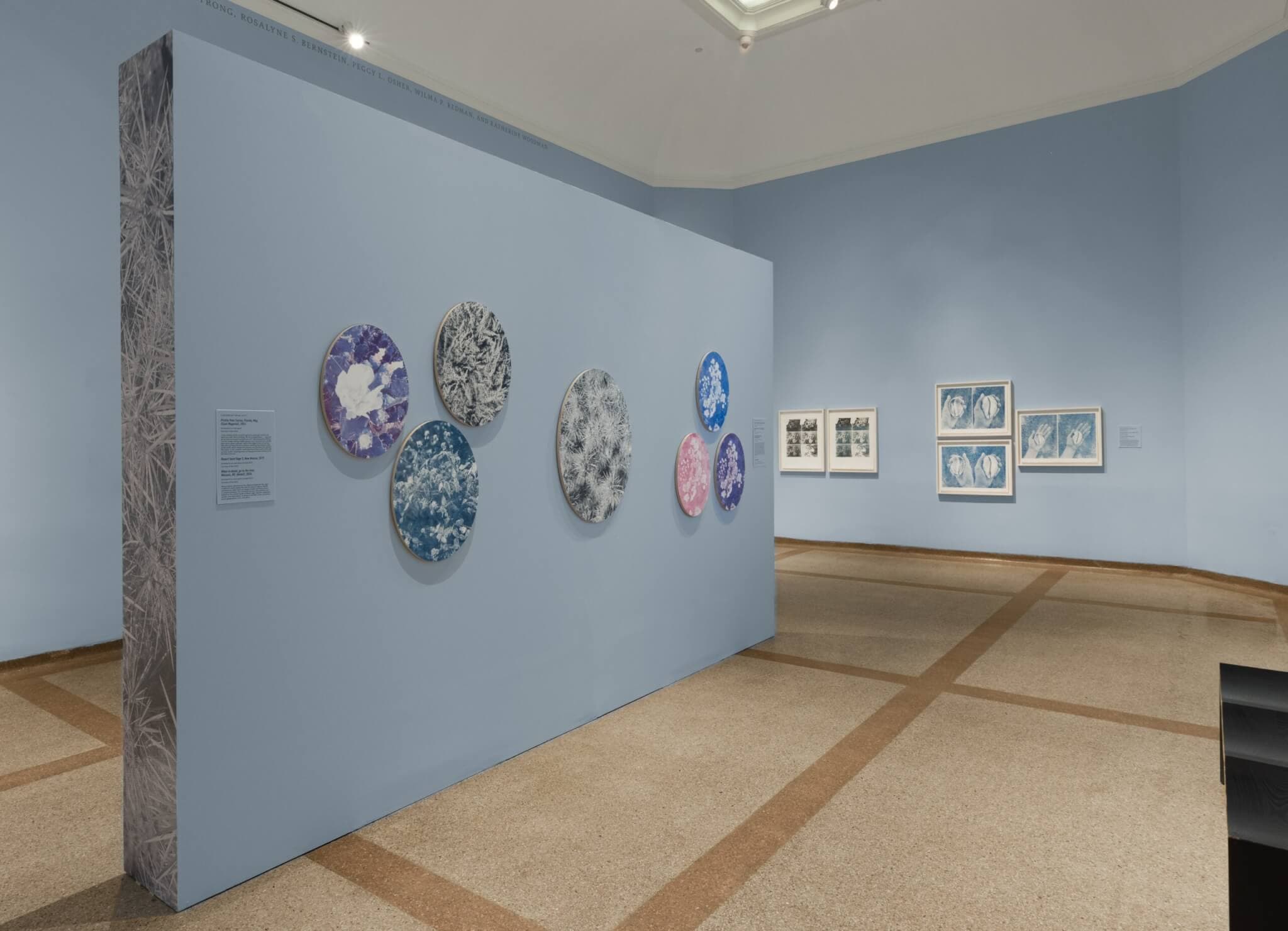
In “Wonderlands,” Biddle dives deep into the place that has aided in her formation as both person and artist through a series of photographs that feature snippets of both Biddle (usually the artist’s hand) and a portion of the site (that same hand framed against tidepools, in front of granite outcroppings, positioned against waves, etc.). Some of the photographs were then digitally converted into a collection of hazy, jewel-washed screen prints. The transformation from image to tactile object, and the coloring of each print, a calcified and sunbleached candied sheen, first drew me to the exhibition. This sleight of hand from image to object gives emotional heft and weight to Biddle’s images, which are, on their surface, deeply personal moments that can feel difficult to rupture, to live within as an outsider.
I encounter a difficulty in feeling at home, or rather, a part of such immensity. I’m made that much more aware of my own smallness, separateness, loneliness in this world when confronted by such seemingly impenetrable vastness. Yet, like Annie Dillard’s 1974 book Pilgrim at Tinker Creek, in which Dillard states, “I am not washed and beautiful, in control of a shining world in which everything fits, but instead am wondering awed about on a splintered wreck I’ve come to care for,” Biddle’s work penetrates and transforms such feelings of sheer bewilderment and overwhelm into a shared belonging, a faith in the body, of sensing and feeling, and a closely held devotion to the land.
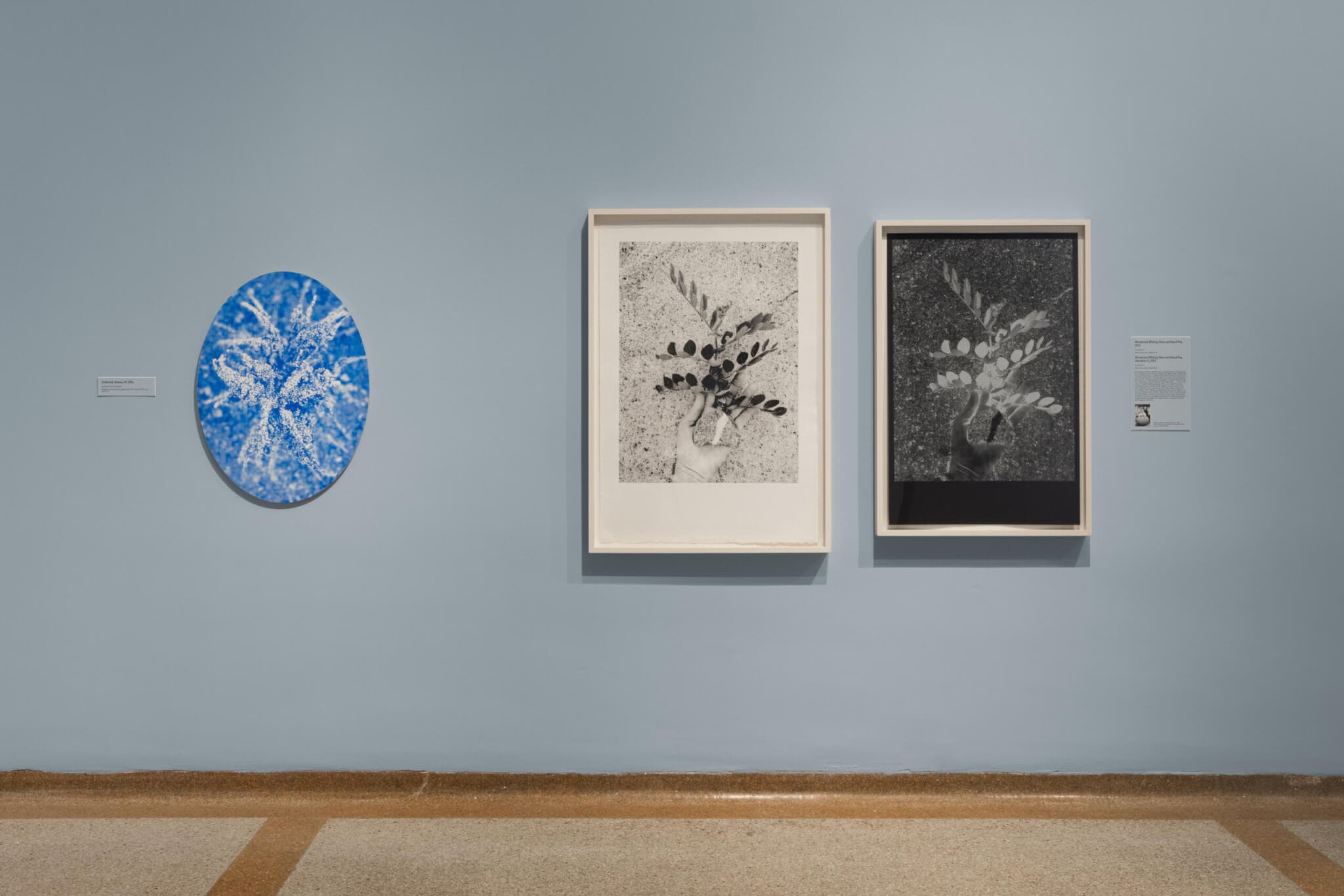
Eve Biddle (United States, born 1982), (left) Goldenrod, Amenia, NY, 2024. (center) Wonderland Wishing Stone and Beach Pea, 2022. (right) Wonderland Wishing Stone and Beach Pea (Variation 1), 2022. Installation view, “Eve Biddle: Wonderlands,” the Portland Museum of Art, 2026. Photo by Abby Lank. Courtesy of the Portland Museum of Art.
The show itself is installed within a single museum gallery, with a freestanding wall at the center. With Biddle’s screenprints installed upon the walls like a church’s stained glass windows—some small like a secret, less than a foot tall, and others standing almost the height of the average viewer—there’s something to be said about how Biddle grapples with the idea of faith within her portraits of nature, faith in the possibility of both viewer and artist sharing a joint eye. I can see what you see, understand you as the world made you, but how can you understand me? This, I believe, is the tension that sits at the heart of the show: the space that exists between what you see and what you hope to believe.
These questions, the frictions inherent to giving oneself over to the waves of an ocean, the whirls of life within a tidepool, or the vision of another, provoke a feeling of everyday transcendence. Running water on your fingers, kelp wrapped around your wrist, the branch firmly within your hand, all become small miracles in Biddle’s eye.
Take the pair of photos Wonderland Wishing Stone and Beach Pea (2022) and Wonderland Wishing Stone and Beach Pea (Variation 1) (2022) as examples. Installed as a pair, slightly off-center on the same wall, the pieces both feature Biddle’s hand partially buried in sand, cupping a “wishing stone,” while a sprig of beach pea fans upward from her fingers. According to old wives’ tales, a wishing stone is a stone encircled by an unbroken line of quartz that is believed to bring luck to its bearer. Variation 1 is a slightly smaller screenprint of its partner, appearing to be a photographic negative, with the light on the sand and Biddle’s hand reversed; her hand blends into the sand, is almost indistinguishable from the beach and the stone, the dark leaves of the beach pea now illuminated an unearthly white. The two prints are day and night; the artist asks her viewers to see through a glass darkly, to remove the grays, the textures, the demarcations between the self and the big other.
With Biddle’s commitment to land—how we see it, how we relate to it, how we ourselves live within it—I can’t help but situate her in conversation with the recently departed Dillard, for the two share a similar logic of value. Both take the rough material of a place, life’s concrete littleness, to make texts and images at once mysterious and personal, totems of belief both private and public: the lands that compose the churning center of Dillard’s “splintered wreck.”
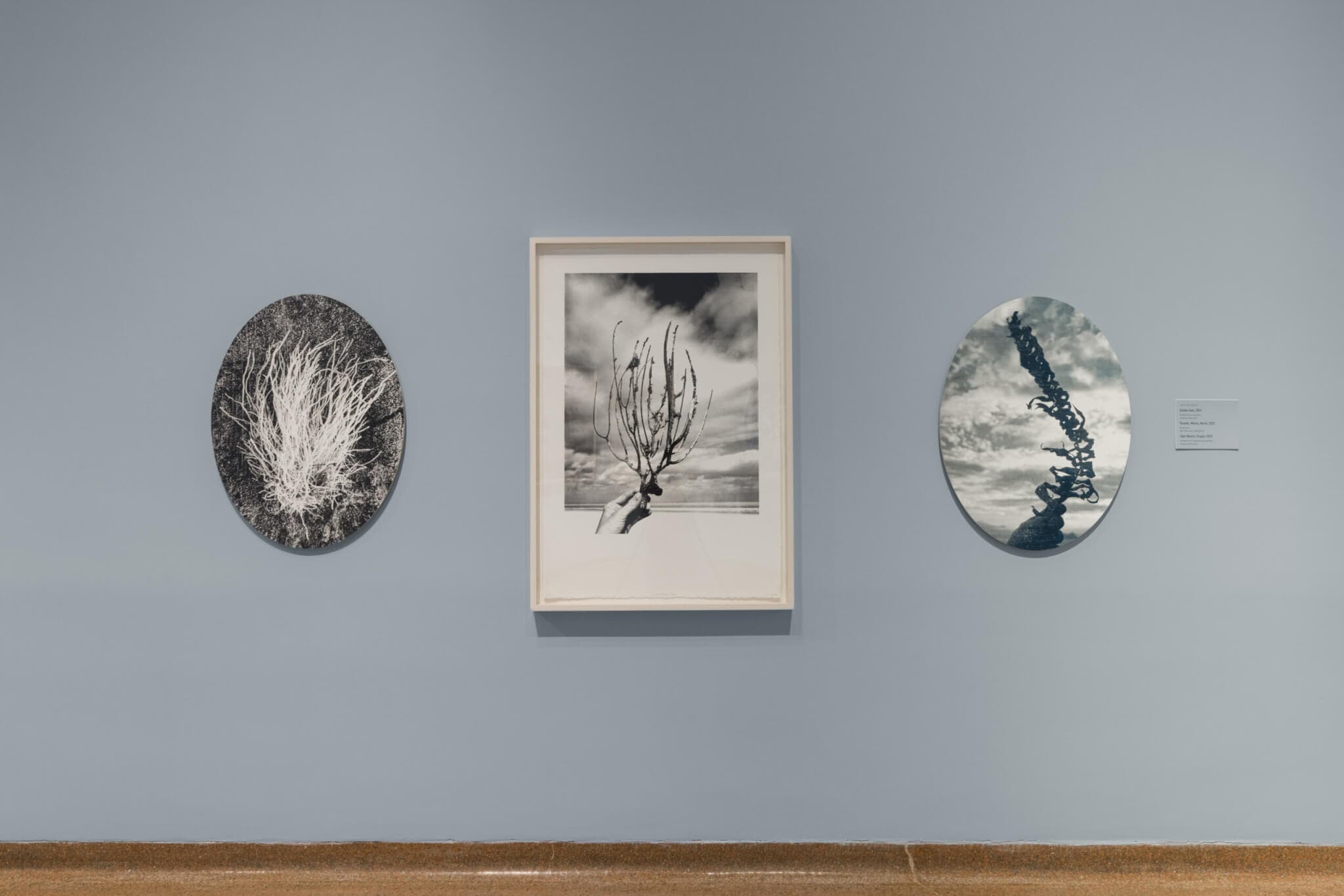
(center) Eve Biddle, Yucatan, Mexico, March, 2022. Installation view, “Eve Biddle: Wonderlands,” the Portland Museum of Art, 2026. Photo by Abby Lank. Courtesy of the Portland Museum of Art.
The 2024 Bridal Veil triptych, a trio of cyan, magenta, and violet prints, features a splattering of delicate bridal veil blooms taken near Biddle’s studio in upstate New York. The works present a similar entreaty to really look and question what one sees. Is a flower ever just a flower, a simple bloom? The three prints are installed on oval panels, though according to the wall text, Biddle prefers the term ellipse rather than oval to describe the shape, given the former’s evocation of cycles, such as birth and death. Against dappled fields of lollipop-stained color, the pearl-like blooms of the bridal veil appear overexposed, almost celestial in their brightness.
Across the gallery, Yucatan, Mexico, March (2022) is a black-and-white screenprint made from a photograph of New Mexican sagebrush. It is one of the rare photos in the show from outside of Maine, a decision that works both as a distraction from the artist’s grounded sense of place and a punctuating mark, a neon light that compels viewers to pay attention to it. In the piece’s wall text, Biddle states, “I love Mother Earth, and she’s going to come and crush us all. We’re so small. We’re nothing. We’re so insignificant . . . and how do we feel connected to where we are?” The text panel continues on to describe this sentiment as nihilism, but here I’d disagree, for I think Biddle’s faith in the world—its majesty, its wreckage—is more akin to something older, mystical, to which we no longer have easy access. Perhaps we never did. The immensity that Biddle finds in smallness and the prostrations of this type of faith illuminate our shared ability to see beyond the everyday, to grasp the secret within the waves, the holiness in the bud, and makes the artist’s “Wonderlands” truly wonderous.
“Eve Biddle: Wonderlands” is on view through January 24, 2027, at the Portland Museum of Art, 7 Congress Square, Portland, ME.