This interview originally appeared in Issue 16, published May 16, 2026. You can read this piece and more by purchasing a copy of or subscription to the magazine
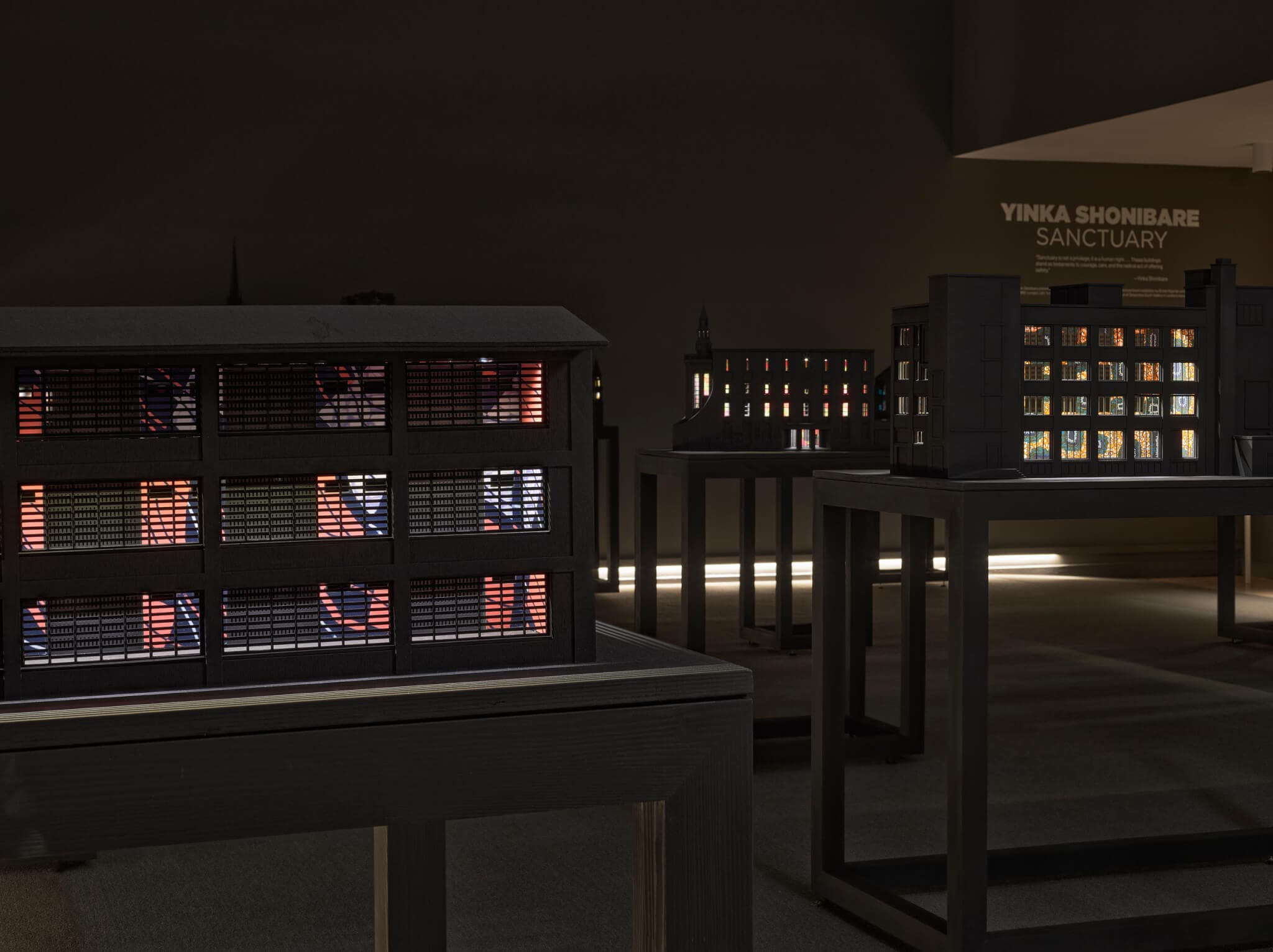
“Yinka Shonibare: Sanctuary,” the American premiere of Sanctuary City (2024) by the internationally celebrated British Nigerian artist Yinka Shonibare, is on view at the Rose Art Museum through January 3, 2027. Curated by Henry and Lois Foster Director and Chief Curator Gannit Ankori, the exhibition reflects upon the geopolitics of immigration, displacement, and persecution. First presented in “Yinka Shonibare CBE: Suspended States” at the Serpentine South Gallery in 2024, the work arrived in the United States amid renewed debates about and actions against those seeking shelter and those who offer sanctuary.
Working across painting, sculpture, photography, film, and installation, Shonibare explores the complexities of what he has termed the “postcolonial hybrid” and the dynamics of global exchange through a critical lens that is often theatrical and laced with irony. His work is distinguished by the signature use of Ankara, or “Dutch wax” fabrics, that have come to signify African identity while also reflecting histories of European colonization and industrialization within the African diaspora.
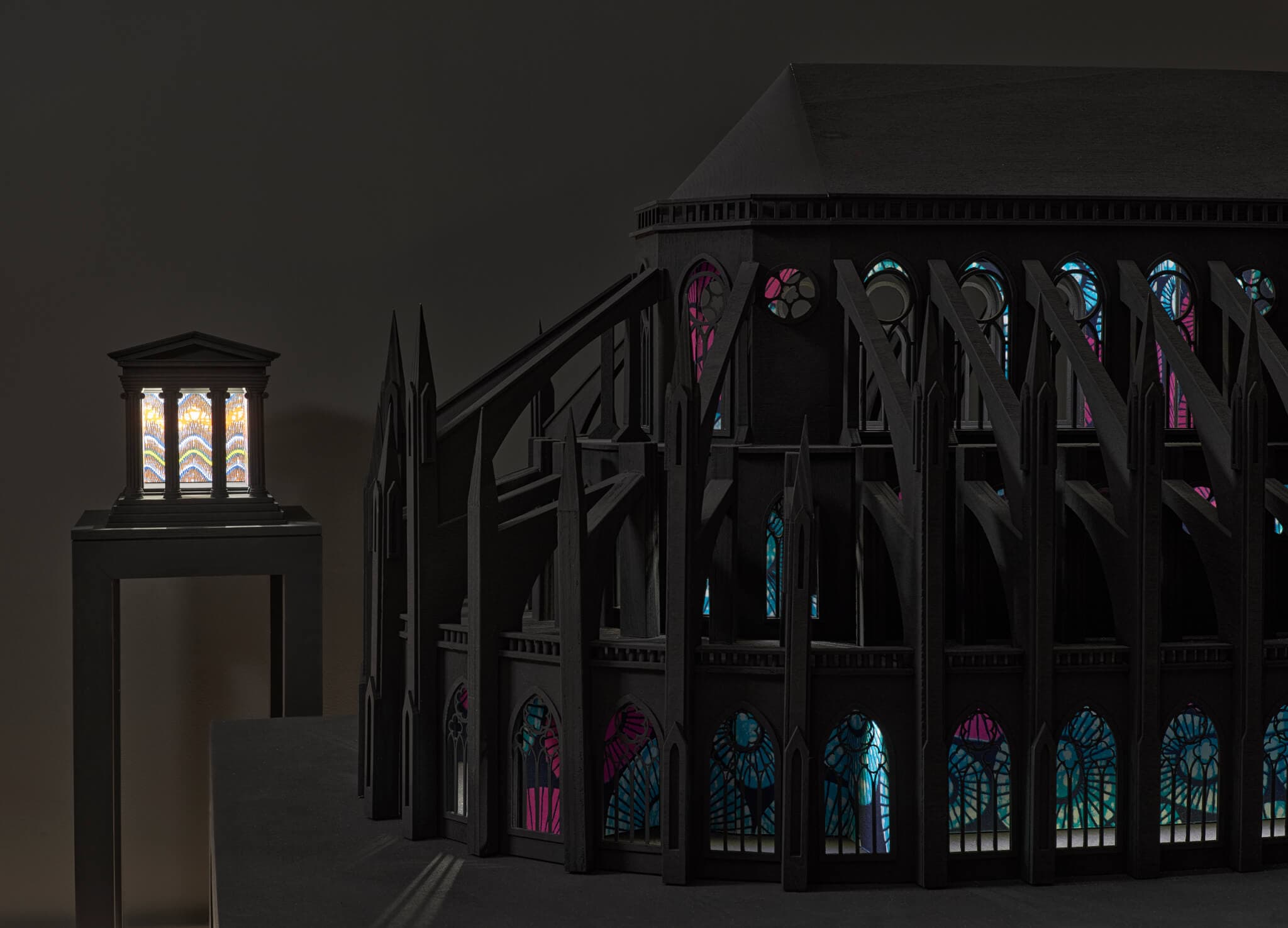
In “Sanctuary,” architecture becomes both the literal embodiment of and a metaphor for refuge. Sanctuary City unfolds like a vision of the night sky within a darkened gallery where the walls, floor, and architectural forms are rendered a deep black that envelops the viewer. As visitors move through a loose grid, details in the architectural models are revealed as darkness is punctuated by light and color. Lit from within, the darkened structures glow through openings animated like stained glass, radiating the intertwined legacies of African and European colonial histories. Shonibare has lined the interiors with Ankara prints, their fluid geometries suggestive of alternative conceptual frameworks and modes of sheltering.
The eighteen buildings span geographies and time periods while addressing the idea of sanctuary. These include sacred spaces such as the Temple of Athena Nike and Tōkei-ji, a Buddhist temple that sheltered women in the Tokugawa period, alongside secular buildings like the United Nations and the Bibby Stockholm barge, which came to symbolize failures of the UK asylum system. Together they trace a global continuum of exclusions, refuge, and generosity.
When “Yinka Shonibare: Sanctuary” opened in February 2026, the artist met with me over Zoom to discuss the origins of the work and his reflections on cities, architecture, the enduring necessity to shelter those at risk, and shelter as a human right.
The following conversation has been edited and condensed.
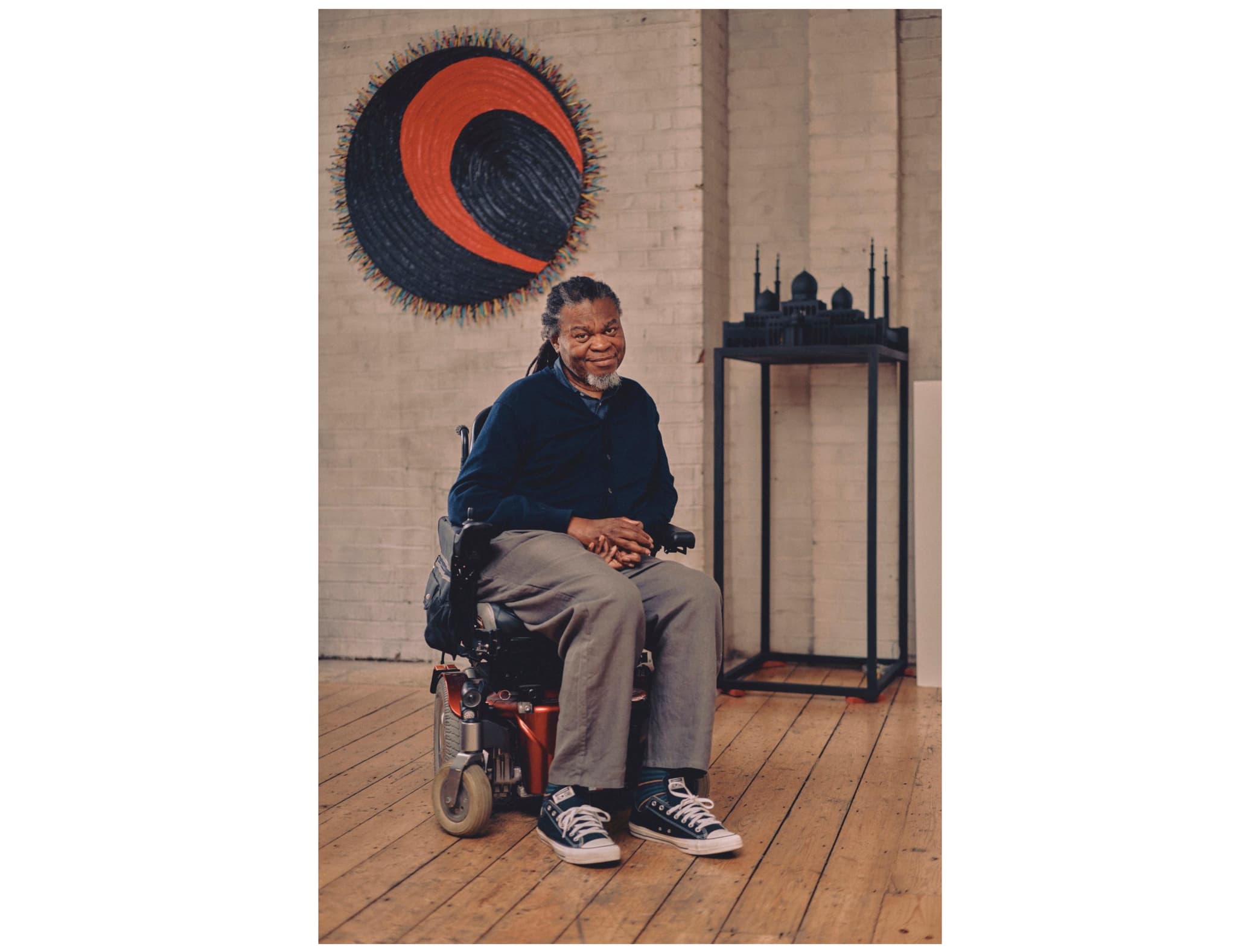
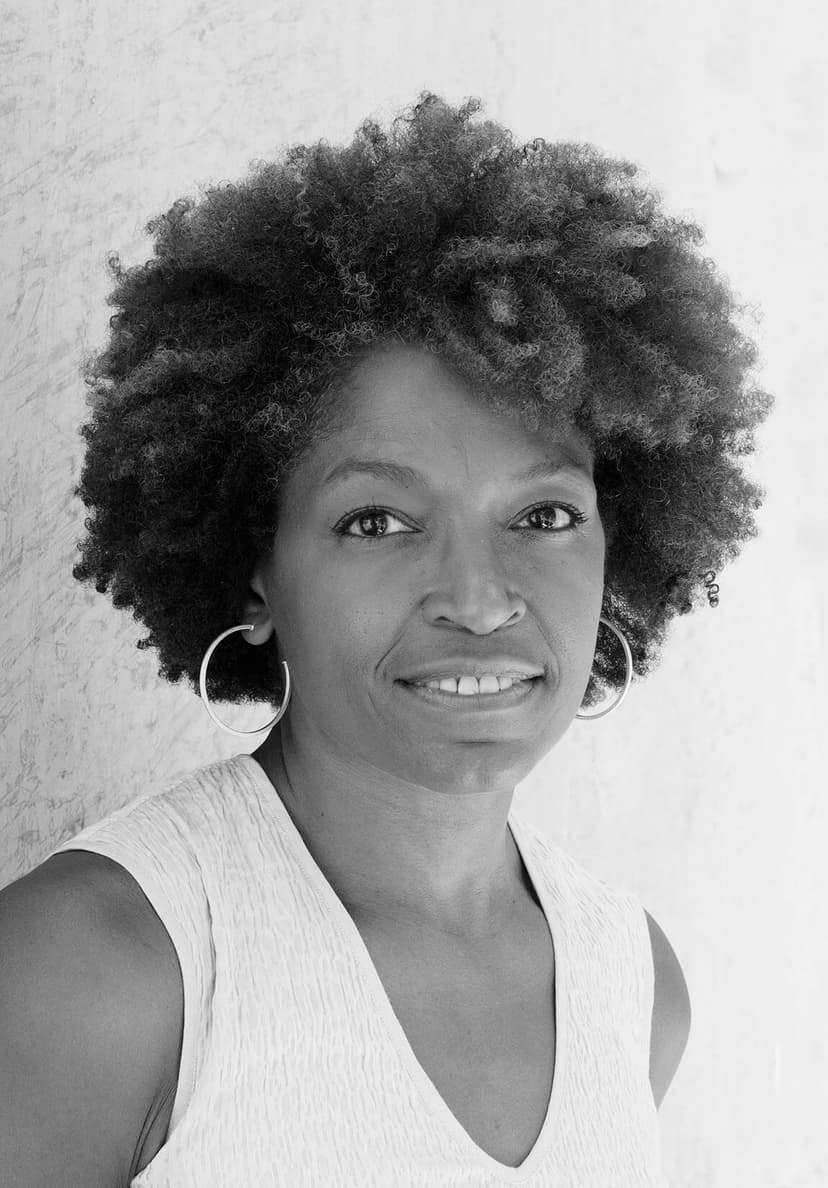
Portrait of Yinka Shonibare. Photography by Tom Jamieson. Image © Yinka Shonibare and Tom Jamieson.
Yolande Daniels: You were appointed a Commander of the Order of the British Empire in 2019 and have used the title to reflect on empire and postcolonial identity. Why is it omitted in “Sanctuary” at the Rose Art Museum? Yinka Shonibare: When I was appointed a member of the British Empire, it was quite common for many British Africans to refuse the honor because of the role of the empire. It’s a prestigious order to have in the United Kingdom, and I thought: Why should we as Black people always stay on the margins? So the point I wanted to make is that we too deserve to be honored. And so I understand that in the title it says “British Empire,” but in reality, the empire is kind of over. So I didn’t see why people had to refuse that celebration of their achievements just because they’re Black.
I want to be seen, to be visible. If that’s provocative for some people, that’s fine. But for me, it’s actually much more powerful to be at the center of the establishment as a Black person.
We’ve come to a point now where many people of African origin and Black people seem proud to have that after their name. So my point at the time [in omitting it] was a political one, and now I don’t see any need to do that.
JYD: You’ve referenced historical political moments as catalysts for particular works. For example, President Emmanuel Macron’s 2017 pledge to return twenty-six looted treasures to Benin informed your Monument to the Restitution of the Mind and Soul and your recreation of the Benin Bronzes for Nigeria Imaginary at the 2024 Venice Biennale. Were there particular catalysts or instances that directly informed the development of Sanctuary City?
YS: Well, as you know, the world seems to be moving towards the right more. Global conflicts have created many refugees, but then there’s also a resistance to the movement of people around the world. And so it was inevitable that I would make a work like Sanctuary City, because art is always about what’s happening around you. In thinking about asylum seekers and refugees, you have to ask how to allocate resources. And do you feel you are generous enough to accommodate others?
Human beings have always been nomadic. People seek better opportunities elsewhere. How do we manage that in a modern world? Do we do that by persecuting people? Have we done that by kindness historically? I had to look at the way we’ve historically helped refugees or people who might have been considered outcasts. I felt that looking at history again offered the best metaphor for exploring those issues.
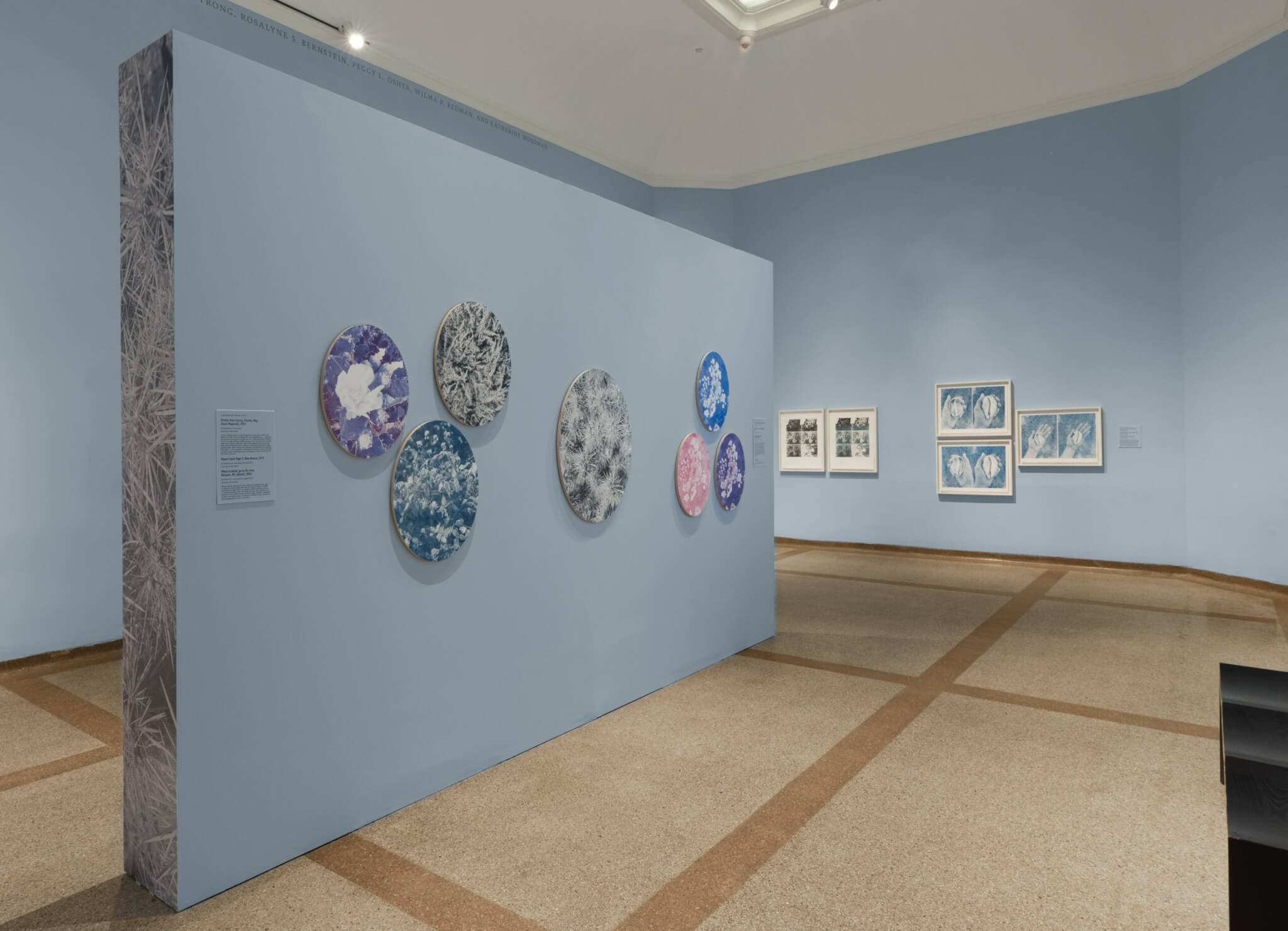
Installation view, “Yinka Shonibare: Sanctuary,” Rose Art Museum, Brandeis University, February 11, 2026–January 3, 2027. Julia Featheringill Photography. Courtesy of Rose Art Museum.
JYD: Your work engages postcolonial identity, imperial legacies, and the search for refuge, alongside the human right to shelter. How are these ideas shaping this work?
YS: Well, first of all, we created the United Nations to preserve human rights, to stop conflict. It seems to me that those fundamental values are somewhat disappearing. After the Second World War, nations really thought we mustn’t revisit that catastrophe again. But recently, all of those values seem to be getting erased one by one. As an artist, I’m not necessarily on one political side or the other. I reflect on the state of things. And through my work, I’m reflecting on the situation in which we find ourselves. Are we reversing some of those values that we all, by consensus, agreed upon?
Sanctuary City is about form and architecture and the role that architecture plays to support or deny values such as human rights and the right to shelter. The darkness of the buildings becomes a metaphor for darkness in our society, but then the light is a beacon within that. Physically, when you enter a dark space, of course you can’t see everything immediately, but then things start to appear in front of you. So there’s a kind of visual poetry as well, and the physicality of the space and the use of light is meant to affect you emotionally. And then the color from within that beacon, which is the result of the patterns of the [Dutch wax print] fabrics as well. And the fabrics also have a meaning and a history of their own.
JYD: The layout assembles fragments of city blocks across geographies, times, and scales. What shaped this organization, and does it challenge how we understand cities and architecture?
YS: Most vibrant cities are diverse in their nature and the architecture is also diverse. You go from France to the United Kingdom to America, and cities actually thrive on the idea of diversity because people are bringing many different cultural heritages to the space. And that’s what makes the city a place you want to be.
The notion of a sanctuary city, I must admit, was actually inspired by what was going on in the United States, but I didn’t want to limit it to that contemporary context. It’s also about architectural history, architectural styles, because some of the architecture is really fascinating. I wanted it to feel like a cityscape at night. But that city, by nature, is diverse and it spans time as well. So the city then becomes a metaphor to explore some of these big ideas. One of the pieces is the Peter Mott House in New Jersey where enslaved people were given shelter. That building represents the resistance of the people. So the buildings are not simply architectural structures. They are ideas in themselves.
JYD: In previous works, models served as study tools, while in Sanctuary City, models take on a metaphoric role. Could you address the shift in your use of models—from study tools to a metaphor for refuge and protection?
YS: I think there are two things going on there: the direction and the making. There are the skills required to actually make the models, and for that I use professional makers. So, my role there was directing. In a way, that’s how my studio runs. Basically I direct the various projects I want to do. I do the research, but then I give the research to skilled practitioners to actually make what I want made. So in that sense, it’s a collaborative project. I provide the material ideas, and I select fabrics, and I design the look rather the way that an architect would work. You’d make your architectural drawings or models, but you wouldn’t actually build the building yourself. You would have craftspeople or skilled people to then make it. I think I get my ideas across better that way because then I know I’m going to get the best skilled people to implement those ideas.
JYD: There’s an intimate act of looking, of bending down, of peering into the models. Did that have any kind of impact on the meaning of the work and the way that they shape the viewer’s physical and psychological engagement?
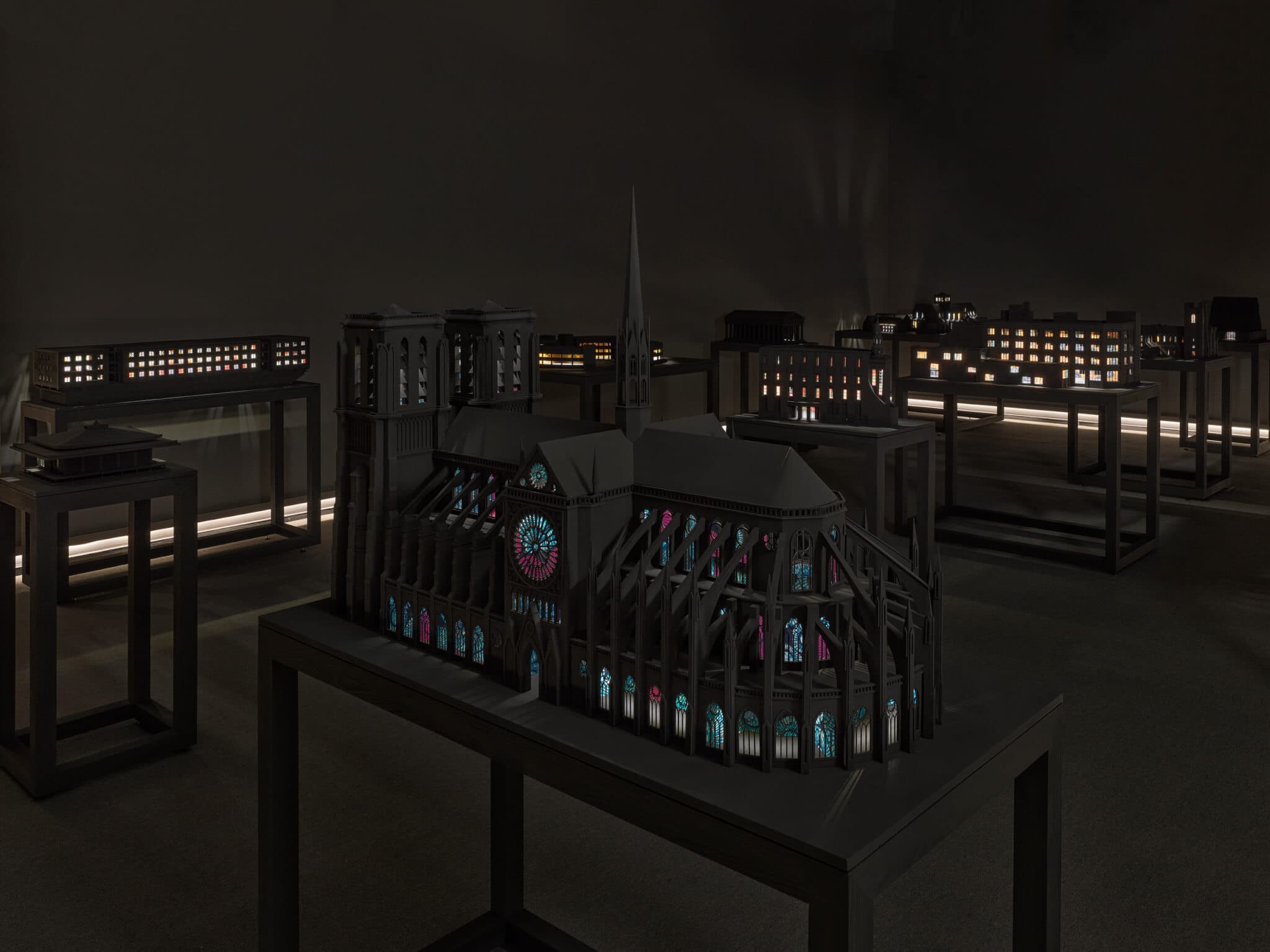
Installation view, “Yinka Shonibare: Sanctuary,” Rose Art Museum, Brandeis University, February 11, 2026–January 3, 2027. Julia Featheringill Photography. Courtesy of Rose Art Museum.
YS: It’s a very physical exhibition in the sense that it’s an installation, so it’s the whole of your body and your senses that are being engaged. You may have to bend to look at it or walk around it. Some people are affected by the light of the room; some people find it terribly sad. Your engagement with a painting is different because you stand in front of it and you look at it. But [with Sanctuary City], your physicality is involved in the work. And that’s, I guess, why it’s special. It’s the same way with architecture—your whole body has to engage with it.
JYD: I was struck by the interiors and Dutch wax fabric, particularly in the Peter Mott House model, where a gridded pattern seems to camouflage openings. Am I reading into it?
YS: I don’t know if you’ve seen any of the costume pieces [such as How Does a Girl Like You Get to Be a Girl Like You? (1995)] I made earlier, but the interesting thing about working with those fabrics is that you find there’s a kind of incongruency about them. For example, you make a Victorian dress with a fabric pattern with clocks on it or something. When you juxtapose two supposedly opposing things, you get different layers of meaning. They’re kind of poetic plays with visual language. The juxtaposition allows you to create a third meaning.
JYD: It made me wonder about the Dutch wax fabrics as—despite their colonial history—commonly representative of an association with Africa. And so when looking at the interiors, every single one is emanating an aura of the post-colonial diaspora. I just wondered if there was a deeper layer to that.
YS: In a way there is, because the African text is also historically loaded in terms of diaspora history. And then because there’s an ambivalence about them because on the one hand they’ve been claimed as being indigenously African. But then on the other hand, they’re Dutch, Indonesian, and mixed. The fabrics express that complexity of history because the fabrics belong to Africans, of course, because they’ve been claimed and appropriated by Africans. But then on the other hand, they do not belong to Africans. So they’re doing two things at the same time. That’s why I use the fabrics, because you have people who think I’m celebrating that they embody some kind of strong expression of Africa. Yes, they do. But there’s also a critical look at the construction of that identity at the same time.
JYD: How would you respond if I suggested that in reflecting on the Dutch wax animated interiors in Sanctuary City, each space—and by extension, the people who look at it—are all touched by Africa and a sense of Africanness?
YS: Well, I’m from the African diaspora, so I make work about that, but it’s just my starting point. The issue of sanctuary or refugees applies across the board. It’s not simply an African issue. I’m the author of my work, so I say it from my perspective. I imagine the audience would have some kind of empathy with the plight of people from the African diaspora, but it’s a broader question now. Globally there are millions of refugees from all corners of the world. So my ultimate aim is to make my work move beyond questions of Africa. In essence, if a work is strong enough then it should have a degree of universality to it. Those experiences are not just unique to the question of Africanness. And the colonial question is not simply African too. It moves beyond that.
JYD: The question is about the centrality of Africanness in the interiors. Do the Ankara fabric interiors suggest an alternative world order, or is that a misreading?
YS: My works are usually somewhere in between light and dark. I think that’s the essence of my practice. And so you do see the agency, of course, because I consider myself no one’s victim. But at the same time, you can’t hide the darkness because it’s there. We all have a history. You can’t hide that. So there is definitely agency in my work and the notions of empowerment, and of course, culture, which is bold and present in my work. But it’s also work that doesn’t shy away from showing that it’s not all roses.
JYD: Yes, that’s the central metaphor: In the darkness, there’s light.
YS: There’s exuberance.