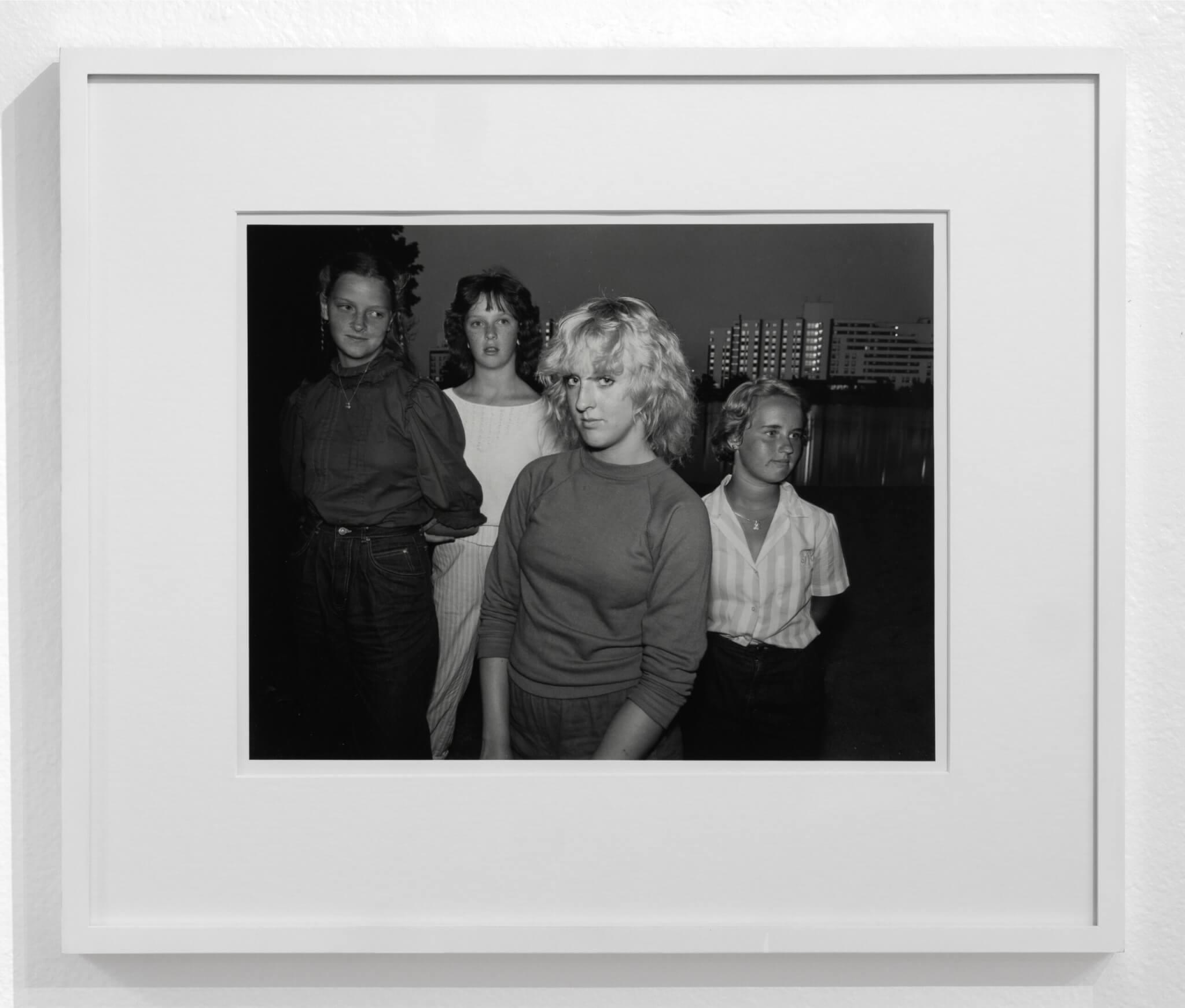
In his solo show “Bell Pond,” presented by Abakus Projects at Gallery 300, documentary filmmaker and photographer Stephen DiRado presents a vision of a communal refuge in the heart of his hometown and a new perspective on the first photo series of his career. The single white-walled basement gallery is packed with twenty-nine large-format black-and-white prints that DiRado took in the early 1980s, shortly after graduating from Massachusetts College of Art. Freddie and Theresa, Bob and Tammy, John, Tonia, and Maverick (all 1983): Every work bears the names of its photographed subjects, all connected, and sometimes upstaged, by Bell Pond, the urban park they all gathered in to escape the heat of the summer in 1983.
DiRado, a Worcester native, had driven past the pond earlier that year, tucked just outside of the city’s downtown, and had become set on photographing the beach and parkgoers. While often concerned with recognizable signatures of the time—shirtless Budweiser-drinking twenty somethings; parentally posed swim-drenched families; and preteen girls in shiny one-piece bathing suits sharing cigarettes—the strength of these images lies in an intimacy that peeks out behind layers of hot summer swagger. Every portrait is underscored by the relationship the artist has with his subjects: DiRado is less like an outsider photographing the public and more like a friend capturing a birthday party. In Bob, Bob, George, and Bob (1983), an image of four shirtless friends drinking beers in their blue jeans, it’s clear that DiRado is photographing them with their explicit permission and participation. They feel comfortable posturing, like movie stars in a magazine foldout, harsh brows and performed frowns, one Bob prominently displaying his drinker’s stomach. It’s this tension between self-fashioning and disclosure that “Bell Pond” plays with so effectively. Through the trust and the participation of the subjects, we are shown the parts of themselves that they value and the parts they’d like to conceal. DiRado understands that allowing for this performance disarms his subjects. By inviting performance, he encourages his subjects to take on aspirational forms that become vessels for their concealed authenticity.
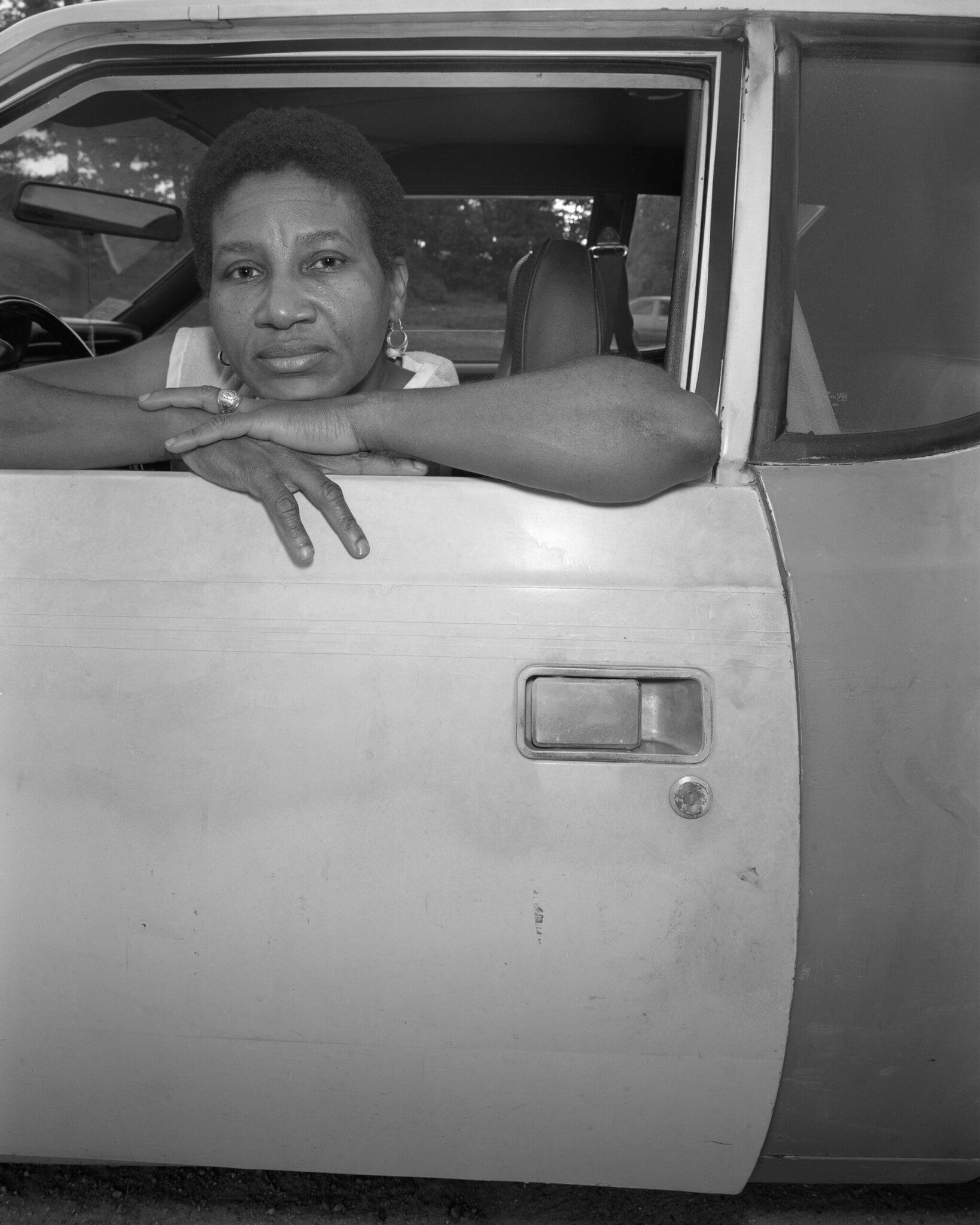
Stephen DiRado, Calvin, Bell Pond, 1983. Courtesy of the artist.
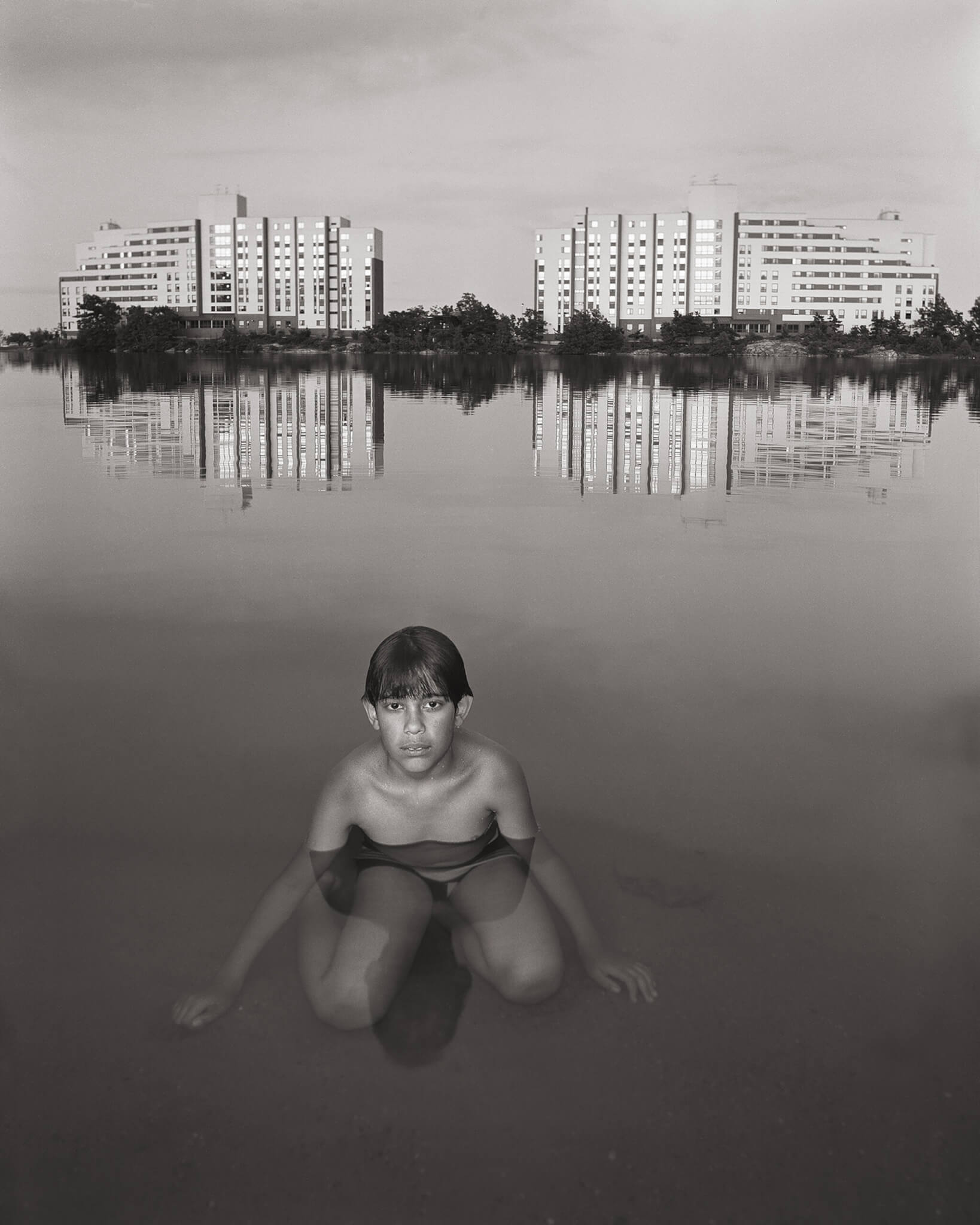
Stephen DiRado, Tim, Bell Pond, 1983. Courtesy of the artist.
In an essay DiRado penned for his new monograph (TBW Books, 2026) of the same title, he cites the Bell Pond series as a formative blueprint that would help develop the philosophy of his photographic practice. “What I had accomplished was not a formulaic stamped-out essay, but a standard for all the projects that would follow in my career.” He says that on his first day bringing a camera to Bell Pond, he was quickly surrounded by a throng of Worcesterites, curious about who he was, why he was photographing, and if he worked for the cops or the newspaper, or something else entirely.
For the exhibition, DiRado’s twenty-nine photographs line the otherwise blank walls of Gallery 300, most matted in white or gray frames made by the artist. It is a curatorial decision that fits the ethos of the Bell Pond series, maintaining a steady horizon line across works while situating the viewer within a populated landscape.
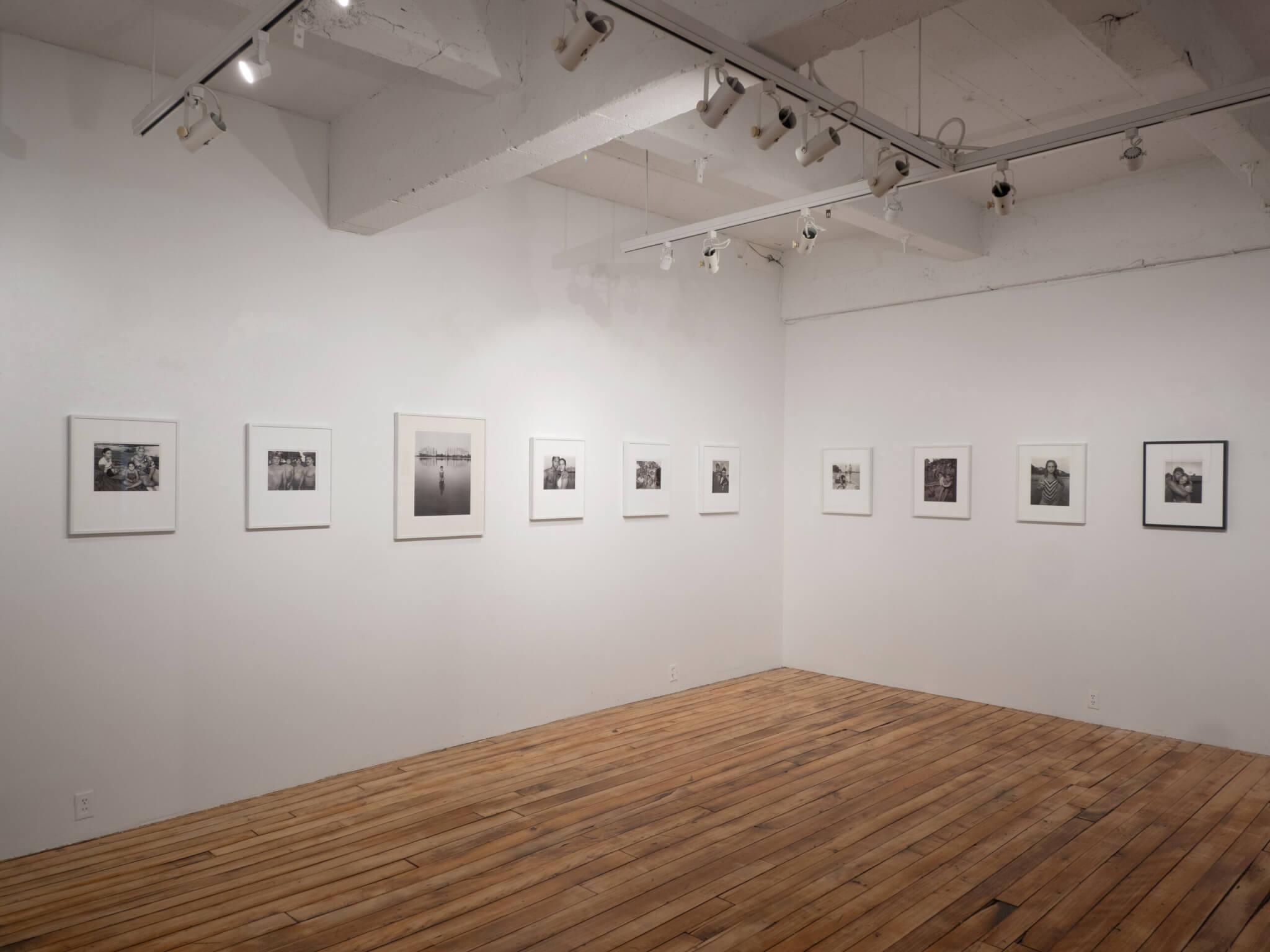
“Stephen DiRado: Bell Pond,” Gallery 300, 2026. Courtesy of Abakus Projects.
“Bell Pond” is visually watermarked by the details of the park’s environment, a blend of imposing mid-eighties Massachusetts urbanism and the stillness of a large, glassy pond. On many horizons, we see the office parks or housing developments that shoulder the parties and picnics and romantic afternoons that populate the park. They act as a reminder of time and place and the larger world, such as in Tim (1983), a shot of a solitary young boy dwarfed by the natural and manmade features of the landscape. Works that depict lone subjects are rare in this series, so when they do appear in Tim or Calvin (1983), hanging near the far end of the gallery, they seem solemn and meditative. Calvin shows a middle-aged woman leaning out of the driver’s side window of a busted car, what looks to be an old Crown Victoria police cruiser, her arms folded neatly on the sill. In her, we do not witness the bravado of the drunk boys, the spark of rebellious young smokers; instead, we are shown an intimate vision of one woman’s solitude. She seems distant and detached, her shoulders slumped to distribute her weight over the edge of the car, her gaze is loose and unfocused. We see her truly disarmed; we get the feeling she has given permission, license for the photographer—and, by extension, the audience—to feel with her. It’s a testament to a young DiRado and the whole of his Bell Pond series that he’s always able to inspire an unassuming comfort in his subjects, enabling the community to experience their friends, dress up, rebel, drink, smoke, wear their blue jeans, display their new tattoos, and bear the complexity of their humanity on film.
These pictures debuted at a local gallery in 1984. The opening was filled with mostly the beachgoers of Bell Pond, coming to see themselves and each other mounted on the walls. Stephen DiRado says he keeps in touch.
“Stephen DiRado: Bell Pond” is on view through December 4, 2026, at Gallery 300, 300 Summer Street, Boston, MA.