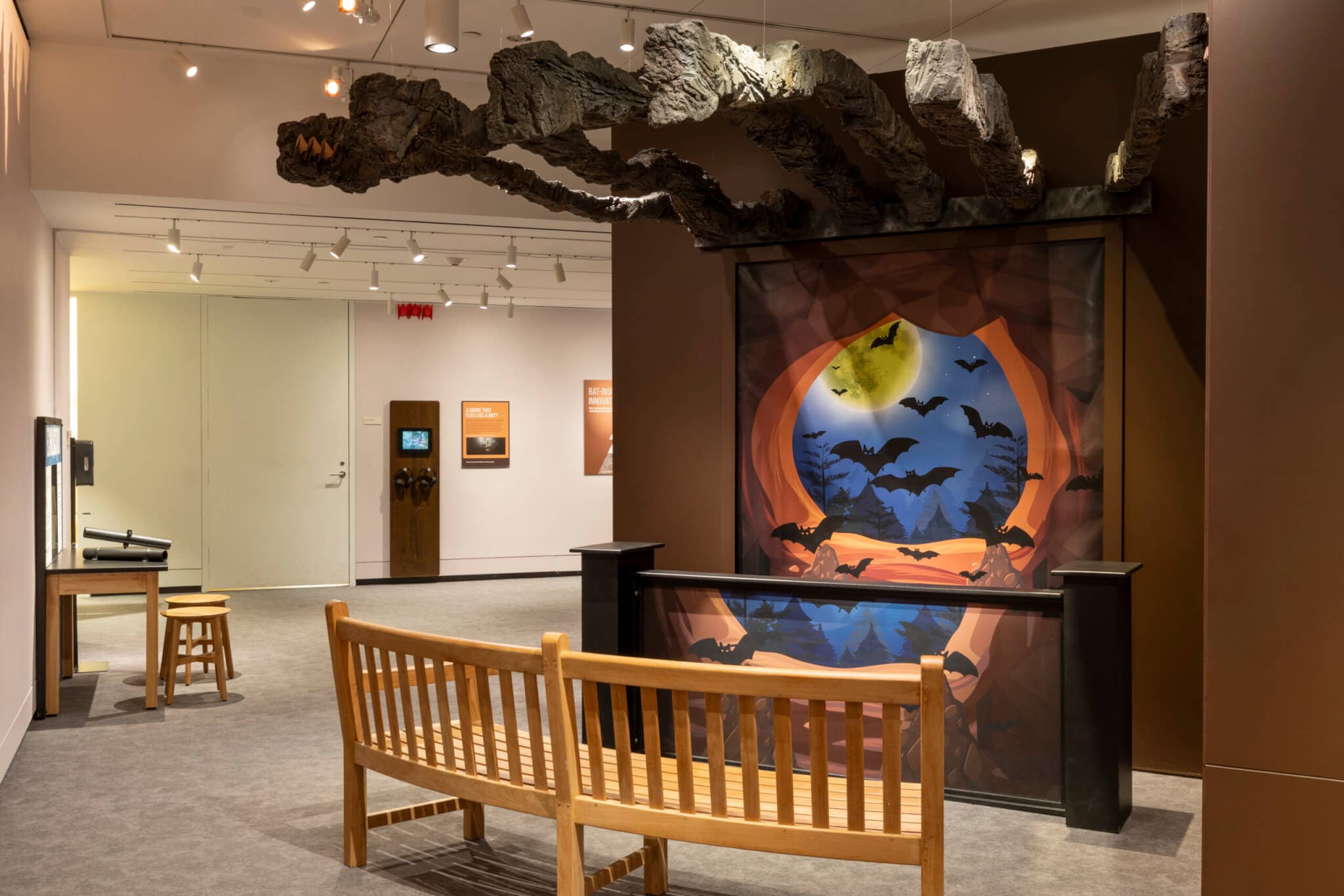
In the Peabody Essex Museum’s current Dotty Brown Art & Nature Center exhibition Bats!, we are ushered into a dimly-lit chamber of artifacts, natural phenomena, and images dedicated to this specific fascinating animal. The bat holds a certain degree of symbolic menace. Examples from art, science, and history are all on view, creating an impression of a dominant life-form with great social and environmental influence. The room is a classic Wunderkammer, a cabinet of curiosities, replete with bat-centric objects and documents, both symbolic and descriptive, such as diagrams of bat biology and examples of artwork that take the bat as the primary subject. But in an uncanny twist, greeting you in the very back of the room—protected and secretive in a dark corner—the animal itself lurks. A watcher whose physical presence immediately overwrites and recontextualizes all of the referential material that surrounds it, the vital presence of this animal and its enigmatic gaze changes how we inhabit the space.
“We call them our bat ambassadors,” says Jane Winchell, the curator of the exhibition which closes July 28. The small group of live Egyptian fruit bats peers out at the audience, inhabiting a mysterious subjective reality, much like the cryptic anamorphic figure in Hans Holbein’s 1533 painting The Ambassadors, located in London’s National Gallery and ubiquitous in art history textbooks. And as in that painting, the exhibition contains a secret message about the ubiquity of darkness.
A noteworthy aspect of “Bats!” is how the work on view successfully reframes the bat, taking an animal often associated in European culture with fears of contagions like dangerous magic and rabies, and illuminating a competing, more optimistic, set of touchpoints. Some of the most exciting visual reference points in the show are articles from East Asia and South America, where, according to Winchell, bats are revered for “the way (they) move through the darkness of night with no apparent aid.” This seemingly magical ability brings images of bats to talismanic objects such as a Korean candle lantern (from before 1885) used as a practical and good luck aid in delivering babies, who are famous for arriving in the dark of night. A dark, ornate bronze bell in a wooden stand from eighteenth-to-nineteenth-century China serves a similar function of projecting the bats’ good luck into a space—in this case through sound rather than (the absence of) light. And a golden bat-man figure pendant made between 900 and 1600 CE by a Tairona artist in Colombia honors the bat as a totemic figure of transformation and extrasensory perception. Indeed, the object seems in practice to be a pair of mystical glasses, with eyeholes through which a shaman would gaze under the influence of the bat’s powerful form. The entire object is small enough to wear as a pendant or to cover the face. At the bottom of the pendant are the bat-man’s tiny feet, and his head is ornamented with an upwardly cascading curlicue of golden bars accented with dots and discs that also cover his eyes, emphasizing his ability to see in the nighttime without the aid of his eyes.
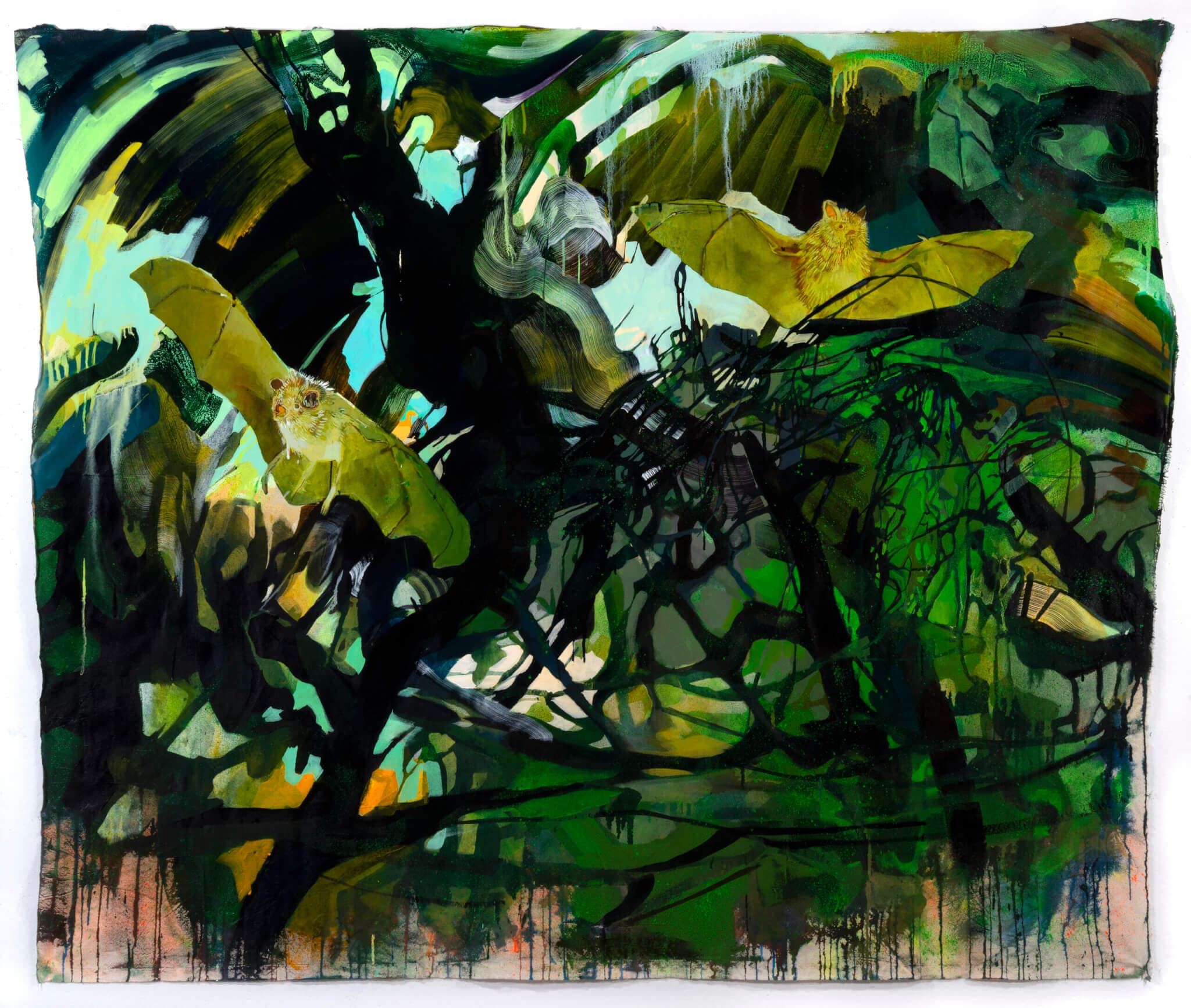
Rebecca Saylor Sack, Presence | Läsnäolo from Shadow Fliers series, 2022. Acrylic on muslin. Courtesy of the artist. Photo by Karen Mauch.
Examples from contemporary art add to this conversation in various ways—Lino Tagliapietra’s 2000 yellow glass sculpture The Batman, on a similar scale to the Colombian bat-man figure pendant, simplifies the bat figure through its elegant, abstracted shape and at the same time refers to the pop-cultural icon of Batman’s visual emblem. Michael G. LaFosse’s folded paper bat sculptures take a more specific look at the physicality of the creatures themselves, as in Big Brown Bat, Eptesicus fuscus, 1974. And Rebecca Saylor Sack’s calligraphic, luminous painting Presence / Läsnäolo from her Shadow Fliers series (2022) emphasizes the ethereal nature of the bat’s flight through its environment. The painting’s middle ground of loose brushwork and gestural mark making provide an airy setting for images of two carefully rendered golden bats, set apart by the tightness of their visual description. The bats sail through the dense and atmospheric tangle of black, green, and blue lines, suggesting a forest canopy at dusk and a shift from what is visually obvious to that which is extrapolated, or interpreted non-optically. The unstretched canvas is pinned directly to the wall, suggesting the flapping wings of the animal rather than the carefully contained edges of a framed painting.
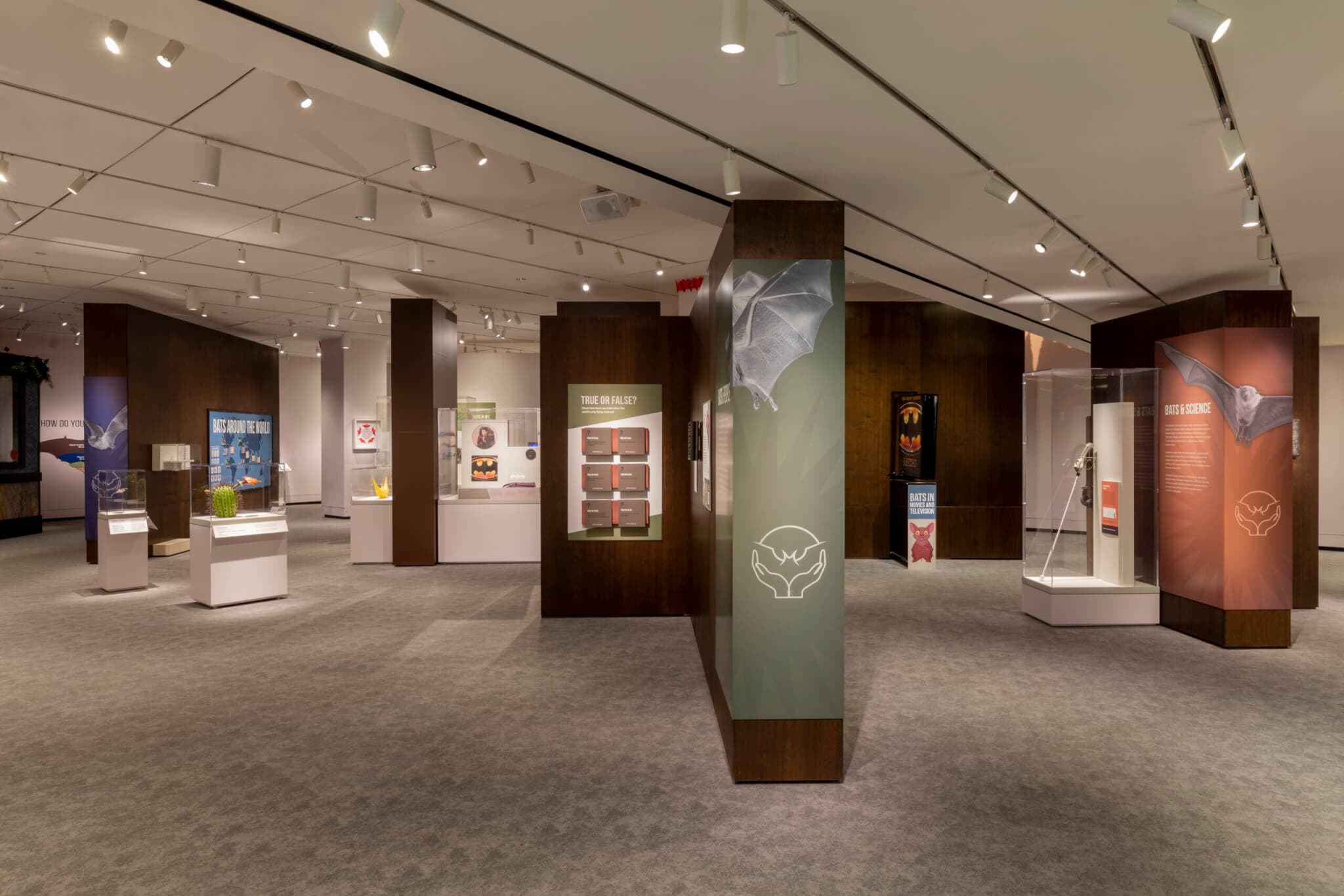
Installation view, “Bats!,” Peabody Essex Museum, Salem, MA, 2024. Courtesy of Peabody Essex Museum.
The scientific information on view is visually compelling—such as a large chart of life-sized bat wingspans, under the banner “How Do You Measure Up?” which provides another physical example of how the bat’s body engages space, and an informational film with a trance-like sequence documenting a bat on the hunt for nighttime insects. Winchell is quick to point out that bats are much more threatened by humans than any threat they pose to us—despite common belief, for example, less than one percent of bats carry rabies. Bats are pollinators, they reduce the population of disease-bearing insects, and they serve as nocturnal allies in ways that Bats! gracefully describes. The bat ambassadors, however, remain the hidden beating heart of the exhibition. Gazing out impassively from behind a screen like a clutch of nonhuman priests in an upside-down confessional, the bats of Bats! question our status as creatures whose lives are constrained by the inability to navigate the darkness of night without help. They call on a higher ability, which in our limited experience we can only faintly imagine through the creative engines of art and science.
“Bats!” is on view at Peabody Essex Museum, 161 Essex Street, Salem, MA 01970 through July 28, 2024.