Dominick Cocozza is an emerging artist who, quite literally, has been on the move. In “Me acuerdo (I Remember),” his first solo presentation since graduating from RISD in 2024, Cocozza mines his personal history as a transnational adoptee from Guatemala through the figure of the “worry doll,” a traditional Mayan toy that is represented as “protesting, journeying, and in kinship with one another, stewarding safe spaces of togetherness and discovery,” according to the exhibition text. A classically trained painter who returned to Guatemala in 2022 for the first time since being adopted in 2002, Cocozza soon after began painting the worry doll as a stand-in for himself and others in his immediate circle.
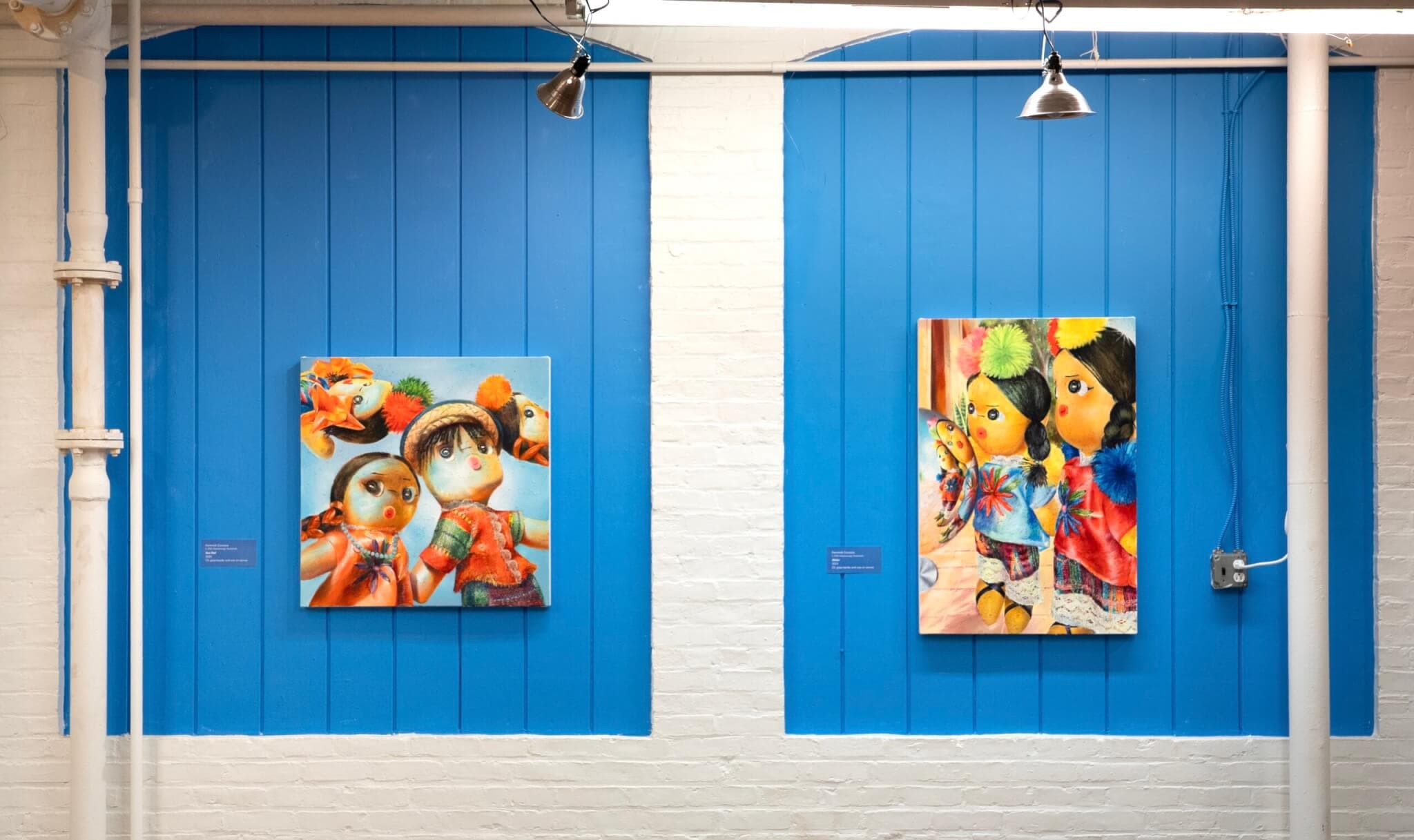
(left) Dominick Cocozza, Sun Dial, 2025. (right) Dominick Cocozza, Globe, 2025. Both oil, glass beads, and wax on canvas. Installation view, “Dominick Cocozza: Me acuerdo (I Remember),” Aunty’s House, Providence, Rhode Island, 2025. Courtesy of the artist.
Installed at Aunty’s House, an artist-run space, in Providence, that has artist studios and hosts exhibitions and community programs, “Me acuerdo” brings together a large body of Cocozza’s works that have latent visual references to the Indigenous craft and textile traditions instrinsically shaped by the Guatemalan Civil War. The thirty-six-year-long conflict resulted in a genocide of Mayan people and the forced displacement of thousands from their ancestral lands. Painstakingly handmade by Mayan women, these now-celebrated Guatemalan wearable textiles and crafts are palimpsests of history and memory, containing the material evidence of Indigenous peoples’ survivance over the decades.1 The worry dolls, in Cocozza’s adept hands, become yet another vehicle for storytelling, and in this case, brilliantly illuminate the creativity of Latine and Indigenous contemporary artists whose artwork builds new worlds north of the US border. Jumping in scale from massive to intimate, I am most interested in the ways that the paintings in “Me acuerdo” lean into the nostalgia of a lost childhood while simultaneously refusing the anthropological imperative to relegate Guatemala’s Maya Tz’utujil communities to the past. In the largest and most dynamic paintings, the worry dolls engage in daily, or common, activities familiar to most viewers in the US regardless of social or geographic location: drinking and sharing chisme, or gossip, among friends; protesting for Indigenous and migrant rights; meeting in the park to celebrate with fireworks after dark. These actions are universal and contemporary: Cocozza’s dolls very much inhabit our present world from their respective locations suspended between childhood and adulthood.

Dominick Cocozza, No Signal, 2025. Oil, sand, and wax on canvas, 48 x 36 inches. Installation view, “Dominick Cocozza: Me acuerdo (I Remember),” Aunty’s House, Providence, Rhode Island, 2025. Courtesy of the artist.
Several of the most intriguing paintings in the exhibition disorder proportion, scale, and perspective to illustrate the more-than-human qualities of these soft figures. In my favorite work, titled No Signal (2025), two girl-dolls stand at odd angles to one another on a desolate cobblestone street; one street lamp illuminates their path, the only other light source emanating from the glowing screen of a cell phone opened to its front-facing camera that one doll inexplicably holds. The face of this doll in the foreground is in soft focus, contrasting with the almost hyper-detailed cobblestones and rocks above and behind her and her companion. The two dolls exist on a strangely flattened and foreshortened picture plane mimicking that of a high-definition iPhone photo—a cheeky reminder for viewers to recognize both Indigenous and mestizo Guatemalans at home and abroad as fully in control of their own representations. Hung nearby is another standout, Globe (2025), in which one doll’s figure expands to fill nearly the entire canvas, her face and body multiplied across mirrors that consecutively focus and zoom closer into her face. This doll almost leaps off of the canvas, and her three-dimensionality is emphasized with the glass beads that Cocozza has embedded beneath layers of paint, creating textures that may refer to the gravel and concrete of city streets or rural paths. As she looks at herself in these endless mirrors, the doll’s blank eyes and pursed lips make me consider: How does she feel about her many reflections? Furthermore, I wonder if any of these larger-than-life dolls are still pretending to solely be inanimate objects designed for the comfort or play of their (human) owners, or have by now fully refused being possessed by others to become beings in their own right? The same questions might be asked of transnational adoptees and other Latine migrants who have been (and continue to be) forcibly displaced, and which will remain with me long after this tender and vibrant presentation of “Me acuerdo (I Remember)” closes on November 6.
1 Gerald Vizenor, Chapter 4 “Aesthetics of Survivance” in Native Liberty: Natural Reason and Cultural Survivance, (Lawrence, KS: University of Nebraska Press, 2009) pp. 85–104.
“Dominick Cocozza: Me acuerdo (I Remember)” is on view through November 6, 2025, at Aunty’s House, 25 Acorn Street, Providence, Rhode Island.