Painting, photography, performance, sculpture, playwriting: Arnold J. Kemp has done it all. An artist with a maverick approach to making, Kemp’s thirty-five-year career has been defined by a complete disregard for the constraints of definition. Instead, the Boston-born maker embraces a punk ethos of experimentation and reinvention, constantly testing the boundaries of both material and representation.
Marking the occasion of his first institutional survey, “Not One Thing,” on view at Tufts University Art Galleries, Kemp joins Cierra Michele Peters, artist, curator, organizer, and the director of communications, culture & enfranchisement at the Boston Ujima Project, to discuss his early years in the city, his time at the School of the Museum of Fine Arts and Tufts, and his philosophical approach to art-making—one that embraces the plurality of identity, the power of play, and the stakes involved in seeing and being seen.
The following conversation has been edited and condensed.
Cierra Michele Peters: You grew up in Dorchester; you went to school in Fenway. And you ended up going to Tufts and the School of the Museum of Fine Arts (SMFA) for dual degrees in literature and studio art. What were you making back then?
Arnold Kemp: I worked in the school library with Ellen Gallagher. She’s amazing. We started a group called Spectrum, and it was meant to give gallery shows to people of color, especially Black people at the museum school, because we were not being included.
I was making paintings; I was making sculpture. I did a lot with alternative photo processes like cyanotypes and Van Dyke brown prints and lots of weird chemical things. I also knew how to work in a series, so one experiment could lead to many things. I took a lot of watercolor classes. People were like, “Oh, you should paint in oil” or “I love your work. Why can’t it be bigger?” I also heard, “You’re too smart to be an artist. You would be a much better artist if you thought less.” But I did meet faculty there who really got it and saw that I was a real artist. And the person who said I was too smart to be an artist actually apologized to me. He came to me and told me that his wife told him I was an incredible artist and that he should apologize.
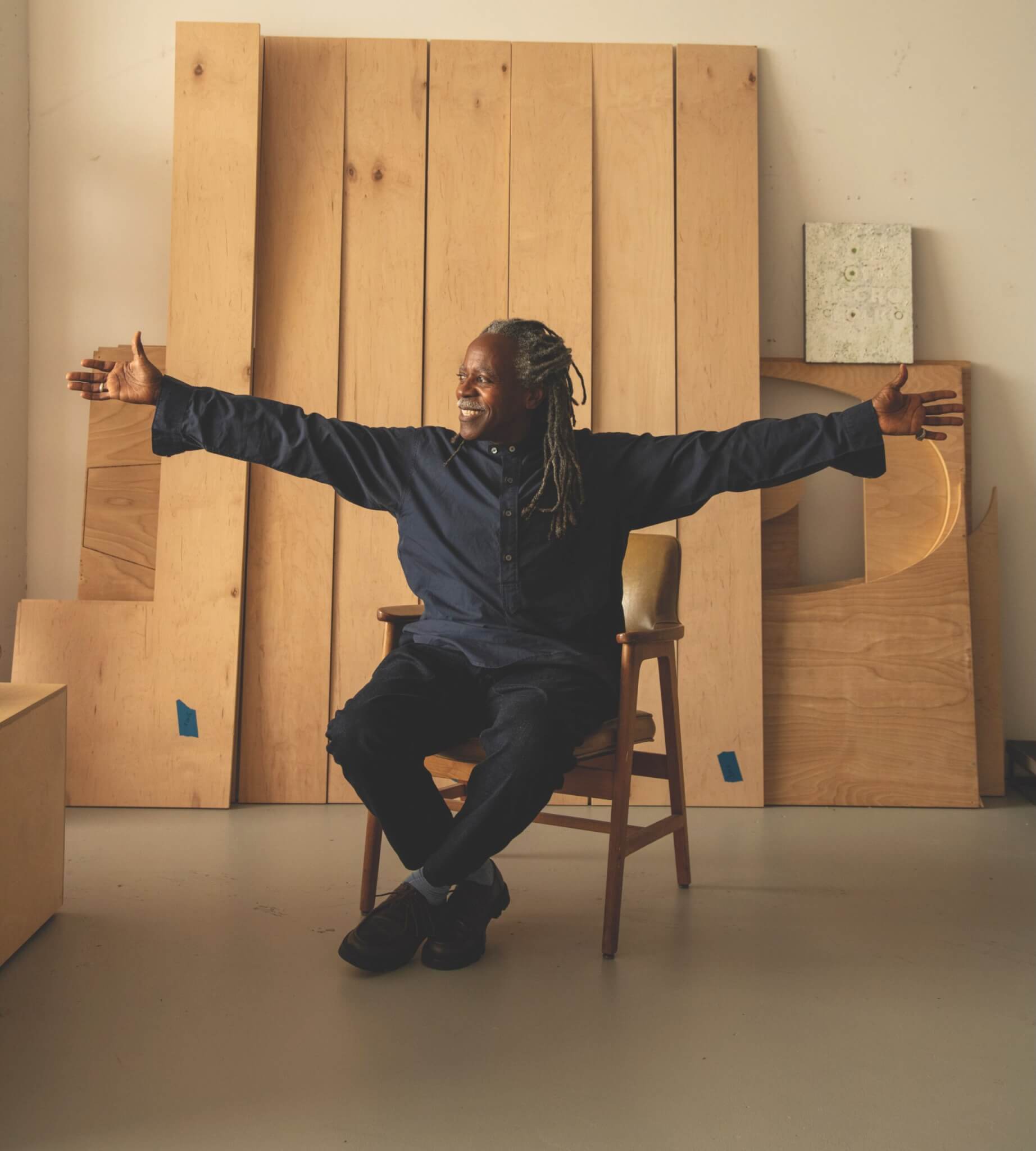
Portrait of Arnold J. Kemp in his Chicago studio, 2026. Photo by Kevin White for Boston Art Review.
CMP: I’m curious about the spaces, the scenes, the people that shaped you, and if you see a line between your later commitments to alternative spaces and your earlier work?
AJK: At Tufts, I was part of what was called the Arts House. We organized poetry readings and art exhibitions for other artists. Fifteen students living together, a very diverse group: the nerds and outcasts and skater kids, the punk kids, and kids who wanted to be in rock bands. I feel like supporting other artists—or starting a space to support other artists—is what I have been doing since the ’80s. We would bring in really big artists, like Tim Rollins, Marie Howe, and Nicholas Nixon, to lecture us. They would come for free, which was amazing.
When I left Boston in ’91, I moved to San Francisco and struggled
to get a job for three months, but then I got a job at a nonprofit called New Langton Arts basically doing that same thing. And there, I got to know artists like Daniel Joseph Martinez, John Baldessari, Robert Mapplethorpe, and Adrian Piper, who is a big cultural role model for me.
CMP: Is there something you learned inside of those spaces that you carry forth in your work now?
AJK: Many things, but I’m thinking of a particular moment when I was talking to Carrie Mae Weems. She’s brilliant. She said, “I see you’re struggling with trying to decide: Are you a poet? Are you an artist? Are you a curator? And you’re trying to get people to see you as an artist, but people identify you where your power is.”
This is when I was curating solo shows for Nikki S. Lee and Laylah Ali. I was working with David Hammons and Katherine Dunham. So many people in New York saw me as a curator. I didn’t want to use my relationships as a curator to promote myself as an artist. One day, Thelma Golden said to me, “Arnold, why didn’t you tell me you’re an artist?” And I said, “Oh, because I really respect our relationship, curator to curator, and I didn’t feel right about that.” She said, “Well, Mark Bradford told me you’re an artist.” And then Thelma put me in “Freestyle” (2001), which was a big, big thing.
What I learned from working with those spaces is although I still have commercial galleries that sell my work, and I show my work in museums, I still show in those kinds of [alternative] spaces. A really important show I did a few years ago was in Portland, Oregon, in a former student’s garage. He started a gallery there. A museum bought eight of my drawings from those punk rock kids who started that space. And before that, I did a great show in another student’s closet in his apartment called “In the Closet.” It was all about R. Kelly. It had video and live fish and an aquarium and prints and found objects. It is one of the best shows I ever did. I want to see it somewhere else, but I don’t think anyone wants to deal with live goldfish.
And I have the big show at Tufts, right? But my next show is in an apartment gallery in Berlin that was started by another artist. We met in Chicago and realized we have a lot in common, and so the thing about community is that it’s a deep thread that runs through my work.
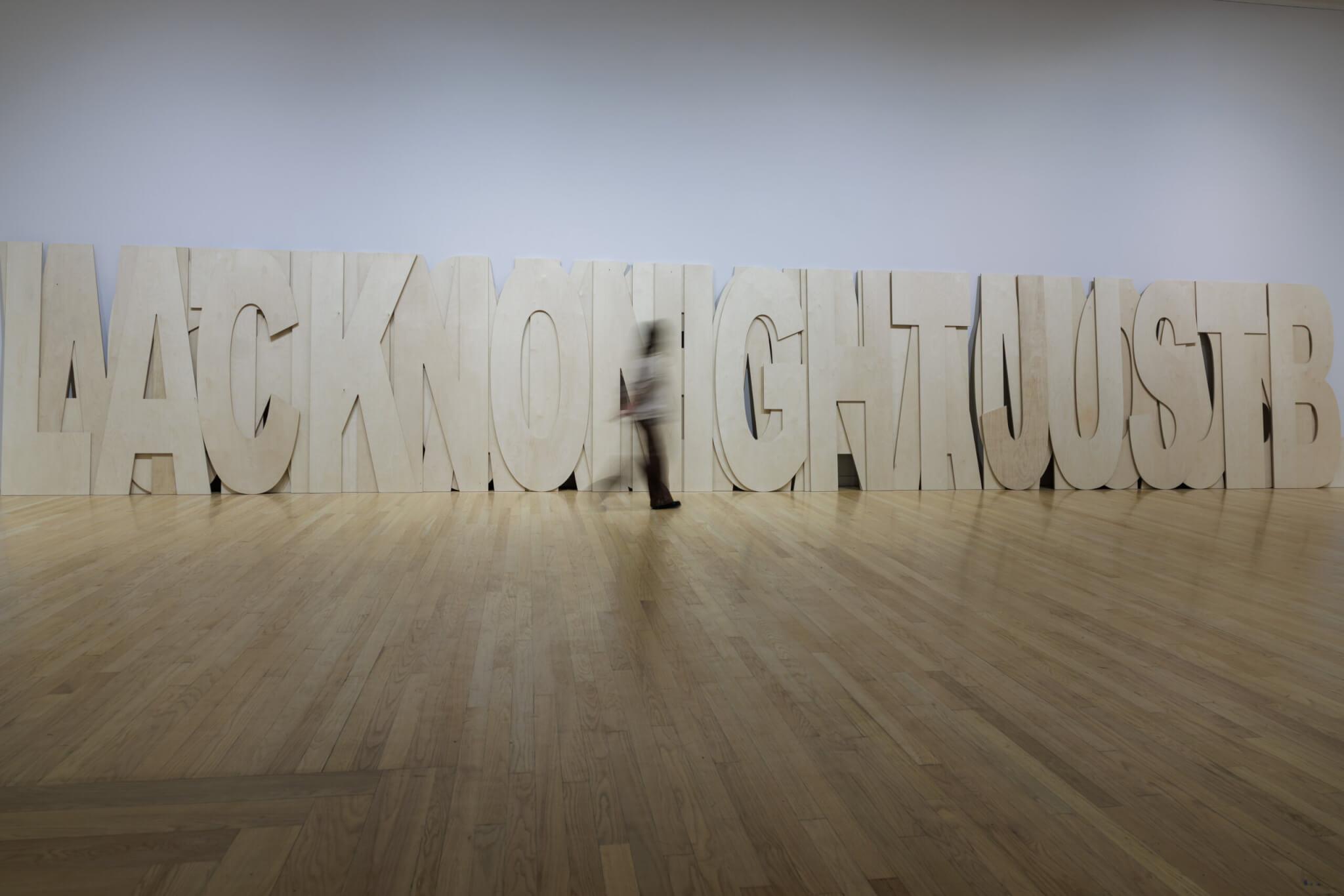
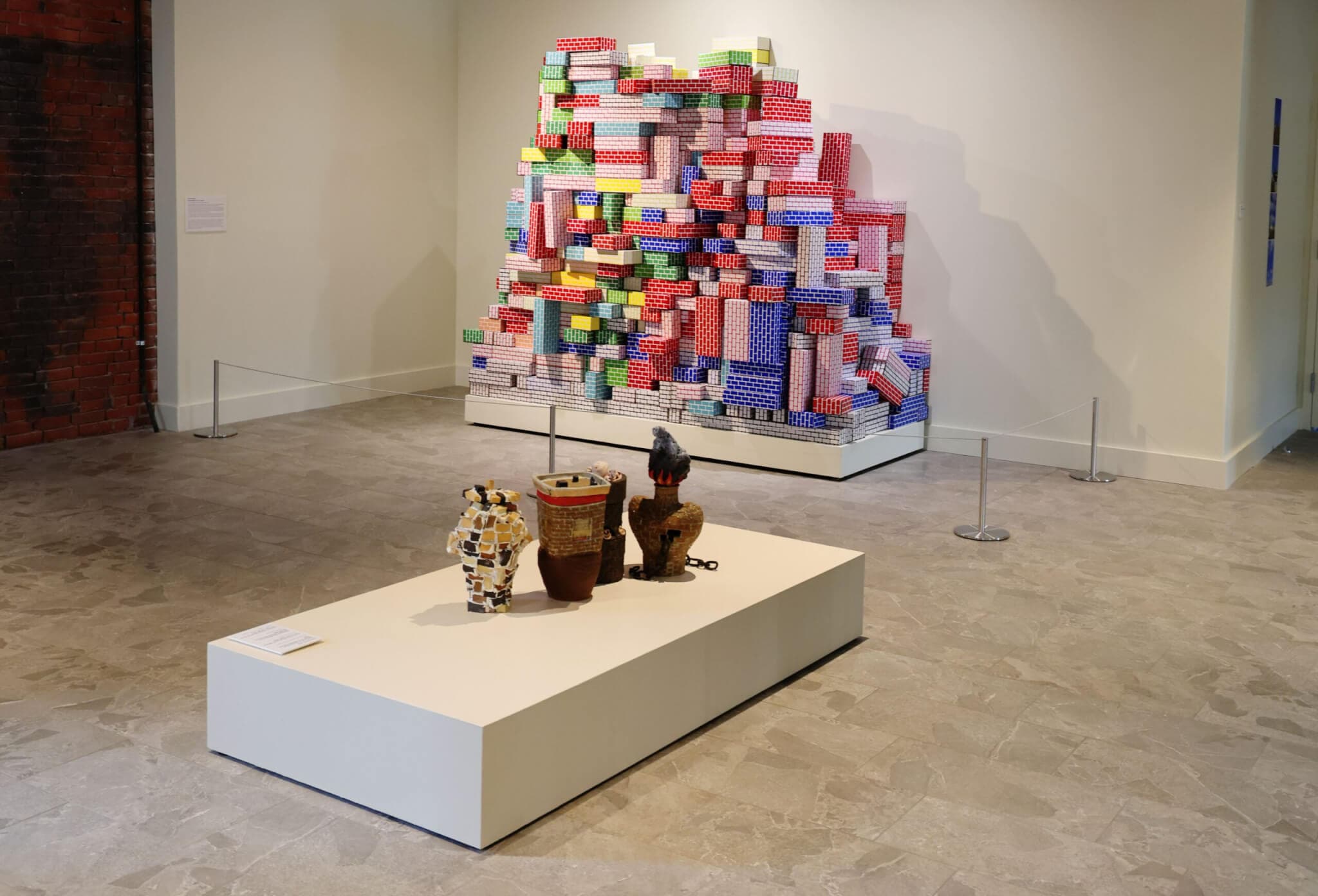
Installation view, “Arnold J. Kemp: Not One Thing,” Tufts University Art Galleries, Medford. July 29–December 6, 2026. Photo by Tim Correira.
CMP: I’m curious what you think an artist owes to the cultural ecosystems that make their work possible.
AJK: I’ve had this thought for a long time, and I think it comes from thinking about Hip Hop. When I was in grad school, I said to a really important art historian, “No one has ever written about the posse, in terms of artists acknowledging the community that they make art within. Hip Hop artists do it on the back of their albums. First they thank God, and then there’s a giant list of thank-yous. You know, Sol LeWitt and Mark Dion—we should be writing about their posses.” And he said to me, “That sounds very interesting. You could write about it.” And he turned his back and he walked away.
In terms of owing, I think we have to acknowledge that there’s a myth of the sole genius. You know, behind Mark Bradford, there really is a giant studio. Laura Owens, Jacqueline Humphries—they’ve thanked their assistants.
Oh, and can I say something else? In high school, not everyone could take AP art. You had to be nominated by one of the professors. And the AP art students got to take classes at the museum after school. I was in an art class that was run by a white woman. She didn’t nominate me.
And my friends—most of them were white, actually—said, “Arnold, you’re a better artist than we are. Why were we nominated and you weren’t? You should go talk to our art teacher.” She was a Black woman named Theresa Craddock. I went to Mrs. Craddock and I told her what was going on, and Mrs. Craddock nominated me to take those classes at the Museum of Fine Arts. She was the first person to ever buy an artwork of mine. That meant a lot.
CMP: I’m curious about the title of your show, “Not One Thing.” How did you come to that title?
AJK: Okay, so it wasn’t the first title. The first idea for the title of the show was “Tender and Haunted”—kind of like all these stories I’m telling you. I thought that title gave the whole show away too much. And I also was working on a book and I didn’t want the title of the book to be the same title as the exhibition.
So we were going back and forth about titles, and in the middle of the night, I woke up and thought, “Ah! ‘Not One Thing.’ That is a great title for the show.”
Because there’s painting, there’s sculpture, there’s photographs, there’s performances. But also, I think there are several through lines. And I think it’s in reference to who I’ve tried to be in the world: not being essentialized as Black, or queer, punk, whatever. I’m a lot of things, and I think it’s constantly changing, constantly evolving. It’s about a kind of freedom.
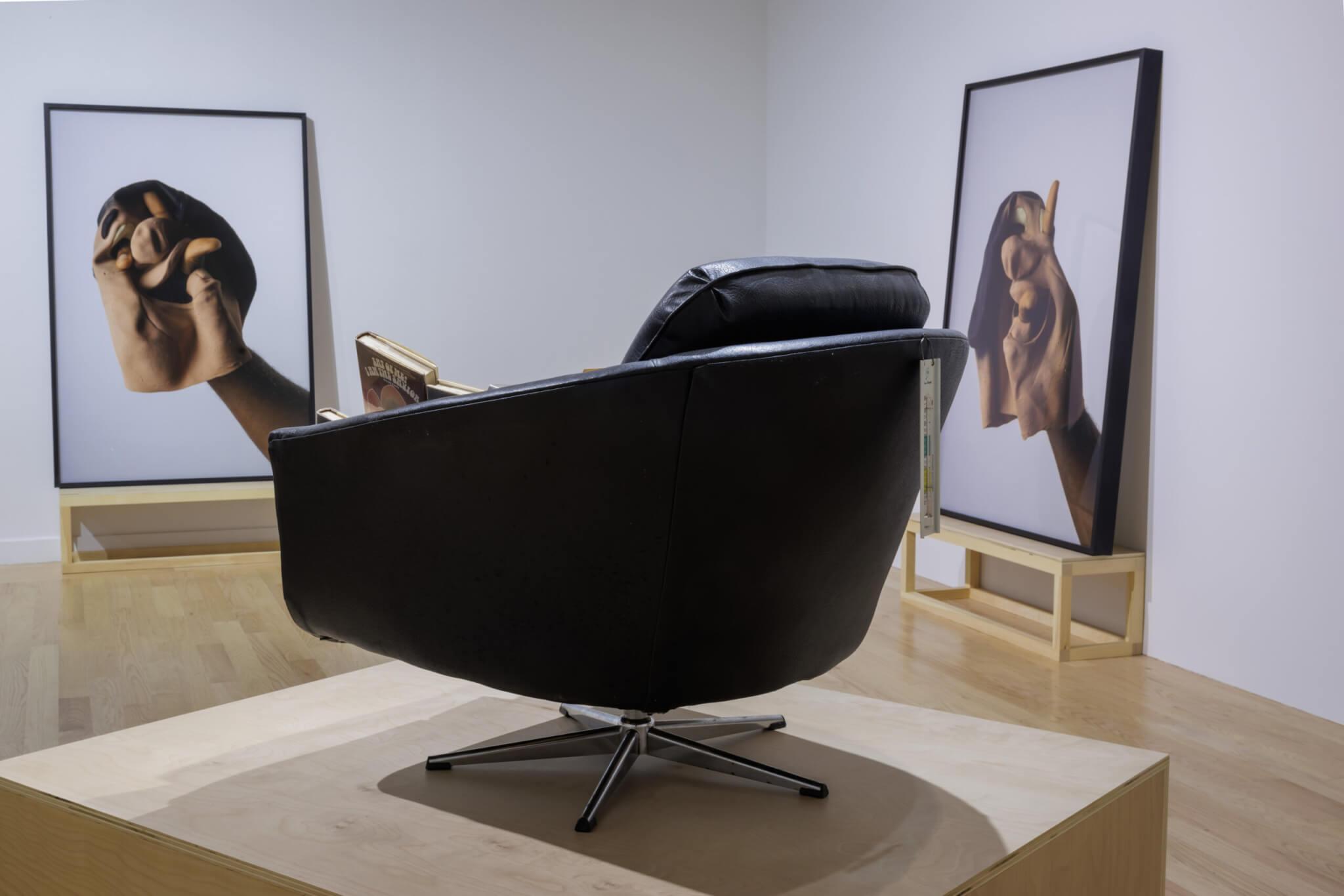
Installation view, “Arnold J. Kemp: Not One Thing,” Tufts University Art Galleries, Medford. July 29–December 6, 2026. Photo by Tim Correira.
CMP: I want to ask you about one of the works in the show, Mr. Kemp, Yellowing, Drying, Scorching. There’s a vinyl-covered chair. There’s a thermometer. There’s copies of this book, Eat of Me, I Am the Savior by another Black artist called Arnold Kemp. Can you talk about this idea of multiplicity or collectivity that recurs through the show?
AJK: It’s about the way artists think. I’m someone who notices things in the world that other people might not see. So the first thing I noticed was that novel in the early ’90s. Shortly after that, I got an email from a woman who asked me if I thought I had a half sister from Boston. And I wrote to her and said, “Oh, I think you have me confused with Arnold Kemp, the writer.” Also, around that time, I got an email from someone who said, “Hi, I was a student of yours in upstate New York, and I was in your play Black Masks, White Wounds.” And I said, “I’m sorry, you have me confused with an Arnold Kemp from another generation who could literally be my father.”
So then I thought, “I have to start collecting his book,” but I was just doing it to do it. No big project in mind. I did do a performance one afternoon in San Francisco where I stood on the street selling the novel like David Hammons’s snowball sale [Bliz-aard Ball Sale (1983)], but there’s no documentation of that. I did an installation in Europe where the books were just on a card table like they were for sale. Around 2020, I had this idea that I wanted to do an exhibition with not only that Arnold Kemp, but my father and my grandfather, and another Arnold Kemp with no relation to me, who’s a bodybuilder in LA. Anyway, it’s all super complicated. And none of this is possible without the internet. I did a Google search and saw there’s an Arnold Kemp who’s a Scottish newspaperman; there’s
Arnold Kemp, the novelist; there’s Arnold Kemp, the artist, the writer, the curator. I’m those three, right? It has to do with the way artists think—to follow a line of research, or to notice something other people aren’t noticing, and then to go deeply into it.
CMP: How long did it take you to collect all forty copies? It must be out of print by now, right?
AJK: It’s well out of print. I think I’ve been collecting them actively since at least 2003.
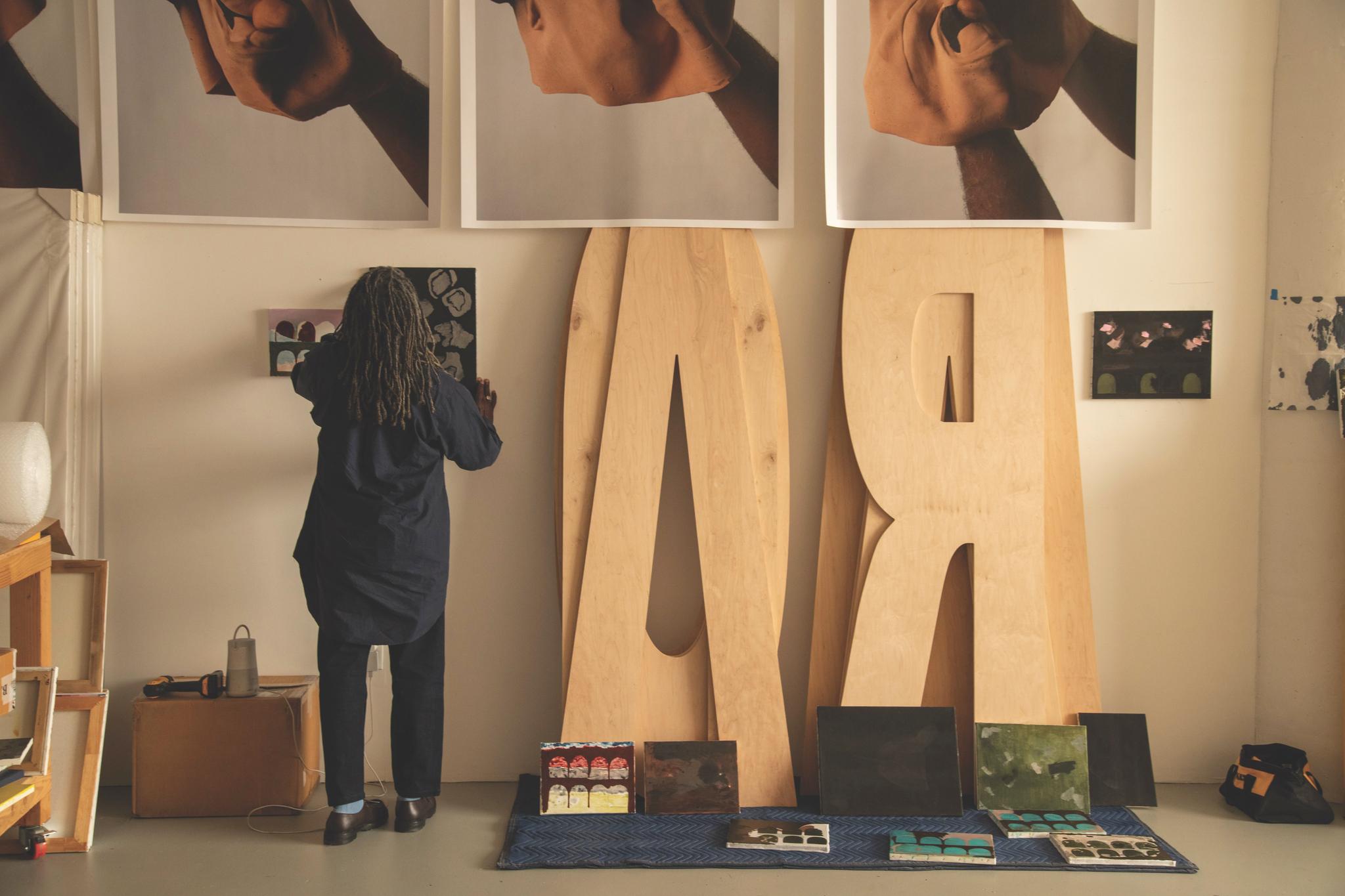
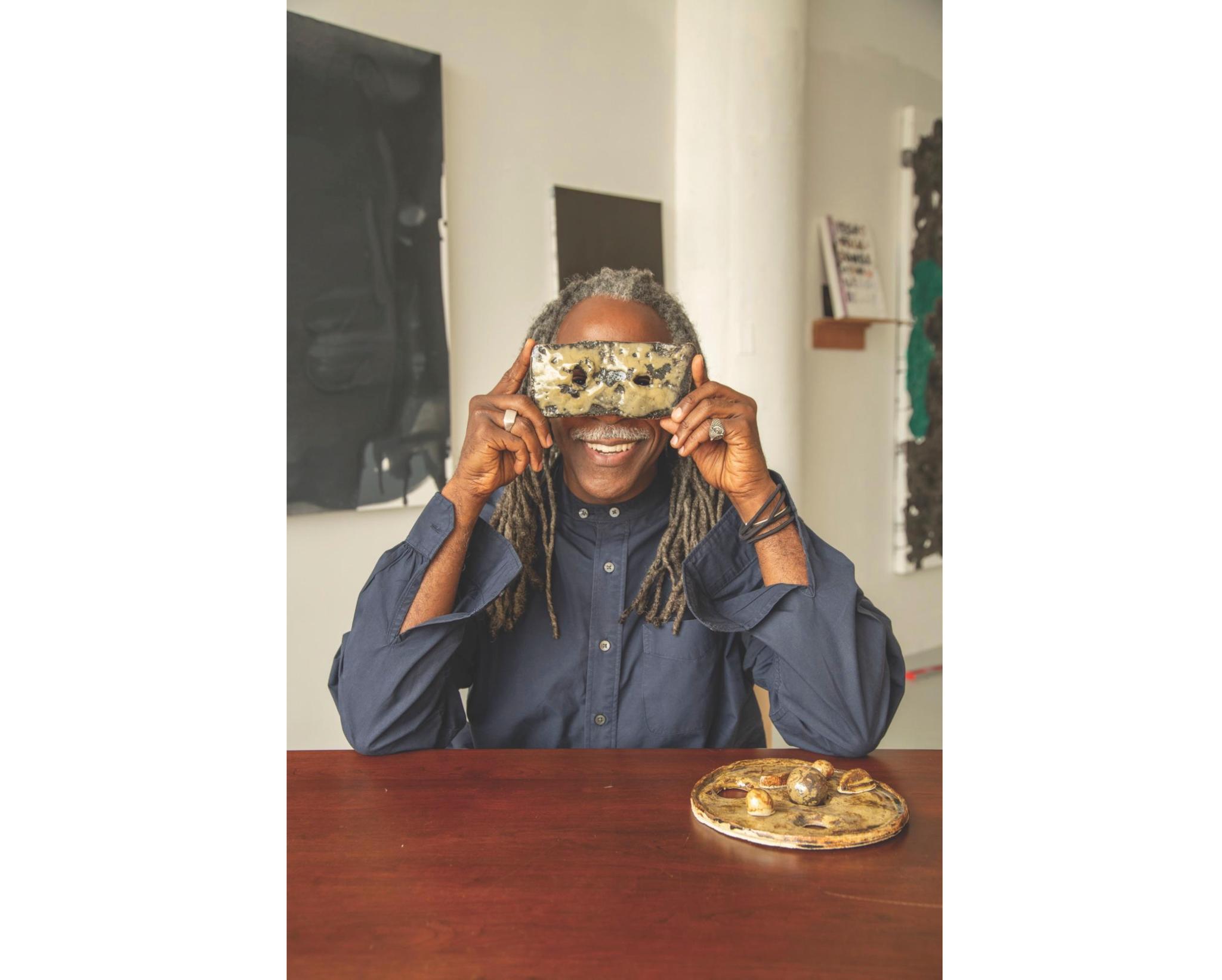
Portrait of Arnold J. Kemp in his Chicago studio, 2026. Photo by Kevin White for Boston Art Review.
CMP: I noticed the idea of fugitivity comes up a lot around your work and how people write about it. How do you feel about that? Do you see fugitivity in your work?
AJK: Well, I think about fugitivity and I have to think also about Afro-pessimist aesthetics—is there a possibility in that? I mean, people could look at the work and talk about fugitivity in terms of the material—those books are very different than an oil painting, which is made to last forever. This idea of multiple selves is not running away from the self. I think when we previously talked, I said something like democracy, but really I think it’s about emancipation and freedom, which is very different from democracy. I think democracy in my work is happening in that I’m letting multiple voices share in a conversation that works together—like a free jazz band where everyone is playing their solo parts, but at times, it really does come together and work. The idea of fugitivity isn’t about running away from the self, but actually coming toward the self. I have to have my own voice in this conversation. And I think in terms of fugitivity, I get to take things apart. When I was a little boy, I loved to take things apart, and I might not have been able to put them back together. It’s the same with my art-making. So my ultimate question is, What is art? What does it do for us?
CMP: Democracy ultimately is about citizenship—who is or is not allowed to be a citizen, who fits within those frames in relation to the state.
AJK: And fugitivity is running away from slavery, right?
CMP: Yeah, it’s running away from structure, but what are we running toward? There’s so much bound up in that. I’m thinking a lot about my own personal explorations during the last year, and I’m wondering how much data you need to understand that something is Black: How much visual information, how much sonic information, what kind of words and textures?
AJK: Well, you’re bringing up this thing that relates to Afro-pessimism and the desire of the art world for Black people to speak with authenticity about our experience. And how do you do that when we all actually have different experiences? I don’t want to deal with essential ideas of Blackness. Also, we should question this: Who is desiring this authenticity?
CMP: And what forms of authenticity are the most authentic? What’s the most real?
AJK: I’ve related this story a few times that I had a studio visit once with a museum group, and someone in the group said, “We visited a lot of Black artists today, and everyone is making work about slavery. Why aren’t you?” The first thing I said was, “You already know that about me and my people, so I don’t need to repeat that for you.” Right? So, you just asked how much you need to signal that it’s Black.
CMP: Not much.
AJK: But why do you have to?
CMP: There’s something in your work that suggests a kind of possibility; you show that you don’t have to choose between being an Afro-pessimist or believing in a Black possibility.
AJK: I’m trying to get it all to happen at once. Something could be beautiful, frightening, and funny all at the same time. Like these really big images of my hands inside of a giant Fred Flintstone mask. It’s hard to put your finger on the multiple feelings. They’re really beautiful photographs. They’re funny, but they’re also kind of frightening. I try to get that in a lot of my work. Maybe that’s the trickster part of me. I think only I can do that.
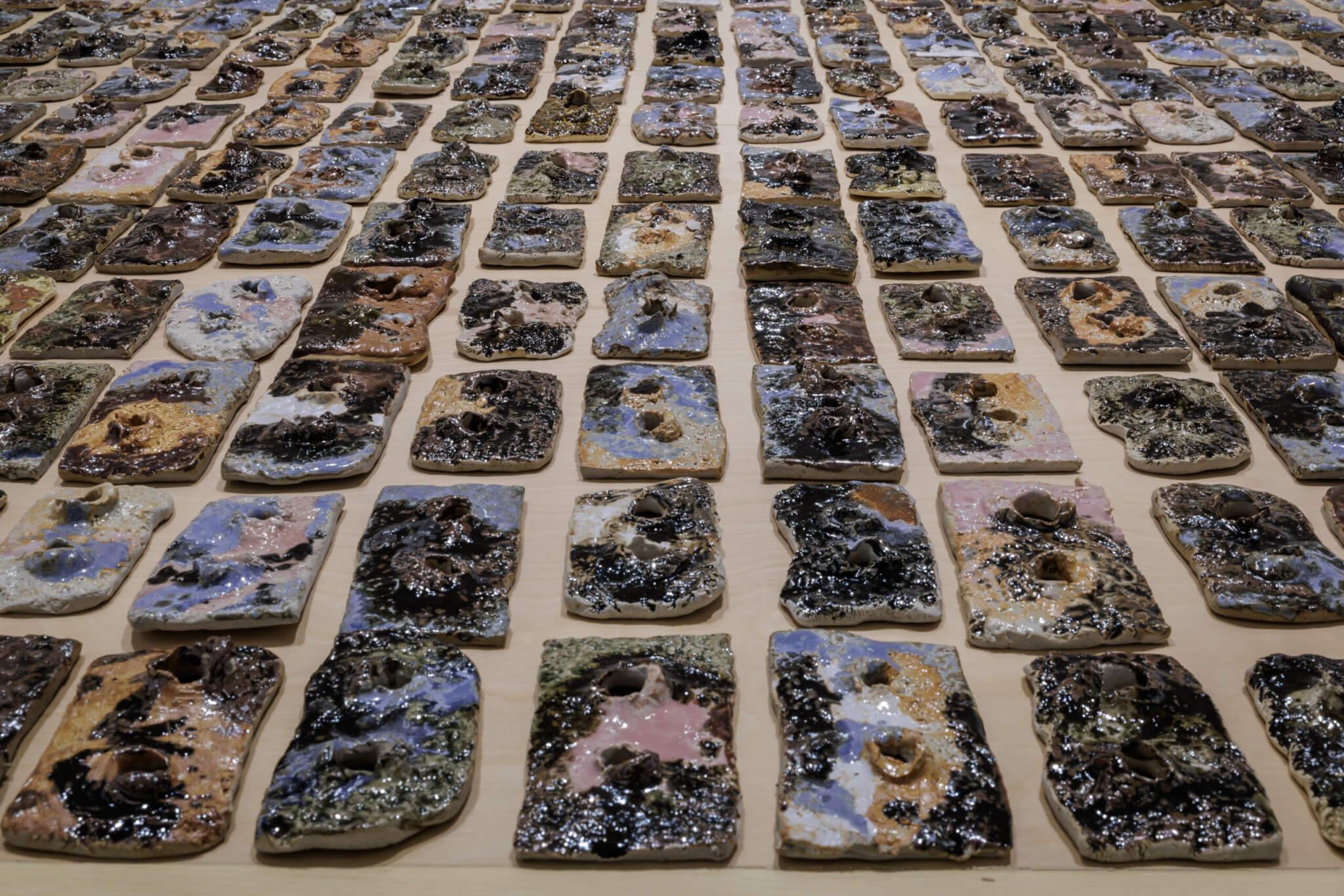
Arnold J. Kemp, Talking to the Sun, detail, 2022. 500 glazed stoneware masks on purpose-built birch pedestal. Installation view, “Arnold J. Kemp: Not One Thing,” Tufts University Art Galleries, Medford. July 29–December 6, 2026. Photo by Tim Correira.
CMP: From a philosophical sense, I’m curious to know how you’re conceiving of the mask and what the masks are doing for you?
AJK: When I think about the piece Talking to the Sun, you know, there’s 494 masks; it’s a crowd. They’re all individual. Each one of us has our masks and we put on different masks at different times. What they are on the outside isn’t what’s on the inside. This comes from looking at the traditional arts of West Africa as something that could be hot on the surface with a cool interior or the opposite—cool on the surface and hot on the interior. But again, these sorts of multiple versions or multiple voices coming together—almost like a chorus—is how I look at the masks. I’ve always been fascinated by this. The work is looking at the viewer while the viewer’s looking at the object. That’s how identity works for me. It’s not just a projection. It’s not just about someone looking at me; it’s also about me looking at them.
CMP: What becomes possible when Blackness is released from the obligation to represent itself and becomes instead a method for making space, making selves, making worlds?
AJK: Well, I think we go back to ideas about emancipation, but also improvisation and contingency. I can go right back to the Bahamas with this question. The Bahamas is a place where, historically, people don’t call themselves artists because everyone on the island can make stuff. They’re very creative with making do. We used to do Junkanoo wearing newspapers and sea sponges. In the Bahamas, you don’t have to represent Blackness because we’re the majority. So there’s a kind of emancipatory feeling that is possible. We’re not trying to escape the struggles that are going on.
But to be able to fight those things, you have to be able to laugh in the face of dire situations. My therapist—I haven’t seen him in like two years—he could never understand why I was laughing all the time and telling him about really rough stuff. First off, it’s just who I am, but if you ever listen to the blues, that’s one of the things you learn. You have to laugh to keep from crying. It’s just the way of life.