It comes / Unadorned / Like a phrase —Toni Morrison, “It Comes Unadorned”
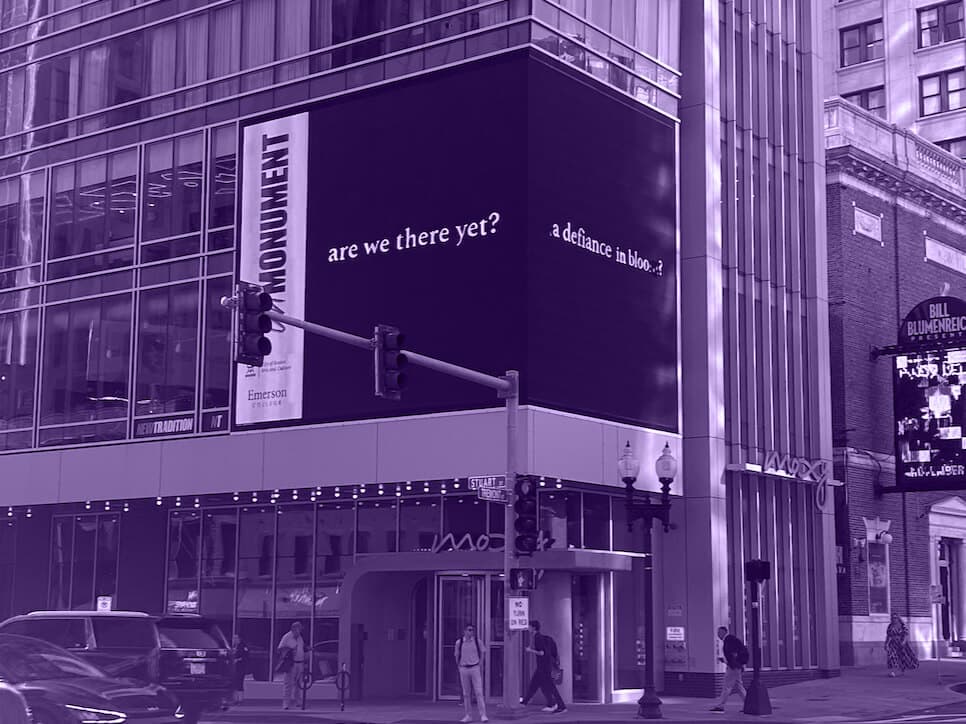
A large digital advertising screen sits in the hip of a Downtown Boston hotel in the theater district, wrapping around its sharp right-angled corner at the intersection of Stuart and Tremont streets. Just above the hotel’s entrance and pink LED name sign, colorful ads rotate on the sleek screen embedded in the hotel’s glass exterior. Positioned on a corner a block away from Boston Common and Emerson College, the ads are big and bright enough to make them out from three blocks away. The visual noise is familiar. We are used to being sold something. But through an intervention by artist Kameelah Janan Rasheed, we are now confronted—just for a moment—by a new screen. An entirely black one materializes within the ad roll with lowercase white letters radiating across the middle: “are we there yet?”
A question.
There’s something about knowing it’s not really supposed to be there. It’s not an ad, or is it? The serif font resembles text on a document, the kind intended to be studied. A formal typeface with decorative small strokes curving and extending the straight lines of letters. Enlarged on the screen and floating without context, these antique-style letters feel out of place.
Rasheed’s “visual poems” began appearing on signage across the MBTA’s green and orange lines and buses on September 1 and will stay through the end of October 2025. The project is presented by Emerson Contemporary’s “Hidden Histories” series, which paired four artists with Boston archives for a year of research to produce public art projects for digital technologies, as part of the City of Boston’s Un-Monument initiative. In Rasheed’s project—as is often the case in her work—the archival texts are not only context, but they are the medium itself. Each word has a “shape,” each letter has a “spirit”1—language is the sign.
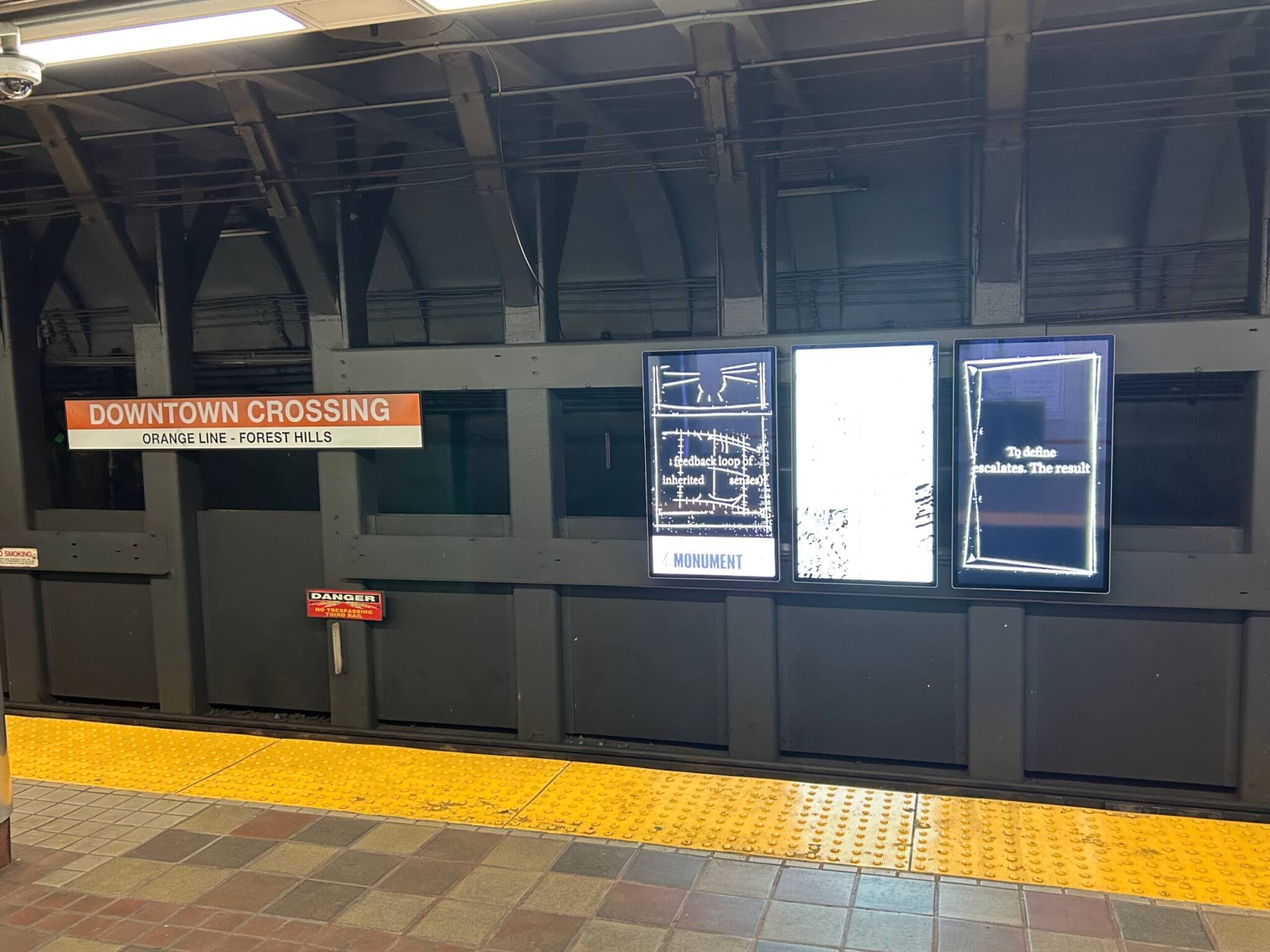
Kameelah Janan Rasheed, I have Asked Myself: “Can a Sentence be Haunted? And if so by what?” public poetry collection, Boston, 2025. Courtesy of Emerson Contemporary.
Each of the visual poems were made using historical typefaces and marginalia that Rasheed found in some of Boston’s oldest books. She conducted her research at the Boston Athenaeum, one of the oldest independent libraries in the United States. The membership-based cultural institution, founded in 1807, was a hub of Boston’s elite intellectual life in the nineteenth century and continues to hold extensive research materials on Boston and New England history as well as the fine arts. Within these archives, Rasheed often found ornate typefaces, laden with the kind of swirls and arches that we also find embellishing many of the city’s buildings. Using what is preserved in private and making it public, Rasheed probes: What adorns local histories and the spaces they produce within and around us, and what does that adornment conceal?
Rasheed, who often refers to words as “wet”—unstable, always in the process of forming—lifted words, letters, or fonts of these texts from their collections by way of scanning and scratching, placing them on the public stages of ad space where they might become something else. The texts trick themselves,2 reminding me of the way in which Tracy K. Smith uses erasure poetry to “unburden the text from the constraints of its original purposes.”3 Here, in this unburdened state, the words play.
“are we there yet?”
We encounter Rasheed’s poems by surprise while in motion, back and forth, on and off, in public. Amid our daily lives they, for a moment, might slow us down and steal our attention back into a collective longing beyond what we’ve been told is beautiful and therefore complete.
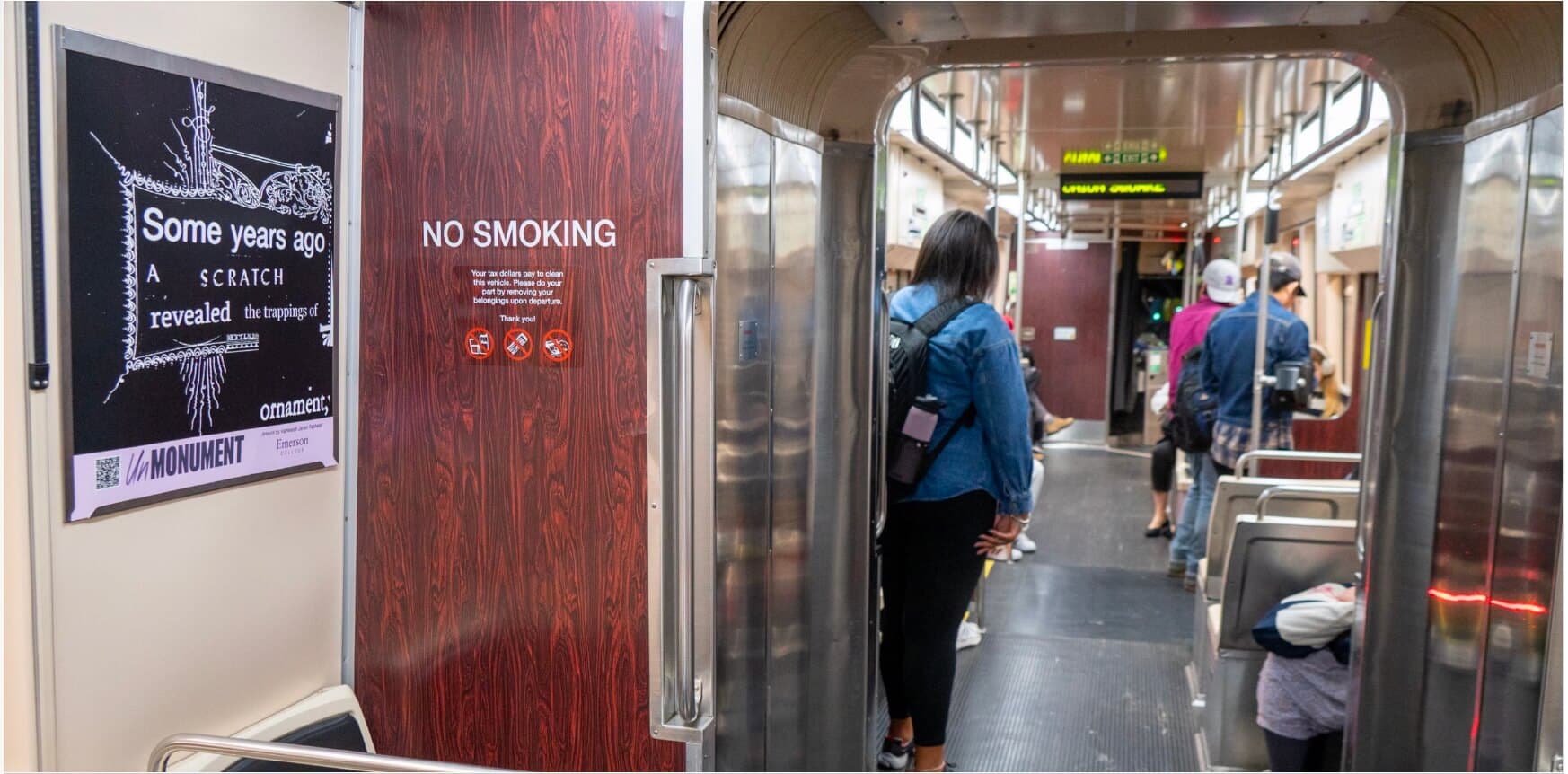
Kameelah Janan Rasheed, I have Asked Myself: “Can a Sentence be Haunted? And if so by what?” public poetry collection, Boston, 2025. Courtesy of Emerson Contemporary.
I can’t help but think about the 2005 comedy movie where a Black family is on a seemingly never-ending road trip and the children famously ask “Are we there yet?” And they don’t ask once. They ask again and again until they’ve arrived. But arrival is the end. So there is irony in their question: By asking if the destination is here, the state of being far away, or on the way, becomes known. The question is a reminder, and it is cyclical. Like study, or prayer, the question relies on repetition for ongoing revelation.
The black-and-white image vanishes into the next ad soon after it appears. By nature of a loop, it will return to ask.
1 Kameelah Janan Rasheed, lecture/performance during her residency at Emerson College, February 27, 2024.
2 Kameelah Janan Rasheed, lecture/performance.
3 Tracy K. Smith, “On Being Nobody: Poetry’s Intervention into Common Reality,” virtual lecture, Harvard Radcliffe Institute, September 25, 2024, https://www.radcliffe.harvard.edu/event/2024-tracy-k-smith-fellow-presentation-virtual